Thailand Aircraft Cabin Interior Market Size, Share & Growth Rate
The Thailand Aircraft Cabin Interior Market was estimated at USD 187 Million in 2025 and is projected to reach USD 249 Million by 2032, growing at a CAGR of 4.2% from 2026 to 2032. This growth trajectory is primarily fueled by the surging demand for air travel, both domestically and internationally, along with airlines' ongoing commitment to enhancing passenger comfort and experience. As airlines increasingly prioritize innovative cabin designs, Thailand's cost-effective manufacturing capabilities position it favorably to capitalize on these trends.
Thailand Aircraft Cabin Interior Market Year-wise Growth Rate and Key Drivers
This graph highlights how the Thailand Aircraft Cabin Interior Market has steadily grown over the years, supported by major growth factors.
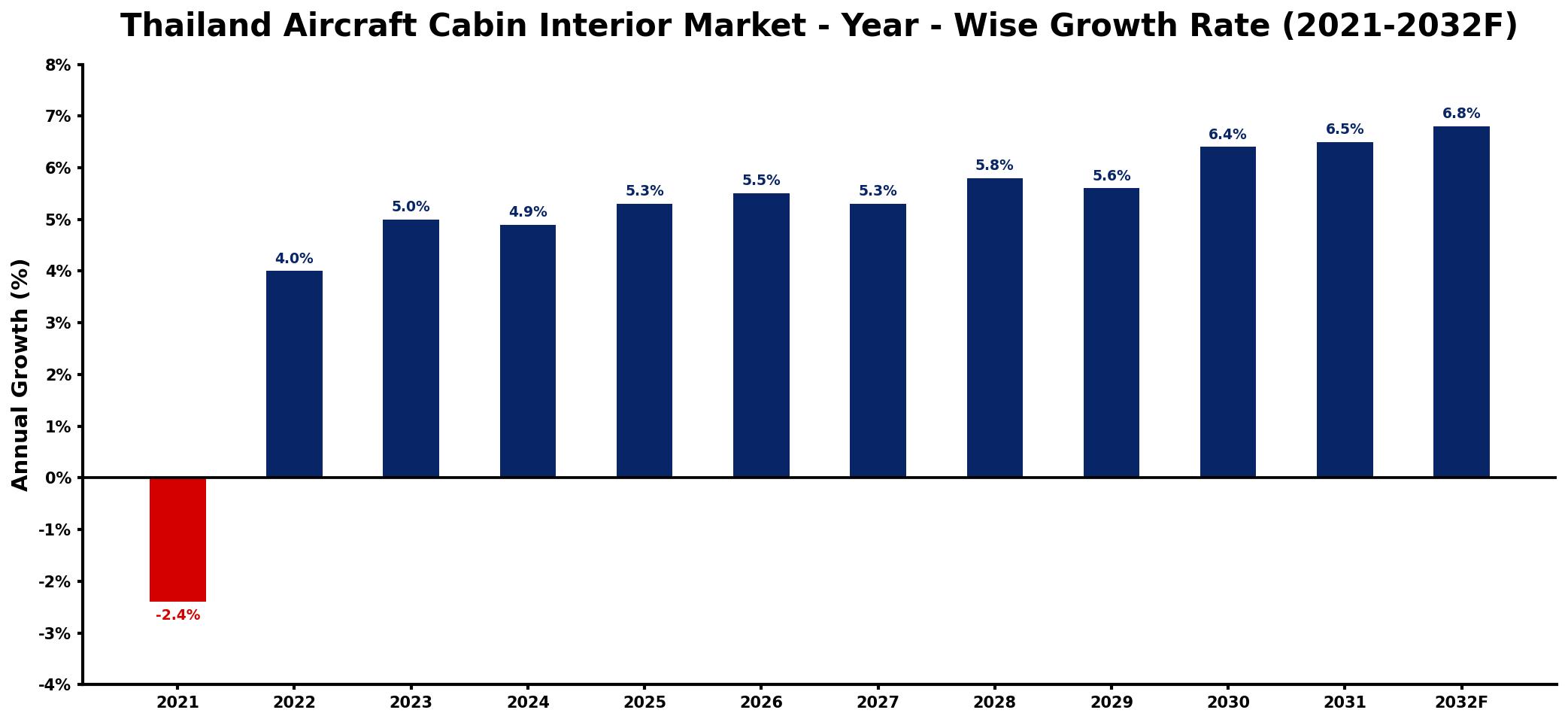
The table below presents the year‑wise growth rates along with the key drivers influencing the market
| Year | Growth Rate | Major Drivers |
| 2021 | -2.4% | decrease in travel demand |
| 2022 | 4.0% | increased airline fleet orders |
| 2023 | 5.0% | rising passenger travel expectations |
| 2024 | 4.9% | growing focus on sustainability |
| 2025 | 5.3% | expansion of regional airlines |
| 2026 | 5.5% | technological advancements in comfort |
| 2027 | 5.3% | increasing investment in retrofitting |
| 2028 | 5.8% | enhanced passenger experience initiatives |
| 2029 | 5.6% | rising demand for personalization |
| 2030 | 6.4% | emphasis on health safety features |
| 2031 | 6.5% | growing trends in luxury travel |
| 2032 | 6.8% | increased competition among carriers |
Note: Market size estimations and growth projections presented in this report are based on 6Wresearch's proprietary forecasting methodology, utilizing the latest available industry data, government publications, and primary research inputs.
Thailand Aircraft Cabin Interior Market Synopsis
In recent years, the Thailand Aircraft Cabin Interior Market has seen significant advancements driven by a skilled workforce and innovative design approaches. The focus on passenger experience has led to a surge in demand for high-quality seating, state-of-the-art in-flight entertainment systems, and bespoke cabin fixtures that cater to evolving consumer preferences.
As a pivotal player in the aerospace sector, Thailand offers manufacturers a strategic location for aircraft cabin production. The market is characterized by a blend of local craftsmanship and global design trends, enabling airlines to create distinctive cabin environments that enhance customer satisfaction while adhering to strict safety regulations.
Thailand Aircraft Cabin Interior Market Key Takeaways
- The market is poised for steady growth, driven by rising air travel demand.
- Innovations in materials and designs play a crucial role in shaping the industry's future.
- Customization and unique cabin aesthetics are essential for airlines to differentiate their offerings.
- Thailand's strategic position and cost efficiencies attract international investments in cabin interior production.
- The market is gradually recovering from the impacts of the COVID-19 pandemic.
Evaluation of Restraints in Thailand Aircraft Cabin Interior Market
Despite its growth potential, the Thailand Aircraft Cabin Interior Market faces several constraints. One of the primary challenges is the constant demand for customization, which compels manufacturers to innovate continuously. The need for unique cabin designs can strain resources and extend production timelines. Additionally, fluctuations in global air travel demand, particularly during unforeseen crises, may lead to order cancellations or delays, impacting the financial stability of market players. Compliance with safety and regulatory requirements further complicates the manufacturing process, necessitating ongoing investment in quality assurance.
Thailand Aircraft Cabin Interior Market Trends
A notable trend shaping the Thailand Aircraft Cabin Interior Market is the increasing integration of sustainable materials in cabin design. As environmental concerns become more pressing, airlines are seeking ways to reduce their carbon footprint through eco-friendly interiors. Additionally, advancements in technology are leading to smarter cabin features, such as enhanced entertainment systems and improved passenger connectivity. The growing consumer preference for personalized experiences also drives demand for bespoke cabin interiors, pushing manufacturers to adopt more innovative design approaches.
Thailand Aircraft Cabin Interior Market Opportunities
The Thailand Aircraft Cabin Interior Market presents significant growth opportunities, particularly in the realm of eco-friendly and technologically advanced solutions. Companies that can develop sustainable materials or create versatile designs that can be easily customized stand to gain a competitive edge. Furthermore, as the aviation sector recovers and expands post-pandemic, there will be increased demand for refurbished aircraft interiors, creating avenues for established and emerging manufacturers alike. Collaborations between local firms and international brands also hold potential for innovative product offerings.
Government Initiatives in the Thailand Aircraft Cabin Interior Market
The Thai government is increasingly recognizing the importance of the aviation sector to the national economy. As such, it has initiated policies aimed at promoting investment in aerospace manufacturing, including the aircraft cabin interior segment. Government programs are focused on enhancing infrastructure, providing incentives for research and development, and encouraging partnerships between educational institutions and industry players to build a more skilled workforce. These initiatives are designed to position Thailand as a leading hub for aircraft manufacturing in Southeast Asia.
Future Insights of the Thailand Aircraft Cabin Interior Market
Looking ahead to the period from 2026 to 2032, the Thailand Aircraft Cabin Interior Market is expected to witness sustained growth driven by a combination of factors. The resumption of air travel following the pandemic is anticipated to boost investments in new aircraft and cabin refurbishments. Furthermore, an increasing emphasis on passenger wellness and comfort will compel airlines to enhance their cabin offerings, ensuring manufacturers remain agile and responsive to market demands. As technological advancements continue to unfold, innovative solutions will further redefine the passenger experience within Thai aircraft cabins.
Thailand Aircraft Cabin Interior Market Latest Developments (2025 - 2026)
Recent developments in the Thailand Aircraft Cabin Interior Market indicate a growing focus on integrating smart technologies within cabin designs. Companies are increasingly exploring partnerships with tech firms to incorporate features such as personalized lighting and connectivity solutions tailored to passenger needs. Additionally, sustainability initiatives are gaining momentum, with firms actively researching and implementing the use of recyclable materials in cabin production, aligning with global environmental standards and consumer expectations.
Thailand Aircraft Cabin Interior Market - Key Attractiveness of the Report
- 10 Years of Market Numbers
- Historical Data Starting from 2022 to 2025
- Base Year: 2025
- Forecast Data until 2032
- Key Performance Indicators Impacting the Market
- Major Upcoming Developments and Projects
Key Highlights of the Report:
- Thailand Aircraft Cabin Interior Market Outlook
- Market Size of Thailand Aircraft Cabin Interior Market, 2025
- Forecast of Thailand Aircraft Cabin Interior Market, 2032
- Historical Data and Forecast of Thailand Aircraft Cabin Interior Revenues & Volume for the Period 2022-2032F
- Thailand Aircraft Cabin Interior Market Trend Evolution
- Thailand Aircraft Cabin Interior Market Drivers and Challenges
- Thailand Aircraft Cabin Interior Price Trends
- Thailand Aircraft Cabin Interior Porter's Five Forces
- Thailand Aircraft Cabin Interior Industry Life Cycle
- Historical Data and Forecast of Thailand Aircraft Cabin Interior Market Revenues & Volume By Type for the Period 2022-2032F
- Historical Data and Forecast of Thailand Aircraft Cabin Interior Market Revenues & Volume By Seats for the Period 2022-2032F
- Historical Data and Forecast of Thailand Aircraft Cabin Interior Market Revenues & Volume By Cabin Lightening for the Period 2022-2032F
- Historical Data and Forecast of Thailand Aircraft Cabin Interior Market Revenues & Volume By Windows and Windshields for the Period 2022-2032F
- Historical Data and Forecast of Thailand Aircraft Cabin Interior Market Revenues & Volume By Galley and Lavatory for the Period 2022-2032F
- Historical Data and Forecast of Thailand Aircraft Cabin Interior Market Revenues & Volume By In-Flight Entertainment & Connectivity for the Period 2022-2032F
- Historical Data and Forecast of Thailand Aircraft Cabin Interior Market Revenues & Volume By Others for the Period 2022-2032F
- Historical Data and Forecast of Thailand Aircraft Cabin Interior Market Revenues & Volume By Class for the Period 2022-2032F
- Historical Data and Forecast of Thailand Aircraft Cabin Interior Market Revenues & Volume By First Class for the Period 2022-2032F
- Historical Data and Forecast of Thailand Aircraft Cabin Interior Market Revenues & Volume By Business Class for the Period 2022-2032F
- Historical Data and Forecast of Thailand Aircraft Cabin Interior Market Revenues & Volume By Premium Economy Class for the Period 2022-2032F
- Historical Data and Forecast of Thailand Aircraft Cabin Interior Market Revenues & Volume By Economy Class for the Period 2022-2032F
- Historical Data and Forecast of Thailand Aircraft Cabin Interior Market Revenues & Volume By Aircraft Type for the Period 2022-2032F
- Historical Data and Forecast of Thailand Aircraft Cabin Interior Market Revenues & Volume By Narrow Body Aircraft for the Period 2022-2032F
- Historical Data and Forecast of Thailand Aircraft Cabin Interior Market Revenues & Volume By Wide-Body Aircraft for the Period 2022-2032F
- Historical Data and Forecast of Thailand Aircraft Cabin Interior Market Revenues & Volume By Business Jets for the Period 2022-2032F
- Historical Data and Forecast of Thailand Aircraft Cabin Interior Market Revenues & Volume By Regional Transport Aircraft for the Period 2022-2032F
- Historical Data and Forecast of Thailand Aircraft Cabin Interior Market Revenues & Volume By End User for the Period 2022-2032F
- Historical Data and Forecast of Thailand Aircraft Cabin Interior Market Revenues & Volume By OEM for the Period 2022-2032F
- Historical Data and Forecast of Thailand Aircraft Cabin Interior Market Revenues & Volume By Aftermarket for the Period 2022-2032F
- Thailand Aircraft Cabin Interior Import Export Trade Statistics
- Market Opportunity Assessment By Type
- Market Opportunity Assessment By Class
- Market Opportunity Assessment By Aircraft Type
- Market Opportunity Assessment By End User
- Thailand Aircraft Cabin Interior Top Companies Market Share
- Thailand Aircraft Cabin Interior Competitive Benchmarking By Technical and Operational Parameters
- Thailand Aircraft Cabin Interior Company Profiles
- Thailand Aircraft Cabin Interior Key Strategic Recommendations






































