Thailand Algorithmic Trading Market Size & Growth Rate (2026-2032)
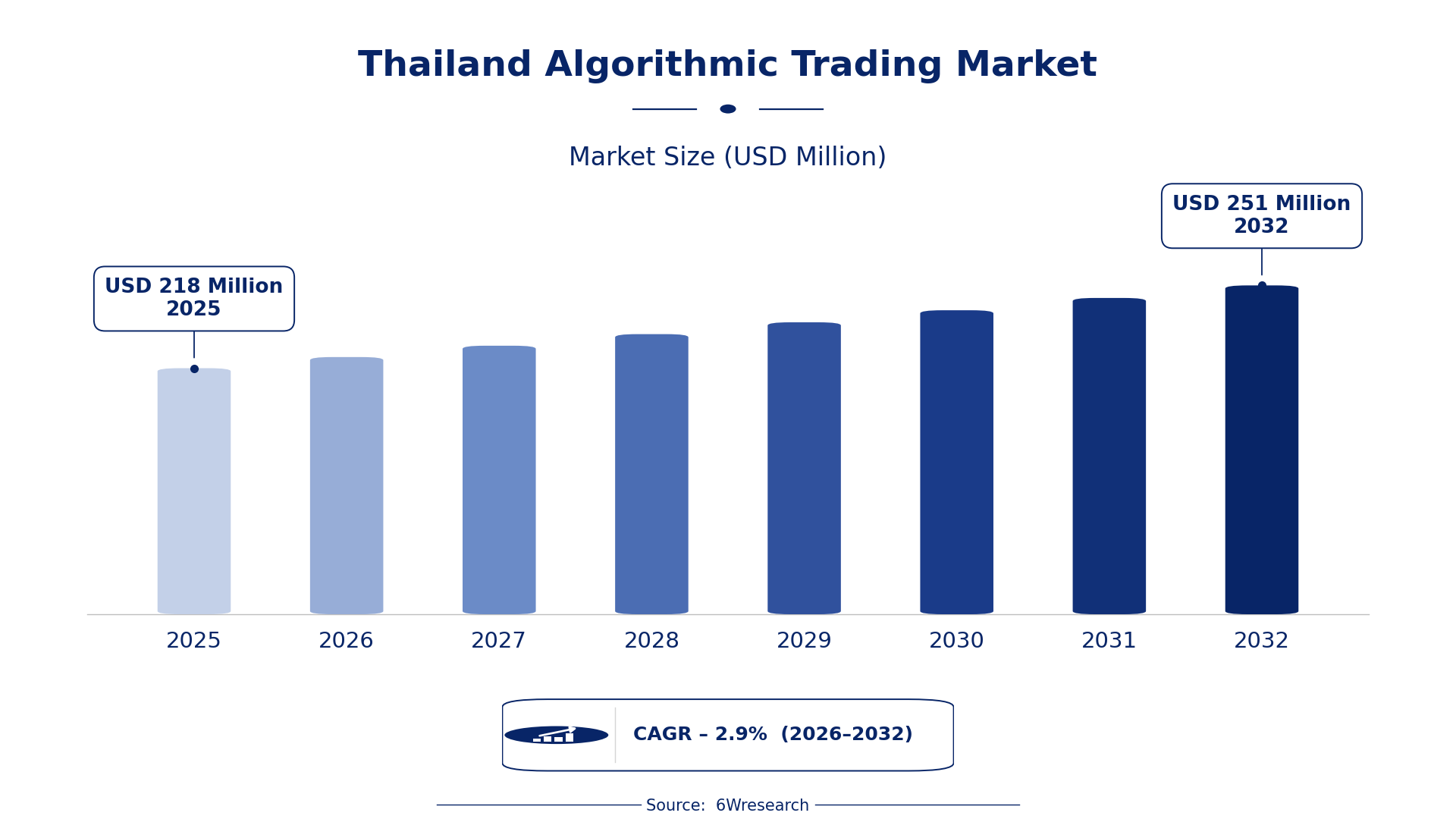
The Thailand Algorithmic Trading Market was estimated at USD 218 Million in 2025 and is projected to reach USD 251 Million by 2032, growing at a CAGR of 2.9% from 2026 to 2032.
Thailand Algorithmic Trading Market Synopsis
The adoption of algorithmic trading is gaining momentum in Thailand's financial sector, with traders increasingly turning to automated solutions for enhanced trading efficiency. This trend reflects a broader global shift towards data-driven strategies in financial markets, where speed and accuracy are paramount.
As financial institutions look to maintain a competitive edge, the demand for algorithmic trading solutions has surged. These technologies, which utilize complex algorithms to execute trades, are seen as essential tools for navigating the complexities of modern markets, especially during volatile periods.
Thailand Algorithmic Trading Market Year-wise Growth Rate and Key Drivers
This graph illustrates the annual growth rates of the Thailand Algorithmic Trading Market from 2021 to 2032, highlighting a steady upward trajectory and projected expansion over the forecast period.
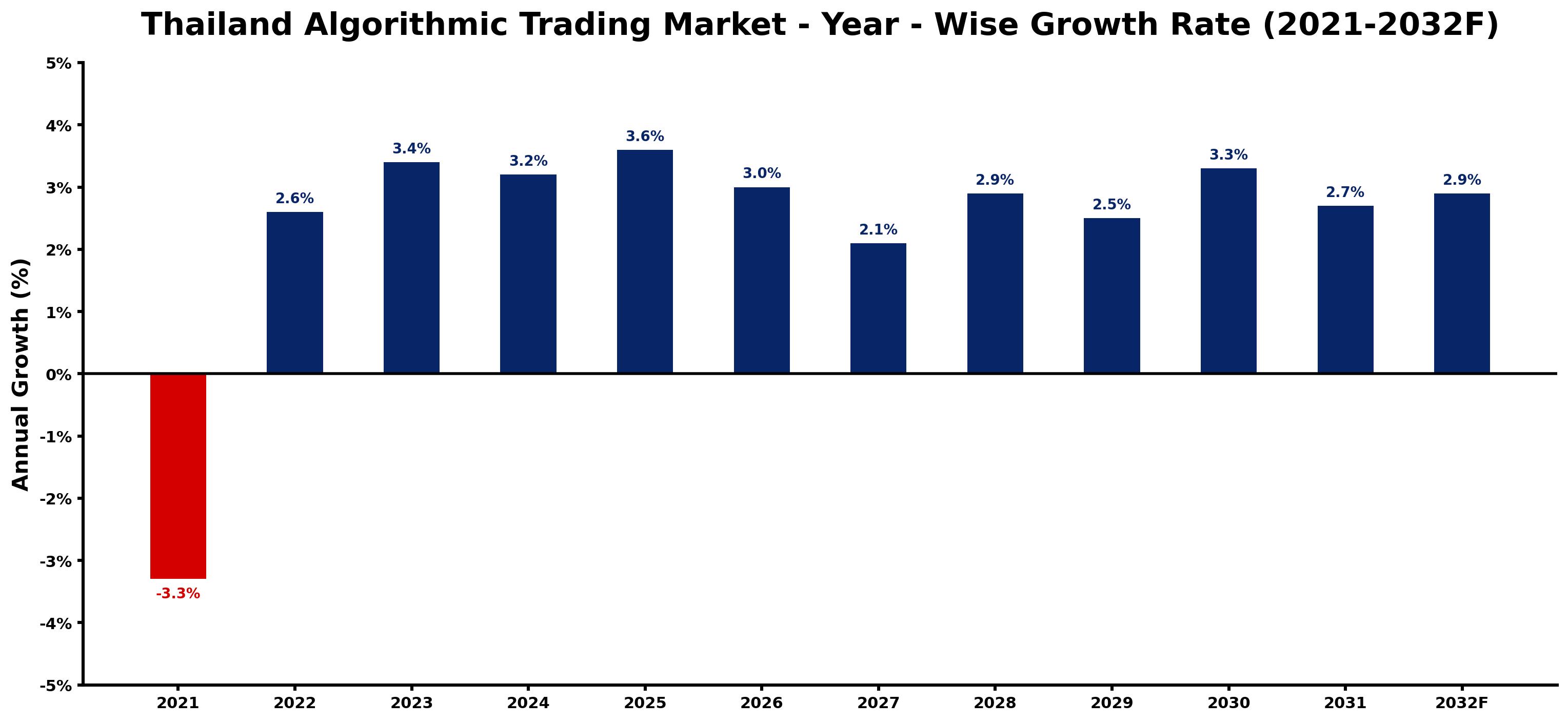
The table below presents the year‑wise growth rates along with the key drivers influencing the market
| Year | Growth Rate | Major Drivers |
| 2021 | -3.3% | Securities and Exchange Commission's strict trading regulations |
| 2022 | 2.6% | Increased investment in digital finance transformation initiatives. |
| 2023 | 3.4% | Surge in retail investor adoption of algorithmic trading tools. |
| 2024 | 3.2% | Brokers enhancing platforms with advanced AI capabilities. |
| 2025 | 3.6% | Regulatory support for fintech innovation by Thai SEC. |
| 2026 | 3.0% | Development of local AI algorithms tailored for trading. |
| 2027 | 2.1% | Rising participation in stock market from younger demographics. |
| 2028 | 2.9% | Thailand’s fintech sandbox fostering experimentation with algorithmic trading. |
| 2029 | 2.5% | Partnerships between banks and tech firms optimizing trading systems. |
| 2030 | 3.3% | Growing awareness of algorithmic benefits among institutional investors. |
| 2031 | 2.7% | Increased liquidity in Thai stock market attracting algorithmic traders. |
| 2032 | 2.9% | Rise in mobile trading applications for algorithms in Thailand. |
Note: Market size estimations and growth projections presented in this report are based on 6Wresearch's proprietary forecasting methodology, utilizing the latest available industry data, government publications, and primary research inputs.
Thailand Algorithmic Trading Market Key Takeaways
Below are some of the specific key takeaways from the market, including:
- The market is projected to grow steadily, reflecting increasing reliance on automated trading strategies.
- Financial institutions are prioritizing efficiency and data-driven decision-making through algorithmic solutions.
- Regulatory frameworks are evolving to address the complexities introduced by algorithmic trading.
- Demand for transparency in trading processes is becoming a focal point for market participants.
- Technological advancements in machine learning are enhancing algorithmic trading capabilities.
Evaluation of Restraints in Thailand Algorithmic Trading Market
Despite the promising growth trajectory, the Thailand Algorithmic Trading Market faces notable restraints. Regulatory scrutiny is intensifying, with authorities demanding greater transparency in trading practices. These regulations aim to mitigate risks associated with market manipulation and ensure the integrity of financial transactions. Additionally, developing effective risk management frameworks poses a challenge as firms must balance speed with security. The dynamic nature of financial markets further complicates the establishment of resilient algorithmic trading systems, making it essential for stakeholders to adapt continuously to changing conditions.
Thailand Algorithmic Trading Market Trends
A noticeable trend within the Thailand Algorithmic Trading Market is the integration of machine learning and artificial intelligence into trading algorithms. These technologies are not only enhancing trade execution speeds but also improving predictive analytics, allowing traders to make more informed decisions. on top of that, the increasing use of big data analytics is shaping how trading strategies are formulated, leading to more refined approaches tailored to specific market conditions.
Additionally, the push for greater regulatory compliance is prompting companies to invest in more transparent and accountable trading systems. This shift is likely to drive demand for algorithmic solutions that provide detailed tracking and reporting features, helping firms meet evolving regulatory standards.
Thailand Algorithmic Trading Market Opportunities
Investment opportunities abound in the Thailand Algorithmic Trading Market, especially for firms that can innovate around existing technologies. As demand for high-frequency trading increases, there is a clear opening for solutions that enhance speed and efficiency. on top of that, educational initiatives aimed at upskilling traders in algorithmic techniques present a unique opportunity for companies offering training and resources. The potential for collaboration between technology providers and financial institutions also suggests a fertile ground for partnerships that can drive further advancements in trading methodologies.
Government Initiatives in the Thailand Algorithmic Trading Market
The Thai government is actively shaping the Algorithmic Trading Market through various initiatives aimed at enhancing financial market infrastructure and regulatory frameworks. By focusing on transparency and security, these policies are designed to foster a more competitive and efficient trading environment. The commitment to modernizing financial regulations demonstrates the government's recognition of algorithmic trading as a vital component of the country's financial ecosystem.
- A regulatory framework introduced in 2025 mandating greater transparency in algorithmic trading processes.
- A national digital infrastructure upgrade programme now in its rollout phase, improving connectivity for trading platforms.
- Currently ongoing discussions about implementing stricter risk management guidelines for algorithmic trading.
- A planned public-private initiative expected to enhance educational resources on algorithmic trading strategies by 2027.
Future Insights of the Thailand Algorithmic Trading Market
From 2026 to 2032, the Thailand Algorithmic Trading Market is expected to evolve significantly. The integration of advanced technologies, such as artificial intelligence and blockchain, will likely redefine trading strategies. As firms increasingly automate their trading processes, efficiency and accuracy will remain top priorities. Regulatory developments will also shape market dynamics, encouraging innovation while ensuring market integrity. Stakeholders who adapt to these changes are likely to emerge as leaders in this competitive landscape.
Thailand Algorithmic Trading Market Latest Developments
Recent months have seen a surge in activity within the Thailand Algorithmic Trading Market, as firms respond to evolving market demands and regulatory pressures. The push towards enhanced algorithmic solutions has resulted in notable advancements and strategic partnerships aimed at improving trade execution and compliance.
- A major technology vendor launched a new algorithmic trading platform in early 2025, designed to improve execution speeds for institutional clients.
- Ongoing development of a collaborative trading initiative among leading financial institutions, aimed at sharing best practices and resources.
- In mid-2025, a financial institution rolled out a machine learning-based trading strategy that has shown promising initial results.
- Upcoming plans for a regional conference focused on algorithmic trading strategies, set to take place in Q4 2026, to foster industry networking.
Thailand Algorithmic Trading Market - Key Attractiveness of the Report
- 10 Years of Market Numbers
- Historical Data Starting from 2022 to 2025
- Base Year: 2025
- Forecast Data until 2032
- Key Performance Indicators Impacting the Market
- Major Upcoming Developments and Projects
Key Highlights of the Report:
- Thailand Algorithmic Trading Market Outlook
- Market Size of Thailand Algorithmic Trading Market, 2025
- Forecast of Thailand Algorithmic Trading Market, 2032
- Historical Data and Forecast of Thailand Algorithmic Trading Revenues & Volume for the Period 2022-2032F
- Thailand Algorithmic Trading Market Trend Evolution
- Thailand Algorithmic Trading Market Drivers and Challenges
- Thailand Algorithmic Trading Price Trends
- Thailand Algorithmic Trading Porter's Five Forces
- Thailand Algorithmic Trading Industry Life Cycle
- Historical Data and Forecast of Thailand Algorithmic Trading Market Revenues & Volume By Trading Type for the Period 2022-2032F
- Historical Data and Forecast of Thailand Algorithmic Trading Market Revenues & Volume By Foreign Exchange (FOREX) for the Period 2022-2032F
- Historical Data and Forecast of Thailand Algorithmic Trading Market Revenues & Volume By Stock Markets for the Period 2022-2032F
- Historical Data and Forecast of Thailand Algorithmic Trading Market Revenues & Volume By Exchange-Traded Fund (ETF) for the Period 2022-2032F
- Historical Data and Forecast of Thailand Algorithmic Trading Market Revenues & Volume By Bonds for the Period 2022-2032F
- Historical Data and Forecast of Thailand Algorithmic Trading Market Revenues & Volume By Cryptocurrencies for the Period 2022-2032F
- Historical Data and Forecast of Thailand Algorithmic Trading Market Revenues & Volume By Others for the Period 2022-2032F
- Historical Data and Forecast of Thailand Algorithmic Trading Market Revenues & Volume By Deployment Mode for the Period 2022-2032F
- Historical Data and Forecast of Thailand Algorithmic Trading Market Revenues & Volume By Cloud for the Period 2022-2032F
- Historical Data and Forecast of Thailand Algorithmic Trading Market Revenues & Volume By On-premises for the Period 2022-2032F
- Historical Data and Forecast of Thailand Algorithmic Trading Market Revenues & Volume By Component for the Period 2022-2032F
- Historical Data and Forecast of Thailand Algorithmic Trading Market Revenues & Volume By Solutions for the Period 2022-2032F
- Historical Data and Forecast of Thailand Algorithmic Trading Market Revenues & Volume By Services for the Period 2022-2032F
- Historical Data and Forecast of Thailand Algorithmic Trading Market Revenues & Volume By Enterprise Size for the Period 2022-2032F
- Historical Data and Forecast of Thailand Algorithmic Trading Market Revenues & Volume By Small and Medium-sized Enterprises (SMEs) for the Period 2022-2032F
- Historical Data and Forecast of Thailand Algorithmic Trading Market Revenues & Volume By Large Enterprises for the Period 2022-2032F
- Thailand Algorithmic Trading Import Export Trade Statistics
- Market Opportunity Assessment By Trading Type
- Market Opportunity Assessment By Deployment Mode
- Market Opportunity Assessment By Component
- Market Opportunity Assessment By Enterprise Size
- Thailand Algorithmic Trading Top Companies Market Share
- Thailand Algorithmic Trading Competitive Benchmarking By Technical and Operational Parameters
- Thailand Algorithmic Trading Company Profiles
- Thailand Algorithmic Trading Key Strategic Recommendations






































