Thailand Aluminium chloride Market Size, Share & Growth Rate
The Thailand Aluminium chloride Market was estimated at USD 164 Million in 2025 and is projected to reach USD 187 Million by 2032, growing at a CAGR of 1.9% from 2026 to 2032. This growth trajectory is largely driven by the expanding applications of aluminium chloride across various sectors, particularly in water treatment and food processing. The increased focus on effective water management and consumer demand for safer food processing methods are pivotal in shaping the market's future.
Thailand Aluminium chloride Market Year-wise Growth Rate and Key Drivers
This graph highlights how the Thailand Aluminium chloride Market has steadily grown over the years, supported by major growth factors.
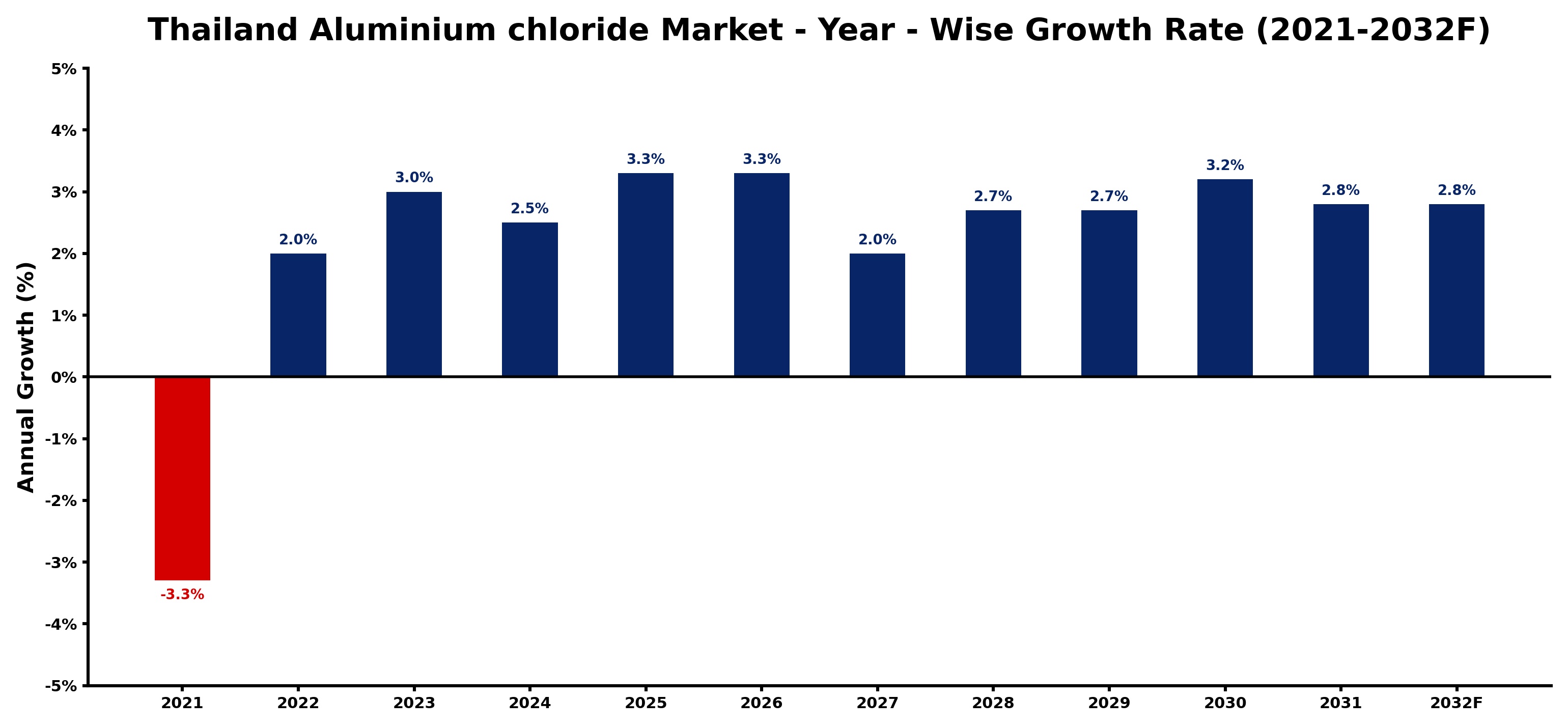
The table below presents the year‑wise growth rates along with the key drivers influencing the market
| Year | Growth Rate | Major Drivers |
| 2021 | -3.3% | Weak demand from construction sector lowered aluminium chloride consumption |
| 2022 | 2.0% | Plant upgrades enhanced Thailand's aluminium chloride production efficiency |
| 2023 | 3.0% | Manufacturing investments in wastewater treatment drive aluminum chloride demand |
| 2024 | 2.5% | New manufacturing plants boost aluminium chloride production capabilities |
| 2025 | 3.3% | New aluminum chloride plant commissioning boosts regional production capacity |
| 2026 | 3.3% | Manufacturing investments boosted local aluminium chloride production capacities |
| 2027 | 2.0% | Domestic infrastructure projects boosted demand for aluminium chloride supplies |
| 2028 | 2.7% | Technological upgrades in chemical processing boost aluminium chloride production efficiency |
| 2029 | 2.7% | Increased infrastructure projects drive aluminium chloride procurement in Thailand |
| 2030 | 3.2% | Modernized wastewater treatment systems drive aluminium chloride production demand |
| 2031 | 2.8% | Domestic wastewater treatment upgrades boosted aluminium chloride production capacity |
| 2032 | 2.8% | Construction sector revival boosts aluminium chloride demand in Thailand |
Note - Market size estimations and growth projections presented in this report are based on 6Wresearch's advanced forecasting approach, validated with industry datasets as of June 2026.
Thailand Aluminium chloride Market Synopsis
The aluminium chloride market in Thailand has experienced robust growth, bolstered by its essential roles in key industries such as water treatment and pharmaceuticals. However, while recent trends show a positive momentum, projections indicate a slowing growth rate in the coming years, largely due to stabilizing demand patterns.
Looking ahead, the market is poised for gradual expansion, driven by heightened consumer awareness regarding health and safety, especially in food applications. The focus on sustainable practices and improved production efficiencies will also play a crucial role in maintaining the market's viability and competitive edge.
Thailand Aluminium chloride Market Key Takeaways
- Strong growth in applications across water treatment and food processing is driving market demand.
- Consumer health awareness is leading to increased utilisation of aluminium chloride in food safety applications.
- Production efficiency and sustainability remain critical focus areas for industry stakeholders.
- Emerging regulations and environmental policies are influencing market dynamics significantly.
- Investment in innovative processing technologies may open new opportunities for market players.
Evaluation of Restraints in Thailand Aluminium chloride Market
While the Thailand aluminium chloride market presents numerous opportunities, several constraints must be acknowledged. Intense competition from global players often pressures local manufacturers on pricing strategies. Additionally, production efficiencies are crucial, as rising operational costs can inhibit profitability. Environmental concerns regarding waste management and regulatory compliance further complicate the landscape, requiring companies to invest in sustainable practices and technologies. The balance between maintaining product quality and managing these challenges continues to shape market dynamics.
Thailand Aluminium chloride Market Trends
Current trends in the Thailand aluminium chloride market highlight a shift toward sustainable and environmentally friendly production methods. Companies are increasingly adopting green chemistry principles to enhance production efficiency while minimizing waste. Furthermore, the pharmaceutical industry's growth is encouraging the exploration of new applications for aluminium chloride, particularly in drug formulations. Enhanced public awareness around water quality is also propelling demand for advanced water treatment solutions, fostering innovation in flocculant technologies.
Thailand Aluminium chloride Market Opportunities
The Thailand aluminium chloride market is ripe for growth, particularly in the areas of water treatment and food processing. As regulatory frameworks around food safety tighten, there is a significant opportunity for aluminium chloride to enhance safety and quality in processed food items. Additionally, advancements in chemical manufacturing processes present opportunities for cost reduction and efficiency improvements, allowing firms to capture larger market shares and invest in innovative solutions.
Government Initiatives in the Thailand Aluminium chloride Market
The Thai government has recognized the importance of water quality management and is implementing policies to support the treatment sector. Incentives for sustainable manufacturing practices are being introduced, encouraging businesses to adopt eco-friendly technologies. Furthermore, public spending on infrastructure improvements, particularly in water treatment facilities, is expected to enhance market opportunities for aluminium chloride applications.
Future Insights of the Thailand Aluminium chloride Market
From 2026 to 2032, the Thailand aluminium chloride market is projected to maintain steady growth. The continuing expansion of the pharmaceutical and chemical sectors, alongside increasing environmental awareness, will serve as key drivers. Additionally, ongoing innovations in product applications and processing efficiencies are expected to further enhance the market landscape. As businesses align with regulatory standards and consumer expectations, the market is likely to witness an evolution that fosters both resilience and sustainability.
Thailand Aluminium chloride Market Latest Developments (May 2025 - June 2026)
Recent developments in the Thailand aluminium chloride market include significant investments in innovative water treatment technologies, designed to improve efficiency and reduce environmental impact. Additionally, the industry has seen collaborative efforts among stakeholders to enhance safety standards in food processing, reflecting the growing commitment to consumer health. These trends are contributing to a more dynamic market environment as companies adapt to emerging challenges and opportunities.
Thailand Aluminium chloride Market - Key Attractiveness of the Report
- 10 Years of Market Numbers
- Historical Data Starting from 2022 to 2025
- Base Year: 2025
- Forecast Data until 2032
- Key Performance Indicators Impacting the Market
- Major Upcoming Developments and Projects
Key Highlights of the Report:
- Thailand Aluminium chloride Market Outlook
- Market Size of Thailand Aluminium chloride Market, 2025
- Forecast of Thailand Aluminium chloride Market, 2032
- Historical Data and Forecast of Thailand Aluminium chloride Revenues & Volume for the Period 2022-2032F
- Thailand Aluminium chloride Market Trend Evolution
- Thailand Aluminium chloride Market Drivers and Challenges
- Thailand Aluminium chloride Price Trends
- Thailand Aluminium chloride Porter's Five Forces
- Thailand Aluminium chloride Industry Life Cycle
- Historical Data and Forecast of Thailand Aluminium chloride Market Revenues & Volume By Production Method for the Period 2022-2032F
- Historical Data and Forecast of Thailand Aluminium chloride Market Revenues & Volume By Chlorination of aluminium for the Period 2022-2032F
- Historical Data and Forecast of Thailand Aluminium chloride Market Revenues & Volume By Crystallization of anhydrous aluminium chloride from solution of HCL for the Period 2022-2032F
- Historical Data and Forecast of Thailand Aluminium chloride Market Revenues & Volume By Reaction of bauxite with coke and chlorine for the Period 2022-2032F
- Historical Data and Forecast of Thailand Aluminium chloride Market Revenues & Volume By Application for the Period 2022-2032F
- Historical Data and Forecast of Thailand Aluminium chloride Market Revenues & Volume By Waste water treatment for the Period 2022-2032F
- Historical Data and Forecast of Thailand Aluminium chloride Market Revenues & Volume By Inks for the Period 2022-2032F
- Historical Data and Forecast of Thailand Aluminium chloride Market Revenues & Volume By Synthetic rubber for the Period 2022-2032F
- Historical Data and Forecast of Thailand Aluminium chloride Market Revenues & Volume By Lubricants for the Period 2022-2032F
- Historical Data and Forecast of Thailand Aluminium chloride Market Revenues & Volume By Wood Preservatives for the Period 2022-2032F
- Historical Data and Forecast of Thailand Aluminium chloride Market Revenues & Volume By Others for the Period 2022-2032F
- Historical Data and Forecast of Thailand Aluminium chloride Market Revenues & Volume By End-use Industries for the Period 2022-2032F
- Historical Data and Forecast of Thailand Aluminium chloride Market Revenues & Volume By Chemicals for the Period 2022-2032F
- Historical Data and Forecast of Thailand Aluminium chloride Market Revenues & Volume By Pharmaceuticals for the Period 2022-2032F
- Historical Data and Forecast of Thailand Aluminium chloride Market Revenues & Volume By Agrochemicals for the Period 2022-2032F
- Historical Data and Forecast of Thailand Aluminium chloride Market Revenues & Volume By Metal Production for the Period 2022-2032F
- Historical Data and Forecast of Thailand Aluminium chloride Market Revenues & Volume By Pulp & Paper for the Period 2022-2032F
- Historical Data and Forecast of Thailand Aluminium chloride Market Revenues & Volume By Others for the Period 2022-2032F
- Thailand Aluminium chloride Import Export Trade Statistics
- Market Opportunity Assessment By Production Method
- Market Opportunity Assessment By Application
- Market Opportunity Assessment By End-use Industries
- Thailand Aluminium chloride Top Companies Market Share
- Thailand Aluminium chloride Competitive Benchmarking By Technical and Operational Parameters
- Thailand Aluminium chloride Company Profiles
- Thailand Aluminium chloride Key Strategic Recommendations






































