Thailand Aluminium Sulphate Market Size, Share & Growth Rate
The Thailand Aluminium Sulphate Market was estimated at USD 93 Million in 2025 and is projected to reach USD 106 Million by 2032, growing at a CAGR of 1.9% from 2026 to 2032. This growth trajectory is underpinned by increasing applications in water treatment and the burgeoning demand from the paper and pulp industries. Additionally, the emphasis on sustainable water management practices is driving investments in aluminium sulphate, further boosting its market presence.
Thailand Aluminium Sulphate Market Year-wise Growth Rate and Key Drivers
This graph highlights how the Thailand Aluminium Sulphate Market has steadily grown over the years, supported by major growth factors.
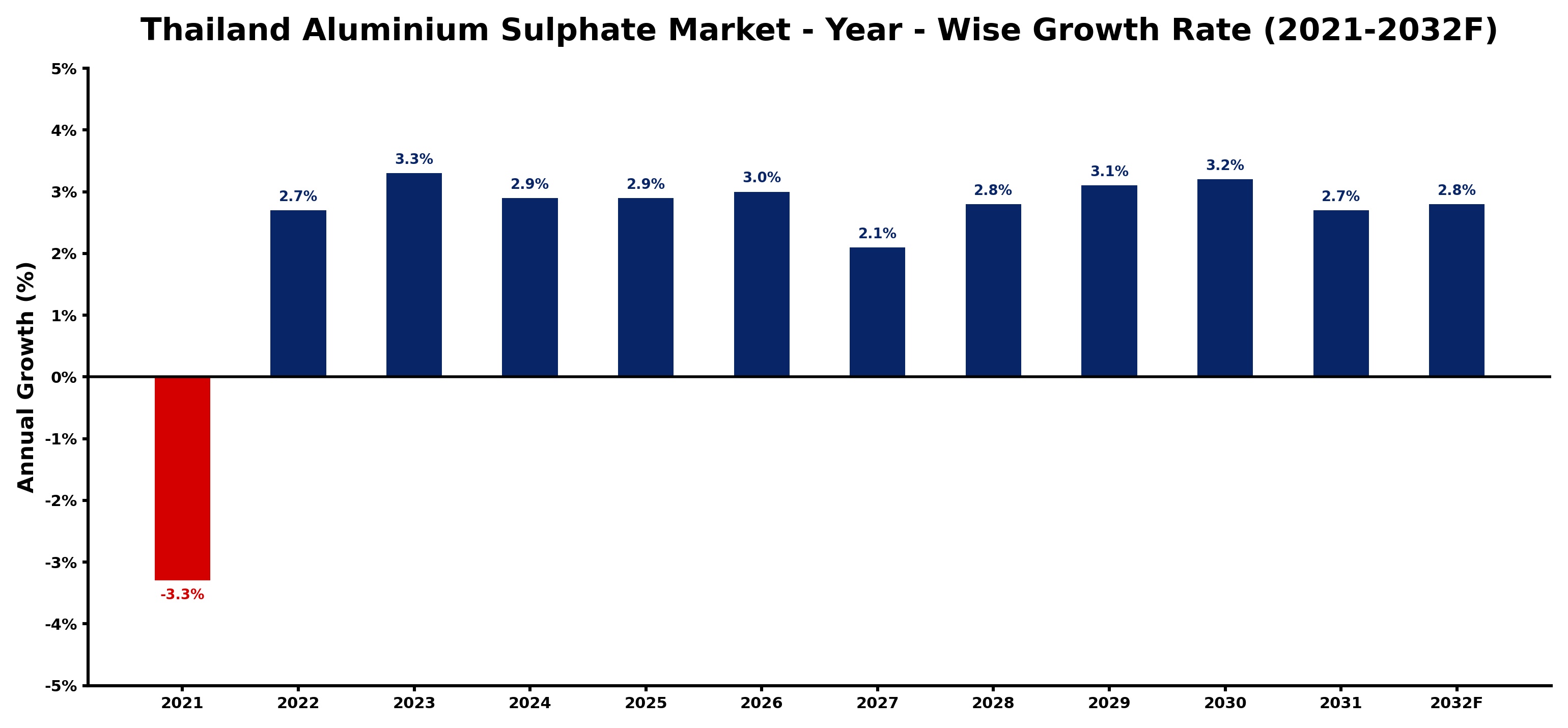
The table below presents the year‑wise growth rates along with the key drivers influencing the market
| Year | Growth Rate | Major Drivers |
| 2021 | -3.3% | Demand for water treatment declined |
| 2022 | 2.7% | Construction sector recovery stimulated demand |
| 2023 | 3.3% | Agricultural applications expanded significantly |
| 2024 | 2.9% | Industrial usage increased steadily |
| 2025 | 2.9% | Environmental regulations enhanced adoption |
| 2026 | 3.0% | Water purification technologies advanced rapidly |
| 2027 | 2.1% | Infrastructure projects boosted consumption |
| 2028 | 2.8% | Food processing demand rose sharply |
| 2029 | 3.1% | Chemical manufacturing expanded production |
| 2030 | 3.2% | Export opportunities increased significantly |
| 2031 | 2.7% | Sustainability initiatives drove growth |
| 2032 | 2.8% | Market diversification enhanced resilience |
Note - Market size estimations and growth projections presented in this report are based on 6Wresearch's advanced forecasting approach, validated with industry datasets as of June 2026.
Thailand Aluminium Sulphate Market Synopsis
Recently, the Thailand aluminium sulphate market has witnessed a surge in demand, particularly due to its essential roles in water purification and industrial applications. However, as we look forward, the market is set to face evolving challenges alongside persistent growth, particularly in response to environmental regulations and technological advancements.
With robust contributions from sectors such as food & beverages, agriculture, and wastewater treatment, the outlook remains positive. Future trends suggest an increasing reliance on aluminium sulphate as industries adapt to meet stricter environmental standards while striving for cost-effective solutions.
Thailand Aluminium Sulphate Market Key Takeaways
- The market is poised for steady growth driven by demand from various industrial applications.
- Government initiatives focused on improving water quality are significantly impacting demand.
- Environmental concerns are shaping production practices within the aluminium sulphate industry.
- Technological advancements are expected to enhance the efficiency of aluminium sulphate applications.
- The market is recovering from the pandemic-induced downturn as industrial activities ramp up.
Evaluation of Restraints in Thailand Aluminium Sulphate Market
Despite the promising growth prospects, the Thailand aluminium sulphate market faces notable restraints. One significant challenge is the sourcing of raw materials, which can become increasingly difficult and expensive. Additionally, the environmental implications of aluminium sulphate production—such as waste disposal and water management—pose operational hurdles. Addressing these issues is crucial for sustainable market growth and will require both industry and government efforts to innovate and improve production methods.
Thailand Aluminium Sulphate Market Trends
Several trends are shaping the Thailand aluminium sulphate market. The push for greener production methods is becoming increasingly prevalent, with businesses seeking to reduce their environmental footprints. Moreover, the integration of advanced technologies in production and application processes is optimizing performance and cost-efficiency. Additionally, growing public awareness of water quality issues is leading to heightened demand for water treatment solutions that utilize aluminium sulphate.
Thailand Aluminium Sulphate Market Opportunities
The landscape for opportunities within the Thailand aluminium sulphate market is dynamic. With the government emphasizing water safety initiatives, companies investing in water treatment technologies are well-positioned for growth. Furthermore, as the paper and pulp industries evolve, innovations in application methods present avenues for manufacturers to expand their product offerings. The trend towards sustainable practices is fostering collaborations across sectors, providing fertile ground for investment.
Government Initiatives in the Thailand Aluminium Sulphate Market
The Thai government is actively promoting initiatives aimed at improving access to safe drinking water, which directly influences the demand for aluminium sulphate in water treatment processes. Public spending on environmental sustainability and safe drinking water projects is indicative of a commitment to enhancing the quality of life for citizens. Additionally, regulatory frameworks are being established to encourage responsible production and usage of chemicals, including aluminium sulphate, ensuring its safe application in various industries.
Future Insights of the Thailand Aluminium Sulphate Market
Looking ahead to 2026-2032, the Thailand aluminium sulphate market is expected to maintain its growth trajectory, driven primarily by sustained demand from the water treatment and paper industries. As government initiatives continue to prioritize water quality and environmental concerns take center stage, manufacturers will need to innovate and adapt their processes. The emphasis on sustainability will likely spur new developments and partnerships, positioning the market favorably for continued expansion.
Thailand Aluminium Sulphate Market Latest Developments (May 2025 - June 2026)
In recent months, there have been notable movements within the Thailand aluminium sulphate market. Increased investments in water treatment infrastructure are becoming apparent as local authorities push for improvements in water safety. Furthermore, there is a rising trend of companies exploring new production methodologies aimed at reducing environmental impact. Partnerships between government agencies and private firms are also on the rise, focusing on enhancing the efficiency of aluminium sulphate usage in various applications.
Thailand Aluminium Sulphate Market - Key Attractiveness of the Report
- 10 Years of Market Numbers
- Historical Data Starting from 2022 to 2025
- Base Year: 2025
- Forecast Data until 2032
- Key Performance Indicators Impacting the Market
- Major Upcoming Developments and Projects
Key Highlights of the Report:
- Thailand Aluminium Sulphate Market Outlook
- Market Size of Thailand Aluminium Sulphate Market, 2025
- Forecast of Thailand Aluminium Sulphate Market, 2032
- Historical Data and Forecast of Thailand Aluminium Sulphate Revenues & Volume for the Period 2022-2032F
- Thailand Aluminium Sulphate Market Trend Evolution
- Thailand Aluminium Sulphate Market Drivers and Challenges
- Thailand Aluminium Sulphate Price Trends
- Thailand Aluminium Sulphate Porter's Five Forces
- Thailand Aluminium Sulphate Industry Life Cycle
- Historical Data and Forecast of Thailand Aluminium Sulphate Market Revenues & Volume By Applications for the Period 2022-2032F
- Historical Data and Forecast of Thailand Aluminium Sulphate Market Revenues & Volume By Food and beverages industry for the Period 2022-2032F
- Historical Data and Forecast of Thailand Aluminium Sulphate Market Revenues & Volume By Health care industry for the Period 2022-2032F
- Historical Data and Forecast of Thailand Aluminium Sulphate Market Revenues & Volume By Water purification and water treatment plants for the Period 2022-2032F
- Historical Data and Forecast of Thailand Aluminium Sulphate Market Revenues & Volume By Pepper industry for the Period 2022-2032F
- Historical Data and Forecast of Thailand Aluminium Sulphate Market Revenues & Volume By Others for the Period 2022-2032F
- Historical Data and Forecast of Thailand Aluminium Sulphate Market Revenues & Volume By Functionality for the Period 2022-2032F
- Historical Data and Forecast of Thailand Aluminium Sulphate Market Revenues & Volume By As an additive for the Period 2022-2032F
- Historical Data and Forecast of Thailand Aluminium Sulphate Market Revenues & Volume By As BOD and COD removal for the Period 2022-2032F
- Historical Data and Forecast of Thailand Aluminium Sulphate Market Revenues & Volume By Colour removal for the Period 2022-2032F
- Historical Data and Forecast of Thailand Aluminium Sulphate Market Revenues & Volume By Cell separation for the Period 2022-2032F
- Historical Data and Forecast of Thailand Aluminium Sulphate Market Revenues & Volume By Product Form for the Period 2022-2032F
- Historical Data and Forecast of Thailand Aluminium Sulphate Market Revenues & Volume By Liquid for the Period 2022-2032F
- Historical Data and Forecast of Thailand Aluminium Sulphate Market Revenues & Volume By Solid for the Period 2022-2032F
- Thailand Aluminium Sulphate Import Export Trade Statistics
- Market Opportunity Assessment By Applications
- Market Opportunity Assessment By Functionality
- Market Opportunity Assessment By Product Form
- Thailand Aluminium Sulphate Top Companies Market Share
- Thailand Aluminium Sulphate Competitive Benchmarking By Technical and Operational Parameters
- Thailand Aluminium Sulphate Company Profiles
- Thailand Aluminium Sulphate Key Strategic Recommendations






































