Thailand Ammonium Hydroxide Market: Import Trend Analysis
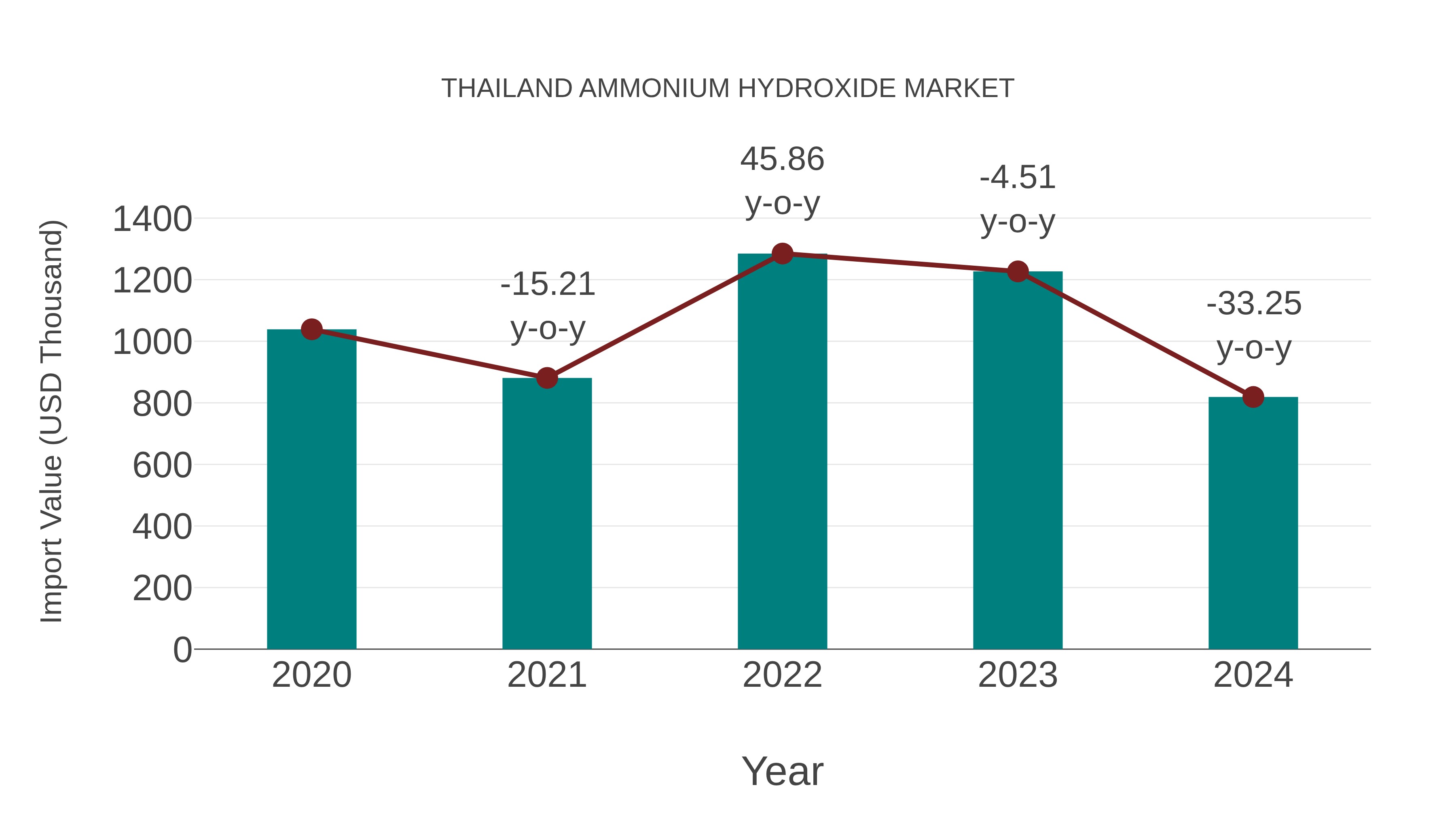
Thailand import trend for ammonium hydroxide in 2024 experienced a decline, with a growth rate of -33.25% compared to the previous year. The compound annual growth rate (CAGR) for the period of 2020-2024 stood at -5.77%. This decline could be attributed to shifting demand dynamics or changes in trade policies impacting the market stability.
Thailand Ammonium Hydroxide Market Synopsis
The ammonium hydroxide market in Thailand was projected to reach $186 million by 2025 from $144 million in 2018, registering a CAGR of 4.5% during the forecast period, according to 6Wresearch. This growth is mainly driven by its increased usage across various industries such as pharmaceuticals, fertilizers etc., making it one of the most important chemicals used worldwide today with a wide variety of applications like cleaning & sanitation products production and water treatment processes among others that are driving its consumption rate globally including Thailand where it holds significant share in terms of value sales.
Drivers of the Market
The Thailand ammonium hydroxide market`s growth is tied to its applications in various sectors, including cleaning, pharmaceuticals, and chemical synthesis. As industries focus on efficient cleaning agents and manufacturing processes, the demand for ammonium hydroxide increases. Its use in the food processing industry also contributes to market growth.
Challenges of the Market
The Thailand ammonium hydroxide market faces challenges associated with its hazardous nature and potential environmental impacts. Regulatory compliance, proper handling, and safe storage of the chemical are crucial. Moreover, the competition from alternative chemicals in various industrial applications can impact market growth.
COVID-19 Impact on the Market
The Thailand ammonium hydroxide market experienced disruptions in supply chains, impacting industries such as cleaning, textiles, and agriculture that use this compound. With industrial activities reduced and consumer spending constrained, the market faced challenges. As economic activities normalize, the market is likely to recover gradually.
Key Players in the Market
In the Thailand ammonium hydroxide market, significant players include BASF SE, Dow Chemical Company, and Orica Limited. These companies are major suppliers of ammonium hydroxide for various applications such as cleaning, industrial processes, and agriculture. Their global reach and commitment to product quality make them key contributors to the market.
Key Highlights of the Report:
- Thailand Ammonium Hydroxide Market Outlook
- Market Size of Thailand Ammonium Hydroxide Market, 2025
- Forecast of Thailand Ammonium Hydroxide Market, 2032
- Historical Data and Forecast of Thailand Ammonium Hydroxide Revenues & Volume for the Period 2022-2032F
- Thailand Ammonium Hydroxide Market Trend Evolution
- Thailand Ammonium Hydroxide Market Drivers and Challenges
- Thailand Ammonium Hydroxide Price Trends
- Thailand Ammonium Hydroxide Porter's Five Forces
- Thailand Ammonium Hydroxide Industry Life Cycle
- Historical Data and Forecast of Thailand Ammonium Hydroxide Market Revenues & Volume By End-Use Industry for the Period 2022-2032F
- Historical Data and Forecast of Thailand Ammonium Hydroxide Market Revenues & Volume By Pharmaceutical for the Period 2022-2032F
- Historical Data and Forecast of Thailand Ammonium Hydroxide Market Revenues & Volume By Food & Beverage for the Period 2022-2032F
- Historical Data and Forecast of Thailand Ammonium Hydroxide Market Revenues & Volume By Personal Care for the Period 2022-2032F
- Historical Data and Forecast of Thailand Ammonium Hydroxide Market Revenues & Volume By Chemical for the Period 2022-2032F
- Historical Data and Forecast of Thailand Ammonium Hydroxide Market Revenues & Volume By Agriculture for the Period 2022-2032F
- Historical Data and Forecast of Thailand Ammonium Hydroxide Market Revenues & Volume By Others for the Period 2022-2032F
- Historical Data and Forecast of Thailand Ammonium Hydroxide Market Revenues & Volume By Application for the Period 2022-2032F
- Historical Data and Forecast of Thailand Ammonium Hydroxide Market Revenues & Volume By Leaving agent for the Period 2022-2032F
- Historical Data and Forecast of Thailand Ammonium Hydroxide Market Revenues & Volume By Acid Neutraliser for the Period 2022-2032F
- Historical Data and Forecast of Thailand Ammonium Hydroxide Market Revenues & Volume By Flavour enhancer for the Period 2022-2032F
- Historical Data and Forecast of Thailand Ammonium Hydroxide Market Revenues & Volume By Others for the Period 2022-2032F
- Historical Data and Forecast of Thailand Ammonium Hydroxide Market Revenues & Volume By Source for the Period 2022-2032F
- Historical Data and Forecast of Thailand Ammonium Hydroxide Market Revenues & Volume By Natural for the Period 2022-2032F
- Historical Data and Forecast of Thailand Ammonium Hydroxide Market Revenues & Volume By Chemical for the Period 2022-2032F
- Thailand Ammonium Hydroxide Import Export Trade Statistics
- Market Opportunity Assessment By End-Use Industry
- Market Opportunity Assessment By Application
- Market Opportunity Assessment By Source
- Thailand Ammonium Hydroxide Top Companies Market Share
- Thailand Ammonium Hydroxide Competitive Benchmarking By Technical and Operational Parameters
- Thailand Ammonium Hydroxide Company Profiles
- Thailand Ammonium Hydroxide Key Strategic Recommendations






































