Thailand Antidiabetics Market Size, Share & Growth Rate
The Thailand Antidiabetics Market was estimated at USD 238 Million in 2025 and is projected to reach USD 270 Million by 2032, growing at a CAGR of 1.8% from 2026 to 2032. This growth is primarily driven by the increasing diabetic population, alongside heightened awareness of diabetes management across the nation. As lifestyle changes contribute to rising diabetes rates, the demand for effective antidiabetic medications continues to escalate, bolstered by government initiatives focused on early detection and treatment.
Thailand Antidiabetics Market Year-wise Growth Rate and Key Drivers
This graph highlights how the Thailand Antidiabetics Market has steadily grown over the years, supported by major growth factors.
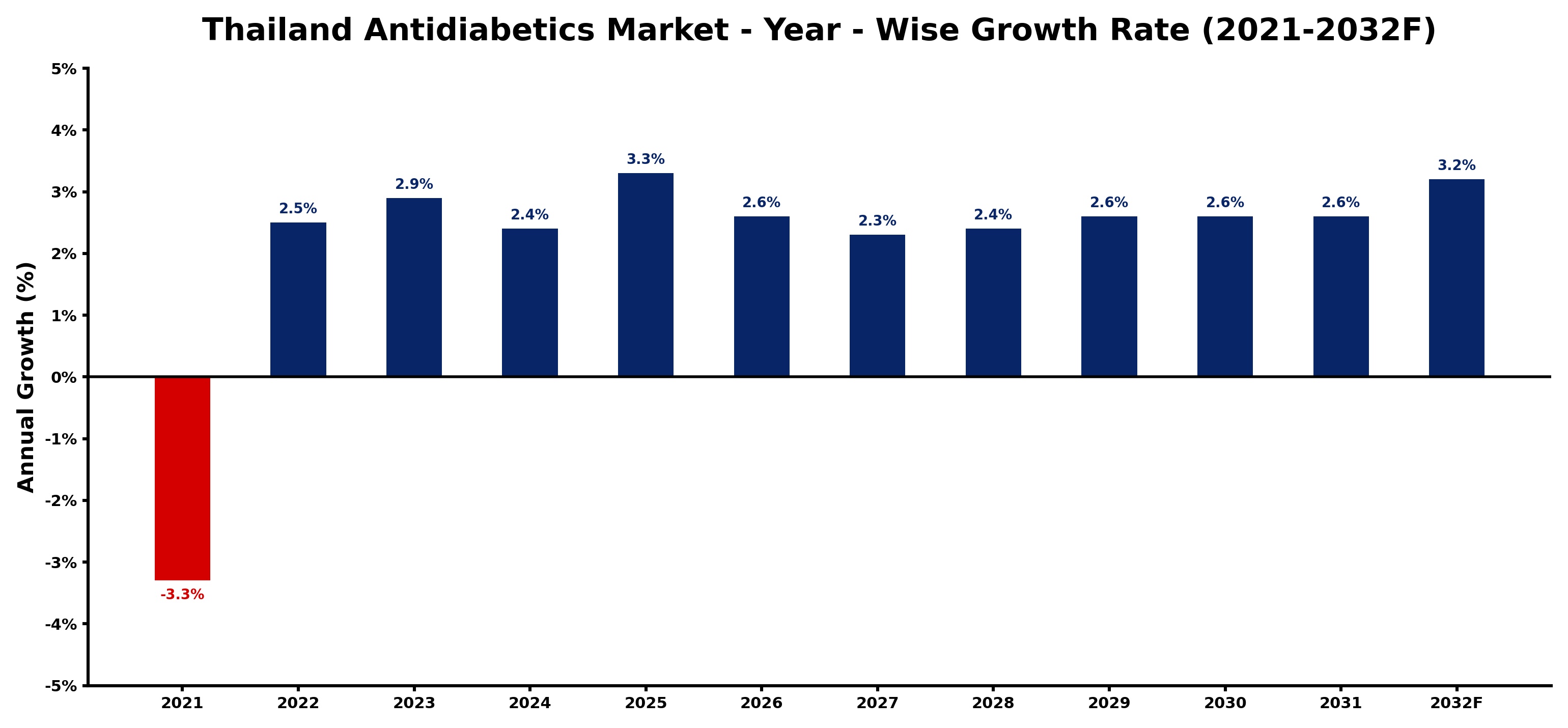
The table below presents the year‑wise growth rates along with the key drivers influencing the market
| Year | Growth Rate | Major Drivers |
| 2021 | -3.3% | Increasing adoption of advanced technologies |
| 2022 | 2.5% | Increasing industrial infrastructure investments |
| 2023 | 2.9% | Increasing industrial infrastructure investments |
| 2024 | 2.4% | Rapid growth in telecom and data center sectors |
| 2025 | 3.3% | Rising electricity demand across industries |
| 2026 | 2.6% | Increasing industrial infrastructure investments |
| 2027 | 2.3% | Increasing industrial infrastructure investments |
| 2028 | 2.4% | Rising electricity demand across industries |
| 2029 | 2.6% | Rising electricity demand across industries |
| 2030 | 2.6% | Growing renewable energy integration projects |
| 2031 | 2.6% | Expansion of commercial construction activities |
| 2032 | 3.2% | Growing renewable energy integration projects |
Note - Market size estimations and growth projections presented in this report are based on 6Wresearch's advanced forecasting approach, validated with industry datasets as of June 2026.
Thailand Antidiabetics Market Synopsis
The Thai market for antidiabetic medications is characterized by a diverse range of treatment options, including insulin, oral hypoglycemic agents, and GLP-1 receptor agonists, tailored to meet the needs of patients at various stages of diabetes. With the prevalence of diabetes steadily increasing, the demand for these medications is expected to rise significantly, reflecting the urgency for effective blood glucose management.
Additionally, government-led initiatives aimed at increasing public awareness about diabetes have resulted in higher diagnosis rates, further fueling the market. Innovative advancements in pharmaceutical research are leading to the development of more efficient antidiabetic drugs, ensuring that healthcare professionals have access to superior treatment options for their patients.
Thailand Antidiabetics Market Key Takeaways
- The diabetes prevalence in Thailand is rising due to lifestyle changes, driving market demand for antidiabetics.
- Government initiatives aimed at diabetes awareness are significantly impacting diagnosis and treatment rates.
- Advancements in medical research are leading to the introduction of innovative antidiabetic medications.
- Issues of affordability and adherence to treatment regimens continue to challenge market growth.
- COVID-19 has shifted focus towards telemedicine and remote diabetes management solutions.
Evaluation of Restraints in Thailand Antidiabetics Market
Despite the positive growth trajectory, the antidiabetics market in Thailand contends with several significant restraints. One critical issue is the affordability of advanced medications, which can restrict access for lower-income populations. Additionally, patient adherence to complex treatment regimens remains a challenge; managing diabetes often requires lifestyle changes in conjunction with medication, which can overwhelm some patients. The proliferation of counterfeit or substandard drugs also undermines the market's integrity, as it raises safety concerns and diminishes trust in prescribed treatments.
Thailand Antidiabetics Market Trends
Current trends indicate a shift towards more integrated diabetes management solutions, combining medication with technology such as glucose monitoring devices and telehealth platforms. The emergence of digital health solutions enhances patient engagement and adherence, supporting better management of diabetes. Additionally, there is growing interest in personalized medicine approaches, aimed at tailoring diabetes treatments to individual patient profiles for improved outcomes.
Thailand Antidiabetics Market Opportunities
Significant growth opportunities exist within the Thailand Antidiabetics Market, particularly in enhancing accessibility to medications through governmental support and health insurance initiatives. The increasing emphasis on preventive care and early diagnosis also presents avenues for developing educational programs to increase awareness. Furthermore, the potential for introducing innovative drug delivery systems and combination therapies may attract investment and spur market expansion.
Government Initiatives in the Thailand Antidiabetics Market
The Thai government is actively pursuing policies to combat diabetes through health promotion campaigns and funding for diabetes research. Programs focusing on diabetes awareness, early screening, and preventive measures are being implemented to reduce the burden of this chronic disease. Public health spending on diabetes management is being increased, aiming to improve access to medications and promote better treatment adherence among patients.
Future Insights of the Thailand Antidiabetics Market
Looking ahead to 2026-2032, the Thailand Antidiabetics Market is poised for steady growth driven by an increasing emphasis on diabetes education and management technologies. The ongoing evolution of treatment modalities, along with sustained governmental support for public health initiatives, will likely shape the market's landscape. As awareness and understanding of diabetes improve, the demand for both existing and novel antidiabetic medications will continue to expand, fostering innovation and investment within the sector.
Thailand Antidiabetics Market Latest Developments (May 2025 - June 2026)
Recent developments indicate a marked increase in collaborations between technology firms and pharmaceutical companies to enhance diabetes management solutions. The rise of telehealth services has accelerated, allowing for ongoing patient monitoring and education. Additionally, there has been a push towards research and development of more accessible oral and injectable therapies, aligned with the need for improved patient compliance and satisfaction in diabetes care.
Thailand Antidiabetics Market - Key Attractiveness of the Report
- 10 Years of Market Numbers
- Historical Data Starting from 2022 to 2025
- Base Year: 2025
- Forecast Data until 2032
- Key Performance Indicators Impacting the Market
- Major Upcoming Developments and Projects
Key Highlights of the Report:
- Thailand Antidiabetics Market Outlook
- Market Size of Thailand Antidiabetics Market, 2025
- Forecast of Thailand Antidiabetics Market, 2032
- Historical Data and Forecast of Thailand Antidiabetics Revenues & Volume for the Period 2022-2032F
- Thailand Antidiabetics Market Trend Evolution
- Thailand Antidiabetics Market Drivers and Challenges
- Thailand Antidiabetics Price Trends
- Thailand Antidiabetics Porter's Five Forces
- Thailand Antidiabetics Industry Life Cycle
- Historical Data and Forecast of Thailand Antidiabetics Market Revenues & Volume By Product for the Period 2022-2032F
- Historical Data and Forecast of Thailand Antidiabetics Market Revenues & Volume By Insulin for the Period 2022-2032F
- Historical Data and Forecast of Thailand Antidiabetics Market Revenues & Volume By Drug Class for the Period 2022-2032F
- Historical Data and Forecast of Thailand Antidiabetics Market Revenues & Volume By Patient Population for the Period 2022-2032F
- Historical Data and Forecast of Thailand Antidiabetics Market Revenues & Volume By Paediatric for the Period 2022-2032F
- Historical Data and Forecast of Thailand Antidiabetics Market Revenues & Volume By Adult for the Period 2022-2032F
- Historical Data and Forecast of Thailand Antidiabetics Market Revenues & Volume By Geriatric for the Period 2022-2032F
- Historical Data and Forecast of Thailand Antidiabetics Market Revenues & Volume By Route of Administration for the Period 2022-2032F
- Historical Data and Forecast of Thailand Antidiabetics Market Revenues & Volume By Insulin syringe/ Insulin pen for the Period 2022-2032F
- Historical Data and Forecast of Thailand Antidiabetics Market Revenues & Volume By Insulin pump for the Period 2022-2032F
- Historical Data and Forecast of Thailand Antidiabetics Market Revenues & Volume By Intravenous infusion for the Period 2022-2032F
- Historical Data and Forecast of Thailand Antidiabetics Market Revenues & Volume By Oral for the Period 2022-2032F
- Historical Data and Forecast of Thailand Antidiabetics Market Revenues & Volume By Others for the Period 2022-2032F
- Thailand Antidiabetics Import Export Trade Statistics
- Market Opportunity Assessment By Product
- Market Opportunity Assessment By Patient Population
- Market Opportunity Assessment By Route of Administration
- Thailand Antidiabetics Top Companies Market Share
- Thailand Antidiabetics Competitive Benchmarking By Technical and Operational Parameters
- Thailand Antidiabetics Company Profiles
- Thailand Antidiabetics Key Strategic Recommendations






































