Thailand Antiparasitics Drugs Market Size, Share & Growth Rate
The Thailand Antiparasitics Drugs Market was estimated at USD 110 Million in 2025 and is projected to reach USD 126 Million by 2032, growing at a CAGR of 2.0% from 2026 to 2032. This growth trajectory is underscored by rising public health initiatives and increased awareness regarding the treatment of parasitic infections. As Thailand faces a persistent challenge from these infections, effective treatments become paramount, leading to a steady demand for antiparasitic drugs throughout the healthcare landscape.
Thailand Antiparasitics Drugs Market Year-wise Growth Rate and Key Drivers
This graph highlights how the Thailand Antiparasitics Drugs Market has steadily grown over the years, supported by major growth factors.
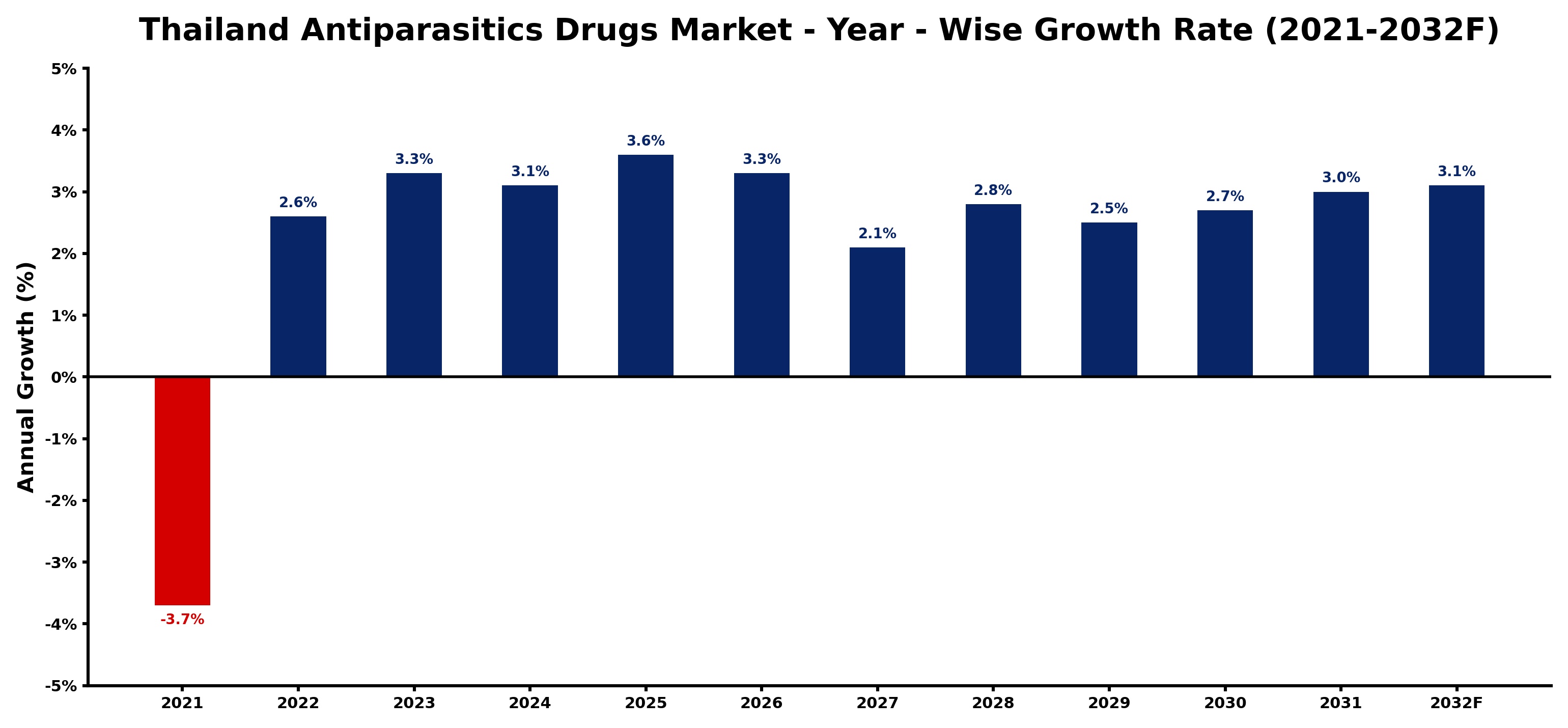
The table below presents the year‑wise growth rates along with the key drivers influencing the market
| Year | Growth Rate | Major Drivers |
| 2021 | -3.7% | Inflationary pressures diminished consumer spending on antiparasitics and health |
| 2022 | 2.6% | Pharmaceutical companies prioritize local manufacturing for antiparasitics cost efficiency |
| 2023 | 3.3% | Strengthened manufacturing investments boosted local antiparasitic drug production capacity |
| 2024 | 3.1% | Regional pharmaceutical manufacturing boosts domestic antiparasitics drug production capacity |
| 2025 | 3.6% | Pharmaceutical manufacturing upgrades enhanced production capacity for antiparasitics |
| 2026 | 3.3% | Tech integration in veterinary practices boosts antiparasitic drug demand |
| 2027 | 2.1% | Export driven demand surge prompted increased antiparasitic production capabilities |
| 2028 | 2.8% | Biopharmaceutical manufacturing investments boosted antiparasitics production capabilities |
| 2029 | 2.5% | Domestic production upgrades boosted demand for veterinary antiparasitics |
| 2030 | 2.7% | Advanced manufacturing technologies streamline production of antiparasitic formulations |
| 2031 | 3.0% | Manufacturing investments boosted local capacity for antiparasitics production |
| 2032 | 3.1% | Domestic pharmaceutical manufacturing investments boost antiparasitics production capacity |
Note - Market size estimations and growth projections presented in this report are based on 6Wresearch’s advanced forecasting approach, validated with industry datasets as of June 2026.
Thailand Antiparasitics Drugs Market Synopsis
In Thailand, the antiparasitics drugs market has become increasingly significant as the nation grapples with various parasitic diseases affecting both humans and animals. The growing incidence of these infections, coupled with heightened consumer awareness about health and wellness, has catalyzed demand for effective antiparasitic solutions.
Moreover, government efforts to enhance public health, including free diagnostic campaigns, have facilitated broader access to these vital medications. This environment creates a unique synergy of factors that are propelling the market forward, encouraging both innovation in drug development and the distribution of existing therapies.
Thailand Antiparasitics Drugs Market Key Takeaways
- The market is projected to grow steadily, driven by public health initiatives and awareness campaigns.
- Increased prevalence of parasitic infections among humans and animals significantly impacts drug demand.
- Accessibility of antiparasitic medications remains a key concern, particularly in rural communities.
- Government programs are enhancing diagnostic capabilities, thereby encouraging treatment uptake.
- Technological advancements in drug formulation continue to play a critical role in market expansion.
Evaluation of Restraints in Thailand Antiparasitics Drugs Market
Despite the robust growth forecast for the antiparasitics drugs market in Thailand, several significant restraints warrant attention. One of the primary challenges is the evolving resistance of parasites to existing treatments, which complicates the management of infections and necessitates the development of new solutions. Additionally, access to these medications remains uneven, particularly in rural areas where healthcare infrastructure may be lacking. This disparity not only affects treatment outcomes but also hinders efforts to control parasitic diseases on a larger scale.
Thailand Antiparasitics Drugs Market Trends
Current trends in the Thailand antiparasitics drugs market include a notable shift towards preventive treatment options, as stakeholders recognize the importance of addressing parasitic infections before they manifest. Advances in pharmaceutical technology are also paving the way for more effective drug formulations, which aim to combat resistant strains. Furthermore, collaboration between public health organizations and pharmaceutical companies is increasing, promoting the development of innovative solutions tailored to local health challenges.
Thailand Antiparasitics Drugs Market Opportunities
Opportunities for growth in the antiparasitics drugs market are ripe, particularly as the government enhances its public health initiatives. Investment in research and development could lead to breakthroughs in drug efficacy and administration. Additionally, expanding access to medications in underserved regions not only opens up new markets but also aligns with national health goals. The integration of technology in healthcare delivery can further enhance patient adherence to treatment regimens, thus driving demand.
Government Initiatives in the Thailand Antiparasitics Drugs Market
The Thai government has implemented various initiatives aimed at improving public health and controlling parasitic infections. These include free diagnostic testing campaigns and enhanced access to treatments through public health programs. Additionally, public spending on healthcare is increasing, which supports the infrastructure necessary to ensure that antiparasitic drugs are available and accessible to all citizens, particularly in remote areas.
Future Insights of the Thailand Antiparasitics Drugs Market
Looking ahead to 2026-2032, the Thailand antiparasitics drugs market is poised for steady growth as the nation continues to address its public health challenges. The ongoing emphasis on education, awareness, and effective treatment methods is expected to shape future market dynamics. Moreover, evolving partnerships between the public and private sectors may lead to innovative solutions, enhancing the overall management of parasitic infections and improving health outcomes across the country.
Thailand Antiparasitics Drugs Market Latest Developments (May 2025 - June 2026)
In recent months, the antiparasitics drugs market in Thailand has seen a surge in interest from both public health agencies and pharmaceutical companies. New partnerships are being formed to address the challenges posed by parasitic infections, particularly in underserved communities. Initiatives aimed at improving diagnostic capabilities and treatment access are also gaining traction, reflecting the commitment to enhancing healthcare delivery in the region. Additionally, ongoing research efforts are focused on developing more effective and targeted antiparasitic therapies.
Thailand Antiparasitics Drugs Market - Key Attractiveness of the Report
- 10 Years of Market Numbers
- Historical Data Starting from 2022 to 2025
- Base Year: 2025
- Forecast Data until 2032
- Key Performance Indicators Impacting the Market
- Major Upcoming Developments and Projects
Key Highlights of the Report:
- Thailand Antiparasitics Drugs Market Outlook
- Market Size of Thailand Antiparasitics Drugs Market, 2025
- Forecast of Thailand Antiparasitics Drugs Market, 2032
- Historical Data and Forecast of Thailand Antiparasitics Drugs Revenues & Volume for the Period 2022-2032F
- Thailand Antiparasitics Drugs Market Trend Evolution
- Thailand Antiparasitics Drugs Market Drivers and Challenges
- Thailand Antiparasitics Drugs Price Trends
- Thailand Antiparasitics Drugs Porter's Five Forces
- Thailand Antiparasitics Drugs Industry Life Cycle
- Historical Data and Forecast of Thailand Antiparasitics Drugs Market Revenues & Volume By Route of Administration for the Period 2022-2032F
- Historical Data and Forecast of Thailand Antiparasitics Drugs Market Revenues & Volume By Oral for the Period 2022-2032F
- Historical Data and Forecast of Thailand Antiparasitics Drugs Market Revenues & Volume By Injectable for the Period 2022-2032F
- Historical Data and Forecast of Thailand Antiparasitics Drugs Market Revenues & Volume By Topical for the Period 2022-2032F
- Historical Data and Forecast of Thailand Antiparasitics Drugs Market Revenues & Volume By Drug class for the Period 2022-2032F
- Historical Data and Forecast of Thailand Antiparasitics Drugs Market Revenues & Volume By Anthelmintics for the Period 2022-2032F
- Historical Data and Forecast of Thailand Antiparasitics Drugs Market Revenues & Volume By Antiprotozoals for the Period 2022-2032F
- Historical Data and Forecast of Thailand Antiparasitics Drugs Market Revenues & Volume By Others for the Period 2022-2032F
- Historical Data and Forecast of Thailand Antiparasitics Drugs Market Revenues & Volume By Distribution Channel for the Period 2022-2032F
- Historical Data and Forecast of Thailand Antiparasitics Drugs Market Revenues & Volume By Hospital Pharmacies for the Period 2022-2032F
- Historical Data and Forecast of Thailand Antiparasitics Drugs Market Revenues & Volume By Retail Pharmacies for the Period 2022-2032F
- Historical Data and Forecast of Thailand Antiparasitics Drugs Market Revenues & Volume By Online Pharmacies for the Period 2022-2032F
- Thailand Antiparasitics Drugs Import Export Trade Statistics
- Market Opportunity Assessment By Route of Administration
- Market Opportunity Assessment By Drug class
- Market Opportunity Assessment By Distribution Channel
- Thailand Antiparasitics Drugs Top Companies Market Share
- Thailand Antiparasitics Drugs Competitive Benchmarking By Technical and Operational Parameters
- Thailand Antiparasitics Drugs Company Profiles
- Thailand Antiparasitics Drugs Key Strategic Recommendations






































