Thailand Artificial Intelligence in Accounting Market Size & Growth Rate (2026-2032)
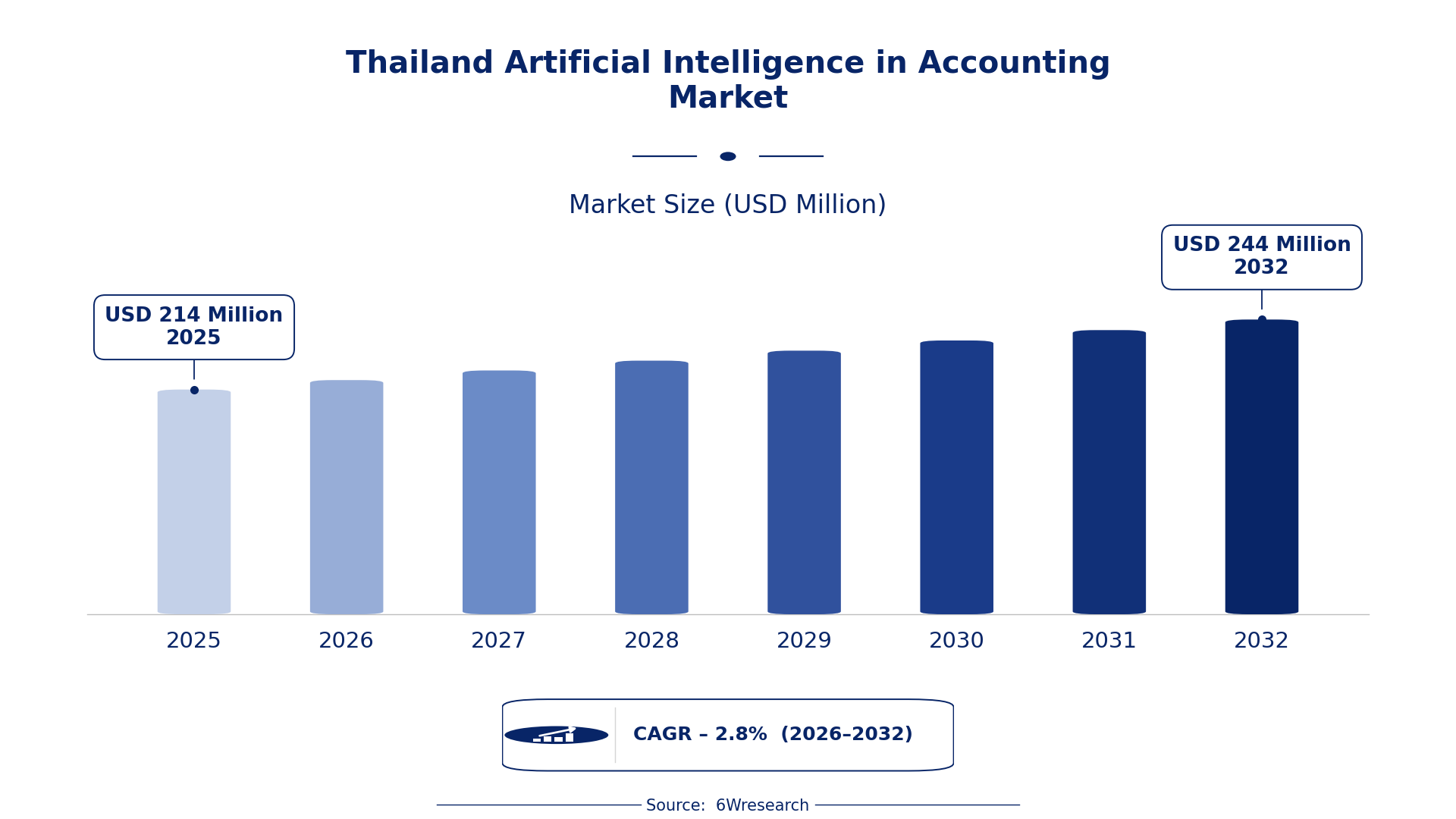
The Thailand Artificial Intelligence in Accounting Market was estimated at USD 214 Million in 2025 and is projected to reach USD 244 Million by 2032, growing at a CAGR of 2.8% from 2026 to 2032.
Thailand Artificial Intelligence in Accounting Market Synopsis
The demand for AI-driven solutions in Thailand's accounting sector is surging, fueled by the need for enhanced accuracy and efficiency in financial reporting. Businesses are increasingly adopting AI technologies to automate repetitive tasks, such as data entry and invoice processing, allowing finance teams to focus on higher-value activities.
As financial data grows in complexity, the role of artificial intelligence in accounting is becoming indispensable. Companies recognize that AI not only streamlines operations but also significantly reduces the risk of human error, making it a vital tool in the current data-driven environment.
Thailand Artificial Intelligence in Accounting Market Year-wise Growth Rate and Key Drivers
This graph illustrates the annual growth rates of the Thailand Artificial Intelligence in Accounting Market from 2021 to 2032, highlighting a steady upward trajectory and projected expansion over the forecast period.
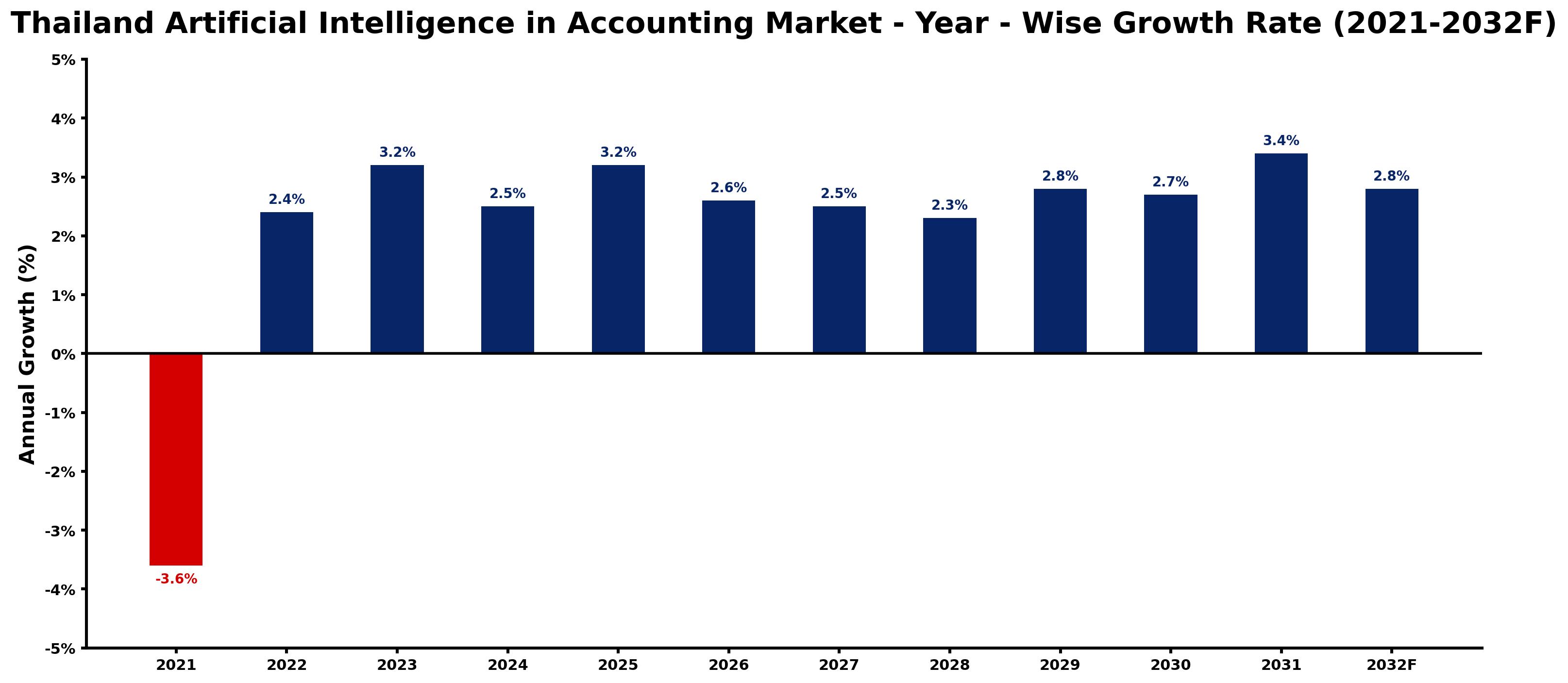
The table below presents the year‑wise growth rates along with the key drivers influencing the market
| Year | Growth Rate | Major Drivers |
| 2021 | -3.6% | Tax regulations by the Revenue Department hinder AI integration. |
| 2022 | 2.4% | Liberalization of Thai accounting regulations for AI adoption |
| 2023 | 3.2% | Increased demand for AI-driven financial fraud detection |
| 2024 | 2.5% | Government support for tech startups in accounting sector |
| 2025 | 3.2% | Rising workforce demand for AI skills in accounting |
| 2026 | 2.6% | Thai SMEs adopting AI for accounting efficiency gains |
| 2027 | 2.5% | Emergence of local fintech firms using AI technologies |
| 2028 | 2.3% | Growing digital transformation initiatives in Thai businesses |
| 2029 | 2.8% | Enhanced data privacy laws facilitating AI trust in accounting |
| 2030 | 2.7% | Thai universities offering specialized AI in accounting programs |
| 2031 | 3.4% | Increased foreign investment in Thailand's tech and accounting |
| 2032 | 2.8% | More collaborative AI projects with local accounting bodies |
Note: Market size estimations and growth projections presented in this report are based on 6Wresearch's proprietary forecasting methodology, utilizing the latest available industry data, government publications, and primary research inputs.
Thailand Artificial Intelligence in Accounting Market Key Takeaways
Below are some of the specific key takeaways from the market, including:
- The integration of AI technologies is transforming traditional accounting practices across various sectors in Thailand.
- Organizations are increasingly prioritizing investments in AI to improve efficiency and ensure compliance with regulatory standards.
- Machine learning algorithms are being deployed for advanced analytics, fraud detection, and financial forecasting.
- The COVID-19 pandemic accelerated the adoption of AI solutions as businesses sought to adapt to new challenges.
- Collaboration between technology providers and accounting firms is fostering innovation in AI applications.
Evaluation of Restraints in Thailand Artificial Intelligence in Accounting Market
Despite the promising growth trajectory, the Thailand Artificial Intelligence in Accounting market faces several restraints. Regulatory compliance is a pressing concern, as businesses must ensure their AI solutions adhere to stringent financial guidelines. Additionally, skepticism regarding the ethical implications of AI in financial processes can hinder adoption. Building trust among stakeholders remains a crucial challenge, as transparency and accountability in AI applications are paramount for widespread acceptance.
Thailand Artificial Intelligence in Accounting Market Trends
Several key trends are shaping the Thailand Artificial Intelligence in Accounting market. The shift towards cloud-based solutions is enabling firms to access AI tools easily and affordably. Businesses are also focusing on customizing AI applications to better fit specific industry needs. on top of that, the demand for real-time data analytics is driving innovations in AI capabilities, allowing companies to make informed financial decisions swiftly.
Thailand Artificial Intelligence in Accounting Market Opportunities
Opportunities abound for players in the Thailand Artificial Intelligence in Accounting market. The increasing complexity of financial operations presents a significant growth avenue for AI solution providers. There is a rising demand for training programs to equip accounting professionals with the skills necessary to utilize AI effectively. Additionally, partnerships between tech companies and financial institutions can lead to the development of more advanced, user-friendly applications tailored to the local market.
Government Initiatives in the Thailand Artificial Intelligence in Accounting Market
The Thai government is actively promoting the integration of artificial intelligence in various sectors, including accounting. With a focus on digital transformation, public policy is increasingly prioritizing the development of regulatory frameworks that support AI adoption while ensuring compliance with financial standards. This proactive approach is essential for fostering innovation and maintaining a competitive edge in the regional market.
- A regulatory framework introduced in 2025 mandating transparency in AI-driven financial reporting.
- A national digital infrastructure upgrade program currently underway to enhance access to AI technologies in accounting.
- A planned public-private initiative expected to develop AI training programs for accounting professionals by 2026.
- Recent initiatives promoting partnerships between government bodies and tech firms to enhance AI capabilities in the financial sector.
Future Insights of the Thailand Artificial Intelligence in Accounting Market
Looking ahead to 2026-2032, the Thailand Artificial Intelligence in Accounting market is set to experience continued growth. As organizations increasingly recognize the value of AI in enhancing financial processes, adoption rates are likely to rise. The ongoing evolution of regulatory frameworks will also play a critical role in shaping market dynamics. Companies that can adapt to these changes and innovate will be well-positioned to capitalize on emerging opportunities.
Thailand Artificial Intelligence in Accounting Market Latest Developments
In the past year, the Thailand Artificial Intelligence in Accounting market has seen a flurry of activity as companies respond to the growing demand for innovative solutions. The trend toward automation and improved efficiency continues to drive new developments, with firms exploring partnerships and technology upgrades to enhance their service offerings.
- A leading technology vendor launched an AI-powered financial forecasting tool in early 2025, designed to assist businesses in predicting cash flow more accurately.
- An initiative that began in mid-2025 and remains underway is focused on integrating AI solutions into small and medium enterprises across Thailand.
- A rollout expected to begin in the second half of 2026 aims to introduce AI-driven compliance tools that help businesses adhere to evolving regulations.
- A major technology provider is currently expanding its AI accounting platform, with enhancements set to be completed by late 2025.
Thailand Artificial Intelligence in Accounting Market - Key Attractiveness of the Report
- 10 Years of Market Numbers
- Historical Data Starting from 2022 to 2025
- Base Year: 2025
- Forecast Data until 2032
- Key Performance Indicators Impacting the Market
- Major Upcoming Developments and Projects
Key Highlights of the Report:
- Thailand Artificial Intelligence in Accounting Market Outlook
- Market Size of Thailand Artificial Intelligence in Accounting Market, 2025
- Forecast of Thailand Artificial Intelligence in Accounting Market, 2032
- Historical Data and Forecast of Thailand Artificial Intelligence in Accounting Revenues & Volume for the Period 2022-2032F
- Thailand Artificial Intelligence in Accounting Market Trend Evolution
- Thailand Artificial Intelligence in Accounting Market Drivers and Challenges
- Thailand Artificial Intelligence in Accounting Price Trends
- Thailand Artificial Intelligence in Accounting Porter's Five Forces
- Thailand Artificial Intelligence in Accounting Industry Life Cycle
- Historical Data and Forecast of Thailand Artificial Intelligence in Accounting Market Revenues & Volume By Application for the Period 2022-2032F
- Historical Data and Forecast of Thailand Artificial Intelligence in Accounting Market Revenues & Volume By Automated Bookkeeping for the Period 2022-2032F
- Historical Data and Forecast of Thailand Artificial Intelligence in Accounting Market Revenues & Volume By Invoice Classification and Approvals for the Period 2022-2032F
- Historical Data and Forecast of Thailand Artificial Intelligence in Accounting Market Revenues & Volume By Fraud and Risk Management for the Period 2022-2032F
- Historical Data and Forecast of Thailand Artificial Intelligence in Accounting Market Revenues & Volume By Reporting for the Period 2022-2032F
- Historical Data and Forecast of Thailand Artificial Intelligence in Accounting Market Revenues & Volume By Others for the Period 2022-2032F
- Historical Data and Forecast of Thailand Artificial Intelligence in Accounting Market Revenues & Volume By Component for the Period 2022-2032F
- Historical Data and Forecast of Thailand Artificial Intelligence in Accounting Market Revenues & Volume By Solutions for the Period 2022-2032F
- Historical Data and Forecast of Thailand Artificial Intelligence in Accounting Market Revenues & Volume By Services for the Period 2022-2032F
- Historical Data and Forecast of Thailand Artificial Intelligence in Accounting Market Revenues & Volume By Technology for the Period 2022-2032F
- Historical Data and Forecast of Thailand Artificial Intelligence in Accounting Market Revenues & Volume By Machine Learning (ML) and Deep Learning for the Period 2022-2032F
- Historical Data and Forecast of Thailand Artificial Intelligence in Accounting Market Revenues & Volume By NLP for the Period 2022-2032F
- Historical Data and Forecast of Thailand Artificial Intelligence in Accounting Market Revenues & Volume By Deployment Mode for the Period 2022-2032F
- Historical Data and Forecast of Thailand Artificial Intelligence in Accounting Market Revenues & Volume By On-premises for the Period 2022-2032F
- Historical Data and Forecast of Thailand Artificial Intelligence in Accounting Market Revenues & Volume By Cloud for the Period 2022-2032F
- Historical Data and Forecast of Thailand Artificial Intelligence in Accounting Market Revenues & Volume By Enterprise Size for the Period 2022-2032F
- Historical Data and Forecast of Thailand Artificial Intelligence in Accounting Market Revenues & Volume By Large Enterprises for the Period 2022-2032F
- Historical Data and Forecast of Thailand Artificial Intelligence in Accounting Market Revenues & Volume By Small and Medium-Sized Enterprises (SMEs) for the Period 2022-2032F
- Thailand Artificial Intelligence in Accounting Import Export Trade Statistics
- Market Opportunity Assessment By Application
- Market Opportunity Assessment By Component
- Market Opportunity Assessment By Technology
- Market Opportunity Assessment By Deployment Mode
- Market Opportunity Assessment By Enterprise Size
- Thailand Artificial Intelligence in Accounting Top Companies Market Share
- Thailand Artificial Intelligence in Accounting Competitive Benchmarking By Technical and Operational Parameters
- Thailand Artificial Intelligence in Accounting Company Profiles
- Thailand Artificial Intelligence in Accounting Key Strategic Recommendations






































