Thailand Artificial Wood Beams Market Size, Share & Growth Rate
The Thailand Artificial Wood Beams Market was estimated at USD 212 Million in 2025 and is projected to reach USD 243 Million by 2032, growing at a CAGR of 2.0% from 2026 to 2032. This upward trajectory is primarily driven by the robust expansion of the construction and real estate sectors, where artificial wood beams are increasingly favored for their durability and aesthetic appeal. The growing preference for sustainable building materials further strengthens the market, aligning with the evolving architectural trends in Thailand.
Thailand Artificial Wood Beams Market Year-wise Growth Rate and Key Drivers
This graph highlights how the Thailand Artificial Wood Beams Market has steadily grown over the years, supported by major growth factors.
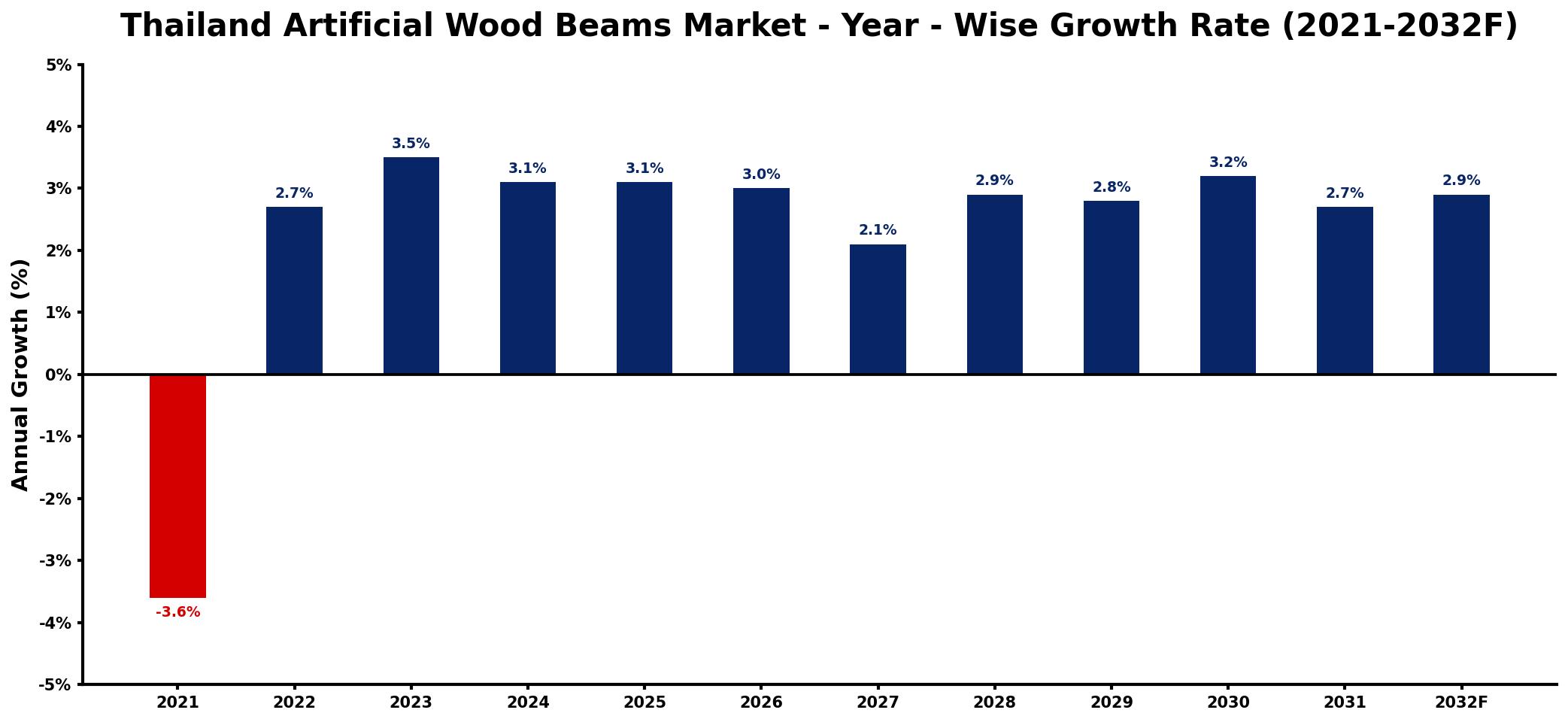
The table below presents the year‑wise growth rates along with the key drivers influencing the market
| Year | Growth Rate | Major Drivers |
| 2021 | -3.6% | Construction activity slowed significantly |
| 2022 | 2.7% | Increased demand for sustainable materials |
| 2023 | 3.5% | Rising investments in infrastructure projects |
| 2024 | 3.1% | Growing popularity of green building |
| 2025 | 3.1% | Expansion of home renovation sector |
| 2026 | 3.0% | Surge in commercial construction projects |
| 2027 | 2.1% | Emergence of new construction technologies |
| 2028 | 2.9% | Increased focus on eco-friendly designs |
| 2029 | 2.8% | Growth in residential housing market |
| 2030 | 3.2% | Rising awareness of energy efficiency |
| 2031 | 2.7% | rising infrastructure development spending |
| 2032 | 2.9% | Increasing preference for lightweight materials |
Note: Market size estimations and growth projections presented in this report are based on 6Wresearch's proprietary forecasting methodology, utilizing the latest available industry data, government publications, and primary research inputs.
Thailand Artificial Wood Beams Market Synopsis
Recent momentum in the Thailand artificial wood beams market highlights a notable shift towards composite materials as alternatives to traditional wood, driven by both architectural preferences and practical considerations. As the market anticipates continued urbanization and infrastructure projects, the future looks promising for artificial wood beams, with increasing applications in both new constructions and renovations.
Despite the recent pandemic-related challenges, the market is now witnessing a revival, fueled by governmental stimulus measures aimed at bolstering the construction industry. The versatility of artificial wood beams, coupled with their resilience against environmental factors, positions them as an attractive choice for architects and designers alike, thereby enhancing their acceptance in various building projects.
Thailand Artificial Wood Beams Market Key Takeaways
- The market is experiencing growth due to heightened demand for durable and aesthetically pleasing construction materials.
- Innovations in sustainable design are shaping consumer preferences towards artificial wood beams.
- Urbanization and infrastructure development are driving applications in both residential and commercial projects.
- Regulatory compliance and cost management remain crucial for stakeholders in the market.
- The recovery from COVID-19 is leading to a reinvigoration of construction activities, positively impacting the market.
Evaluation of Restraints in Thailand Artificial Wood Beams Market
The Thailand artificial wood beams market faces several restraints that can impede its growth trajectory. Sustainability concerns are paramount, as both consumers and builders increasingly emphasize eco-friendly materials. The challenge is for artificial wood beams to demonstrate long-term durability and environmental resistance to compete with traditional wooden options. Additionally, market players must navigate fluctuations in material costs and transportation expenses, which can adversely affect profit margins. Regulatory frameworks and the need for certifications may also pose barriers, influencing adoption rates and overall market dynamics.
Thailand Artificial Wood Beams Market Trends
Current trends indicate a rising inclination towards the use of eco-friendly and innovative construction materials, with artificial wood beams leading the charge. The market is seeing increased integration of technology, with manufacturers developing advanced composite materials that enhance both performance and design flexibility. Furthermore, architects are increasingly exploring the aesthetic possibilities offered by artificial wood beams, driving demand in high-end residential and commercial spaces. Sustainability continues to be a significant trend, influencing both consumer preferences and industry practices.
Thailand Artificial Wood Beams Market Opportunities
As the Thailand artificial wood beams market evolves, several genuine growth opportunities are emerging. The ongoing urban development projects present a robust platform for increased market penetration, particularly in metropolitan areas. Additionally, there is an expanding interest in retrofitting and renovation projects, where artificial wood beams can be leveraged to modernize older structures. Companies that can innovate with sustainable materials and designs will likely capture significant market share. The push for eco-friendly building practices further enhances opportunities for partnerships and collaborations within the construction ecosystem.
Government Initiatives in the Thailand Artificial Wood Beams Market
The Thai government has actively encouraged the construction sector through various initiatives aimed at promoting sustainable building practices. Policies focusing on eco-friendly materials and construction techniques are paving the way for increased adoption of artificial wood beams. Public spending on infrastructure development and urban renewal projects is also on the rise, creating a favorable environment for companies in this market. Additionally, incentives for green building certifications can further drive the demand for innovative construction materials, including artificial wood beams.
Future Insights of the Thailand Artificial Wood Beams Market
Looking ahead to the period from 2026 to 2032, the Thailand artificial wood beams market is poised for significant growth. The anticipated surge in construction activities, coupled with a societal shift toward sustainable materials, will be instrumental in shaping future market dynamics. The integration of advanced manufacturing processes and the continuous improvement of product offerings will bolster the appeal of artificial wood beams among builders and architects alike. As consumer preferences evolve, those who adapt swiftly to market demands will likely thrive in this competitive landscape.
Thailand Artificial Wood Beams Market Latest Developments (2025 - 2026)
In recent months, the Thailand artificial wood beams market has observed several notable developments. Manufacturers are increasingly focusing on sustainability, introducing new product lines that emphasize eco-friendliness and innovative design. Partnerships within the construction industry have also been on the rise, with stakeholders collaborating to promote the benefits of artificial wood beams in various projects. Additionally, ongoing government initiatives aimed at boosting the construction sector are fostering an environment of growth and opportunity, contributing to the overall market momentum.
Thailand Artificial Wood Beams Market - Key Attractiveness of the Report
- 10 Years of Market Numbers
- Historical Data Starting from 2022 to 2025
- Base Year: 2025
- Forecast Data until 2032
- Key Performance Indicators Impacting the Market
- Major Upcoming Developments and Projects
Key Highlights of the Report:
- Thailand Artificial Wood Beams Market Outlook
- Market Size of Thailand Artificial Wood Beams Market, 2025
- Forecast of Thailand Artificial Wood Beams Market, 2032
- Historical Data and Forecast of Thailand Artificial Wood Beams Revenues & Volume for the Period 2022-2032F
- Thailand Artificial Wood Beams Market Trend Evolution
- Thailand Artificial Wood Beams Market Drivers and Challenges
- Thailand Artificial Wood Beams Price Trends
- Thailand Artificial Wood Beams Porter's Five Forces
- Thailand Artificial Wood Beams Industry Life Cycle
- Historical Data and Forecast of Thailand Artificial Wood Beams Market Revenues & Volume By Product Type for the Period 2022-2032F
- Historical Data and Forecast of Thailand Artificial Wood Beams Market Revenues & Volume By U-shaped Beams for the Period 2022-2032F
- Historical Data and Forecast of Thailand Artificial Wood Beams Market Revenues & Volume By Box Beams for the Period 2022-2032F
- Historical Data and Forecast of Thailand Artificial Wood Beams Market Revenues & Volume By Arched Beams for the Period 2022-2032F
- Historical Data and Forecast of Thailand Artificial Wood Beams Market Revenues & Volume By Decorative Beams for the Period 2022-2032F
- Historical Data and Forecast of Thailand Artificial Wood Beams Market Revenues & Volume By Others for the Period 2022-2032F
- Historical Data and Forecast of Thailand Artificial Wood Beams Market Revenues & Volume By Material Type for the Period 2022-2032F
- Historical Data and Forecast of Thailand Artificial Wood Beams Market Revenues & Volume By Thermoplastic for the Period 2022-2032F
- Historical Data and Forecast of Thailand Artificial Wood Beams Market Revenues & Volume By Thermosetting for the Period 2022-2032F
- Historical Data and Forecast of Thailand Artificial Wood Beams Market Revenues & Volume By Others for the Period 2022-2032F
- Historical Data and Forecast of Thailand Artificial Wood Beams Market Revenues & Volume By End Users for the Period 2022-2032F
- Historical Data and Forecast of Thailand Artificial Wood Beams Market Revenues & Volume By Residential for the Period 2022-2032F
- Historical Data and Forecast of Thailand Artificial Wood Beams Market Revenues & Volume By Commercial for the Period 2022-2032F
- Thailand Artificial Wood Beams Import Export Trade Statistics
- Market Opportunity Assessment By Product Type
- Market Opportunity Assessment By Material Type
- Market Opportunity Assessment By End Users
- Thailand Artificial Wood Beams Top Companies Market Share
- Thailand Artificial Wood Beams Competitive Benchmarking By Technical and Operational Parameters
- Thailand Artificial Wood Beams Company Profiles
- Thailand Artificial Wood Beams Key Strategic Recommendations






































