Thailand Automotive Seat Belts Market Size, Share & Growth Rate
The Thailand Automotive Seat Belts Market was estimated at USD 143 Million in 2025 and is projected to reach USD 165 Million by 2032, growing at a CAGR of 2.1% from 2026 to 2032. This growth trajectory reflects a burgeoning commitment to passenger safety, stemming from both consumer demand and stringent regulatory frameworks. As road safety becomes a focal point for the Thai government and automotive manufacturers alike, advancements in seat belt technology and design will likely enhance market dynamics.
Thailand Automotive Seat Belts Market Growth Rate Analysis (2021-2032)
The Thai automotive seat belts market is experiencing a significant rebound following a challenging downturn, with a notable growth of 2.5% in 2022 and a further acceleration to 3.3% in 2023. This resurgence can be attributed to increased domestic vehicle production and heightened consumer awareness regarding safety features. The market is expected to stabilize with a steady growth rate of around 3% annual through 2026, driven by ongoing technological advancements and stricter regulatory standards for vehicle safety. However, slight fluctuations, including a dip to 2.7% in 2027, may arise from varying consumer demand and industrial shifts. By 2032, growth is projected to reach 3.4%, reflecting a strong commitment to safety and the ongoing energy transition in Thailand's automotive sector.
Thailand Automotive Seat Belts Market Year-wise Growth Rate and Key Drivers
This graph highlights how the Thailand Automotive Seat Belts Market has steadily grown over the past five years, supported by major growth factors.
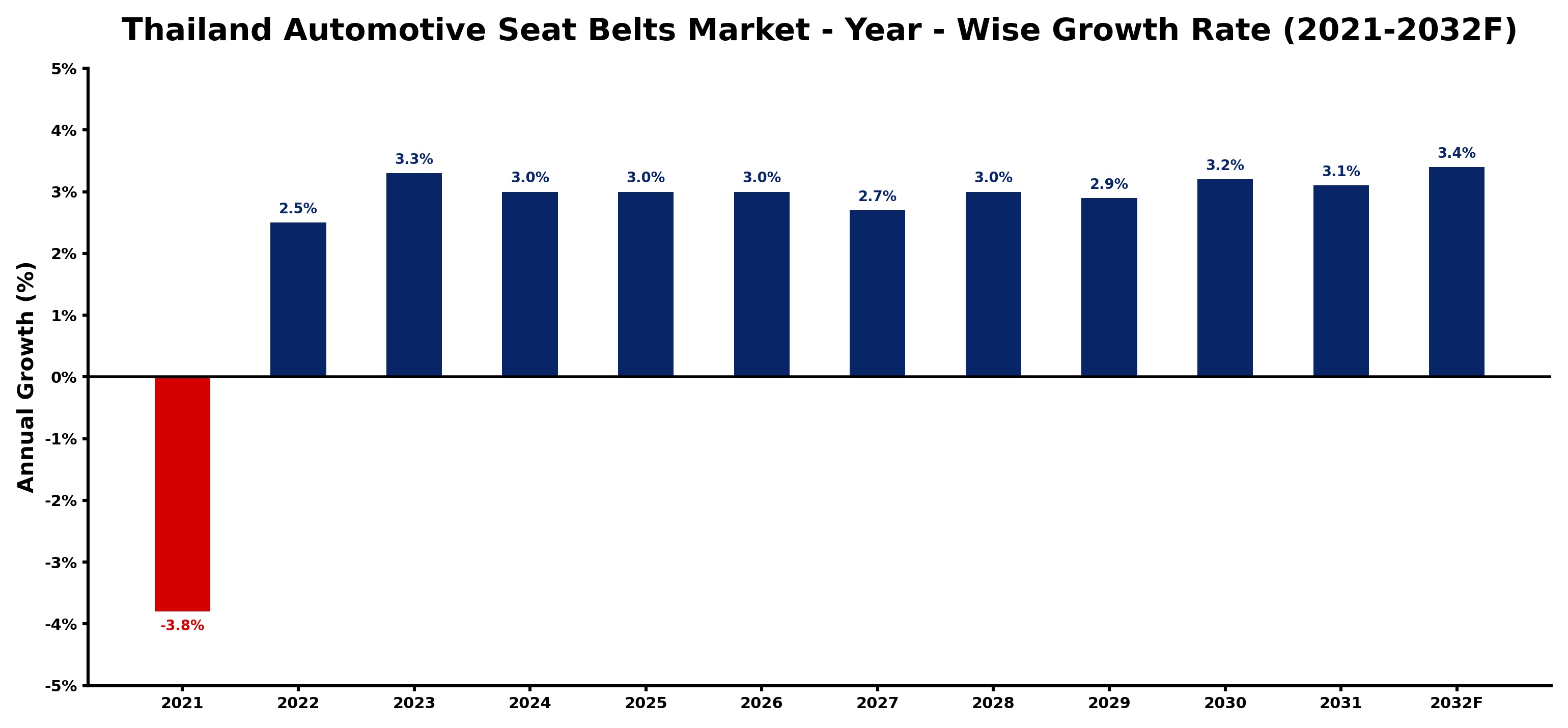
The table below presents the year‑wise growth rates along with the key drivers influencing the market
| Year | Growth Rate | Major Drivers |
| 2021 | -3.8% | Economic downturn affected production |
| 2022 | 2.5% | Automotive production recovery stimulated demand |
| 2023 | 3.3% | Safety regulations enhanced market growth |
| 2024 | 3.0% | Technological advancements improved safety features |
| 2025 | 3.0% | Increased consumer awareness of safety |
| 2026 | 3.0% | Rising vehicle sales boosted demand |
| 2027 | 2.7% | Government initiatives promoted safety standards |
| 2028 | 3.0% | Export opportunities expanded market reach |
| 2029 | 2.9% | Sustainability trends influenced purchasing decisions |
| 2030 | 3.2% | Innovative designs attracted new customers |
| 2031 | 3.1% | Partnerships with automakers strengthened market |
| 2032 | 3.4% | E-commerce platforms enhanced distribution channels |
Note - Market size estimations and growth projections presented in this report are based on 6Wresearch’s advanced forecasting approach, validated with industry datasets as of June 2026.
Thailand Automotive Seat Belts Market Synopsis
The automotive seat belts market in Thailand has seen significant momentum in recent years, driven by increasing awareness of road safety among consumers. Looking ahead, the market is poised for a steady transition, with innovative safety technologies on the rise, including features such as pretensioners and integrated airbags. This evolving landscape points to a growing emphasis on both safety and comfort in vehicle design.
While the past few years have highlighted a robust market potential, emerging regulations are expected to shape future demands. Manufacturers are likely to pivot towards high-performance seat belt systems that align with both consumer expectations and governmental safety mandates. As competition intensifies, the market will require continuous adaptation and innovation to meet the challenges ahead.
Thailand Automotive Seat Belts Market Key Takeaways
- Rising consumer safety awareness is significantly driving market growth.
- Technological advancements in seat belt design are fostering innovation.
- Government regulations are becoming increasingly stringent, promoting market compliance.
- Partnerships between manufacturers and automotive companies are on the rise, enhancing product offerings.
- COVID-19 has led to shifting consumer preferences towards personal vehicles, impacting demand trends.
Evaluation of Restraints in Thailand Automotive Seat Belts Market
Several factors act as restraints in the Thailand automotive seat belts market. Foremost among these is the need for manufacturers to stay abreast of rapidly evolving safety regulations, which can pose compliance challenges. Additionally, enhancing user comfort without compromising the effectiveness of restraints is a continuous balancing act. Compounding these issues is the presence of counterfeit and substandard products, which threaten to undermine consumer trust in safety systems. These challenges highlight the necessity for strategic innovation and quality assurance in maintaining market integrity.
Thailand Automotive Seat Belts Market Trends
The market is currently witnessing several transformative trends. The integration of smart technologies, such as seat belt reminders and enhanced tensioners, is becoming increasingly common, positioning manufacturers at the forefront of consumer safety enhancements. In addition, a growing emphasis on sustainability is prompting the exploration of lighter, stronger materials in seat belt production. This trend not only supports safety standards but also aligns with the automotive industry's broader shift towards eco-friendliness and energy efficiency.
Thailand Automotive Seat Belts Market Opportunities
Opportunities for growth in the Thailand automotive seat belts market are abundant, particularly as passenger safety continues to take precedence. As regulations evolve, there is potential for manufacturers to create more sophisticated seat belt systems, which provide improved comfort and restraint performance. Strategic collaborations with automotive manufacturers can also pave the way for co-developing innovative solutions tailored to specific vehicle segments, enhancing overall market presence and consumer reach.
Government Initiatives in the Thailand Automotive Seat Belts Market
The Thai government has enacted various policies to bolster road safety, which include mandates on the installation of seat belts across all vehicle types. Public spending is increasingly directed towards safety campaigns and initiatives aimed at raising awareness about the importance of using seat belts. These government efforts play a crucial role in shaping the market landscape, fostering a culture that prioritizes passenger safety and compliance with safety regulations.
Future Insights of the Thailand Automotive Seat Belts Market
Looking towards the future, the Thailand automotive seat belts market is expected to evolve significantly between 2026 and 2032. As consumer expectations continue to shift, manufacturers must prioritize innovation while complying with ever-tightening regulations. The ongoing introduction of advanced safety features and a focus on sustainable materials will likely emerge as key differentiators. Moreover, as road safety remains a critical concern, the market stands to benefit from heightened awareness and proactive measures from both consumers and policymakers.
Thailand Automotive Seat Belts Market Latest Developments (May 2025 - June 2026)
Recent developments in the Thailand automotive seat belts market showcase an increasing focus on integrating advanced safety technologies. Manufacturers are exploring collaborations with tech firms to enhance the functionality and efficacy of seat belts. Moreover, there has been a noticeable trend toward adopting eco-friendly materials in seat belt production, reflecting broader industry movements toward sustainability. These initiatives signal a proactive approach in responding to regulatory changes and consumer demands for greater safety in vehicles.
Thailand Automotive Seat Belts Market - Key Attractiveness of the Report
- 10 Years of Market Numbers
- Historical Data Starting from 2022 to 2025
- Base Year: 2025
- Forecast Data until 2032
- Key Performance Indicators Impacting the Market
- Major Upcoming Developments and Projects
Key Highlights of the Report:
- Thailand Automotive Seat Belts Market Outlook
- Market Size of Thailand Automotive Seat Belts Market, 2025
- Forecast of Thailand Automotive Seat Belts Market, 2032F
- Historical Data and Forecast of Thailand Automotive Seat Belts Revenues & Volume for the Period 2022-2032F
- Thailand Automotive Seat Belts Market Trend Evolution
- Thailand Automotive Seat Belts Market Drivers and Challenges
- Thailand Automotive Seat Belts Price Trends
- Thailand Automotive Seat Belts Porter's Five Forces
- Thailand Automotive Seat Belts Industry Life Cycle
- Historical Data and Forecast of Thailand Automotive Seat Belts Market Revenues & Volume By Type for the Period 2022-2032F
- Historical Data and Forecast of Thailand Automotive Seat Belts Market Revenues & Volume By 2-point Seatbelt for the Period 2022-2032F
- Historical Data and Forecast of Thailand Automotive Seat Belts Market Revenues & Volume By 3-point Seatbelt for the Period 2022-2032F
- Historical Data and Forecast of Thailand Automotive Seat Belts Market Revenues & Volume By Vehicle for the Period 2022-2032F
- Historical Data and Forecast of Thailand Automotive Seat Belts Market Revenues & Volume By Passenger Cars for the Period 2022-2032F
- Historical Data and Forecast of Thailand Automotive Seat Belts Market Revenues & Volume By Light Commercial Vehicles for the Period 2022-2032F
- Historical Data and Forecast of Thailand Automotive Seat Belts Market Revenues & Volume By Heavy Commercial Vehicles for the Period 2022-2032F
- Historical Data and Forecast of Thailand Automotive Seat Belts Market Revenues & Volume By Component for the Period 2022-2032F
- Historical Data and Forecast of Thailand Automotive Seat Belts Market Revenues & Volume By Webbing strap for the Period 2022-2032F
- Historical Data and Forecast of Thailand Automotive Seat Belts Market Revenues & Volume By Retractor for the Period 2022-2032F
- Historical Data and Forecast of Thailand Automotive Seat Belts Market Revenues & Volume By Buckle for the Period 2022-2032F
- Historical Data and Forecast of Thailand Automotive Seat Belts Market Revenues & Volume By Tongue for the Period 2022-2032F
- Historical Data and Forecast of Thailand Automotive Seat Belts Market Revenues & Volume By Pillar Loop for the Period 2022-2032F
- Historical Data and Forecast of Thailand Automotive Seat Belts Market Revenues & Volume By Distribution Channels for the Period 2022-2032F
- Historical Data and Forecast of Thailand Automotive Seat Belts Market Revenues & Volume By OEM for the Period 2022-2032F
- Historical Data and Forecast of Thailand Automotive Seat Belts Market Revenues & Volume By Aftermarket for the Period 2022-2032F
- Thailand Automotive Seat Belts Import Export Trade Statistics
- Market Opportunity Assessment By Type
- Market Opportunity Assessment By Vehicle
- Market Opportunity Assessment By Component
- Market Opportunity Assessment By Distribution Channels
- Thailand Automotive Seat Belts Top Companies Market Share
- Thailand Automotive Seat Belts Competitive Benchmarking By Technical and Operational Parameters
- Thailand Automotive Seat Belts Company Profiles
- Thailand Automotive Seat Belts Key Strategic Recommendations






































