Thailand Automotive Stamping Market Size, Share & Growth Rate
The Thailand Automotive Stamping Market was estimated at USD 124 Million in 2025 and is projected to reach USD 142 Million by 2032, growing at a CAGR of 2.0% from 2026 to 2032. This growth trajectory reflects the robust expansion of Thailand's automotive sector, which is increasingly focused on producing lightweight and electric vehicle components. Furthermore, the combination of government incentives and an influx of foreign investment significantly enhances the market's potential as it adapts to evolving consumer preferences and technological advancements.
Thailand Automotive Stamping Market Year-wise Growth Rate and Key Drivers
This graph highlights how the Thailand Automotive Stamping Market has steadily grown over the years, supported by major growth factors.
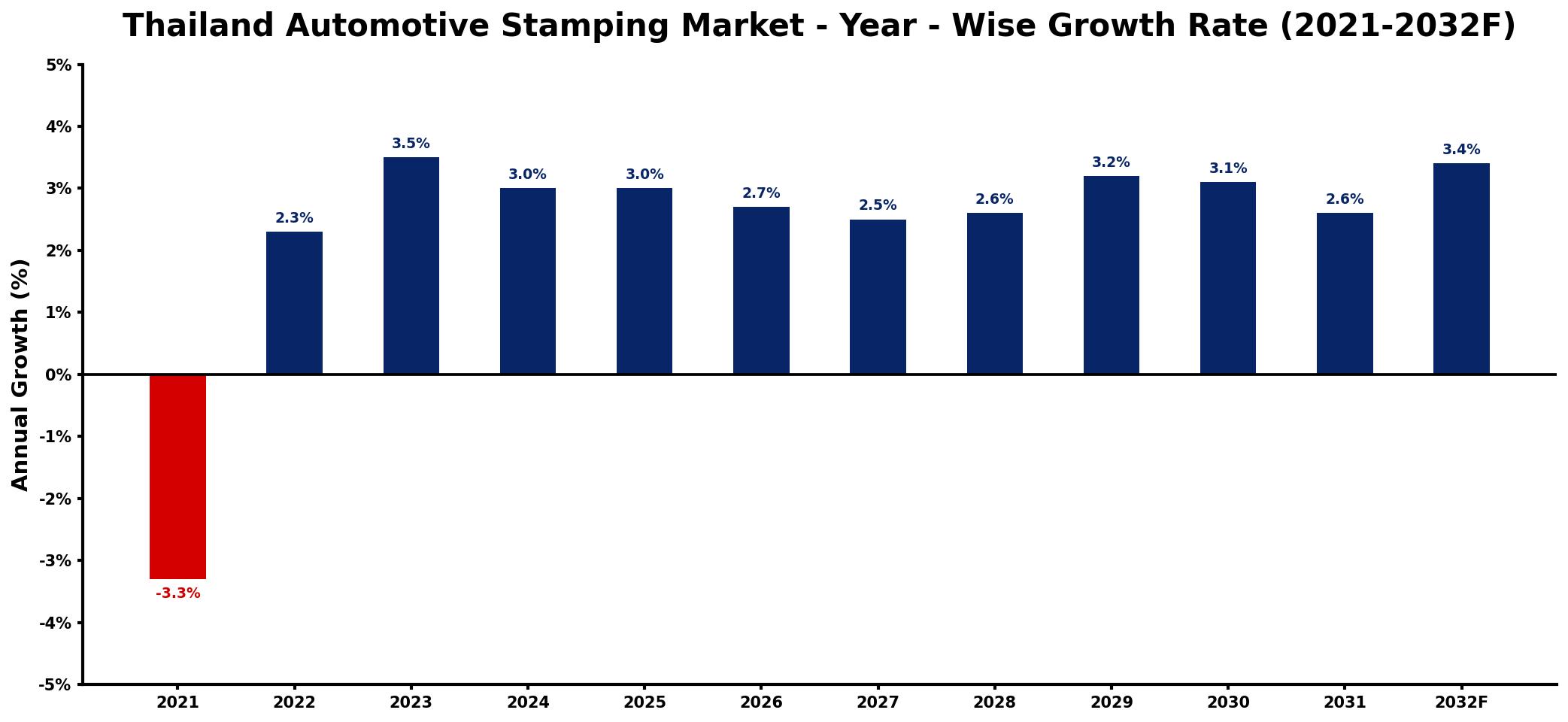
The table below presents the year‑wise growth rates along with the key drivers influencing the market
| Year | Growth Rate | Major Drivers |
| 2021 | -3.3% | decreased manufacturing capacity utilization |
| 2022 | 2.3% | rising consumer vehicle demand |
| 2023 | 3.5% | increased foreign direct investments |
| 2024 | 3.0% | growing electric vehicle adoption |
| 2025 | 3.0% | expansion of local suppliers network |
| 2026 | 2.7% | enhanced production efficiency technologies |
| 2027 | 2.5% | increased exports to neighboring markets |
| 2028 | 2.6% | growing demand for lightweight materials |
| 2029 | 3.2% | rising focus on sustainable practices |
| 2030 | 3.1% | increased automation in manufacturing |
| 2031 | 2.6% | growing market for customized solutions |
| 2032 | 3.4% | rising export shipment volumes |
Note: Market size estimations and growth projections presented in this report are based on 6Wresearch's proprietary forecasting methodology, utilizing the latest available industry data, government publications, and primary research inputs.
Thailand Automotive Stamping Market Synopsis
In recent years, Thailand has solidified its position as a prominent automotive manufacturing hub in Southeast Asia, leading to a rising demand for stamping components essential in vehicle production. This demand is not only fueled by local consumption but also by strong export markets, highlighting Thailand's strategic advantage in the global automotive supply chain.
The country's automotive stamping industry plays a pivotal role in creating vital components, from body panels to structural parts. As automakers pivot toward producing electric and hybrid vehicles, the stamping market is witnessing a transformation, aligning production methods with the evolving needs of the automotive sector.
Thailand Automotive Stamping Market Key Takeaways
- Thailand's automotive stamping market is integral to the growing vehicle production ecosystem.
- Investment in advanced stamping technologies is essential for adapting to electric vehicle demands.
- Domestic and export markets drive substantial growth in component manufacturing.
- Government incentives bolster investments in the automotive sector, enhancing market prospects.
- Fluctuations in raw material prices present ongoing challenges to profitability.
Evaluation of Restraints in Thailand Automotive Stamping Market
While the Thailand automotive stamping market demonstrates solid growth potential, several restraints impede its full advancement. Supply chain disruptions, particularly highlighted during the COVID-19 pandemic, have showcased vulnerabilities in production schedules and cost structures. Furthermore, the volatility of raw material prices, particularly for essential inputs like steel and aluminum, challenges manufacturers' ability to maintain profitability. As automotive design trends evolve toward lightweight and electric components, companies must invest in new technologies, which adds to the financial burden and complexity of production.
Thailand Automotive Stamping Market Trends
The automotive stamping market in Thailand is witnessing significant trends that reflect the sector's evolution. One prominent trend is the shift towards lightweight materials aimed at improving fuel efficiency and accommodating electric vehicle designs. Stamping technologies are increasingly becoming more automated, promoting efficiency and precision in manufacturing processes. Additionally, there is a rising focus on sustainability, pushing companies to adopt eco-friendly materials and processes. These trends are not only reshaping production methods but also influencing supplier relationships and logistics within the industry.
Thailand Automotive Stamping Market Opportunities
The Thailand automotive stamping market presents several growth opportunities, particularly in the realm of electric vehicles and hybrid models. As the automotive industry transitions towards sustainable mobility, there is a growing need for lightweight and high-strength materials. This creates a niche for companies willing to invest in R&D to innovate their stamping processes. Additionally, emerging markets within Southeast Asia provide avenues for expansion, allowing companies to leverage Thailand's existing infrastructure and skilled workforce to meet increasing regional demand.
Government Initiatives in the Thailand Automotive Stamping Market
The Thai government has implemented several initiatives to boost the automotive industry, including the automotive stamping sector. Policies promoting electric vehicle manufacturing and investments in infrastructure are pivotal. Incentives such as tax breaks for foreign investors and grants for R&D in sustainable automotive technologies are also in place, aimed at enhancing the countrys competitiveness in the global market. These initiatives not only foster local production capabilities but also encourage innovation in automotive component manufacturing.
Future Insights of the Thailand Automotive Stamping Market
Looking ahead to the period from 2026 to 2032, the Thailand automotive stamping market is poised for continued growth. The integration of advanced technologies, such as artificial intelligence and automation, is expected to streamline operations and improve manufacturing efficiency. Moreover, as electric and hybrid vehicles become more prevalent, stamping companies will need to adapt their production lines to meet new standards and requirements. The collaboration between government entities and private investors will be crucial in facilitating this transition, ultimately positioning Thailand as a leader in automotive innovation.
Thailand Automotive Stamping Market Latest Developments (2025 - 2026)
Recent developments in the Thailand automotive stamping market reflect a dynamic response to changing industry demands. Innovations in lightweight stamping technologies and collaborations between manufacturers and tech firms are on the rise. Furthermore, the government is expected to announce new policies aimed at enhancing the electric vehicle ecosystem, which will likely impact stamping processes. As consumer preferences shift toward sustainability, market players are investing in greener materials and methods, aligning with global trends and regulations.
Thailand Automotive Stamping Market - Key Attractiveness of the Report
- 10 Years of Market Numbers
- Historical Data Starting from 2022 to 2025
- Base Year: 2025
- Forecast Data until 2032
- Key Performance Indicators Impacting the Market
- Major Upcoming Developments and Projects
Key Highlights of the Report:
- Thailand Automotive Stamping Market Outlook
- Market Size of Thailand Automotive Stamping Market, 2025
- Forecast of Thailand Automotive Stamping Market, 2032
- Historical Data and Forecast of Thailand Automotive Stamping Revenues & Volume for the Period 2022-2032F
- Thailand Automotive Stamping Market Trend Evolution
- Thailand Automotive Stamping Market Drivers and Challenges
- Thailand Automotive Stamping Price Trends
- Thailand Automotive Stamping Porter's Five Forces
- Thailand Automotive Stamping Industry Life Cycle
- Historical Data and Forecast of Thailand Automotive Stamping Market Revenues & Volume By Vehicle for the Period 2022-2032F
- Historical Data and Forecast of Thailand Automotive Stamping Market Revenues & Volume By Two-Wheeler for the Period 2022-2032F
- Historical Data and Forecast of Thailand Automotive Stamping Market Revenues & Volume By Three-Wheeler for the Period 2022-2032F
- Historical Data and Forecast of Thailand Automotive Stamping Market Revenues & Volume By Passenger Car for the Period 2022-2032F
- Historical Data and Forecast of Thailand Automotive Stamping Market Revenues & Volume By Commercial Vehicle for the Period 2022-2032F
- Historical Data and Forecast of Thailand Automotive Stamping Market Revenues & Volume By Material for the Period 2022-2032F
- Historical Data and Forecast of Thailand Automotive Stamping Market Revenues & Volume By Steel for the Period 2022-2032F
- Historical Data and Forecast of Thailand Automotive Stamping Market Revenues & Volume By Aluminium for the Period 2022-2032F
- Historical Data and Forecast of Thailand Automotive Stamping Market Revenues & Volume By Others for the Period 2022-2032F
- Historical Data and Forecast of Thailand Automotive Stamping Market Revenues & Volume By Process for the Period 2022-2032F
- Historical Data and Forecast of Thailand Automotive Stamping Market Revenues & Volume By Progressive Die Stamping for the Period 2022-2032F
- Historical Data and Forecast of Thailand Automotive Stamping Market Revenues & Volume By Tandem Stamping for the Period 2022-2032F
- Historical Data and Forecast of Thailand Automotive Stamping Market Revenues & Volume By Transfer Stamping for the Period 2022-2032F
- Historical Data and Forecast of Thailand Automotive Stamping Market Revenues & Volume By Product for the Period 2022-2032F
- Historical Data and Forecast of Thailand Automotive Stamping Market Revenues & Volume By Body Stamping for the Period 2022-2032F
- Historical Data and Forecast of Thailand Automotive Stamping Market Revenues & Volume By BIW Parts for the Period 2022-2032F
- Historical Data and Forecast of Thailand Automotive Stamping Market Revenues & Volume By Chassis for the Period 2022-2032F
- Historical Data and Forecast of Thailand Automotive Stamping Market Revenues & Volume By Non-Body Stamping for the Period 2022-2032F
- Historical Data and Forecast of Thailand Automotive Stamping Market Revenues & Volume By Engine Parts for the Period 2022-2032F
- Historical Data and Forecast of Thailand Automotive Stamping Market Revenues & Volume By Transmission and Steering Parts for the Period 2022-2032F
- Historical Data and Forecast of Thailand Automotive Stamping Market Revenues & Volume By Braking and Suspension Parts for the Period 2022-2032F
- Historical Data and Forecast of Thailand Automotive Stamping Market Revenues & Volume By Electrical Parts for the Period 2022-2032F
- Thailand Automotive Stamping Import Export Trade Statistics
- Market Opportunity Assessment By Vehicle
- Market Opportunity Assessment By Material
- Market Opportunity Assessment By Process
- Market Opportunity Assessment By Product
- Thailand Automotive Stamping Top Companies Market Share
- Thailand Automotive Stamping Competitive Benchmarking By Technical and Operational Parameters
- Thailand Automotive Stamping Company Profiles
- Thailand Automotive Stamping Key Strategic Recommendations






































