Thailand Belt Conveyors Market Summary
The thailand belt conveyors market was estimated at USD 116 Million in 2025 and is projected to reach USD 133 Million by 2032, growing at a CAGR of 2.7% from 2026 to 2032.
Thailand Belt Conveyors Market Year-wise Growth Rate and Key Drivers
This graph highlights how the Thailand Belt Conveyors Market has steadily grown over the past five years, supported by major growth factors.
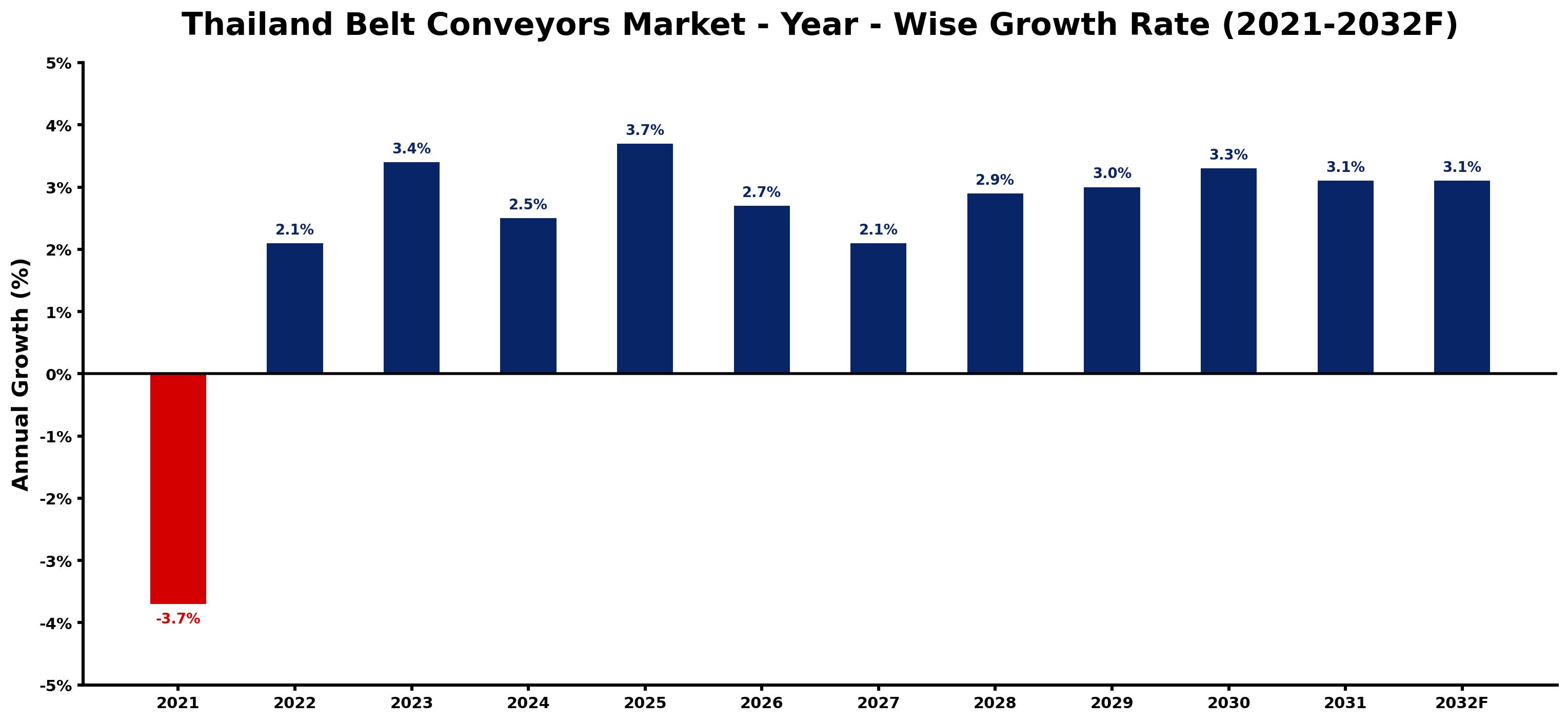
The table below presents the year wise growth rates along with the key drivers influencing the market
| Year | Growth Rate | Major Drivers |
| 2021 | -3.7% | Supply chain disruptions significantly hindered manufacturing capabilities, leading to decreased demand for belt conveyors. |
| 2022 | 2.1% | Investment in manufacturing capabilities highlighted the need for conveyor systems modernization. |
| 2023 | 3.4% | Increased export activities emphasized logistics efficiency, boosting conveyor system installations. |
| 2024 | 2.5% | Urbanization trends spurred construction activity, necessitating robust conveyor technology integration. |
| 2025 | 3.7% | Technological innovation in automation created new opportunities for conveyor systems in factories. |
| 2026 | 2.7% | Sustainability initiatives prompted companies to adopt energy-efficient conveyor solutions. |
| 2027 | 2.1% | Infrastructure developments across Thailand fueled demand for bulk material transport systems. |
| 2028 | 2.9% | E-commerce sector expansion required advanced logistics, increasing conveyor utilization in warehouses. |
| 2029 | 3.0% | Shifts towards localized manufacturing reduced reliance on imported conveyor solutions. |
| 2030 | 3.3% | Labor shortages in logistics heightened interest in automation, boosting conveyor investments. |
| 2031 | 3.1% | Digital transformation in supply chains increased demand for integrated conveyor systems. |
| 2032 | 3.1% | Growing awareness of workplace safety drove investments in modern conveyor safety technologies. |
Note - Market size estimations and growth projections presented in this report are based on 6Wresearch's advanced forecasting approach, validated with industry datasets as of June 2026.
Thailand Belt Conveyors Market Synopsis
The Thailand Belt Conveyors Market is projected to reach 2.7% and witness significant growth during the forecast period (2026-2032). This growth can be attributed to several factors including an uptick in industrial activities and an increasing demand for efficient materials handling solutions. The market is expected to benefit from advancements in technology, particularly in automation and artificial intelligence, which enhance the operational capabilities of belt conveyors, making them indispensable in modern manufacturing and distribution processes.
Thailand Belt Conveyors Market Growth Drivers
The Thailand Belt Conveyors Market is driven by various factors that support its expansion. Key drivers include:
- Increased demand for automation in the manufacturing sector is significantly propelling the adoption of belt conveyors, as these systems are capable of transforming production efficiency through improved speed and accuracy.
- The rise of e-commerce and logistics industries is creating a heightened requirement for advanced material handling solutions, positioning belt conveyors as critical infrastructure components within distribution centers.
- Technological advancements such as the integration of smart sensors and AI are enhancing the performance of belt conveyors, making them more adaptable to various industrial applications.
- Sustainable practices in manufacturing and other industries are leading to the increased use of energy-efficient conveyor systems, contributing to the overall growth of the market.
- Government initiatives focused on bolstering infrastructure and supporting manufacturing will provide additional impetus to the belt conveyors market, opening doors for new investments.
Thailand Belt Conveyors Market Challenges and Restraints
Despite the positive growth outlook, the Thailand Belt Conveyors Market faces several challenges that could hinder its growth trajectory:
- The high installation costs associated with automated belt conveying systems remain a significant barrier, particularly for small and medium-sized enterprises (SMEs) hesitant to transition from traditional methods.
- Limited awareness and technical expertise regarding advanced conveyor technologies can deter manufacturers from adopting modernized systems that could enhance productivity.
- Economic fluctuations can impact investment in infrastructure projects, leading to reduced demand for belt conveyor systems in various industrial sectors.
- Supply chain disruptions, exacerbated by events such as the COVID-19 pandemic, can negatively affect the availability of necessary components for belt conveyors, slowing down production timelines.
- Compliance with stringent safety and environmental regulations may impose additional operational costs on manufacturers, affecting their competitiveness.
Thailand Belt Conveyors Market Government Investment and Initiatives
The government of Thailand has been actively promoting policies to enhance the manufacturing sector, which includes investments in high-tech conveyor systems. Key initiatives include:
- Implementation of tax incentives aimed at encouraging local manufacturing and boosting investment in automation technologies.
- Support mechanisms for SMEs to access advanced manufacturing technologies, thereby facilitating their transition to automated material handling systems.
- Public-private partnerships are being explored to fund infrastructure development projects, thereby creating a conducive environment for the expansion of conveyor usage.
- Investment in research and development aimed at fostering innovation in manufacturing technology, which may include breakthroughs in conveyor systems.
- Active promotion of sustainability initiatives by the government, which encourages businesses to adopt energy-efficient machinery, including belt conveyors.
Thailand Belt Conveyors Market Latest Developments (May 2025 - June 2026)
In the period leading up to June 2026, the Thailand Belt Conveyors Market has experienced several key developments. The market saw a surge in investment from both domestic and international players, as companies recognized the importance of upgrading their material handling capabilities. This trend is reflected in various announcements for new conveyor projects and modernization efforts. Additionally, advancements in IoT technology have begun to reshape conveyor functionalities, allowing for more streamlined processes and real-time tracking of goods.
Furthermore, there has been a concerted effort among manufacturers to address the challenges posed by supply chain disruptions by diversifying their supply sources and enhancing local production capabilities. This strategic pivot is expected to reduce lead times and improve market responsiveness.
Thailand Belt Conveyors Market - Key Attractiveness of the Report
- 10 Years of Market Numbers
- Historical Data Starting from 2022 to 2025
- Base Year: 2025
- Forecast Data until 2032
- Key Performance Indicators Impacting the Market
- Major Upcoming Developments and Projects
Key Highlights of the Report:
- Thailand Belt Conveyors Market Outlook
- Market Size of Thailand Belt Conveyors Market, 2025
- Forecast of Thailand Belt Conveyors Market, 2032
- Historical Data and Forecast of Thailand Belt Conveyors Revenues & Volume for the Period 2022-2032F
- Thailand Belt Conveyors Market Trend Evolution
- Thailand Belt Conveyors Market Drivers and Challenges
- Thailand Belt Conveyors Price Trends
- Thailand Belt Conveyors Porter's Five Forces
- Thailand Belt Conveyors Industry Life Cycle
- Historical Data and Forecast of Thailand Belt Conveyors Market Revenues & Volume By Belt Type for the Period 2022-2032F
- Historical Data and Forecast of Thailand Belt Conveyors Market Revenues & Volume By Lightweight for the Period 2022-2032F
- Historical Data and Forecast of Thailand Belt Conveyors Market Revenues & Volume By Medium-weight for the Period 2022-2032F
- Historical Data and Forecast of Thailand Belt Conveyors Market Revenues & Volume By Heavy-weight for the Period 2022-2032F
- Historical Data and Forecast of Thailand Belt Conveyors Market Revenues & Volume By Type for the Period 2022-2032F
- Historical Data and Forecast of Thailand Belt Conveyors Market Revenues & Volume By Overhead for the Period 2022-2032F
- Historical Data and Forecast of Thailand Belt Conveyors Market Revenues & Volume By Floor for the Period 2022-2032F
- Historical Data and Forecast of Thailand Belt Conveyors Market Revenues & Volume By Roller for the Period 2022-2032F
- Historical Data and Forecast of Thailand Belt Conveyors Market Revenues & Volume By Pallet for the Period 2022-2032F
- Historical Data and Forecast of Thailand Belt Conveyors Market Revenues & Volume By Crescent for the Period 2022-2032F
- Historical Data and Forecast of Thailand Belt Conveyors Market Revenues & Volume By End-user Industry for the Period 2022-2032F
- Historical Data and Forecast of Thailand Belt Conveyors Market Revenues & Volume By Retail for the Period 2022-2032F
- Historical Data and Forecast of Thailand Belt Conveyors Market Revenues & Volume By Food & Beverage for the Period 2022-2032F
- Historical Data and Forecast of Thailand Belt Conveyors Market Revenues & Volume By Poultry & Dairy for the Period 2022-2032F
- Historical Data and Forecast of Thailand Belt Conveyors Market Revenues & Volume By Automotive for the Period 2022-2032F
- Historical Data and Forecast of Thailand Belt Conveyors Market Revenues & Volume By Industrial for the Period 2022-2032F
- Historical Data and Forecast of Thailand Belt Conveyors Market Revenues & Volume By Airport for the Period 2022-2032F
- Historical Data and Forecast of Thailand Belt Conveyors Market Revenues & Volume By Others for the Period 2022-2032F
- Thailand Belt Conveyors Import Export Trade Statistics
- Market Opportunity Assessment By Belt Type
- Market Opportunity Assessment By Type
- Market Opportunity Assessment By End-user Industry
- Thailand Belt Conveyors Top Companies Market Share
- Thailand Belt Conveyors Competitive Benchmarking By Technical and Operational Parameters
- Thailand Belt Conveyors Company Profiles
- Thailand Belt Conveyors Key Strategic Recommendations






































