Thailand Benzoic Acid Market: Import Trend Analysis
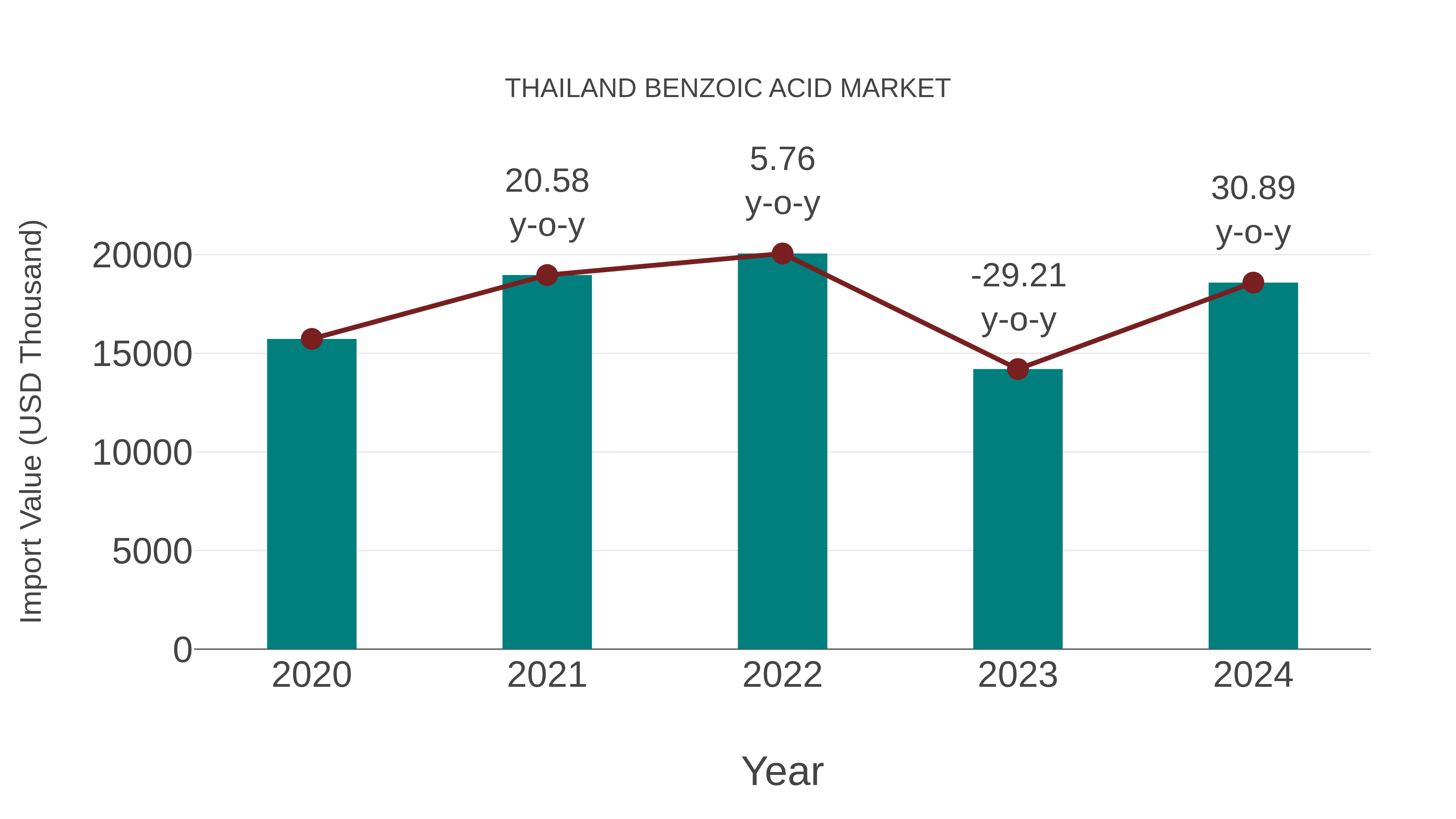
Thailand import trend for benzoic acid in 2024 showed a notable growth rate of 30.89% compared to the previous year, with a compound annual growth rate (CAGR) of 4.26% from 2020 to 2024. The surge in imports can be attributed to the increasing demand for benzoic acid in various industries, indicating a positive import momentum driven by evolving market dynamics.
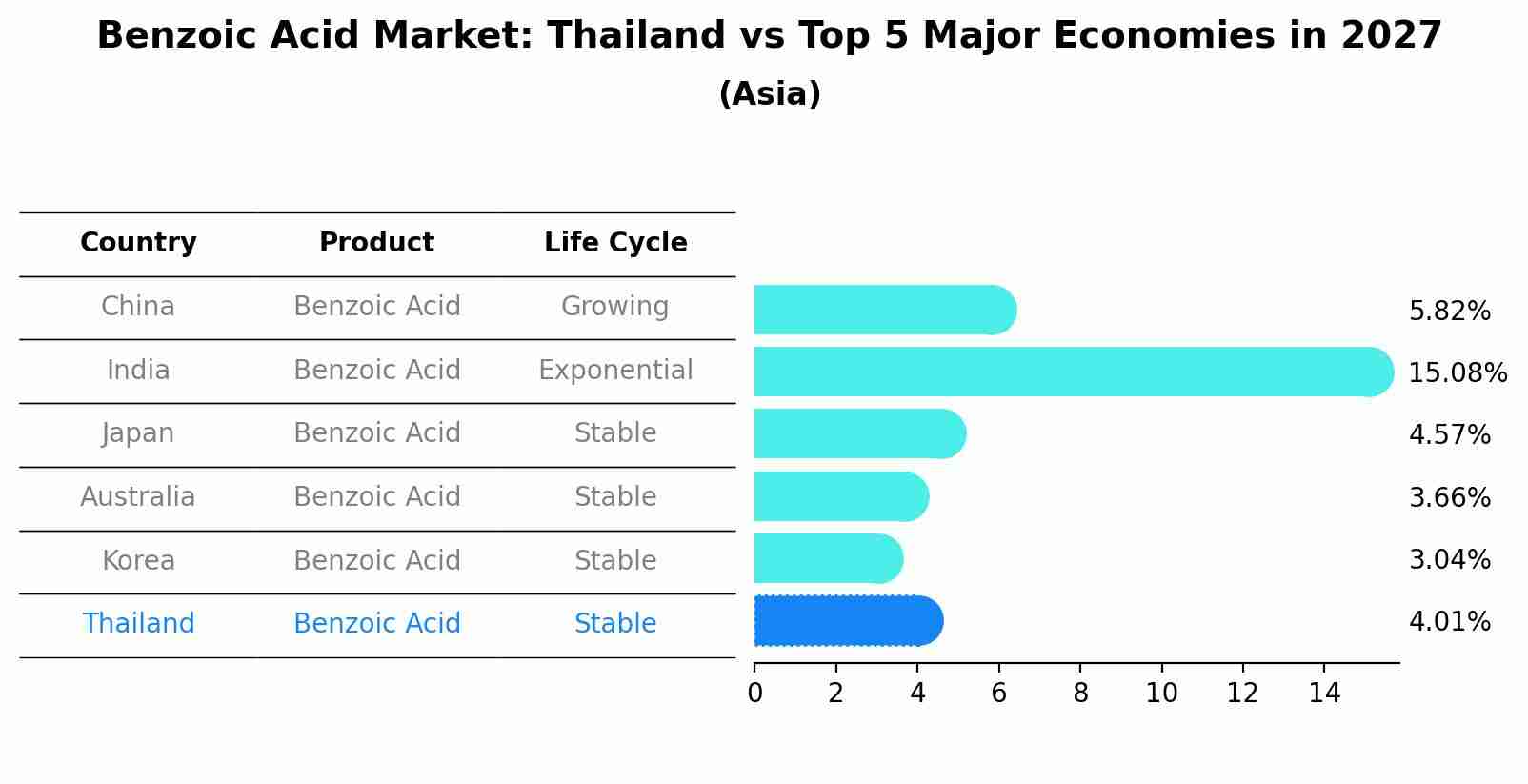
Benzoic Acid Market: Thailand vs Top 5 Major Economies in 2027 (Asia)
By 2027, the Benzoic Acid market in Thailand is anticipated to reach a growth rate of 4.01%, as part of an increasingly competitive Asia region, where China remains at the forefront, supported by India, Japan, Australia and South Korea, driving innovations and market adoption across sectors.
Thailand Benzoic Acid Market Synopsis
The benzoic acid market in Thailand was valued at USD 145 million in 2025 and is anticipated to witness a healthy growth rate during forecast period due mainly due increased demand from food preservation sector followed by use within rubber processing aids industry where it acts as curative agent responsible for curing process through cross linking polymers thereby strengthening them resulting into improved product properties.Further upsurge within plasticizers production shall be one major factor driving overall Thai benzoic acid sales throughout analysis timeframe supported by growing construction activities along with automotive sectors especially electric vehicles which require more plastic parts than regular cars.
Drivers of the Market
The Thailand benzoic acid market is driven by its widespread applications across various industries. Benzoic acid serves as a crucial preservative in the food and beverage industry, enhancing the shelf life of products. Additionally, its use in pharmaceuticals and cosmetics for its antifungal and antibacterial properties contributes to market growth. The increasing demand for convenience foods and packaged goods further fuels the utilization of benzoic acid as a preservative, thus propelling the market`s expansion.
Challenges of the Market
In the Thailand benzoic acid market, challenges arise from the increasing scrutiny on food safety and regulations. Regulatory agencies are placing stricter limits on the use of preservatives like benzoic acid in food and beverages due to potential health concerns. This has led manufacturers to reformulate products and explore alternative preservation methods. Additionally, sourcing high-quality raw materials and maintaining consistent product quality pose challenges for market players. Balancing consumer demand for safe and natural ingredients while adhering to regulatory standards remains a persistent challenge in this market.
COVID-19 Impact on the Market
The Covid-19 pandemic significantly impacted the Thailand benzoic acid market. The restrictions on movement, temporary shutdowns of industries, and disrupted supply chains led to a decrease in demand for products that utilize benzoic acid as an additive, preservative, or intermediate chemical. Sectors such as food and beverage, pharmaceuticals, and personal care experienced fluctuations in production and consumption patterns. As the economy gradually recovers, the market is expected to rebound, driven by the resumption of manufacturing activities and the growing demand for packaged and preserved goods.
Key Players in the Market
In the Thailand benzoic acid market, prominent players include BenzoChem Industries, ThaiBenzo Ltd., and AromaticSynth Corporation. These companies specialize in the production and supply of benzoic acid, a versatile compound used in food preservation, pharmaceuticals, and various industrial applications. Their commitment to product quality and regulatory compliance positions them as key contributors to the market.
Key Highlights of the Report:
- Thailand Benzoic Acid Market Outlook
- Market Size of Thailand Benzoic Acid Market, 2025
- Forecast of Thailand Benzoic Acid Market, 2032
- Historical Data and Forecast of Thailand Benzoic Acid Revenues & Volume for the Period 2022-2032F
- Thailand Benzoic Acid Market Trend Evolution
- Thailand Benzoic Acid Market Drivers and Challenges
- Thailand Benzoic Acid Price Trends
- Thailand Benzoic Acid Porter's Five Forces
- Thailand Benzoic Acid Industry Life Cycle
- Historical Data and Forecast of Thailand Benzoic Acid Market Revenues & Volume By End-use Industry for the Period 2022-2032F
- Historical Data and Forecast of Thailand Benzoic Acid Market Revenues & Volume By Food & Beverages for the Period 2022-2032F
- Historical Data and Forecast of Thailand Benzoic Acid Market Revenues & Volume By Chemical for the Period 2022-2032F
- Historical Data and Forecast of Thailand Benzoic Acid Market Revenues & Volume By Pharmaceutical for the Period 2022-2032F
- Historical Data and Forecast of Thailand Benzoic Acid Market Revenues & Volume By Application for the Period 2022-2032F
- Historical Data and Forecast of Thailand Benzoic Acid Market Revenues & Volume By Benzoates for the Period 2022-2032F
- Historical Data and Forecast of Thailand Benzoic Acid Market Revenues & Volume By Benzoate plasticizers for the Period 2022-2032F
- Historical Data and Forecast of Thailand Benzoic Acid Market Revenues & Volume By Benzoyl Chloride for the Period 2022-2032F
- Historical Data and Forecast of Thailand Benzoic Acid Market Revenues & Volume By Alkyd Resins for the Period 2022-2032F
- Historical Data and Forecast of Thailand Benzoic Acid Market Revenues & Volume By Animal Feed Additive for the Period 2022-2032F
- Thailand Benzoic Acid Import Export Trade Statistics
- Market Opportunity Assessment By End-use Industry
- Market Opportunity Assessment By Application
- Thailand Benzoic Acid Top Companies Market Share
- Thailand Benzoic Acid Competitive Benchmarking By Technical and Operational Parameters
- Thailand Benzoic Acid Company Profiles
- Thailand Benzoic Acid Key Strategic Recommendations






































