Thailand Bimetallic Thermometer Market Size, Share & Growth Rate
The Thailand Bimetallic Thermometer Market was estimated at USD 82 Million in 2025 and is projected to reach USD 94 Million by 2032, growing at a CAGR of 2.0% from 2026 to 2032. This growth is primarily driven by the increasing demand for precise temperature measurement across various sectors such as healthcare, food processing, and industrial manufacturing. Furthermore, the focus on quality control and the necessity for reliable temperature monitoring are enhancing the market's trajectory.
Thailand Bimetallic Thermometer Market Year-wise Growth Rate and Key Drivers
This graph highlights how the Thailand Bimetallic Thermometer Market has steadily grown over the years, supported by major growth factors.
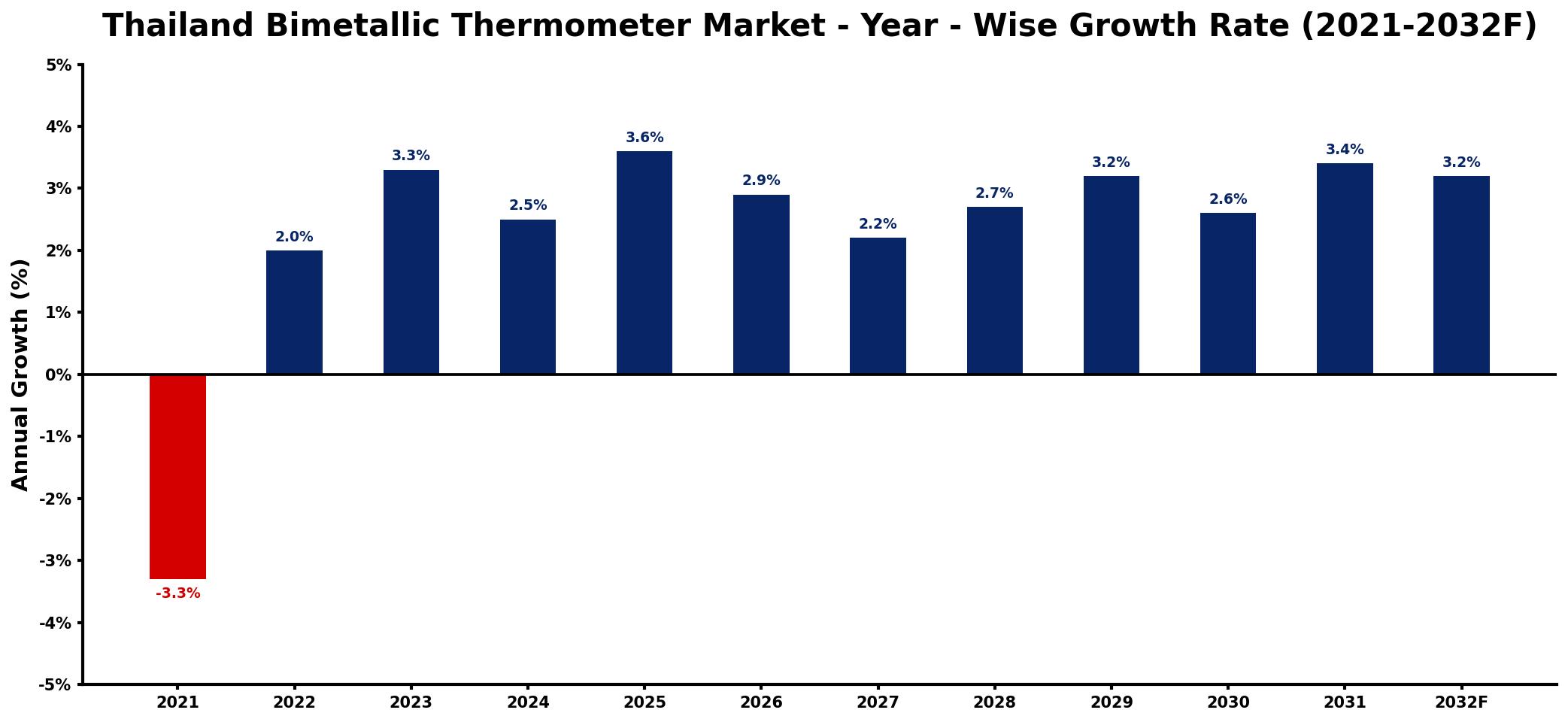
The table below presents the year‑wise growth rates along with the key drivers influencing the market
| Year | Growth Rate | Major Drivers |
| 2021 | -3.3% | decreased industrial manufacturing activity |
| 2022 | 2.0% | rising food safety regulations |
| 2023 | 3.3% | increased demand for precision instruments |
| 2024 | 2.5% | expansion of healthcare facilities |
| 2025 | 3.6% | growth in hospitality sector |
| 2026 | 2.9% | rising popularity of home cooking |
| 2027 | 2.2% | increased investments in agriculture |
| 2028 | 2.7% | growing trend of DIY projects |
| 2029 | 3.2% | rising demand from electronics |
| 2030 | 2.6% | increased focus on energy efficiency |
| 2031 | 3.4% | growing awareness of health standards |
| 2032 | 3.2% | strengthening underlying market demand |
Note: Market size estimations and growth projections presented in this report are based on 6Wresearch's proprietary forecasting methodology, utilizing the latest available industry data, government publications, and primary research inputs.
Thailand Bimetallic Thermometer Market Synopsis
The Thailand Bimetallic Thermometer Market has demonstrated notable resilience in recent years, adapting to shifting industrial needs and technological advancements. As the market transitions from traditional applications toward more integrated solutions, the demand for bimetallic thermometers remains robust, underscoring their essential role in diverse operational environments.
Looking forward, the market is poised for steady growth, fueled by the ongoing industrial expansion and the integration of stricter regulatory standards within critical sectors. Innovations in design and usability are also set to elevate the appeal of bimetallic thermometers, thereby expanding their applicability in both existing and emerging markets.
Thailand Bimetallic Thermometer Market Key Takeaways
- The market is experiencing growth due to increased industrial activities and heightened demand for accurate temperature measurement.
- Technological advancements are enhancing the functionality and ease of use of bimetallic thermometers.
- Stringent quality control regulations in sectors like healthcare are driving the adoption of precise measurement devices.
- Despite competition from digital alternatives, the reliability of bimetallic thermometers ensures their continued relevance.
- The market is gradually recovering from COVID-19 disruptions, particularly in the healthcare sector, which has boosted demand.
Evaluation of Restraints in Thailand Bimetallic Thermometer Market
The Thailand Bimetallic Thermometer Market faces challenges that could inhibit its growth trajectory. One significant restraint is the increasing competition from digital and electronic temperature measurement devices, which are rapidly gaining traction due to their enhanced features and user-friendliness. Additionally, maintaining calibration accuracy remains a critical concern, necessitating ongoing efforts in quality assurance to uphold the reputation of bimetallic thermometers in an evolving marketplace. This tension between traditional and modern measurement solutions will require strategic adaptation from industry stakeholders.
Thailand Bimetallic Thermometer Market Trends
Several current and emerging trends are shaping the Thailand Bimetallic Thermometer Market. The shift towards automation and smart technology is encouraging the integration of bimetallic thermometers into more comprehensive systems, including digital monitoring setups. Additionally, there's a growing emphasis on sustainable manufacturing processes, prompting manufacturers to explore eco-friendly materials and production methods. Lastly, as the healthcare sector increasingly prioritizes patient safety and food safety regulations tighten, the demand for reliable and accurate temperature measuring devices continues to rise.
Thailand Bimetallic Thermometer Market Opportunities
The Thailand Bimetallic Thermometer Market presents numerous opportunities for growth and investment. One key area is the potential for market expansion into new applications, particularly within emerging industries such as renewable energy and biotechnology. Furthermore, leveraging advancements in digital connectivity to develop hybrid thermometer solutions could attract a new customer base. Companies that invest in R&D for innovative designs and user-friendly features may also find a competitive edge in the market.
Government Initiatives in the Thailand Bimetallic Thermometer Market
Government initiatives in Thailand are increasingly focusing on enhancing industrial standards and improving quality assurance across sectors like healthcare and food processing. Policies that promote technological innovation and encourage investments in precision instruments are particularly relevant to the bimetallic thermometer market. Additionally, public funding for infrastructure projects is expected to create further demand for reliable temperature measurement devices, aligning with national goals for improved public health and safety.
Future Insights of the Thailand Bimetallic Thermometer Market
As we look ahead to 2026-2032, the Thailand Bimetallic Thermometer Market is set to evolve in response to both technological advancements and regulatory shifts. The continual demand for accurate temperature monitoring will likely drive innovation, resulting in improved thermometer designs that integrate advanced features while retaining the reliability associated with traditional bimetallic models. As industries adapt to the post-pandemic landscape, the market's growth trajectory appears promising, with ample opportunities for companies prepared to meet changing demands.
Thailand Bimetallic Thermometer Market Latest Developments (2025 - 2026)
Recent developments in the Thailand Bimetallic Thermometer Market reflect a growing focus on enhancing product features and user experiences. Manufacturers are increasingly investing in research and development to improve the accuracy and durability of bimetallic thermometers. Furthermore, collaborations between industry players and technology firms are fostering innovations that integrate digital functionalities with traditional measurement practices, thereby broadening the appeal of these instruments.
Thailand Bimetallic Thermometer Market - Key Attractiveness of the Report
- 10 Years of Market Numbers
- Historical Data Starting from 2022 to 2025
- Base Year: 2025
- Forecast Data until 2032
- Key Performance Indicators Impacting the Market
- Major Upcoming Developments and Projects
Key Highlights of the Report:
- Thailand Bimetallic Thermometer Market Outlook
- Market Size of Thailand Bimetallic Thermometer Market, 2025
- Forecast of Thailand Bimetallic Thermometer Market, 2032
- Historical Data and Forecast of Thailand Bimetallic Thermometer Revenues & Volume for the Period 2022-2032F
- Thailand Bimetallic Thermometer Market Trend Evolution
- Thailand Bimetallic Thermometer Market Drivers and Challenges
- Thailand Bimetallic Thermometer Price Trends
- Thailand Bimetallic Thermometer Porter's Five Forces
- Thailand Bimetallic Thermometer Industry Life Cycle
- Historical Data and Forecast of Thailand Bimetallic Thermometer Market Revenues & Volume By Design Type for the Period 2022-2032F
- Historical Data and Forecast of Thailand Bimetallic Thermometer Market Revenues & Volume By Angle Type for the Period 2022-2032F
- Historical Data and Forecast of Thailand Bimetallic Thermometer Market Revenues & Volume By Straight Type for the Period 2022-2032F
- Historical Data and Forecast of Thailand Bimetallic Thermometer Market Revenues & Volume By Adjustable Angle Type for the Period 2022-2032F
- Historical Data and Forecast of Thailand Bimetallic Thermometer Market Revenues & Volume By End User for the Period 2022-2032F
- Historical Data and Forecast of Thailand Bimetallic Thermometer Market Revenues & Volume By Oil & Gas Industry for the Period 2022-2032F
- Historical Data and Forecast of Thailand Bimetallic Thermometer Market Revenues & Volume By Energy Industries for the Period 2022-2032F
- Historical Data and Forecast of Thailand Bimetallic Thermometer Market Revenues & Volume By Chemical Industries for the Period 2022-2032F
- Historical Data and Forecast of Thailand Bimetallic Thermometer Market Revenues & Volume By Iron & Steel Industries for the Period 2022-2032F
- Historical Data and Forecast of Thailand Bimetallic Thermometer Market Revenues & Volume By Others for the Period 2022-2032F
- Thailand Bimetallic Thermometer Import Export Trade Statistics
- Market Opportunity Assessment By Design Type
- Market Opportunity Assessment By End User
- Thailand Bimetallic Thermometer Top Companies Market Share
- Thailand Bimetallic Thermometer Competitive Benchmarking By Technical and Operational Parameters
- Thailand Bimetallic Thermometer Company Profiles
- Thailand Bimetallic Thermometer Key Strategic Recommendations






































