Thailand Cables Market Size Growth Rate
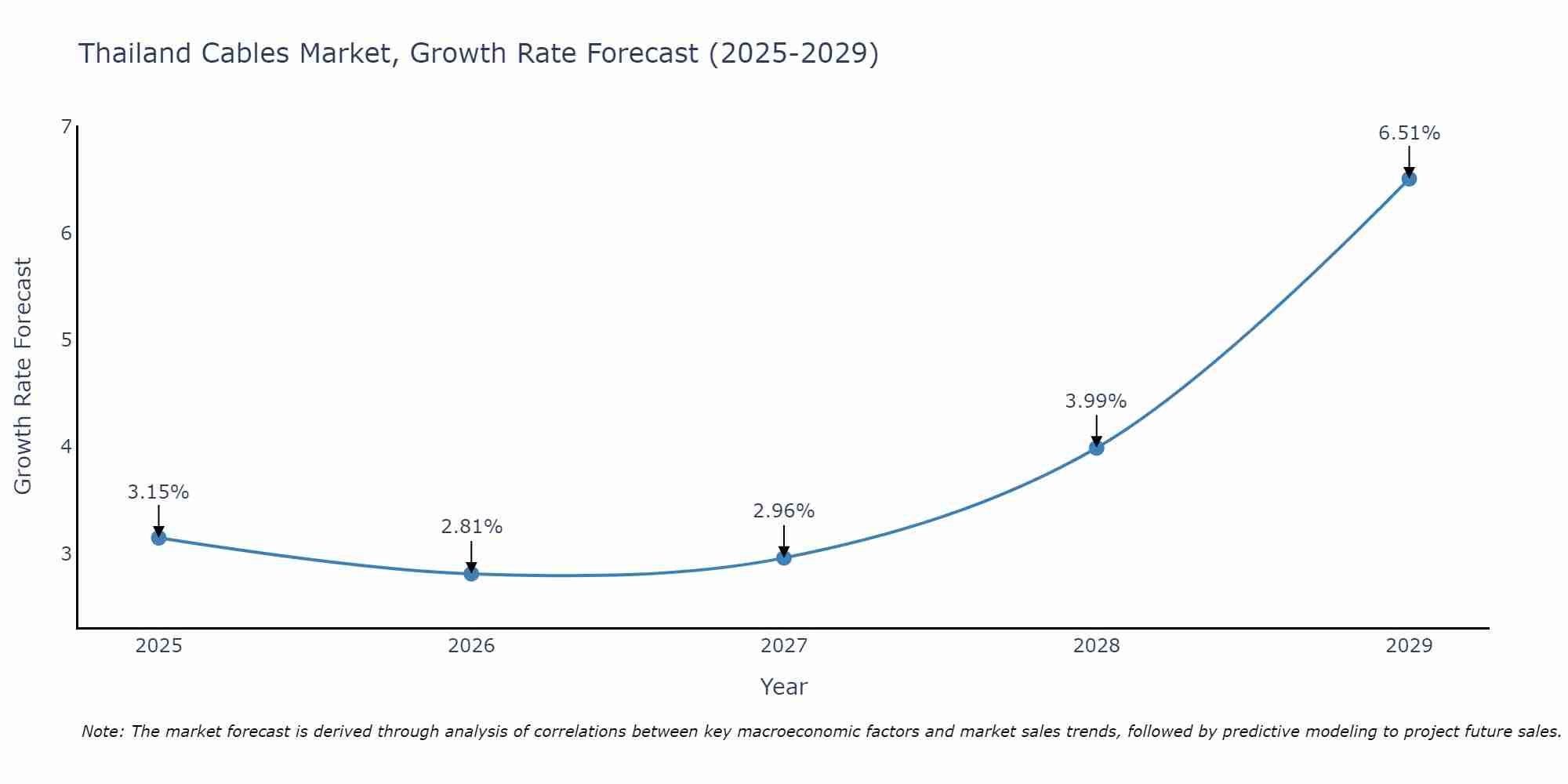
The Thailand Cables Market is projected to witness mixed growth rate patterns during 2025 to 2029. From 3.15% in 2025, the growth rate steadily ascends to 6.51% in 2029.
Cables Market: Thailand vs Top 5 Major Economies in 2027 (Asia)
The Cables market in Thailand is projected to grow at a stable growth rate of 2.96% by 2027, highlighting the country's increasing focus on advanced technologies within the Asia region, where China holds the dominant position, followed closely by India, Japan, Australia and South Korea, shaping overall regional demand.

Thailand Cables Market Synopsis
The Thailand cables market is a vital component of the country`s infrastructure development. It encompasses a wide range of cable types, including power cables, fiber optic cables, and communication cables. With ongoing urbanization and industrialization projects, there is a growing demand for reliable and efficient cable solutions. The adoption of renewable energy sources and the expansion of telecommunications networks further contribute to the demand for cables. The market is competitive, with local and international players catering to diverse industry needs.
Drivers of the Market
The Thailand cables market is propelled by several factors, including infrastructure development projects, industrial automation, and the expansion of the telecommunications sector. The demand for high-quality cables and wiring solutions is rising in both urban and rural areas. Infrastructure projects like roads, railways, and airports require extensive cabling for various applications, while the expansion of broadband and 5G networks has led to increased demand for fiber optic and coaxial cables. Moreover, the growth of renewable energy sources is spurring demand for specialized power cables.
Challenges of the Market
The cables market in Thailand is challenged by price competition, quality control, and sustainability concerns. Price competition in the market can lead to margin erosion for manufacturers, especially when low-cost alternatives from other countries flood the market. Ensuring consistent quality and meeting international standards is crucial for market players to maintain credibility and access global markets. Additionally, the demand for sustainable and eco-friendly materials in cable production is growing, which requires investments in greener manufacturing processes.
COVID-19 Impact on the Market
The pandemic disrupted supply chains and caused delays in the production and distribution of cables. However, the increased demand for high-speed internet and connectivity solutions during lockdowns boosted the cable market. As businesses and households adapted to remote work and online learning, there was a surge in demand for network cables and fiber-optic solutions.
Key Players in the Market
Thailand cables market features several prominent manufacturers, including Siam Electric Industries and Thai-Asia P.E. Pipe. These companies produce a wide range of cables used in electrical and telecommunications applications.
Key Highlights of the Report:
- Thailand Cables Market Outlook
- Market Size of Thailand Cables Market, 2024
- Forecast of Thailand Cables Market, 2031
- Historical Data and Forecast of Thailand Cables Revenues & Volume for the Period 2021-2031
- Thailand Cables Market Trend Evolution
- Thailand Cables Market Drivers and Challenges
- Thailand Cables Price Trends
- Thailand Cables Porter's Five Forces
- Thailand Cables Industry Life Cycle
- Historical Data and Forecast of Thailand Cables Market Revenues & Volume By Installation Type for the Period 2021-2031
- Historical Data and Forecast of Thailand Cables Market Revenues & Volume By Overhead for the Period 2021-2031
- Historical Data and Forecast of Thailand Cables Market Revenues & Volume By Underground for the Period 2021-2031
- Historical Data and Forecast of Thailand Cables Market Revenues & Volume By Submarine for the Period 2021-2031
- Historical Data and Forecast of Thailand Cables Market Revenues & Volume By Voltage Type for the Period 2021-2031
- Historical Data and Forecast of Thailand Cables Market Revenues & Volume By High for the Period 2021-2031
- Historical Data and Forecast of Thailand Cables Market Revenues & Volume By Medium for the Period 2021-2031
- Historical Data and Forecast of Thailand Cables Market Revenues & Volume By Low for the Period 2021-2031
- Historical Data and Forecast of Thailand Cables Market Revenues & Volume By End Use for the Period 2021-2031
- Historical Data and Forecast of Thailand Cables Market Revenues & Volume By Industrial for the Period 2021-2031
- Historical Data and Forecast of Thailand Cables Market Revenues & Volume By Aerospace and Defense for the Period 2021-2031
- Historical Data and Forecast of Thailand Cables Market Revenues & Volume By Oil and Gas for the Period 2021-2031
- Historical Data and Forecast of Thailand Cables Market Revenues & Volume By Energy and Power for the Period 2021-2031
- Historical Data and Forecast of Thailand Cables Market Revenues & Volume By IT and Telecommunication for the Period 2021-2031
- Historical Data and Forecast of Thailand Cables Market Revenues & Volume By Others for the Period 2021-2031
- Thailand Cables Import Export Trade Statistics
- Thailand Cables Top Companies Market Share
- Thailand Cables Competitive Benchmarking By Technical and Operational Parameters
- Thailand Cables Company Profiles
- Thailand Cables Key Strategic Recommendations






































