Thailand Calcium Phosphite Market Size, Share & Growth Rate
The Thailand Calcium Phosphite Market was estimated at USD 244 Million in 2025 and is projected to reach USD 278 Million by 2032, growing at a CAGR of 1.9% from 2026 to 2032. This anticipated growth trajectory is primarily driven by an increasing demand for calcium phosphite across agriculture, food & beverages, and pharmaceuticals. As Thailand's agricultural sector embraces sustainable practices and innovative crop protection solutions, the role of calcium phosphite is becoming increasingly crucial in enhancing agricultural output and ensuring food security.
Thailand Calcium Phosphite Market Year-wise Growth Rate and Key Drivers
This graph highlights how the Thailand Calcium Phosphite Market has steadily grown over the years, supported by major growth factors.
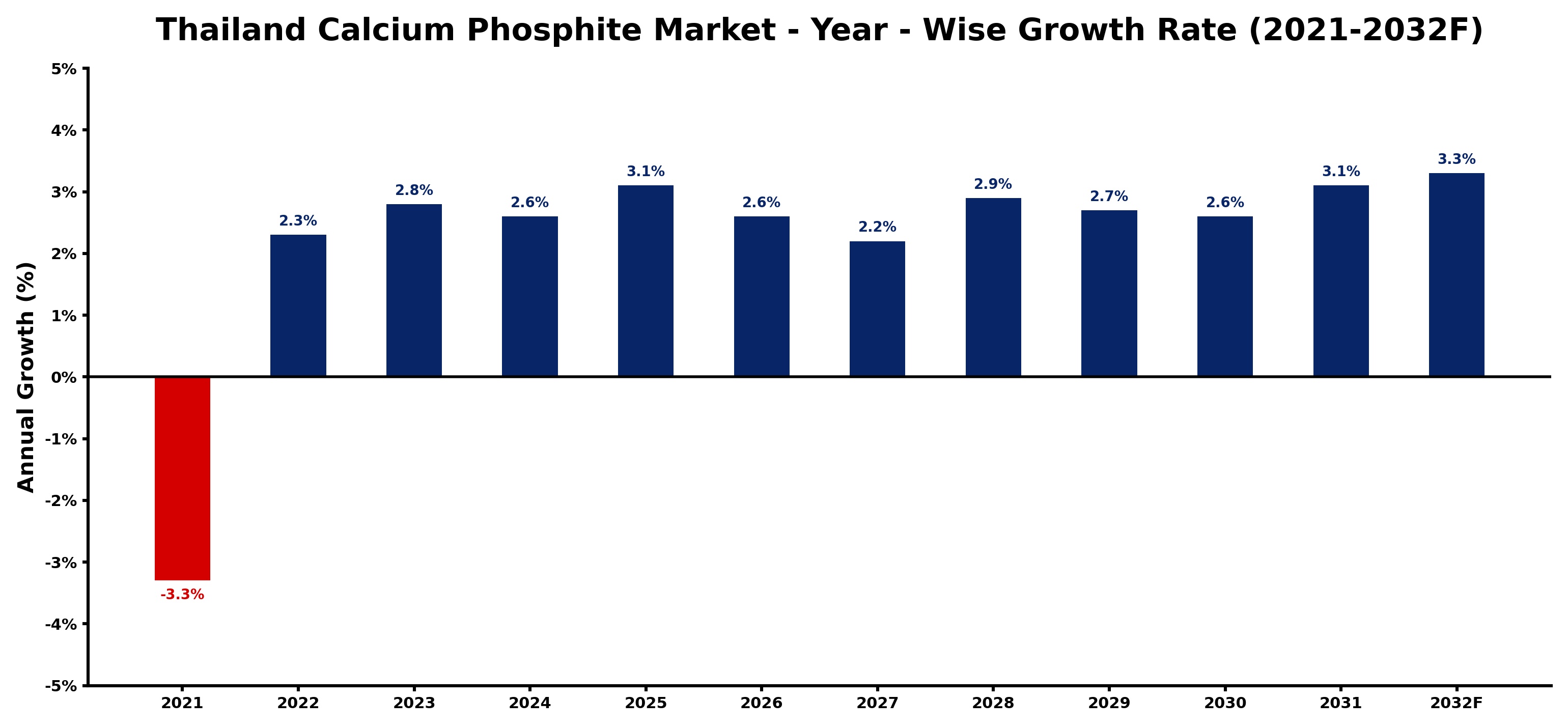
The table below presents the year‑wise growth rates along with the key drivers influencing the market
| Year | Growth Rate | Major Drivers |
| 2021 | -3.3% | Supply chain disruptions limited availability |
| 2022 | 2.3% | Agricultural sector recovery stimulated demand |
| 2023 | 2.8% | Increased awareness of benefits |
| 2024 | 2.6% | Rising health consciousness among consumers |
| 2025 | 3.1% | Enhanced product formulations attracted buyers |
| 2026 | 2.6% | Industrial activity supported growth |
| 2027 | 2.2% | Technological advancements improved production efficiency |
| 2028 | 2.9% | Rising export opportunities boosted sales |
| 2029 | 2.7% | Sustainable farming practices gained traction |
| 2030 | 2.6% | Increased investment in research initiatives |
| 2031 | 3.1% | Consumer preference for fortified products |
| 2032 | 3.3% | Collaborations with health organizations increased |
Note - Market size estimations and growth projections presented in this report are based on 6Wresearch’s advanced forecasting approach, validated with industry datasets as of June 2026.
Thailand Calcium Phosphite Market Synopsis
In recent years, the calcium phosphite market in Thailand has experienced a notable uptick in growth, reflecting heightened awareness regarding sustainable agricultural practices among local farmers. As population growth drives food demand, the significance of effective nutrient management using calcium phosphite is becoming more pronounced.
This compound's essential role in plant nutrition and disease management is further accentuated by rising per capita income levels, leading to greater investments in agricultural technology and crop inputs. Consequently, the Thai market is witnessing a more robust adoption of calcium phosphite products to optimize yields and enhance food quality.
Thailand Calcium Phosphite Market Key Takeaways
- Increasing awareness and adoption of sustainable farming practices are propelling market growth.
- Calcium phosphite is pivotal for improving crop yield and managing agricultural diseases effectively.
- The demand from food & beverages and pharmaceuticals sectors is a significant driver of market expansion.
- Government initiatives promoting efficient agriculture are expected to further bolster market opportunities.
- The market faces challenges related to agricultural dynamics that require innovative solutions.
Evaluation of Restraints in Thailand Calcium Phosphite Market
Despite its growth potential, the calcium phosphite market in Thailand is hindered by several factors. Fluctuations in agricultural practices can impact the consistent demand for this vital input. Furthermore, balancing the urgency for higher agricultural productivity with stringent environmental regulations poses a challenge. The necessity for innovation and advancements in product formulations is critical to address both efficiency in crop protection and compliance with evolving regulations.
Thailand Calcium Phosphite Market Trends
The Thailand calcium phosphite market is currently experiencing a shift towards integrated nutrient management systems that harmonize plant nutrition and environmental stewardship. As consumers become increasingly health-conscious, there is a growing trend towards organic farming, elevating the demand for calcium phosphite as a safe and effective fertilizer alternative. Moreover, advancements in research and development are yielding enhanced formulations that promise better absorption rates and improved effectiveness in combating crop diseases.
Thailand Calcium Phosphite Market Opportunities
The landscape for growth in the calcium phosphite market is rich with opportunity, particularly as the Thai government supports agricultural innovation. Investment in R&D aimed at developing more effective calcium phosphite formulations presents a potential avenue for companies looking to capitalize on this trend. Additionally, expanding applications in animal feed additives offers a promising market segment, especially as livestock production continues to rise in response to increasing protein demand.
Government Initiatives in the Thailand Calcium Phosphite Market
The Thai government is actively promoting policies that incentivize sustainable agricultural practices. Initiatives aimed at encouraging the use of eco-friendly inputs, such as calcium phosphite, play a vital role in enhancing the productivity and sustainability of farms across the nation. Public spending on agricultural innovation and support programs is set to facilitate the adoption of advanced agricultural technologies, thereby strengthening the market for calcium phosphite.
Future Insights of the Thailand Calcium Phosphite Market
Looking ahead to 2026-2032, the Thailand calcium phosphite market is poised for steady growth, driven by the dual forces of rising agricultural productivity needs and the increasing focus on sustainability. As the sector adapts to climate challenges and consumer demands for healthier food options, calcium phosphite will likely emerge as a critical component in achieving effective plant nutrition and crop protection. The confluence of government support and heightened industry awareness is expected to further cement its role in Thailand's agricultural landscape.
Thailand Calcium Phosphite Market Latest Developments (May 2025 - June 2026)
Recent developments in the Thailand calcium phosphite market highlight a growing emphasis on sustainability and innovation. Manufacturers are increasingly focusing on enhancing their product lines to meet the evolving needs of farmers, particularly in disease management and nutrient efficiency. Collaborative efforts between industry stakeholders and government agencies aim to promote best practices in agricultural inputs, fostering a more sustainable approach to farming. Ongoing research initiatives are also setting the stage for breakthroughs in calcium phosphite applications.
Thailand Calcium Phosphite Market - Key Attractiveness of the Report
- 10 Years of Market Numbers
- Historical Data Starting from 2022 to 2025
- Base Year: 2025
- Forecast Data until 2032
- Key Performance Indicators Impacting the Market
- Major Upcoming Developments and Projects
Key Highlights of the Report:
- Thailand Calcium Phosphite Market Outlook
- Market Size of Thailand Calcium Phosphite Market, 2025
- Forecast of Thailand Calcium Phosphite Market, 2032
- Historical Data and Forecast of Thailand Calcium Phosphite Revenues & Volume for the Period 2022-2032F
- Thailand Calcium Phosphite Market Trend Evolution
- Thailand Calcium Phosphite Market Drivers and Challenges
- Thailand Calcium Phosphite Price Trends
- Thailand Calcium Phosphite Porter's Five Forces
- Thailand Calcium Phosphite Industry Life Cycle
- Historical Data and Forecast of Thailand Calcium Phosphite Market Revenues & Volume By Type for the Period 2022-2032F
- Historical Data and Forecast of Thailand Calcium Phosphite Market Revenues & Volume By Purity?90% for the Period 2022-2032F
- Historical Data and Forecast of Thailand Calcium Phosphite Market Revenues & Volume By Other for the Period 2022-2032F
- Historical Data and Forecast of Thailand Calcium Phosphite Market Revenues & Volume By Application for the Period 2022-2032F
- Historical Data and Forecast of Thailand Calcium Phosphite Market Revenues & Volume By Fertilizer for the Period 2022-2032F
- Historical Data and Forecast of Thailand Calcium Phosphite Market Revenues & Volume By Pesticide for the Period 2022-2032F
- Historical Data and Forecast of Thailand Calcium Phosphite Market Revenues & Volume By Anti-rust Coating for the Period 2022-2032F
- Historical Data and Forecast of Thailand Calcium Phosphite Market Revenues & Volume By Other for the Period 2022-2032F
- Thailand Calcium Phosphite Import Export Trade Statistics
- Market Opportunity Assessment By Type
- Market Opportunity Assessment By Application
- Thailand Calcium Phosphite Top Companies Market Share
- Thailand Calcium Phosphite Competitive Benchmarking By Technical and Operational Parameters
- Thailand Calcium Phosphite Company Profiles
- Thailand Calcium Phosphite Key Strategic Recommendations






































