Thailand Carbon Credit Market Size, Share & Growth Rate
The Thailand Carbon Credit Market was estimated at USD 155 Million in 2025 and is projected to reach USD 179 Million by 2032, growing at a CAGR of 2.1% from 2026 to 2032. This growth trajectory is driven by a convergence of national policies aimed at emissions reduction and increasing participation from both private and public sectors in carbon offset initiatives. Additionally, as Thailand enhances its commitments to international climate agreements, demand for carbon credits is expected to rise, providing a solid foundation for market expansion.
Thailand Carbon Credit Market Year-wise Growth Rate and Key Drivers
This graph highlights how the Thailand Carbon Credit Market has steadily grown over the years, supported by major growth factors.
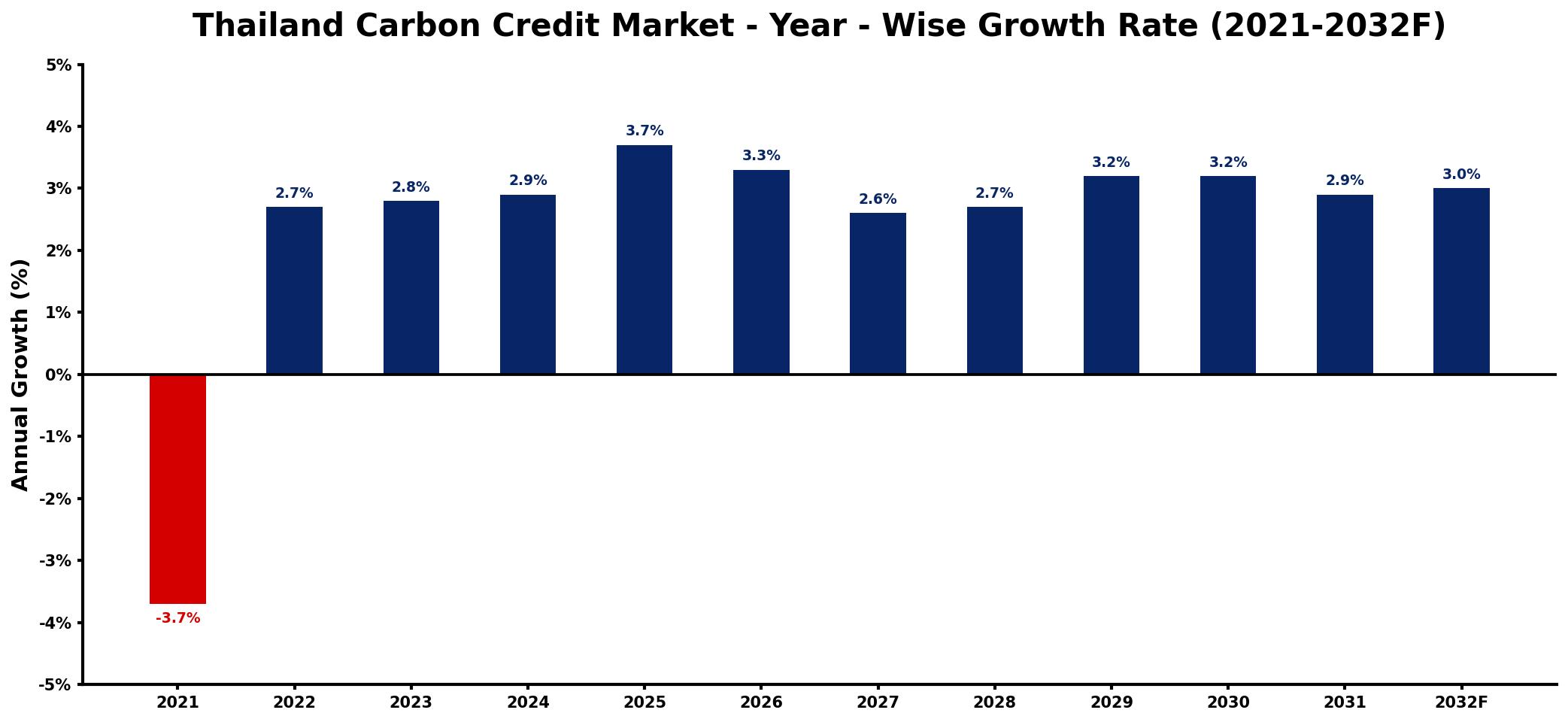
The table below presents the year‑wise growth rates along with the key drivers influencing the market
| Year | Growth Rate | Major Drivers |
| 2021 | -3.7% | decreased investment in sustainability initiatives |
| 2022 | 2.7% | growing public awareness on emissions |
| 2023 | 2.8% | increased regulatory support for sustainability |
| 2024 | 2.9% | rising corporate sustainability commitments |
| 2025 | 3.7% | expansion of renewable energy projects |
| 2026 | 3.3% | enhanced technological innovations in sustainability |
| 2027 | 2.6% | growing demand for sustainable practices |
| 2028 | 2.7% | increased international collaboration on emissions |
| 2029 | 3.2% | rising procurement volume requirements |
| 2030 | 3.2% | rising consumer preference for sustainability |
| 2031 | 2.9% | increased investment in green technologies |
| 2032 | 3.0% | growing focus on environmental responsibility |
Note: Market size estimations and growth projections presented in this report are based on 6Wresearch's proprietary forecasting methodology, utilizing the latest available industry data, government publications, and primary research inputs.
Thailand Carbon Credit Market Synopsis
In recent years, Thailand has positioned itself as a proactive player in the global carbon credit arena, reflecting its commitment to sustainable development and climate action. The country is actively pursuing projects that generate carbon credits while aiming to meet its greenhouse gas emissions reduction targets.
As various sectors begin to recognize the economic potential of carbon credits, there is a burgeoning interest in developing comprehensive strategies that align with Thailands broader environmental objectives. The interplay of domestic policies and international climate commitments is crucial in shaping this market landscape.
Thailand Carbon Credit Market Key Takeaways
- Thailand's commitment to reducing greenhouse gas emissions is propelling the carbon credit market forward.
- Government initiatives are crucial in shaping regulatory frameworks and driving project development.
- Market participants are increasingly viewing carbon credits as essential tools for compliance and sustainability.
- Ongoing developments and policy shifts will impact the stability and attractiveness of the market.
- The COVID-19 pandemic has prompted a reevaluation of sustainable practices, potentially reshaping future project implementations.
Evaluation of Restraints in Thailand Carbon Credit Market
While the Thailand carbon credit market is gaining momentum, several key restraints hinder its full potential. Regulatory complexities pose challenges for developers, making it essential for clear and enforceable policies to be established. The fluctuating nature of carbon credit prices contributes to market volatility, which can dissuade investment in emission reduction projects. As stakeholders work to create a transparent regulatory environment, balancing incentives for sustainable practices with the need for robust governance will be crucial in overcoming these obstacles.
Thailand Carbon Credit Market Trends
Current trends in the Thailand carbon credit market indicate a shift toward more comprehensive carbon accounting and reporting practices. Innovative technologies, such as blockchain, are being explored for their potential to enhance transparency in carbon credit transactions. Additionally, a growing emphasis on corporate sustainability is leading organizations to pursue carbon offsets actively, which is expected to bolster market demand further. Collaborative efforts between the government and private sectors are also emerging as a critical trend driving project development and investment.
Thailand Carbon Credit Market Opportunities
Investment opportunities in the Thailand carbon credit market are abundant, particularly in renewable energy and sustainable land management projects. As more companies seek to mitigate their carbon footprints, projects that focus on reforestation and energy efficiency are gaining traction. Furthermore, as Thailand aligns its climate policies with international standards, opportunities for cross-border carbon credit trading could emerge, enhancing market access and broadening the investment landscape for domestic stakeholders.
Government Initiatives in the Thailand Carbon Credit Market
The Thai government is actively implementing initiatives to strengthen the carbon credit market. These include establishing carbon pricing mechanisms and setting ambitious emissions reduction targets. Various public spending programs are designed to support renewable energy projects and enhance environmental compliance across industries. Furthermore, the government encourages public-private partnerships to drive innovation and investment in carbon offset projects, ensuring the market's alignment with global climate goals.
Future Insights of the Thailand Carbon Credit Market
Looking ahead, the Thailand carbon credit market is expected to continue its upward trajectory, driven by enhanced regulatory frameworks and increasing environmental awareness among businesses. By 2026, a stronger emphasis on sustainability will likely lead to more diverse carbon credit projects and greater participation from various sectors. As the government reinforces its commitment to combating climate change, the alignment of national strategies with international climate goals will provide a robust foundation for market growth through 2032 and beyond.
Thailand Carbon Credit Market Latest Developments (2025 - 2026)
Recent developments in the Thailand carbon credit market indicate a growing emphasis on integrating innovative technologies within carbon offset projects. The government has initiated new programs to foster collaboration between public and private sectors, aimed at streamlining the process of project approvals and enhancing market transparency. As stakeholders adapt to the evolving landscape, a series of workshops and training programs have been implemented to better educate participants on carbon trading dynamics and best practices.
Thailand Carbon Credit Market - Key Attractiveness of the Report
- 10 Years of Market Numbers
- Historical Data Starting from 2022 to 2025
- Base Year: 2025
- Forecast Data until 2032
- Key Performance Indicators Impacting the Market
- Major Upcoming Developments and Projects
Key Highlights of the Report:
- Thailand Carbon Credit Market Outlook
- Market Size of Thailand Carbon Credit Market, 2025
- Forecast of Thailand Carbon Credit Market, 2032
- Historical Data and Forecast of Thailand Carbon Credit Revenues & Volume for the Period 2022-2032F
- Thailand Carbon Credit Market Trend Evolution
- Thailand Carbon Credit Market Drivers and Challenges
- Thailand Carbon Credit Price Trends
- Thailand Carbon Credit Porter's Five Forces
- Thailand Carbon Credit Industry Life Cycle
- Historical Data and Forecast of Thailand Carbon Credit Market Revenues & Volume By Sector for the Period 2022-2032F
- Historical Data and Forecast of Thailand Carbon Credit Market Revenues & Volume By Energy for the Period 2022-2032F
- Historical Data and Forecast of Thailand Carbon Credit Market Revenues & Volume By Transportation for the Period 2022-2032F
- Historical Data and Forecast of Thailand Carbon Credit Market Revenues & Volume By Residential And Commercial Buildings for the Period 2022-2032F
- Historical Data and Forecast of Thailand Carbon Credit Market Revenues & Volume By Industry for the Period 2022-2032F
- Historical Data and Forecast of Thailand Carbon Credit Market Revenues & Volume By Agriculture for the Period 2022-2032F
- Historical Data and Forecast of Thailand Carbon Credit Market Revenues & Volume By Forestry for the Period 2022-2032F
- Historical Data and Forecast of Thailand Carbon Credit Market Revenues & Volume By Water And Wastewater for the Period 2022-2032F
- Thailand Carbon Credit Import Export Trade Statistics
- Market Opportunity Assessment By Sector
- Thailand Carbon Credit Top Companies Market Share
- Thailand Carbon Credit Competitive Benchmarking By Technical and Operational Parameters
- Thailand Carbon Credit Company Profiles
- Thailand Carbon Credit Key Strategic Recommendations






































