Carbon Dioxide Market: Thailand vs Top 5 Major Economies in 2027 (Asia)
By 2027, the Carbon Dioxide market in Thailand is anticipated to reach a growth rate of 6.35%, as part of an increasingly competitive Asia region, where China remains at the forefront, supported by India, Japan, Australia and South Korea, driving innovations and market adoption across sectors.
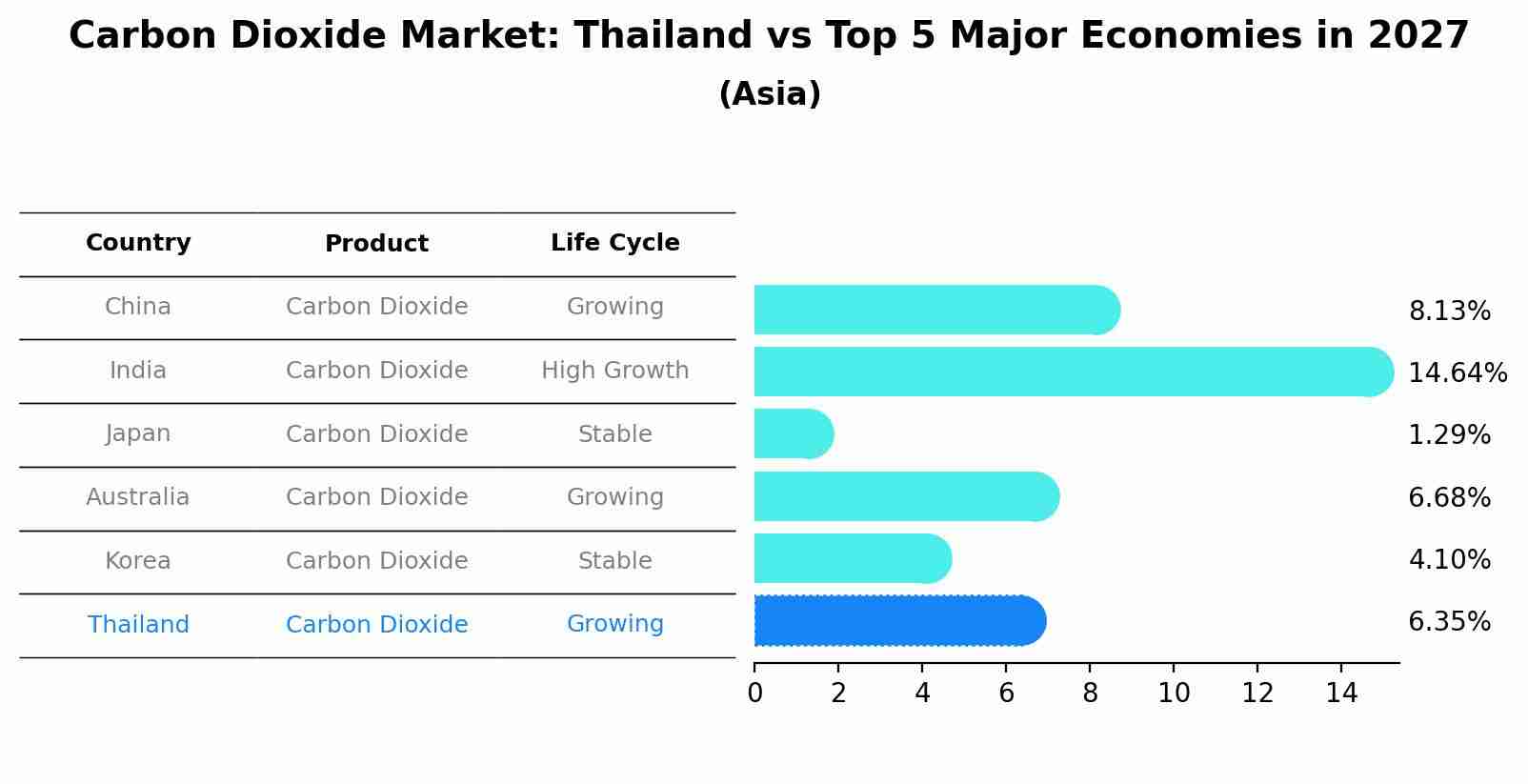
Thailand Carbon Dioxide Market Growth Rate
According to 6wresearch internal database and industry insights, the Thailand carbon Dioxide Market is estimated to grow at a compound annual growth rate (CAGR) of 6.5% during the forecast period (2026–2032).
Topics Covered in the Thailand Carbon Dioxide Market Report
The Thailand Carbon Dioxide Market report broadly covers the market by source and application. The report provides a comprehensive analysis of ongoing market trends, opportunities/high-growth areas, and market drivers that will be pivotal for various stakeholders to align their strategies based on current and future market dynamics.
Thailand Carbon Dioxide Market Highlights
| Report Name |
Thailand Carbon Dioxide Market |
| Forecast period | 2026-2032 |
| CAGR | 6.5% |
| Market Size |
Food & Beverage and Industrial Gas |
Thailand Carbon Dioxide Market Synopsis
Thailand Carbon Dioxide Market is projected to achieve enormous expansion during the forecast period on account of increasing utilization of CO₂ across multiple industries such as food and beverages, oil & gas, and healthcare. CO₂ is widely used in refrigeration, fire suppression, and enhanced oil recovery, which further strengthens its industrial demand.
The growing demand for carbonated beverages and packaged food products is significantly driving the need for food-grade CO₂. Apart from this, the growing emphasis on sustainable industrial practices and carbon capture technologies is contributing to the Thailand carbon dioxide market growth.
Evaluation of Growth Drivers in Thailand Carbon Dioxide Market
Given below are some of the major drivers and their influence on Thailand Carbon Dioxide Market dynamics:
| Drivers | Primary Segment Affected | Why It Matters (Evidence) |
| Rising Beverage Industry | Food & Beverages | Increasing consumption of carbonated drinks boosts CO₂ demand. |
| Industrial Growth | Ethylene Oxide & Hydrogen Source | Expansion in manufacturing industries increases CO₂ production and usage. |
| Medical Applications | Medical Segment | CO₂ is used in surgeries and medical treatments. |
| Oil & Gas Applications | Oil & Gas | Utilization in enhanced oil recovery supports demand. |
| Carbon Capture Technologies | Substitute Natural Gas | Adoption of sustainable practices promotes CO₂ utilization. |
Thailand Carbon Dioxide Market is expected to proliferate, exhibiting a CAGR of 6.5% during the forecast period (2026–2032). The increasing demand from diverse industries and the development of carbon capture technologies are expected to drive market growth. Furthermore, investments in gas industrial infrastructure along with technology improvements are contributing to improved production efficiency and applications. Moreover, concerns about carbon footprints have led to the implementation of carbon dioxide capturing and utilization technology.
Evaluation of Restraints in the Thailand Carbon Dioxide Market
Below are some of the major restraints and their influence on market dynamics:
| Restraints | Primary Segment Affected | What This Means (Evidence) |
| Storage and Transportation Challenges | All Segments | CO₂ requires specialized storage and handling systems. |
| Regulatory Constraints | Industrial Applications | Strict emission regulations may limit production. |
| High Infrastructure Costs | Source Segment | Setting up capture and processing facilities is capital-intensive. |
| Safety Concerns | Medical & Industrial | It requires considerable funds to establish processing and capturing plants. |
| Market Price Volatility | Food & Beverage | Food and Beverage Variations affect the manufacturing process. |
Thailand Carbon Dioxide Market Challenges
In the Thailand carbon dioxide industry, there are several challenges which includes balancing the demand for carbon dioxide from various industries while addressing environmental concerns related to greenhouse gas emissions. Apart from this, efficient carbon capture and storage technologies, along with sustainable sourcing, are key challenges to maintain a balance between industrial needs and environmental responsibility.
Thailand Carbon Dioxide Market Trends
Following are the prevailing trends in the Thailand carbon dioxide market:
- Use in the Food and Beverages Industry: An increase in the demand for carbonated beverages and packaged foods is driving up CO₂ consumption in Thailand.
- CCU Technology in Business: CCU technology used by businesses is helping them to achieve their sustainable goals.
- Use in Health Care: There have been advancements in the application of CO₂ in minimal invasive procedures and healthcare.
- Efficiency of Gas Processing: Recent innovations in gas processing have been beneficial in improving its purity and liquefaction.
Investment Opportunities in Thailand Carbon Dioxide Market
The following are some investment opportunities in the Thailand carbon dioxide market:
- CCU Technologies: Investment in CCU technologies offers potential sustainable and profitable growth.
- CO2 for Food & Beverages: Increased demand for food-grade CO₂ from the beverages and food industries offer opportunities.
- Networks for Industrial Gas Logistics: Setting up an effective logistics network system for storing and transporting CO₂ can be beneficial.
- Medical and Healthcare Industries: Use of CO₂ in the healthcare sector presents many opportunities.
Top 5 Leading Players in Thailand Carbon Dioxide Market
Given below is a list of leading companies dominating the Thailand Carbon Dioxide Market:
1. Bangkok Industrial Gas Co Ltd
| Company Name | Bangkok Industrial Gas Co., Ltd. |
|---|---|
| Established Year | 1970 |
| Headquarters | Bangkok, Thailand |
| Official Website | Click Here |
A leading industrial gas supplier providing CO₂ and other gases for industrial, medical, and food applications.
2. Linde
| Company Name | Linde |
|---|---|
| Established Year | 1990 |
| Headquarters | Bangkok, Thailand |
| Official Website | Click Here |
A global industrial gas company offering CO₂ solutions for diverse applications including food processing and healthcare.
3. Air Liquide
| Company Name | Air Liquide |
|---|---|
| Established Year | 1977 |
| Headquarters | Bangkok, Thailand |
| Official Website | Click Here |
Specializes in industrial and medical gases, including high-purity CO₂ for various industries.
4. Thai Industrial Gas Public Company Limited
| Company Name | Thai Industrial Gas Public Company Limited |
|---|---|
| Established Year | 1986 |
| Headquarters | Bangkok, Thailand |
| Official Website | - |
Engaged in production and distribution of industrial gases including carbon dioxide for manufacturing and commercial use.
5. Praxair
| Company Name | Praxair |
|---|---|
| Established Year | 1996 |
| Headquarters | Bangkok, Thailand |
| Official Website | - |
Praxair provides industrial gas solutions including CO₂ for industrial, medical, and energy sectors.
Government Initiatives being implemented in the Thailand Carbon Dioxide Market
According to Thailand Government Data, several measures have been taken to ensure sustainable growth in industry and emissions reduction. The government has put forward measures under its Thailand 4.0 policy that favor the use of cleaner technology and efficient resource management.
Thailand Greenhouse Gas Management Organization (TGO) is assisting in the implementation of carbon capture and reduction initiatives. The government has put forward the “Bio-Circular-Green (BCG) Economic Model,” encouraging industries to make use of CO₂ emissions and lessen their environmental impact. In addition, the growth in renewable energy and efficiency programs has resulted in increased utilization of CO₂.
Future Insights of the Thailand Carbon Dioxide Market
The Thailand Carbon Dioxide Market is expected to witness firm growth, driven by industrial expansion, increasing demand from food and beverage sectors, and adoption of sustainable practices. The market will likely see advancements in carbon capture technologies and wider application scope. Furthermore, the integration of CO₂ utilization in industrial processes and growing investments in infrastructure will shape the future of the market.
Market Segmentation Analysis
The report offers a comprehensive study of the following market segments and their leading categories:
By Source – Hydrogen Segment to Dominate the Market
According to Keshav, Senior Research Analyst, 6Wresearch, Hydrogen-based CO₂ production dominates the Thailand carbon dioxide market share. This segment benefits from large-scale hydrogen production processes where CO₂ is captured as a by-product.
By Application – Food & Beverages Segment to lead the Market
The Food & Beverages segment dominates the Thailand carbon dioxide industry due to its extensive use in carbonation, packaging, and preservation processes. The growing consumption of soft drinks and processed food products continues to drive demand for CO₂ in this segment.
Key Attractiveness of the Report
- 10 Years of Market Numbers
- Historical Data Starting from 2022 to 2025
- Base Year: 2025
- Forecast Data until 2032
- Key Performance Indicators Impacting the Market
- Major Upcoming Developments and Projects
Key Highlights of the Report:
- Thailand Carbon Dioxide Market Outlook
- Market Size of Thailand Carbon Dioxide Market, 2025
- Forecast of Thailand Carbon Dioxide Market, 2032
- Historical Data and Forecast of Thailand Carbon Dioxide Revenues & Volume for the Period 2022-2032
- Thailand Carbon Dioxide Market Trend Evolution
- Thailand Carbon Dioxide Market Drivers and Challenges
- Thailand Carbon Dioxide Price Trends
- Thailand Carbon Dioxide Porter's Five Forces
- Thailand Carbon Dioxide Industry Life Cycle
- Historical Data and Forecast of Thailand Carbon Dioxide Market Revenues & Volume By Source for the Period 2022-2032
- Historical Data and Forecast of Thailand Carbon Dioxide Market Revenues & Volume By Hydrogen for the Period 2022-2032
- Historical Data and Forecast of Thailand Carbon Dioxide Market Revenues & Volume By Ethyl Alcohol for the Period 2022-2032
- Historical Data and Forecast of Thailand Carbon Dioxide Market Revenues & Volume By Ethylene Oxide for the Period 2022-2032
- Historical Data and Forecast of Thailand Carbon Dioxide Market Revenues & Volume By Substitute Natural Gas for the Period 2022-2032
- Historical Data and Forecast of Thailand Carbon Dioxide Market Revenues & Volume By Others for the Period 2022-2032
- Historical Data and Forecast of Thailand Carbon Dioxide Market Revenues & Volume By Application for the Period 2022-2032
- Historical Data and Forecast of Thailand Carbon Dioxide Market Revenues & Volume By Food & Beverages for the Period 2022-2032
- Historical Data and Forecast of Thailand Carbon Dioxide Market Revenues & Volume By Oil & Gas for the Period 2022-2032
- Historical Data and Forecast of Thailand Carbon Dioxide Market Revenues & Volume By Medical for the Period 2022-2032
- Historical Data and Forecast of Thailand Carbon Dioxide Market Revenues & Volume By Rubber for the Period 2022-2032
- Historical Data and Forecast of Thailand Carbon Dioxide Market Revenues & Volume By Fire Fighting for the Period 2022-2032
- Historical Data and Forecast of Thailand Carbon Dioxide Market Revenues & Volume By Others for the Period 2022-2032
- Thailand Carbon Dioxide Import Export Trade Statistics
- Market Opportunity Assessment By Source
- Market Opportunity Assessment By Application
- Thailand Carbon Dioxide Top Companies Market Share
- Thailand Carbon Dioxide Competitive Benchmarking By Technical and Operational Parameters
- Thailand Carbon Dioxide Company Profiles
- Thailand Carbon Dioxide Key Strategic Recommendations
Market Covered
The report offers a comprehensive study of the following market segments:
By Source
- Hydrogen
- Ethyl Alcohol
- Ethylene Oxide
- Substitute Natural Gas
- Others
By Application
- Food & Beverages
- Oil & Gas
- Medical
- Rubber
- Fire Fighting
- Others






































