Thailand Cashmere Yarn Market Size, Share & Growth Rate
The Thailand Cashmere Yarn Market was estimated at USD 93 Million in 2025 and is projected to reach USD 106 Million by 2032, growing at a CAGR of 1.9% from 2026 to 2032. This growth trajectory is fueled by a rising middle class with increased disposable incomes, which in turn enhances the demand for luxury textiles. Additionally, the evolving fashion landscape in Thailand promotes innovation and a shift towards sustainable practices, further invigorating market demand.
Thailand Cashmere Yarn Market Year-wise Growth Rate and Key Drivers
This graph highlights how the Thailand Cashmere Yarn Market has steadily grown over the years, supported by major growth factors.
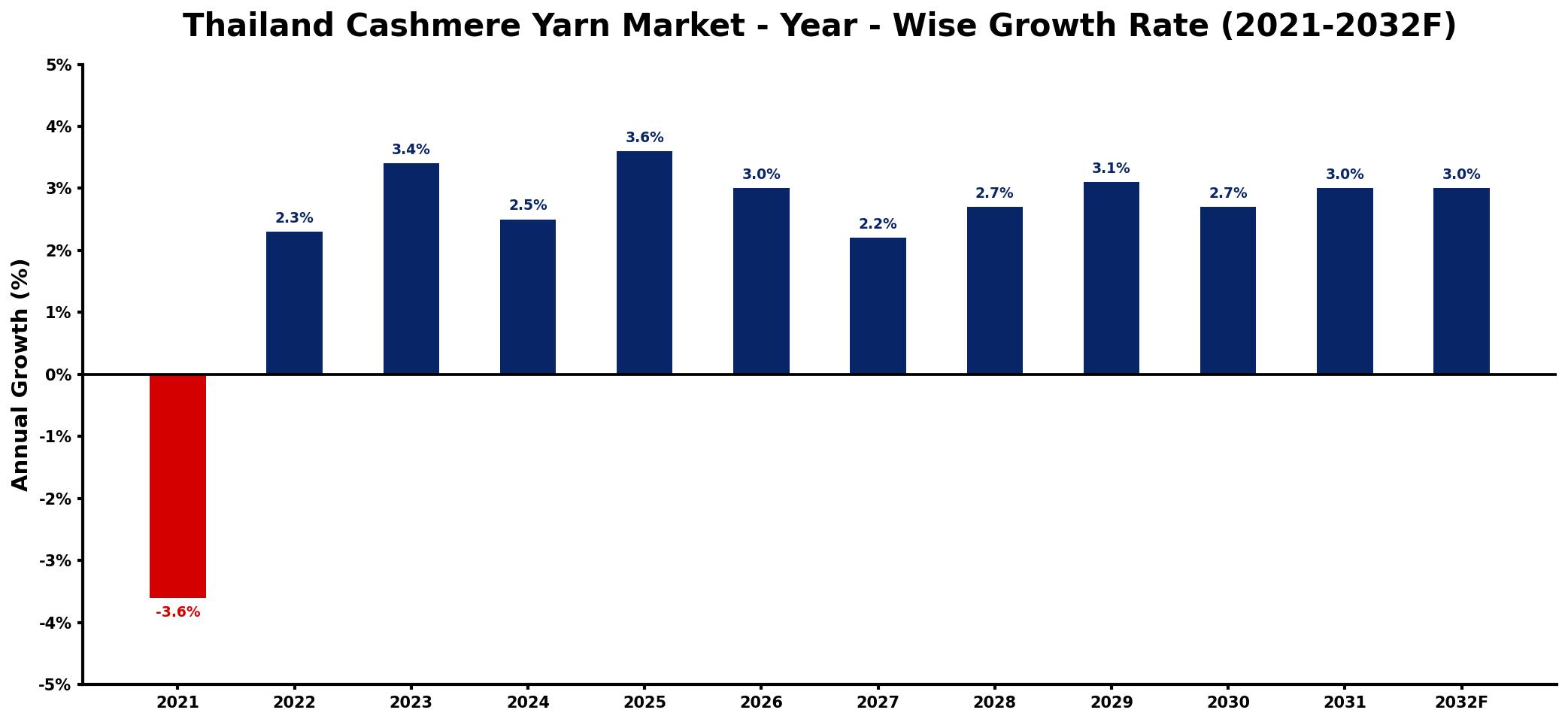
The table below presents the year‑wise growth rates along with the key drivers influencing the market
| Year | Growth Rate | Major Drivers |
| 2021 | -3.6% | decreased consumer spending on luxury |
| 2022 | 2.3% | increased interest in sustainable fashion |
| 2023 | 3.4% | growing demand for premium textiles |
| 2024 | 2.5% | rising investments in fiber technology |
| 2025 | 3.6% | expansion of online retail platforms |
| 2026 | 3.0% | increased collaboration with designers |
| 2027 | 2.2% | growing popularity of eco-friendly materials |
| 2028 | 2.7% | increased exports to international markets |
| 2029 | 3.1% | rising trend of artisanal craftsmanship |
| 2030 | 2.7% | strengthening underlying market demand |
| 2031 | 3.0% | growing awareness of ethical sourcing |
| 2032 | 3.0% | increased focus on product innovation |
Note: Market size estimations and growth projections presented in this report are based on 6Wresearch's proprietary forecasting methodology, utilizing the latest available industry data, government publications, and primary research inputs.
Thailand Cashmere Yarn Market Synopsis
In Thailand, the demand for cashmere yarn is significantly bolstered by a strong inclination towards high-quality and luxurious textiles among consumers. The local fashion industry is increasingly adopting cashmere as a staple due to its unmatched softness and warmth, appealing to both designers and end-users.
Moreover, the country's unique positioning within Southeast Asia facilitates its growth as a cashmere yarn production hub. With a combination of skilled artisans and a growing emphasis on sustainable fashion, Thailand is transforming its textile landscape and elevating the status of cashmere yarn in the market.
Thailand Cashmere Yarn Market Key Takeaways
- The market is witnessing a surge in demand driven by rising consumer affluence and a preference for luxury textiles.
- Sustainability and ethical sourcing of cashmere are increasingly influencing purchasing decisions among consumers.
- Challenges in sourcing high-quality cashmere wool can impact production consistency.
- The post-pandemic market has adapted to changing consumer needs, emphasizing home textiles and loungewear.
- Thailand's robust fashion industry presents significant opportunities for innovation and growth in cashmere yarn applications.
Evaluation of Restraints in Thailand Cashmere Yarn Market
While the Thailand Cashmere Yarn Market exhibits promising growth potential, several constraints limit its expansion. Sourcing high-quality cashmere wool remains a notable challenge, as the luxury fiber requires consistent supply and rigorous quality control. Furthermore, competition from synthetic alternatives poses a threat, compelling cashmere producers to balance luxury with affordability. These factors create a landscape where businesses must navigate the delicate interplay of maintaining premium quality while meeting consumer price expectations.
Thailand Cashmere Yarn Market Trends
Current trends indicate a pronounced shift towards sustainability within the Thailand Cashmere Yarn Market. Consumers are increasingly prioritizing ethical sourcing and transparency in production practices. Additionally, innovations in cashmere processing techniques are emerging, enhancing the fiber's appeal while reducing environmental impact. The incorporation of cashmere yarn into diverse applications—ranging from traditional fashion to contemporary loungewear—highlights its versatility and adaptability to changing consumer preferences.
Thailand Cashmere Yarn Market Opportunities
The Thailand Cashmere Yarn Market is poised for robust growth, particularly in niche segments that cater to eco-conscious consumers. Opportunities exist in expanding product lines to include more sustainable and ethically sourced cashmere options. Additionally, partnerships between local artisans and fashion designers can foster innovation and elevate the profile of cashmere products. The potential for e-commerce platforms to reach broader audiences also presents a unique avenue for growth in this evolving market.
Government Initiatives in the Thailand Cashmere Yarn Market
The Thai government has recognized the importance of promoting the textile sector, including cashmere yarn production, as a key driver for economic growth. Initiatives focusing on sustainable practices in agriculture and textile manufacturing are being emphasized. Programs aimed at enhancing the skillsets of local artisans and investing in technological advancements are also being implemented, providing a conducive environment for the cashmere yarn industry to flourish.
Future Insights of the Thailand Cashmere Yarn Market
Looking ahead to 2026-2032, the Thailand Cashmere Yarn Market is expected to continue its upward trajectory driven by consumer demand for luxurious yet sustainable textiles. The growth of e-commerce and shifts towards online retail will likely reshape the market dynamics, allowing local manufacturers to tap into international demand. Innovations in cashmere production and processing will further enhance the quality and appeal of cashmere products, creating a future filled with opportunities for both established players and emerging brands.
Thailand Cashmere Yarn Market Latest Developments (2025 - 2026)
Recent developments in the Thailand Cashmere Yarn Market reflect a strong shift towards sustainability and innovative practices. Manufacturers have begun exploring new processing technologies that enhance the quality of cashmere while minimizing environmental impact. Additionally, collaborations between local artisans and fashion designers are on the rise, promoting a blend of traditional craftsmanship with contemporary fashion aesthetics.
Thailand Cashmere Yarn Market - Key Attractiveness of the Report
- 10 Years of Market Numbers
- Historical Data Starting from 2022 to 2025
- Base Year: 2025
- Forecast Data until 2032
- Key Performance Indicators Impacting the Market
- Major Upcoming Developments and Projects
Key Highlights of the Report:
- Thailand Cashmere Yarn Market Outlook
- Market Size of Thailand Cashmere Yarn Market, 2025
- Forecast of Thailand Cashmere Yarn Market, 2032
- Historical Data and Forecast of Thailand Cashmere Yarn Revenues & Volume for the Period 2022-2032F
- Thailand Cashmere Yarn Market Trend Evolution
- Thailand Cashmere Yarn Market Drivers and Challenges
- Thailand Cashmere Yarn Price Trends
- Thailand Cashmere Yarn Porter's Five Forces
- Thailand Cashmere Yarn Industry Life Cycle
- Historical Data and Forecast of Thailand Cashmere Yarn Market Revenues & Volume By Type for the Period 2022-2032F
- Historical Data and Forecast of Thailand Cashmere Yarn Market Revenues & Volume By Natural Cashmere Yarn for the Period 2022-2032F
- Historical Data and Forecast of Thailand Cashmere Yarn Market Revenues & Volume By Processed Cashmere Yarn for the Period 2022-2032F
- Historical Data and Forecast of Thailand Cashmere Yarn Market Revenues & Volume By Others for the Period 2022-2032F
- Historical Data and Forecast of Thailand Cashmere Yarn Market Revenues & Volume By Application for the Period 2022-2032F
- Historical Data and Forecast of Thailand Cashmere Yarn Market Revenues & Volume By Sweaters for the Period 2022-2032F
- Historical Data and Forecast of Thailand Cashmere Yarn Market Revenues & Volume By Shawls for the Period 2022-2032F
- Historical Data and Forecast of Thailand Cashmere Yarn Market Revenues & Volume By Suits for the Period 2022-2032F
- Historical Data and Forecast of Thailand Cashmere Yarn Market Revenues & Volume By Socks for the Period 2022-2032F
- Historical Data and Forecast of Thailand Cashmere Yarn Market Revenues & Volume By Others for the Period 2022-2032F
- Thailand Cashmere Yarn Import Export Trade Statistics
- Market Opportunity Assessment By Type
- Market Opportunity Assessment By Application
- Thailand Cashmere Yarn Top Companies Market Share
- Thailand Cashmere Yarn Competitive Benchmarking By Technical and Operational Parameters
- Thailand Cashmere Yarn Company Profiles
- Thailand Cashmere Yarn Key Strategic Recommendations






































