Thailand Chromium Sulphate Market Size, Share & Growth Rate
The Thailand Chromium Sulphate Market was estimated at USD 174 Million in 2025 and is projected to reach USD 198 Million by 2032, growing at a CAGR of 1.9% from 2026 to 2032. This growth trajectory is predominantly fueled by increasing demand from the leather and textile industries, where chromium sulfate plays a critical role in tanning and dyeing processes. Furthermore, as global economies continue to rebound post-pandemic, the resurgence in manufacturing activities is expected to further enhance market performance.
Thailand Chromium Sulphate Market Year-wise Growth Rate and Key Drivers
This graph highlights how the Thailand Chromium Sulphate Market has steadily grown over the years, supported by major growth factors.
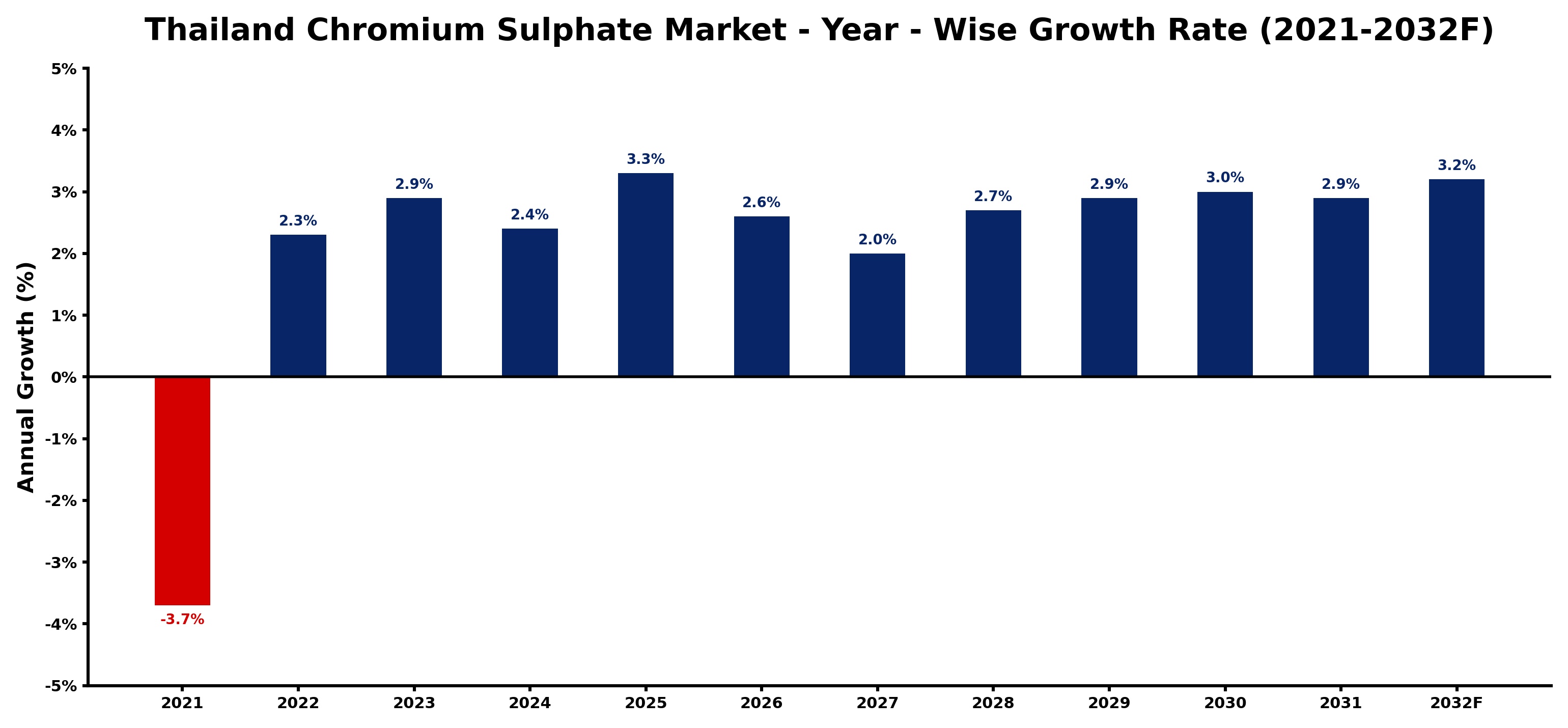
The table below presents the year‑wise growth rates along with the key drivers influencing the market
| Year | Growth Rate | Major Drivers |
| 2021 | -3.7% | Supply chain disruptions affected production |
| 2022 | 2.3% | Increased demand from leather industry |
| 2023 | 2.9% | Sustainable practices gained market traction |
| 2024 | 2.4% | Technological advancements improved efficiency |
| 2025 | 3.3% | Rising automotive sector drove consumption |
| 2026 | 2.6% | Export opportunities expanded significantly |
| 2027 | 2.0% | Regulatory support enhanced market stability |
| 2028 | 2.7% | Growing awareness of product benefits |
| 2029 | 2.9% | Investment in local manufacturing increased |
| 2030 | 3.0% | Collaborations with industries expanded reach |
| 2031 | 2.9% | Emerging markets created new opportunities |
| 2032 | 3.2% | Focus on eco-friendly products surged |
Note - Market size estimations and growth projections presented in this report are based on 6Wresearch’s advanced forecasting approach, validated with industry datasets as of June 2026.
Thailand Chromium Sulphate Market Synopsis
In Thailand, the chromium sulfate market is witnessing noteworthy growth as various industries increasingly incorporate this compound into their production processes. Primarily utilized in leather tanning, the substance also finds applications in textiles and water treatment, which contribute to its rising demand.
The post-COVID landscape has seen a gradual recovery in manufacturing, which is a significant booster for the chromium sulfate sector. Given the versatile nature of chromium sulfate, its use extends beyond just industrial applications, impacting a variety of consumer goods like paints and coatings, thereby widening its market potential.
Thailand Chromium Sulphate Market Key Takeaways
- Growing demand from the leather and textile sectors is a primary driver of market expansion.
- Increased production capabilities are expected to facilitate market growth as local manufacturers respond to international demand.
- Stringent quality and environmental regulations present both challenges and opportunities for market players.
- Recovery from the COVID-19 pandemic is fostering renewed interest in chromium sulfate across multiple industries.
- International trade dynamics, especially with China, are influencing local production strategies in Thailand.
Evaluation of Restraints in Thailand Chromium Sulphate Market
While the Thailand chromium sulfate market holds potential, several restraints can affect its growth trajectory. Stringent quality standards in various applications necessitate consistent product quality, creating pressure on manufacturers. Additionally, navigating the complex web of environmental regulations remains a challenge. Companies must invest in technology and processes that ensure compliance while remaining competitive in pricing. These factors can complicate operational efficiency and innovation within the sector.
Thailand Chromium Sulphate Market Trends
The Thai market for chromium sulfate is influenced by several key trends shaping its demand and technology landscape. Firstly, there is a growing emphasis on sustainable practices, pushing manufacturers to seek eco-friendly alternatives or processes that minimize environmental impact. Secondly, advancements in production technology are allowing for higher purity levels in chromium sulfate, meeting the stringent requirements of high-end applications. Additionally, the burgeoning demand from the e-commerce sector is driving consumer goods production, indirectly bolstering the chromium sulfate market.
Thailand Chromium Sulphate Market Opportunities
Opportunities for growth in the Thailand chromium sulfate market are manifold. With the rise of domestic and international leather goods consumption, manufacturers have the chance to enhance production capacity. Furthermore, as companies increasingly focus on product innovation, there is a ripe landscape for developing specialized chromium sulfate grades tailored for niche applications. Expanding into Southeast Asian markets, where demand is surging, presents an enticing avenue for investment and business expansion.
Government Initiatives in the Thailand Chromium Sulphate Market
The Thai government has been proactive in implementing policies that support industrial growth, including the chromium sulfate sector. Initiatives aimed at enhancing manufacturing capabilities, along with support for sustainable practices, are encouraging local producers to invest in modern technologies. Additionally, public spending on infrastructure development is indirectly benefiting the chromium sulfate market by fostering a conducive environment for manufacturing and export.
Future Insights of the Thailand Chromium Sulphate Market
Looking ahead to the period of 2026-2032, the Thailand chromium sulfate market is expected to stabilize, driven by consistent demand from core sectors such as leather and textiles. The ongoing transition toward sustainable production practices is likely to redefine how manufacturers operate, pushing for innovations that prioritize environmental responsibility. Furthermore, the interplay of local production with global supply chains will be critical, as producers seek to adapt to market fluctuations and emerging consumer preferences.
Thailand Chromium Sulphate Market Latest Developments (May 2025 - June 2026)
Recent developments in the Thailand chromium sulfate market indicate a growing trend toward investment in advanced production techniques. Companies are focusing on improving quality while adhering to stringent environmental standards. Collaboration between domestic manufacturers and international firms is also on the rise, paving the way for knowledge exchange and technology transfer. Furthermore, consumer demand for sustainable products is prompting companies to explore greener alternatives, which is likely to shape future offerings in the market.
Thailand Chromium Sulphate Market - Key Attractiveness of the Report
- 10 Years of Market Numbers
- Historical Data Starting from 2022 to 2025
- Base Year: 2025
- Forecast Data until 2032
- Key Performance Indicators Impacting the Market
- Major Upcoming Developments and Projects
Key Highlights of the Report:
- Thailand Chromium Sulphate Market Outlook
- Market Size of Thailand Chromium Sulphate Market, 2025
- Forecast of Thailand Chromium Sulphate Market, 2032
- Historical Data and Forecast of Thailand Chromium Sulphate Revenues & Volume for the Period 2022-2032F
- Thailand Chromium Sulphate Market Trend Evolution
- Thailand Chromium Sulphate Market Drivers and Challenges
- Thailand Chromium Sulphate Price Trends
- Thailand Chromium Sulphate Porter's Five Forces
- Thailand Chromium Sulphate Industry Life Cycle
- Historical Data and Forecast of Thailand Chromium Sulphate Market Revenues & Volume By Products for the Period 2022-2032F
- Historical Data and Forecast of Thailand Chromium Sulphate Market Revenues & Volume By Basic Chromium Sulphate 21%-23% for the Period 2022-2032F
- Historical Data and Forecast of Thailand Chromium Sulphate Market Revenues & Volume By Basic Chromium Sulphate 24%-26% for the Period 2022-2032F
- Historical Data and Forecast of Thailand Chromium Sulphate Market Revenues & Volume By Applications for the Period 2022-2032F
- Historical Data and Forecast of Thailand Chromium Sulphate Market Revenues & Volume By Tanning Agent for the Period 2022-2032F
- Historical Data and Forecast of Thailand Chromium Sulphate Market Revenues & Volume By Dyeing for the Period 2022-2032F
- Historical Data and Forecast of Thailand Chromium Sulphate Market Revenues & Volume By Painting & Coating for the Period 2022-2032F
- Thailand Chromium Sulphate Import Export Trade Statistics
- Market Opportunity Assessment By Products
- Market Opportunity Assessment By Applications
- Thailand Chromium Sulphate Top Companies Market Share
- Thailand Chromium Sulphate Competitive Benchmarking By Technical and Operational Parameters
- Thailand Chromium Sulphate Company Profiles
- Thailand Chromium Sulphate Key Strategic Recommendations






































