Thailand Circuit Breakers Market Size, Share & Growth Rate
The Thailand Circuit Breakers Market was estimated at USD 244 Million in 2025 and is projected to reach USD 279 Million by 2032, growing at a CAGR of 1.9% from 2026 to 2032. This growth trajectory is underpinned by a surge in construction activities fueled by rapid urbanization and industrial expansion. Moreover, increasing regulatory standards emphasizing safety and energy efficiency are driving the demand for innovative circuit breaker solutions, making them essential components in modern electrical systems.
Thailand Circuit Breakers Market Year-wise Growth Rate and Key Drivers
This graph highlights how the Thailand Circuit Breakers Market has steadily grown over the years, supported by major growth factors.
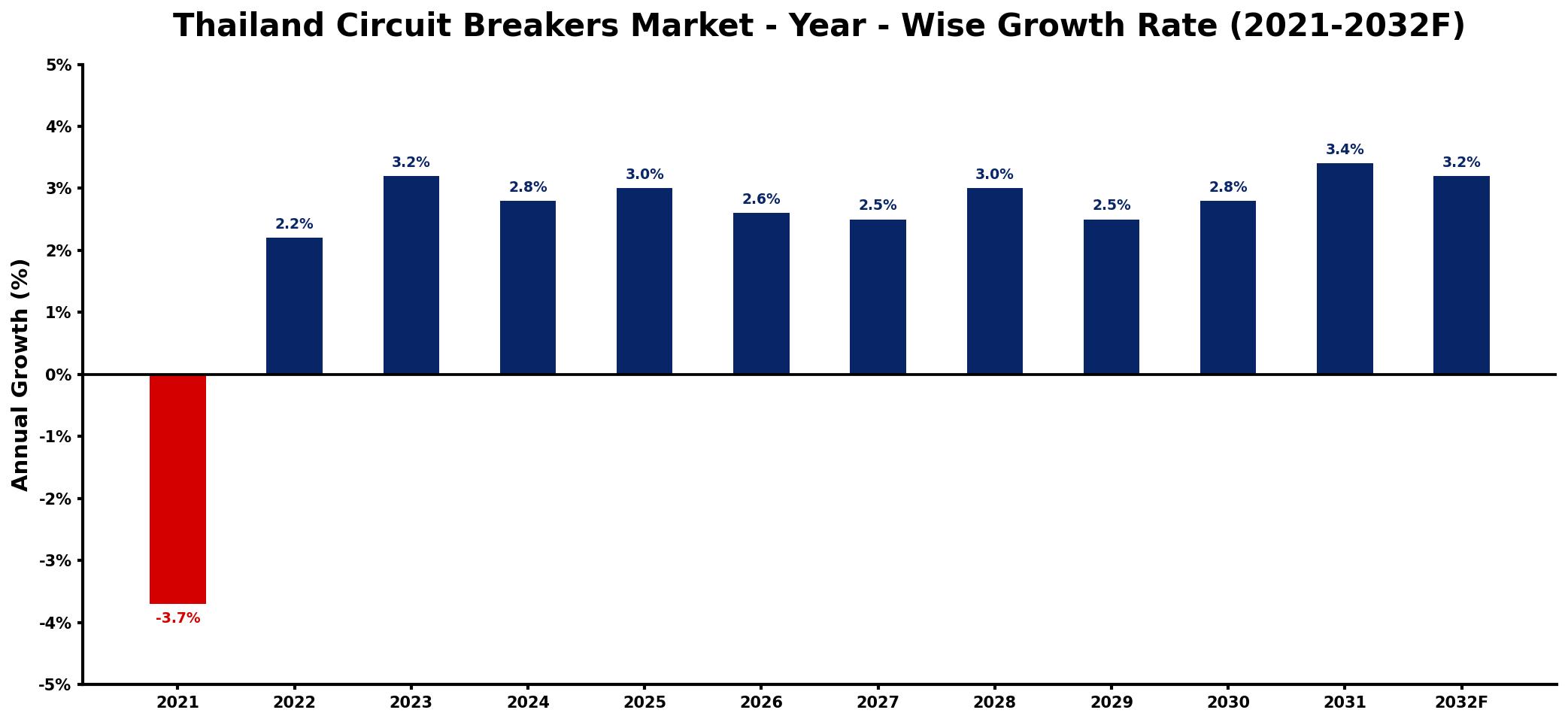
The table below presents the year‑wise growth rates along with the key drivers influencing the market
| Year | Growth Rate | Major Drivers |
| 2021 | -3.7% | decrease in infrastructure investments |
| 2022 | 2.2% | rise in renewable energy projects |
| 2023 | 3.2% | increased residential construction activities |
| 2024 | 2.8% | growing demand for smart technologies |
| 2025 | 3.0% | expansion of manufacturing facilities |
| 2026 | 2.6% | boost in urban development initiatives |
| 2027 | 2.5% | higher investments in energy efficiency |
| 2028 | 3.0% | surge in industrial automation trends |
| 2029 | 2.5% | increase in commercial construction projects |
| 2030 | 2.8% | growing focus on sustainability initiatives |
| 2031 | 3.4% | enhanced product quality standards |
| 2032 | 3.2% | growing emerging market penetration |
Note: Market size estimations and growth projections presented in this report are based on 6Wresearch's proprietary forecasting methodology, utilizing the latest available industry data, government publications, and primary research inputs.
Thailand Circuit Breakers Market Synopsis
As Thailand continues to urbanize and industrialize, the demand for circuit protection devices is at an all-time high. These devices are critical for ensuring electrical safety in residential, commercial, and industrial applications, helping to mitigate risks associated with overloads and short circuits.
The market for circuit breakers in Thailand is intrinsically linked to broader construction trends, with new developments necessitating reliable and efficient electrical infrastructure. A growing awareness of electrical safety standards among consumers and industries is also propelling investments in advanced circuit breaker technologies.
Thailand Circuit Breakers Market Key Takeaways
- The market is closely tied to construction and industrial growth, reflecting the need for circuit protection solutions.
- Regulatory frameworks and government initiatives are driving investments toward safer and more energy-efficient electrical systems.
- Recent technological advancements are shaping the demand for smart circuit breakers capable of higher voltage management.
- The impact of COVID-19 highlighted the resilience of residential circuit breaker demand amidst industrial slowdowns.
- Consumer awareness regarding electrical safety is fostering a trend towards upgrading existing electrical systems.
Evaluation of Restraints in Thailand Circuit Breakers Market
While the market for circuit breakers in Thailand is on an upward trajectory, it is not without challenges. The rapid evolution toward smart grid technologies necessitates circuit breakers that can accommodate higher voltages and offer advanced remote control features. Balancing the integration of these sophisticated technologies while keeping costs manageable is a significant hurdle. Compliance with local electrical codes is paramount, as any deviations can result in legal complications, potentially stalling projects. Additionally, the proliferation of counterfeit circuit breakers poses safety risks and undermines consumer trust, which the industry must actively combat.
Thailand Circuit Breakers Market Trends
One prominent trend in the Thailand Circuit Breakers Market is the shift toward energy efficiency. Many stakeholders are increasingly demanding solutions that minimize energy consumption without sacrificing performance. Furthermore, the integration of IoT technologies in electrical systems is on the rise, leading to the development of smart circuit breakers that enhance monitoring and control capabilities. These innovations not only offer convenience but also align with the growing emphasis on sustainability in energy use.
Thailand Circuit Breakers Market Opportunities
The potential for growth in the Thailand Circuit Breakers Market is significant, particularly in sectors where electrical safety is paramount. Opportunities exist in retrofitting existing buildings with modern circuit breakers, especially as urban infrastructure evolves. Additionally, the push for renewable energy sources opens avenues for circuit protection solutions tailored for solar and wind energy applications. The demand for smart electrical systems is also fostering new business models around smart home technologies, presenting lucrative prospects for investment.
Government Initiatives in the Thailand Circuit Breakers Market
The Thai government has implemented several initiatives aimed at enhancing electrical safety standards and encouraging energy efficiency. Public spending on infrastructure projects, coupled with incentives for energy-saving technologies, reflects a commitment to upgrading the nations electrical systems. These initiatives often include rigorous regulatory frameworks to ensure compliance with safety standards, which in turn bolsters the market for circuit breakers as industries adapt to meet these guidelines.
Future Insights of the Thailand Circuit Breakers Market
Looking ahead to 2026-2032, the Thailand Circuit Breakers Market is expected to evolve significantly, driven by technological advancements and heightened regulatory standards. The growing emphasis on smart grid integration and energy-efficient solutions will likely dominate the landscape, encouraging manufacturers to innovate continuously. As urbanization progresses, the demand for reliable circuit protection solutions will remain critical, positioning the market for stable growth and promising opportunities.
Thailand Circuit Breakers Market Latest Developments (2025 - 2026)
Recent developments in the Thailand Circuit Breakers Market indicate a shift toward more intelligent solutions that enhance user control and safety. Companies are increasingly focusing on integrating smart technologies that allow for real-time monitoring and diagnostics. Additionally, there has been a marked increase in partnerships between technology firms and traditional circuit breaker manufacturers, aimed at accelerating the adoption of IoT-enabled devices across various sectors.
Thailand Circuit Breakers Market - Key Attractiveness of the Report
- 10 Years of Market Numbers
- Historical Data Starting from 2022 to 2025
- Base Year: 2025
- Forecast Data until 2032
- Key Performance Indicators Impacting the Market
- Major Upcoming Developments and Projects
Key Highlights of the Report:
- Thailand Circuit Breakers Market Outlook
- Market Size of Thailand Circuit Breakers Market, 2025
- Forecast of Thailand Circuit Breakers Market, 2032
- Historical Data and Forecast of Thailand Circuit Breakers Revenues & Volume for the Period 2022-2032F
- Thailand Circuit Breakers Market Trend Evolution
- Thailand Circuit Breakers Market Drivers and Challenges
- Thailand Circuit Breakers Price Trends
- Thailand Circuit Breakers Porter's Five Forces
- Thailand Circuit Breakers Industry Life Cycle
- Historical Data and Forecast of Thailand Circuit Breakers Market Revenues & Volume By Type for the Period 2022-2032F
- Historical Data and Forecast of Thailand Circuit Breakers Market Revenues & Volume By Type B MCB for the Period 2022-2032F
- Historical Data and Forecast of Thailand Circuit Breakers Market Revenues & Volume By Type C MCB for the Period 2022-2032F
- Historical Data and Forecast of Thailand Circuit Breakers Market Revenues & Volume By Type D MCB for the Period 2022-2032F
- Historical Data and Forecast of Thailand Circuit Breakers Market Revenues & Volume By Application for the Period 2022-2032F
- Historical Data and Forecast of Thailand Circuit Breakers Market Revenues & Volume By Residential for the Period 2022-2032F
- Historical Data and Forecast of Thailand Circuit Breakers Market Revenues & Volume By Commercial for the Period 2022-2032F
- Historical Data and Forecast of Thailand Circuit Breakers Market Revenues & Volume By Industrial for the Period 2022-2032F
- Thailand Circuit Breakers Import Export Trade Statistics
- Market Opportunity Assessment By Type
- Market Opportunity Assessment By Application
- Thailand Circuit Breakers Top Companies Market Share
- Thailand Circuit Breakers Competitive Benchmarking By Technical and Operational Parameters
- Thailand Circuit Breakers Company Profiles
- Thailand Circuit Breakers Key Strategic Recommendations






































