Thailand Cloud CRM Market Size & Growth Rate (2026-2032)
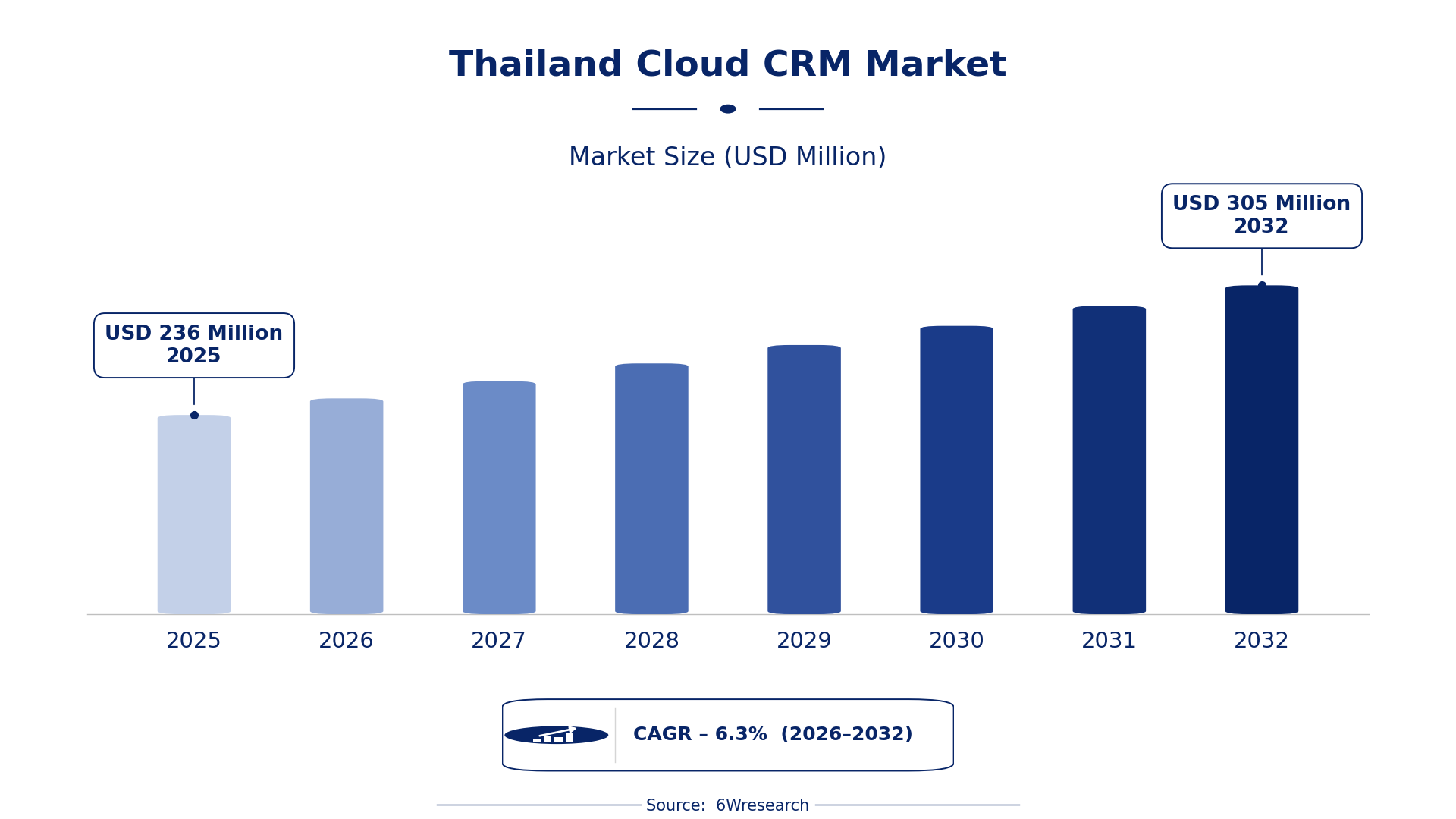
The Thailand Cloud CRM Market was estimated at USD 236 Million in 2025 and is projected to reach USD 305 Million by 2032, growing at a CAGR of 6.3% from 2026 to 2032.
Thailand Cloud CRM Market Synopsis
The demand for cloud-based Customer Relationship Management (CRM) solutions is the strongest force shaping the Thailand Cloud CRM Market right now. Businesses across various sectors are increasingly adopting these tools to centralize customer data and enhance engagement, ultimately driving sales efficiency and customer satisfaction.
Organizations in Thailand are now prioritizing customer-centric strategies more than ever, positioning cloud CRM as a critical component of their digital transformation initiatives. This shift underscores a growing recognition of the need for scalable and agile platforms to manage customer relationships effectively in a competitive environment.
Thailand Cloud CRM Market Year-wise Growth Rate and Key Drivers
This graph illustrates the annual growth rates of the Thailand Cloud CRM Market from 2021 to 2032, highlighting a steady upward trajectory and projected expansion over the forecast period.
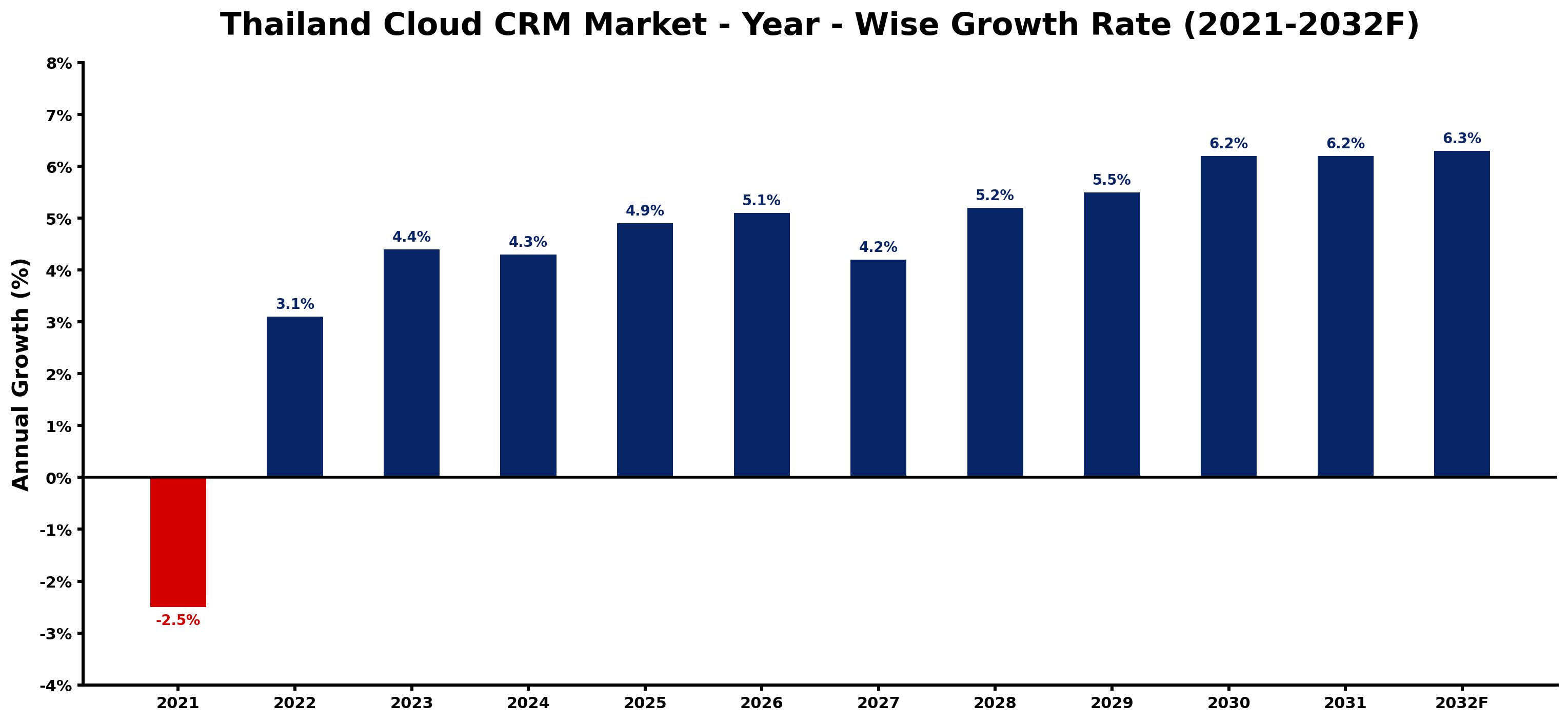
The table below presents the year‑wise growth rates along with the key drivers influencing the market
| Year | Growth Rate | Major Drivers |
| 2021 | -2.5% | Thailand's strict data localization laws hinder cloud adoption. |
| 2022 | 3.1% | Increased digital transformation efforts by Thai SMEs. |
| 2023 | 4.4% | Government initiatives promoting e-commerce adoption in Thailand. |
| 2024 | 4.3% | Growth in mobile internet users enhancing CRM accessibility. |
| 2025 | 4.9% | Rise of Thailand’s digital marketing strategies influencing CRM demand. |
| 2026 | 5.1% | Emergence of local cloud service providers boosting market competition. |
| 2027 | 4.2% | Demand for data-driven insights among Thai businesses rising. |
| 2028 | 5.2% | Increased investment in customer engagement technologies in Thailand. |
| 2029 | 5.5% | Proliferation of social media platforms driving customer interactions. |
| 2030 | 6.2% | Thailand's growing interest in AI-based CRM solutions. |
| 2031 | 6.2% | Boost in customer loyalty programs enhancing CRM implementations. |
| 2032 | 6.3% | Rising focus on customer data privacy regulations in Thailand. |
Note: Market size estimations and growth projections presented in this report are based on 6Wresearch's proprietary forecasting methodology, utilizing the latest available industry data, government publications, and primary research inputs.
Thailand Cloud CRM Market Key Takeaways
Below are some of the specific key takeaways from the market, including:
- Cloud CRM solutions are increasingly being recognized for their ability to streamline customer interactions and improve sales processes.
- The pandemic has acted as a catalyst for cloud CRM adoption, with businesses seeking digital solutions for better customer engagement.
- Data security and compliance with regulations remain significant concerns for organizations transitioning to cloud-based CRM systems.
- Local businesses are increasingly demanding tailored CRM solutions that cater to their unique operational needs.
- Government initiatives are beginning to support the adoption of cloud technologies, enhancing the market's growth prospects.
Evaluation of Restraints in Thailand Cloud CRM Market
Despite the promising growth trajectory, the Thailand Cloud CRM Market faces notable restraints. Data security concerns are paramount; businesses hesitate to migrate sensitive customer information to cloud platforms due to potential breaches and compliance issues. Additionally, the customization needs of various industries complicate the implementation of standardized solutions, often resulting in resistance to adopting cloud CRM. Organizations are also grappling with the challenge of integrating new systems with legacy CRM solutions, making the transition daunting for many.
Thailand Cloud CRM Market Trends
A few key trends are shaping the Thailand Cloud CRM Market. First, there's a marked shift towards AI-driven analytics, enabling companies to glean actionable insights from customer data. As businesses focus on personalization, CRM solutions are evolving to offer more tailored experiences, enhancing customer loyalty. on top of that, the integration of social media channels within CRM platforms is becoming commonplace, allowing for a more comprehensive understanding of customer behavior.
Thailand Cloud CRM Market Opportunities
The potential for growth in the Thailand Cloud CRM Market is considerable. Businesses looking to enhance their customer engagement strategies present ripe opportunities for CRM providers. Additionally, the demand for mobile-compatible CRM solutions is on the rise, driven by an increasingly remote workforce. Investing in security features that address data protection concerns can also set providers apart in this competitive market.
Government Initiatives in the Thailand Cloud CRM Market
The Thai government is actively fostering an environment conducive to the growth of cloud technologies, including CRM solutions. Public policy is increasingly focused on promoting digital transformation across various sectors, which is vital for the Cloud CRM Market's expansion. Regulatory frameworks aimed at enhancing data protection and encouraging technological adoption are crucial in shaping the trajectory of this market.
- A recent initiative launched in 2023 focuses on upgrading digital infrastructure to support cloud technology adoption among small and medium enterprises (SMEs).
- Currently ongoing is a program that aims to streamline regulatory compliance for cloud service providers, enhancing operational efficiency and encouraging innovation.
- There is a planned public-private partnership expected to enhance data security measures by 2025, which will directly benefit cloud CRM solutions.
- The government is promoting a national digital literacy campaign, initiated in early 2024, to educate businesses on the advantages of cloud technologies.
Future Insights of the Thailand Cloud CRM Market
Looking ahead to 2026-2032, the Thailand Cloud CRM Market is set to evolve significantly. As businesses continue to recognize the importance of customer relationships, the demand for sophisticated, cloud-based solutions will intensify. This evolution will be supported by advancements in technology and an increasing emphasis on data-driven decision-making. on top of that, the ongoing development of regulatory frameworks will play a crucial role in shaping market dynamics, ensuring that businesses can operate securely and effectively within the cloud ecosystem.
Thailand Cloud CRM Market Latest Developments
The last 12-14 months have seen a flurry of activity within the Thailand Cloud CRM Market, signaling a robust push towards digital transformation. Organizations are not only adopting cloud solutions at an accelerated pace but are also exploring innovative features to enhance customer engagement. This trend reflects a clear commitment to modernizing customer relationship management practices across the board.
- A leading regional operator launched a new AI-driven CRM platform in Q1 2025, focusing on personalized customer engagement solutions.
- In mid-2025, a major technology vendor initiated a partnership with local businesses to integrate CRM solutions with existing sales systems.
- A service upgrade enhancing data analytics capabilities for cloud CRM solutions is currently underway, expected to be completed by late 2025.
- Another rollout of a user-friendly mobile CRM application is planned for Q3 2026, targeting the growing remote workforce.
Thailand Cloud CRM Market - Key Attractiveness of the Report
- 10 Years of Market Numbers
- Historical Data Starting from 2022 to 2025
- Base Year: 2025
- Forecast Data until 2032
- Key Performance Indicators Impacting the Market
- Major Upcoming Developments and Projects
Key Highlights of the Report:
- Thailand Cloud CRM Market Outlook
- Market Size of Thailand Cloud CRM Market, 2025
- Forecast of Thailand Cloud CRM Market, 2032
- Historical Data and Forecast of Thailand Cloud CRM Revenues & Volume for the Period 2022-2032F
- Thailand Cloud CRM Market Trend Evolution
- Thailand Cloud CRM Market Drivers and Challenges
- Thailand Cloud CRM Price Trends
- Thailand Cloud CRM Porter's Five Forces
- Thailand Cloud CRM Industry Life Cycle
- Historical Data and Forecast of Thailand Cloud CRM Market Revenues & Volume By Vertical for the Period 2022-2032F
- Historical Data and Forecast of Thailand Cloud CRM Market Revenues & Volume By Nonprofit for the Period 2022-2032F
- Historical Data and Forecast of Thailand Cloud CRM Market Revenues & Volume By Higher Education for the Period 2022-2032F
- Historical Data and Forecast of Thailand Cloud CRM Market Revenues & Volume By Nonprofit Sub Vertical for the Period 2022-2032F
- Historical Data and Forecast of Thailand Cloud CRM Market Revenues & Volume By Education for the Period 2022-2032F
- Historical Data and Forecast of Thailand Cloud CRM Market Revenues & Volume By Research and Innovation for the Period 2022-2032F
- Historical Data and Forecast of Thailand Cloud CRM Market Revenues & Volume By Social Affairs for the Period 2022-2032F
- Historical Data and Forecast of Thailand Cloud CRM Market Revenues & Volume By Children and Youth for the Period 2022-2032F
- Historical Data and Forecast of Thailand Cloud CRM Market Revenues & Volume By Art and Culture for the Period 2022-2032F
- Historical Data and Forecast of Thailand Cloud CRM Market Revenues & Volume By Others for the Period 2022-2032F
- Thailand Cloud CRM Import Export Trade Statistics
- Market Opportunity Assessment By Vertical
- Market Opportunity Assessment By Nonprofit Sub Vertical
- Thailand Cloud CRM Top Companies Market Share
- Thailand Cloud CRM Competitive Benchmarking By Technical and Operational Parameters
- Thailand Cloud CRM Company Profiles
- Thailand Cloud CRM Key Strategic Recommendations






































