Thailand Cloud Service Market (2026-2032) | Value, Forecast, Growth, Trends, Outlook, Size & Revenue, Competitive Landscape, Segmentation, Share, Analysis, Industry, Companies
Market Forecast By Service Type (Infrastructure as a Service, Software as a Service, Platform as a Service), By Type (Public Cloud, Private Cloud, Hybrid Cloud), By Organization Size (Small and Medium-sized Enterprises, Large Enterprises), By End Use (Banking, Financial Services and Insurance (BFSI), Healthcare, Retail and Warehousing, Manufacturing, IT and Telecom, Media and Entertainment, Others) And Competitive Landscape
| Product Code: ETC9697865 | Publication Date: Sep 2024 | Updated Date: May 2026 | Product Type: Market Research Report | |
| Publisher: 6Wresearch | Author: Sumit Sagar | No. of Pages: 75 | No. of Figures: 35 | No. of Tables: 20 |
Thailand Cloud Service Market Growth Rate
According to 6Wresearch internal database and industry insights, the Thailand Cloud Service Market is expected to grow at a compound annual growth rate (CAGR) of 16.5% during the forecast period (2026-2032).
Thailand Cloud Service Market Year-wise Growth Rate and Key Drivers
This graph highlights how the Thailand Cloud Service Market has steadily grown over the past five years, supported by major growth factors.
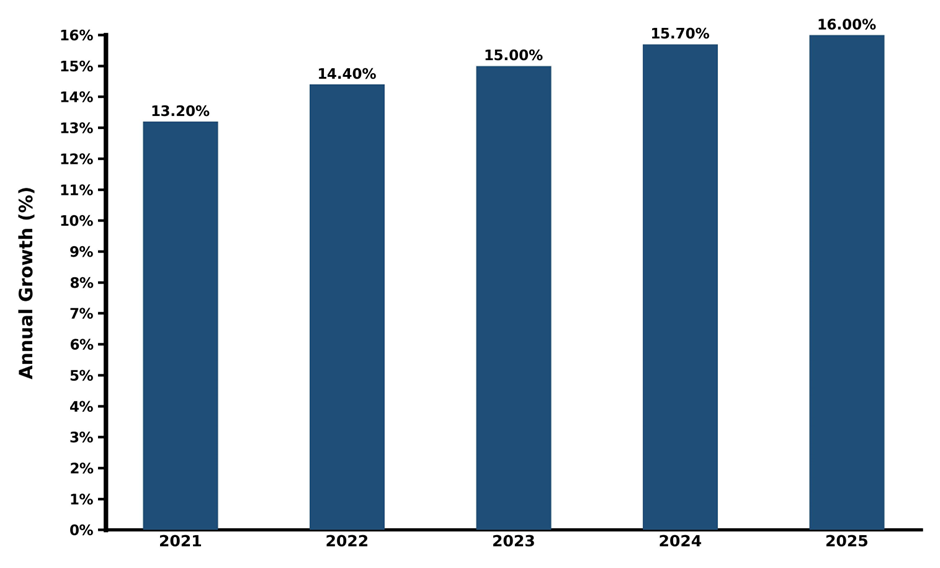
The table below presents the year‑wise growth rates along with the key drivers influencing the market
| Years | Est. Annual Growth (%) | Growth Drivers |
| 2021 | 13.2% | Increasing adoption of cloud-based solutions in small and medium-sized enterprises (SMEs). |
| 2022 | 14.4% | An increase in the demand for scalable infrastructure and business agility in the wake of the pandemic. |
| 2023 | 15% | Increasing digital transformation in companies and the need for solutions for data security and storage. |
| 2024 | 15.7% | Improvements in AI, machine learning and big data analytics boosting cloud services. |
| 2025 | 16% | An increase in the adoption of hybrid cloud solutions across enterprises, seeking flexibility and security |
Topics Covered in the Thailand Cloud Service Market Report
The Thailand Cloud Service Market report majorly covers the market by service type, cloud type, organization size, and end use. This report provides an in-depth analysis of ongoing market trends, opportunities, and market drivers that will be vital for stakeholders to align their strategies based on current and future market trends.
Thailand Cloud Service Market Highlights
| Report Name |
Thailand Cloud Service Market |
| Forecast period | 2026-2032 |
| CAGR | 16.5% |
| Market Size |
Banking, Financial Services and Insurance (BFSI) |
Thailand Cloud Service Market Synopsis
The Thailand Cloud Service Market is growing in the recent years, on account of the increasing adoption of cloud-based infrastructure solutions by businesses in the country looking to cut operational costs, improve scalability, and make sure data security. Furthermore, the growing demand for public and private cloud solutions, combined with an increase in cloud-based technologies in various industries, is anticipated to boost the growth of the market in the coming years.
Evaluation of Growth Drivers in Thailand Cloud Service Market (2026-2032)
Below is a table listing major drivers responsible for the growth of the Thailand Cloud Service Market and their influence on the market dynamics:
| Drivers | Primary Segment Affected | Why It Matters (Evidence) |
| Digital Transformation | All Segments | Businesses increasingly turn to the cloud for digital transformation to increase operational efficiency and agility. |
| Data Security and Compliance | Infrastructure as a Service (IaaS), Software as a Service (SaaS) | Increasing concerns about data privacy and security, driving demand for secure cloud services. |
| Hybrid Cloud Adoption | All Segments | Enterprises adopting hybrid cloud models for better flexibility between on-premise and cloud solutions. |
| Cloud Scalability and Cost Efficiency | IaaS, SaaS, PaaS | There is a rising need for scalable cloud solutions, which offer businesses flexibility and cost savings. |
| Government Support | All Segments | Thai government initiatives promoting digital economy encourage cloud adoption in SMEs and large enterprises. |
The Thailand Cloud Service Market is anticipated to grow at a compound annual growth rate (CAGR) of 16.5% during the forecast period (2026–2032), underpinned by the growing need for scalability, flexibility, and cost-efficient solutions, especially in small and medium-sized enterprises (SMEs). The rising improvements in technology & infrastructure development and increasing adoption of cloud-based solutions in the country are leaving a positive impact on the cloud service’s demand. Lastly, the increasing integration of artificial intelligence (AI), machine learning (ML), and big data analytics within cloud offerings is expected to fuel Thailand Cloud Service Market growth.
Evaluation of Restraints in the Thailand Cloud Service Market
The table below highlights some of the major restraints and their influence on market dynamics:
| Restraints | Primary Segment Affected | What This Means (Evidence) |
| High Initial Investment Costs | Small and Medium-sized Enterprises | SMEs may hesitate to adopt cloud solutions due to high initial costs, making cloud service adoption slower in the SME sector. |
| Data Privacy Concerns | Public Cloud | Concerns over data security, compliance with local regulations, and risks associated with public cloud environments can deter businesses from fully embracing public cloud solutions. |
| Limited Technical Expertise | SMEs, Small Enterprises | Due to a less availability of skilled IT personnel in smaller enterprises, the efficient use and management of cloud services may be affected. |
| Regulatory Barriers | All Segments | Government rules on cloud data storage could slow down the growth of cloud services especially in sectors such as healthcare and finance. |
| Connectivity and Infrastructure Challenges | Rural Areas, Small Enterprises | The lack of high-speed internet and reliable cloud infrastructure could restrict the adoption of cloud services, which make them less accessible to businesses. |
Thailand Cloud Service Market Challenges
Despite strong growth potential of the Thailand Cloud Service Market, it faces several challenges that could affect its growth. One of the main challenges is the high initial investment that is required for cloud infrastructure, which may stop small businesses to adopt cloud services. Also, data privacy and security concerns, particularly in the public cloud sector, may deter organizations to move critical data and applications to cloud platforms.
Thailand Cloud Service Market Trends
Below mentioned are some of the major trends in the Thailand Cloud Service Market:
- Integration with AI and Machine Learning: To improve decision-making and operational efficiency, cloud services are increasingly being integrated with artificial intelligence (AI) and machine learning technologies.
- Hybrid Cloud Solutions: There is an increasing adoption rate of hybrid cloud models, where businesses use both private and public clouds, which is a major trend driving the market.
- Cloud Adoption in Healthcare: To make sure better patient data management and collaboration across multiple healthcare systems, cloud solutions adoption is being increased in the healthcare industry.
Investment Opportunities in the Thailand Cloud Service Market
Here are some of the investment opportunities in the Thailand Cloud Service Market:
- Cloud Security Solutions: Investments in robust security measures for cloud solutions can open new opportunities in both public and private cloud markets.
- SME Cloud Adoption Programs: Developing affordable cloud solutions and providing incentives for SMEs to migrate to the cloud. This generates a significant market opportunity.
- AI-Driven Cloud Services: There is a large investment opportunity for new investors, with the increasing demand for AI-enabled cloud solutions for data analytics and decision-making.
Top 5 Leading Players in Thailand Cloud Service Market
Stated below are some of the leading companies holding a significant share of the Thailand Cloud Service Market:
1. Amazon Web Services (AWS)
| Company Name | Amazon Web Services (AWS) |
|---|---|
| Established Year | 2006 |
| Headquarters | Seattle, USA |
| Official Website | Click Here |
A global leader in cloud computing, AWS provides a broad range of infrastructure, platform, and software services for enterprises, SMEs, and governments.
2. Microsoft Azure
| Company Name | Microsoft Azure |
|---|---|
| Established Year | 2010 |
| Headquarters | Redmond, USA |
| Official Website | Click Here |
Microsoft Azure offers cloud computing solutions with a strong focus on hybrid cloud services, AI, and data analytics.
3. Google Cloud
| Company Name | Google Cloud |
|---|---|
| Established Year | 2008 |
| Headquarters | Mountain View, USA |
| Official Website | Click Here |
Google Cloud provides cloud solutions across AI, machine learning, and big data analytics, with a significant presence in Asia-Pacific.
4. Alibaba Cloud
| Company Name | Alibaba Cloud |
|---|---|
| Established Year | 2009 |
| Headquarters | Hangzhou, China |
| Official Website | Click Here |
Alibaba Cloud is a prominent player in the Asian cloud market, offering a range of cloud solutions, including IaaS, PaaS, and SaaS.
5. IBM Cloud
| Company Name | IBM Cloud |
|---|---|
| Established Year | 2017 |
| Headquarters | Armonk, USA |
| Official Website | Click Here |
IBM Cloud provides enterprise-grade cloud solutions with a focus on hybrid cloud, AI, and blockchain services.
Government Initiatives Introduced in the Thailand Cloud Service Market
According to Thai government data, some major initiatives are taken to promote digital transformation and cloud service adoption in the country. Such as to increase the adoption rate of cloud services, which include tax incentives, funding for technology upgrades, various programs and incentives have been implemented. Another major policy is the "Thailand 4.0" policy, where the government is focusing more on the growth of a digital economy, pushing businesses, especially small and medium-sized enterprises (SMEs), to embrace cloud computing solutions. This initiative is set with aims to improve operational efficiency as well as support the digital transformation of Thai businesses.
Future Insights of the Thailand Cloud Service Market
The future of the Thailand Cloud Service Market seems optimistic as businesses have been increasingly embracing digital transformation to improve operational efficiency, scalability, and agility. Also, there is a rising adoption of advanced technologies such as artificial intelligence (AI), machine learning (ML), and edge computing integrated with cloud platforms, which will increase the demand for cloud solutions. Hybrid cloud models are anticipated to gain traction as organizations seek flexibility between on-premise and cloud environments, while growing focus on data security, regulatory compliance.
Market Segmentation Analysis
The report offers a detailed study of the following market segments and their dominating categories in the Thailand Cloud Service Market:
By Service Type – Software as a Service (SaaS) Dominates the Market
According to Priya, Senior Research Analyst, 6Wresearch, SaaS dominates the market due to the widespread adoption of subscription-based software applications across various industries. SaaS solutions, offering scalable, pay-per-use pricing, and easy integration with business processes, are particularly preferred by small and medium-sized enterprises (SMEs) and large enterprises alike for CRM, ERP, and collaboration tools.
By Cloud Type – Hybrid Cloud to Lead the Market
Hybrid Cloud is expected to lead the market as businesses continue to seek flexibility and scalability in managing workloads between private and public clouds. Hybrid cloud solutions allow organizations to optimize operations by storing sensitive data on private clouds and utilizing public clouds for non-sensitive workloads, therefore enabling both security and agility.
By End Use – Banking, Financial Services and Insurance (BFSI) to Lead the Market
BFSI is expected to lead the Thailand Cloud Service Market share owing to the increasing demand for digital banking services, secure financial transactions, and regulatory compliance. The BFSI sector extensively uses cloud services for data management and customer relationship management (CRM).
Key Attractiveness of the Report
- 10 Years of Market Numbers
- Historical Data Starting from 2022 to 2025
- Base Year: 2025
- Forecast Data until 2032
- Key Performance Indicators Impacting the Market
- Major Upcoming Developments and Projects
Key Highlights of the Report:
- Thailand Cloud Service Market Outlook
- Market Size of Thailand Cloud Service Market, 2025
- Forecast of Thailand Cloud Service Market, 2032
- Historical Data and Forecast of Thailand Cloud Service Revenues & Volume for the Period 2022- 2032
- Thailand Cloud Service Market Trend Evolution
- Thailand Cloud Service Market Drivers and Challenges
- Thailand Cloud Service Price Trends
- Thailand Cloud Service Porter's Five Forces
- Thailand Cloud Service Industry Life Cycle
- Historical Data and Forecast of Thailand Cloud Service Market Revenues & Volume By Service Type for the Period 2022- 2032
- Historical Data and Forecast of Thailand Cloud Service Market Revenues & Volume By Infrastructure as a Service for the Period 2022- 2032
- Historical Data and Forecast of Thailand Cloud Service Market Revenues & Volume By Software as a Service for the Period 2022- 2032
- Historical Data and Forecast of Thailand Cloud Service Market Revenues & Volume By Platform as a Service for the Period 2022- 2032
- Historical Data and Forecast of Thailand Cloud Service Market Revenues & Volume By Type for the Period 2022- 2032
- Historical Data and Forecast of Thailand Cloud Service Market Revenues & Volume By Public Cloud for the Period 2022- 2032
- Historical Data and Forecast of Thailand Cloud Service Market Revenues & Volume By Private Cloud for the Period 2022- 2032
- Historical Data and Forecast of Thailand Cloud Service Market Revenues & Volume By Hybrid Cloud for the Period 2022- 2032
- Historical Data and Forecast of Thailand Cloud Service Market Revenues & Volume By Organization Size for the Period 2022- 2032
- Historical Data and Forecast of Thailand Cloud Service Market Revenues & Volume By Small and Medium-sized Enterprises for the Period 2022- 2032
- Historical Data and Forecast of Thailand Cloud Service Market Revenues & Volume By Large Enterprises for the Period 2022- 2032
- Historical Data and Forecast of Thailand Cloud Service Market Revenues & Volume By End Use for the Period 2022- 2032
- Historical Data and Forecast of Thailand Cloud Service Market Revenues & Volume By Banking for the Period 2022- 2032
- Historical Data and Forecast of Thailand Cloud Service Market Revenues & Volume By Financial Services and Insurance (BFSI) for the Period 2022- 2032
- Historical Data and Forecast of Thailand Cloud Service Market Revenues & Volume By Healthcare for the Period 2022- 2032
- Historical Data and Forecast of Thailand Cloud Service Market Revenues & Volume By Retail and Warehousing for the Period 2022- 2032
- Historical Data and Forecast of Thailand Cloud Service Market Revenues & Volume By Manufacturing for the Period 2022- 2032
- Historical Data and Forecast of Thailand Cloud Service Market Revenues & Volume By IT and Telecom for the Period 2022- 2032
- Historical Data and Forecast of Thailand Cloud Service Market Revenues & Volume By Media and Entertainment, for the Period 2022- 2032
- Historical Data and Forecast of Thailand Cloud Service Market Revenues & Volume By Others for the Period 2022- 2032
- Thailand Cloud Service Import Export Trade Statistics
- Market Opportunity Assessment By Service Type
- Market Opportunity Assessment By Type
- Market Opportunity Assessment By Organization Size
- Market Opportunity Assessment By End Use
- Thailand Cloud Service Top Companies Market Share
- Thailand Cloud Service Competitive Benchmarking By Technical and Operational Parameters
- Thailand Cloud Service Company Profiles
- Thailand Cloud Service Key Strategic Recommendations
Market Covered
The report subsequently covers the market by following segments and subsegments.
By Service Type:
- Infrastructure as a Service
- Software as a Service
- Platform as a Service
By Type:
- Public Cloud
- Private Cloud
- Hybrid Cloud
By Organization Size:
- Small and Medium-sized Enterprises
- Large Enterprises
By End Use:
- Banking, Financial Services and Insurance (BFSI)
- Healthcare
- Retail and Warehousing
- Manufacturing
- IT and Telecom
- Media and Entertainment
- Others
Thailand Cloud Service Market (2026-2032): FAQs
The Thailand Cloud Service Market is projected to grow at a CAGR of 16.5% during the forecast period (2026-2032).
Key technological advancements include the integration of AI and machine learning in cloud platforms and the adoption of multi-cloud and hybrid cloud architectures.
The growth is driven by digital transformation initiatives across industries and government support for cloud infrastructure development.
Major challenges include data security and privacy concerns, lack of skilled professionals, high costs associated with cloud migration, and regulatory barriers.
6Wresearch actively monitors the Thailand Cloud Service Market and publishes its comprehensive annual report, highlighting emerging trends, growth drivers, revenue analysis, and forecast outlook. Our insights help businesses to make data-backed strategic decisions with ongoing market dynamics. Our analysts track relevent industries related to the Thailand Cloud Service Market, allowing our clients with actionable intelligence and reliable forecasts tailored to emerging regional needs.
Yes, we provide customisation as per your requirements. To learn more, feel free to contact us on sales@6wresearch.com
| 1 Executive Summary |
| 2 Introduction |
| 2.1 Key Highlights of the Report |
| 2.2 Report Description |
| 2.3 Market Scope & Segmentation |
| 2.4 Research Methodology |
| 2.5 Assumptions |
| 3 Thailand Cloud Service Market Overview |
| 3.1 Thailand Country Macro Economic Indicators |
| 3.2 Thailand Cloud Service Market Revenues & Volume, 2022 & 2032F |
| 3.3 Thailand Cloud Service Market - Industry Life Cycle |
| 3.4 Thailand Cloud Service Market - Porter's Five Forces |
| 3.5 Thailand Cloud Service Market Revenues & Volume Share, By Service Type, 2022 & 2032F |
| 3.6 Thailand Cloud Service Market Revenues & Volume Share, By Type, 2022 & 2032F |
| 3.7 Thailand Cloud Service Market Revenues & Volume Share, By Organization Size, 2022 & 2032F |
| 3.8 Thailand Cloud Service Market Revenues & Volume Share, By End Use, 2022 & 2032F |
| 4 Thailand Cloud Service Market Dynamics |
| 4.1 Impact Analysis |
| 4.2 Market Drivers |
| 4.2.1 Increasing adoption of digital transformation strategies by businesses in Thailand |
| 4.2.2 Growing demand for cost-effective and scalable IT solutions |
| 4.2.3 Government initiatives to promote cloud technology adoption in the country |
| 4.3 Market Restraints |
| 4.3.1 Concerns about data security and privacy in cloud services |
| 4.3.2 Limited availability of high-speed internet infrastructure in certain regions of Thailand |
| 4.3.3 Resistance to change and lack of awareness about the benefits of cloud services among traditional businesses |
| 5 Thailand Cloud Service Market Trends |
| 6 Thailand Cloud Service Market, By Types |
| 6.1 Thailand Cloud Service Market, By Service Type |
| 6.1.1 Overview and Analysis |
| 6.1.2 Thailand Cloud Service Market Revenues & Volume, By Service Type, 2022- 2032F |
| 6.1.3 Thailand Cloud Service Market Revenues & Volume, By Infrastructure as a Service, 2022- 2032F |
| 6.1.4 Thailand Cloud Service Market Revenues & Volume, By Software as a Service, 2022- 2032F |
| 6.1.5 Thailand Cloud Service Market Revenues & Volume, By Platform as a Service, 2022- 2032F |
| 6.2 Thailand Cloud Service Market, By Type |
| 6.2.1 Overview and Analysis |
| 6.2.2 Thailand Cloud Service Market Revenues & Volume, By Public Cloud, 2022- 2032F |
| 6.2.3 Thailand Cloud Service Market Revenues & Volume, By Private Cloud, 2022- 2032F |
| 6.2.4 Thailand Cloud Service Market Revenues & Volume, By Hybrid Cloud, 2022- 2032F |
| 6.3 Thailand Cloud Service Market, By Organization Size |
| 6.3.1 Overview and Analysis |
| 6.3.2 Thailand Cloud Service Market Revenues & Volume, By Small and Medium-sized Enterprises, 2022- 2032F |
| 6.3.3 Thailand Cloud Service Market Revenues & Volume, By Large Enterprises, 2022- 2032F |
| 6.4 Thailand Cloud Service Market, By End Use |
| 6.4.1 Overview and Analysis |
| 6.4.2 Thailand Cloud Service Market Revenues & Volume, By Banking, 2022- 2032F |
| 6.4.3 Thailand Cloud Service Market Revenues & Volume, By Financial Services and Insurance (BFSI), 2022- 2032F |
| 6.4.4 Thailand Cloud Service Market Revenues & Volume, By Healthcare, 2022- 2032F |
| 6.4.5 Thailand Cloud Service Market Revenues & Volume, By Retail and Warehousing, 2022- 2032F |
| 6.4.6 Thailand Cloud Service Market Revenues & Volume, By Manufacturing, 2022- 2032F |
| 6.4.7 Thailand Cloud Service Market Revenues & Volume, By IT and Telecom, 2022- 2032F |
| 6.4.8 Thailand Cloud Service Market Revenues & Volume, By Others, 2022- 2032F |
| 6.4.9 Thailand Cloud Service Market Revenues & Volume, By Others, 2022- 2032F |
| 7 Thailand Cloud Service Market Import-Export Trade Statistics |
| 7.1 Thailand Cloud Service Market Export to Major Countries |
| 7.2 Thailand Cloud Service Market Imports from Major Countries |
| 8 Thailand Cloud Service Market Key Performance Indicators |
| 8.1 Average revenue per user (ARPU) for cloud services in Thailand |
| 8.2 Percentage of businesses in Thailand using cloud services for critical operations |
| 8.3 Rate of growth in the number of cloud service providers in Thailand |
| 9 Thailand Cloud Service Market - Opportunity Assessment |
| 9.1 Thailand Cloud Service Market Opportunity Assessment, By Service Type, 2022 & 2032F |
| 9.2 Thailand Cloud Service Market Opportunity Assessment, By Type, 2022 & 2032F |
| 9.3 Thailand Cloud Service Market Opportunity Assessment, By Organization Size, 2022 & 2032F |
| 9.4 Thailand Cloud Service Market Opportunity Assessment, By End Use, 2022 & 2032F |
| 10 Thailand Cloud Service Market - Competitive Landscape |
| 10.1 Thailand Cloud Service Market Revenue Share, By Companies, 2025 |
| 10.2 Thailand Cloud Service Market Competitive Benchmarking, By Operating and Technical Parameters |
| 11 Company Profiles |
| 12 Recommendations |
| 13 Disclaimer |
Global Go To Market Strategy - 2030
Export potential enables firms to identify high-growth global markets with greater confidence by combining advanced trade intelligence with a structured quantitative methodology. The framework analyzes emerging demand trends and country-level import patterns while integrating macroeconomic and trade datasets such as GDP and population forecasts, bilateral import–export flows, tariff structures, elasticity differentials between developed and developing economies, geographic distance, and import demand projections. Using weighted trade values from 2020–2024 as the base period to project country-to-country export potential for 2030, these inputs are operationalized through calculated drivers such as gravity model parameters, tariff impact factors, and projected GDP per-capita growth. Through an analysis of hidden potentials, demand hotspots, and market conditions that are most favorable to success, this method enables firms to focus on target countries, maximize returns, and global expansion with data, backed by accuracy.
By factoring in the projected importer demand gap that is currently unmet and could be potential opportunity, it identifies the potential for the Exporter (Country) among 190 countries, against the general trade analysis, which identifies the biggest importer or exporter.
To discover high-growth global markets and optimize your business strategy:
Click Here
Pricing
- Single User License$ 1,995
- Department License$ 2,400
- Site License$ 3,120
- Global License$ 3,795

Leadership Perspectives from Industry Events
Search
Thought Leadership and Analyst Meet





Our Clients








6WResearch In News
- India Air Conditioner Market Set for Strong Rebound in 2026 After Weather-Led Correction and GST-Driven Recovery: 6Wresearch
- ADAS in India: How Automatic Emergency Braking, Blind Spot Detection & Driver Monitoring are Transforming Road Safety
- Doha a strategic location for EV manufacturing hub: IPA Qatar
- Demand for luxury TVs surging in the GCC, says Samsung
- Empowering Growth: The Thriving Journey of Bangladesh’s Cable Industry
- Demand for luxury TVs surging in the GCC, says Samsung
Latest Reports
- Poland Fire Protection Systems Market (2026-2032)
- Cape Verde Portable Hand-Thrown Extinguisher Market (2026-2032)
- Canada Portable Hand-Thrown Extinguisher Market (2026-2032)
- Cameroon Portable Hand-Thrown Extinguisher Market (2026-2032)
- Burundi Portable Hand-Thrown Extinguisher Market (2026-2032)
- Burkina Faso Portable Hand-Thrown Extinguisher Market (2026-2032)
- Bulgaria Portable Hand-Thrown Extinguisher Market (2026-2032)
- Brunei Portable Hand-Thrown Extinguisher Market (2026-2032)
- Botswana Portable Hand-Thrown Extinguisher Market (2026-2032)
- Bosnia and Herzegovina Portable Hand-Thrown Extinguisher Market (2026-2032)
Industry Events and Analyst Meet

HIMTEX 2026

India Refining Summit 2026

India EV Show 2026

EV tech India Expo 2026

Auto Tech Asia 2026
Whitepaper
- Middle East & Africa Commercial Security Market Click here to view more.
- Middle East & Africa Fire Safety Systems & Equipment Market Click here to view more.
- GCC Drone Market Click here to view more.
- Middle East Lighting Fixture Market Click here to view more.
- GCC Physical & Perimeter Security Market Click here to view more.


