Thailand Clutch Housing Market Size, Share & Growth Rate
The Thailand Clutch Housing Market was estimated at USD 146 Million in 2025 and is projected to reach USD 167 Million by 2032, growing at a CAGR of 1.9% from 2026 to 2032. This growth trajectory is primarily supported by the ongoing expansion of the automotive industry, where clutch housings are integral components for manual transmission systems. Additionally, as Thailand solidifies its position as a regional manufacturing hub, the influx of both domestic and international automotive production continues to fuel the demand for high-quality clutch housings.
Thailand Clutch Housing Market Year-wise Growth Rate and Key Drivers
This graph highlights how the Thailand Clutch Housing Market has steadily grown over the years, supported by major growth factors.
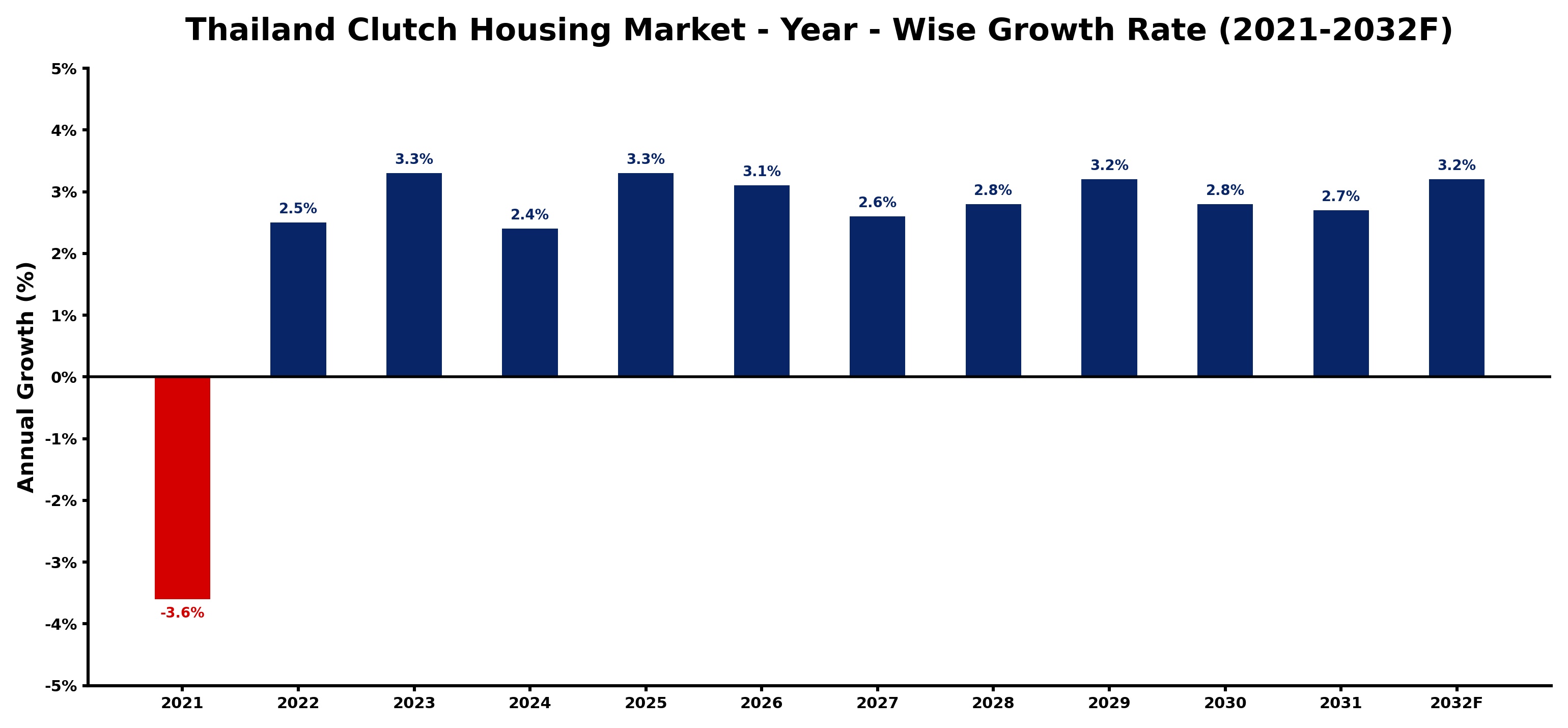
The table below presents the year‑wise growth rates along with the key drivers influencing the market
| Year | Growth Rate | Major Drivers |
| 2021 | -3.6% | Reduced manufacturing investments weakened demand for clutch housing components |
| 2022 | 2.5% | Increased assembly line efficiencies boosted clutch housing production output |
| 2023 | 3.3% | Local clutch housing manufacturers increased production capacity to meet export demands |
| 2024 | 2.4% | Thai manufacturers invest in precision machining for competitive edge |
| 2025 | 3.3% | OEM demand recovery boosted clutch housing manufacturing investment levels |
| 2026 | 3.1% | Local manufacturers adopt advanced materials to enhance clutch durability |
| 2027 | 2.6% | New manufacturing facilities boost Thailand's clutch housing production capacity |
| 2028 | 2.8% | Improved digital monitoring technologies enhanced clutch housing production efficiency |
| 2029 | 3.2% | New assembly line installations boost clutch housing production capacity |
| 2030 | 2.8% | Local suppliers ramped up production to meet automotive demand |
| 2031 | 2.7% | Domestic investments in robotics advanced clutch housing production efficiency |
| 2032 | 3.2% | Automotive sector recovery boosts demand for clutch housing production |
Note - Market size estimations and growth projections presented in this report are based on 6Wresearch's advanced forecasting approach, validated with industry datasets as of June 2026.
Thailand Clutch Housing Market Synopsis
The driving force shaping the Thailand clutch housing market is the robust automotive manufacturing sector, which accounts for a significant majority of the demand. This sector's growth is underpinned by increased vehicle production and a strong export orientation, encouraging local suppliers to scale their operations and innovate.
As vehicle electrification trends rise, manufacturers are also exploring new materials and designs that align with modern engineering standards. This shift is prompting a reevaluation of clutch designs, aimed at enhancing performance while reducing weight and production costs, ultimately driving market dynamics.
Thailand Clutch Housing Market Key Takeaways
- The market is poised for steady growth, aligning with the automotive sector's expansion.
- Domestic production coupled with increasing exports is creating significant demand for clutch housings.
- Technological advancements in materials and designs are fostering innovation in the market.
- Challenges related to vehicle electrification necessitate strategic adaptations among manufacturers.
- Key players in the market are increasingly focused on quality control and precision engineering.
Evaluation of Restraints in Thailand Clutch Housing Market
Despite its growth potential, the Thailand clutch housing market faces several restraints. The transition towards electric and hybrid vehicles reduces the demand for traditional clutch systems, compelling manufacturers to re-evaluate their production lines. Moreover, the pressure to maintain cost competitiveness while adhering to stringent quality standards can limit operational flexibility. As the market evolves, manufacturers must navigate these complexities to ensure sustainability and relevance in an increasingly dynamic automotive landscape.
Thailand Clutch Housing Market Trends
Emerging trends within the Thailand clutch housing market reflect a clear shift towards lightweight and durable materials, aimed at enhancing vehicle efficiency. Innovations in production technologies, such as additive manufacturing and enhanced metal forming techniques, are gaining traction. These advancements facilitate the design of more compact and efficient clutch housings, catering to the evolving needs of the automotive industry. Additionally, the rise of sustainability-focused manufacturing processes highlights a growing awareness among producers to minimize environmental impact.
Thailand Clutch Housing Market Opportunities
The market presents lucrative opportunities, particularly for manufacturers willing to invest in research and development. The increasing demand for electric vehicles opens a pathway for innovative clutch systems designed for hybrid models, which can create new revenue streams. Furthermore, enhancing partnerships with global automotive companies could drive exports, positioning local firms to capitalize on both domestic and international growth potential.
Government Initiatives in the Thailand Clutch Housing Market
The Thai government has implemented several initiatives to bolster the automotive sector, including incentives for research and development in eco-friendly technologies. Public spending in infrastructure and manufacturing facilities supports the automotive industry's expansion, encouraging domestic and foreign investment. Additionally, regulatory frameworks promoting sustainable practices are paving the way for innovations in manufacturing processes, aligning with global environmental standards.
Future Insights of the Thailand Clutch Housing Market
Looking towards 2026-2032, the Thailand clutch housing market is expected to undergo significant transformations driven by technological advancements and changing consumer preferences. With the shift towards electric and hybrid vehicles continuing to accelerate, manufacturers will need to adapt their offerings to meet new specifications. The integration of smart technologies in automotive components may also play a pivotal role, enhancing performance and usability. Overall, proactive adaptation and innovation will be key for stakeholders aiming to thrive in this evolving landscape.
Thailand Clutch Housing Market Latest Developments (May 2025 - June 2026)
Recent developments indicate a growing focus on sustainability within the Thailand clutch housing market. Companies are increasingly adopting eco-friendly manufacturing practices in response to regulatory shifts and consumer demand for greener solutions. Furthermore, collaborations between local manufacturers and international firms are becoming more common, fostering technological exchange and enhancing production capabilities. These trends are expected to shape the market positively as stakeholders align with global automotive trends.
Thailand Clutch Housing Market - Key Attractiveness of the Report
- 10 Years of Market Numbers
- Historical Data Starting from 2022 to 2025
- Base Year: 2025
- Forecast Data until 2032
- Key Performance Indicators Impacting the Market
- Major Upcoming Developments and Projects
Key Highlights of the Report:
- Thailand Clutch Housing Market Outlook
- Market Size of Thailand Clutch Housing Market, 2025
- Forecast of Thailand Clutch Housing Market, 2032
- Historical Data and Forecast of Thailand Clutch Housing Revenues & Volume for the Period 2022-2032F
- Thailand Clutch Housing Market Trend Evolution
- Thailand Clutch Housing Market Drivers and Challenges
- Thailand Clutch Housing Price Trends
- Thailand Clutch Housing Porter's Five Forces
- Thailand Clutch Housing Industry Life Cycle
- Historical Data and Forecast of Thailand Clutch Housing Market Revenues & Volume By Type for the Period 2022-2032F
- Historical Data and Forecast of Thailand Clutch Housing Market Revenues & Volume By Heavy Clutch Housing for the Period 2022-2032F
- Historical Data and Forecast of Thailand Clutch Housing Market Revenues & Volume By Large Clutch Housing for the Period 2022-2032F
- Historical Data and Forecast of Thailand Clutch Housing Market Revenues & Volume By Small Clutch Housing for the Period 2022-2032F
- Historical Data and Forecast of Thailand Clutch Housing Market Revenues & Volume By Application for the Period 2022-2032F
- Historical Data and Forecast of Thailand Clutch Housing Market Revenues & Volume By OEM(Original Equipment Manufacturers) for the Period 2022-2032F
- Historical Data and Forecast of Thailand Clutch Housing Market Revenues & Volume By Aftermarket for the Period 2022-2032F
- Historical Data and Forecast of Thailand Clutch Housing Market Revenues & Volume By Material Type for the Period 2022-2032F
- Historical Data and Forecast of Thailand Clutch Housing Market Revenues & Volume By Cast Iron for the Period 2022-2032F
- Historical Data and Forecast of Thailand Clutch Housing Market Revenues & Volume By Aluminium for the Period 2022-2032F
- Historical Data and Forecast of Thailand Clutch Housing Market Revenues & Volume By Others for the Period 2022-2032F
- Thailand Clutch Housing Import Export Trade Statistics
- Market Opportunity Assessment By Type
- Market Opportunity Assessment By Application
- Market Opportunity Assessment By Material Type
- Thailand Clutch Housing Top Companies Market Share
- Thailand Clutch Housing Competitive Benchmarking By Technical and Operational Parameters
- Thailand Clutch Housing Company Profiles
- Thailand Clutch Housing Key Strategic Recommendations






































