Thailand Coffee Market: Import Trend Analysis
Thailand coffee market saw a notable decline in import momentum from 2023 to 2024, with a growth rate of -75.36% during this period. The compound annual growth rate (CAGR) for imports from 2020 to 2024 was -81.35%. This significant downturn could be attributed to shifting consumer preferences, changes in trade policies, or market instability.
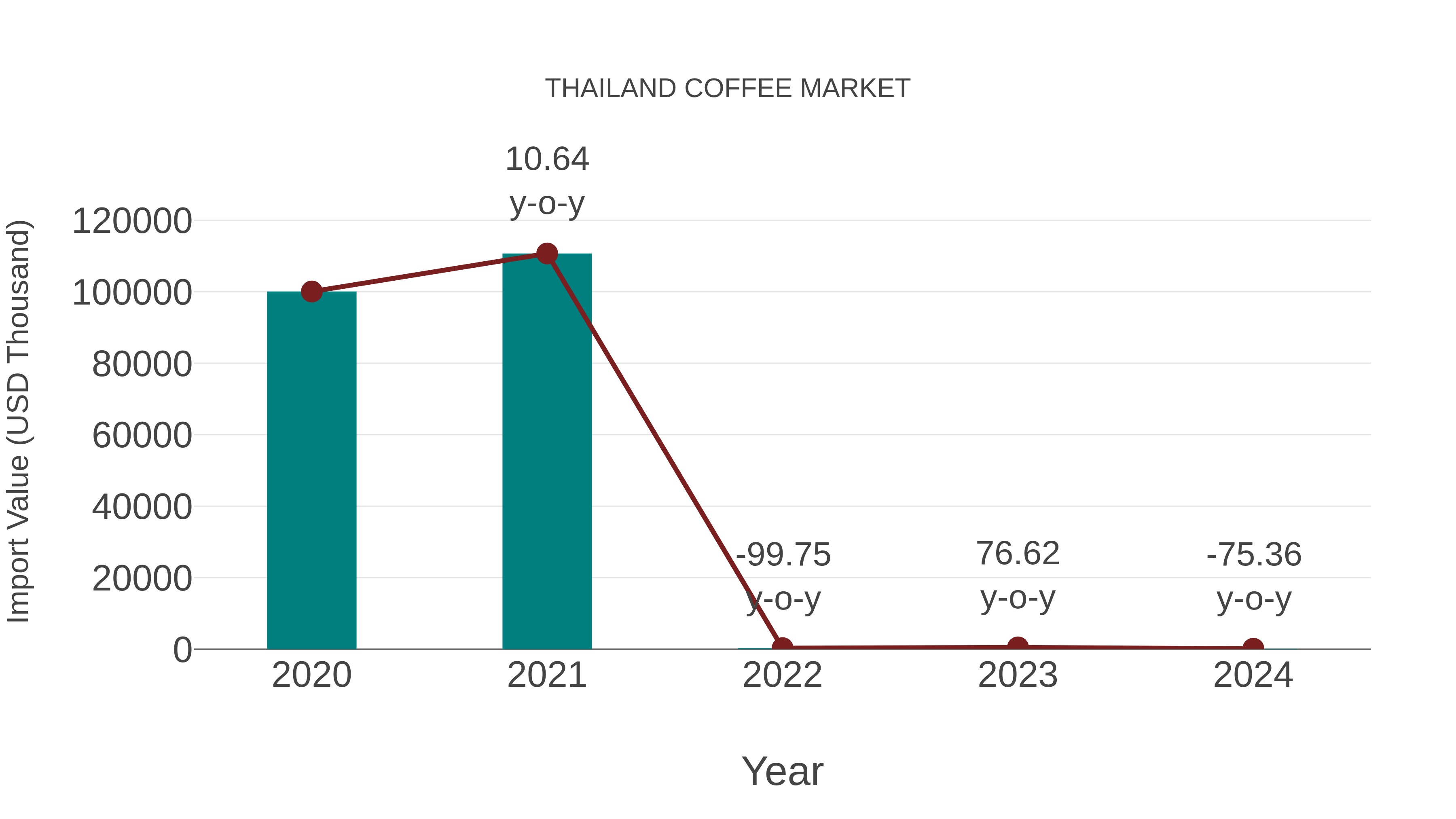
Thailand Coffee Market Growth Rate
According to 6Wresearch internal database and industry insights, the Thailand Coffee Market is expected to grow at a compound annual growth rate (CAGR) of 8.2% during the forecast period (2026–2032).
Topics Covered in the Thailand Coffee Market Report
The Thailand Coffee Market report thoroughly covers the market by product type and distribution channel. The report provides a detailed analysis of ongoing market trends, opportunities/high-growth areas, and market drivers that will help stakeholders align strategies based on current and future market dynamics.
Thailand Coffee Market Highlights
| Report Name | Thailand Coffee Market |
| Forecast Period | 2026–2032 |
| CAGR | 8.2% |
| Growing Sector | Coffee Pods and Online Retail |
Thailand Coffee Market Synopsis
Thailand Coffee Market is projected to accomplish major transformation in the coming years on the back of change in consumer behavior from traditional instant mixes to premium, high-quality artisanal brews. The "National Coffee Development Plan (2022–2031)" and the "Royal Projects," which have transformed the northern highlands into a global hub for sustainable Arabica production has further accelerated the Thailand Coffee Market growth.
Evaluation of Growth Drivers in Thailand Coffee Market
Below are some key drivers and their influence on the market dynamics:
| Drivers | Primary Segments Affected | Why It Matters |
| Change in Urban Lifestyle | By Product Type (Coffee Pods) | Busy professionals prefer the convenience and speed of single-serve capsules. |
| Influx of Tourism | By Distribution Channel (On-Trade) | Rebounding international visitor numbers boost sales in hotels and high-street cafes. |
| Health Awareness | By Product Type (Instant Coffee) | Demand for "3-in-1" mixes with abridged sugar or herbal additives is surging. |
| Premiumization | By Product Type (Whole-Bean) | Connoisseurs are widely investing in home grinders and high-grade specialty beans. |
| Digital Commerce | By Distribution Channel (Off-Trade) | E-commerce platforms simplify direct-to-consumer sales for boutique roasteries. |
Thailand Coffee Market is expected to grow at a CAGR of 8.2% during the forecast period 2026–2032. Demand is driven by evolving consumer tastes toward specialty and health-oriented formats, bolstered by the rise of café culture and RTD convenience. Thailand Coffee Market growth is further supported by rising disposable incomes, urbanisation, and youth adoption of premium coffee experiences. Wellness trends encourage low sugar and functional coffee products, while retail modernisation improves access across channels.
Evaluation of Restraints in Thailand Coffee Market
Below are some prominent restraints and their influence on the market dynamics:
| Restraints | Primary Segments Affected | What This Means |
| High Import Duties | By Product Type (Whole-Bean) | Substantial tariffs on imported roasted beans can increase prices for international brands. |
| Climate Change | By Product Type (All Segments) | The erratic weather patterns in the northern part of Thailand have disturbed the crop yields as well as the quality of beans. |
| Volatile Raw Material Prices | By Product Type (Instant Coffee) | Prices of Arabica and Robusta coffee are unpredictable and thus, affect the profit margins of bulk coffee manufacturers. |
| Intense Competition | By Distribution Channel (On-Trade) | Market saturation of café chains in major cities leads to aggressive price-cutting and low loyalty. |
| Sugar Tax | By Product Type (RTD/3-in-1) | Government excise taxes on sugary beverages may lead to price hikes. |
Thailand Coffee Market Challenges
Thailand Coffee Industry is expected to continue its upward momentum during the forecast period. However, the limited availability of high-altitude land for Arabica cultivation can be a major barrier for local players trying to scale up to meet global demand. Moreover, the absence of standardized training for small-scale farmers contributes to inconsistent quality of the beans, which affects the competitiveness of Thai coffee in the international market. In addition, there is a substantial challenge in dealing with the “waste footprint” of the developing coffee pod market, as the recycling infrastructure for plastic and aluminum capsules is still in its infancy.
Thailand Coffee Market Trends
A key trend in the Thailand Coffee Market is the adoption of digital platforms and AI driven analytics by café chains and RTD brands to personalise offerings and optimise inventory and marketing. Businesses use mobile apps and loyalty programs to enhance customer interaction and boost sales. Another trend is the integration of in-store purchases with e commerce and click and collect services so consumers experience seamless buying. Retailers are linking physical cafés and online sales, offering convenience driven services like same day delivery, personalised packs, and interactive experience.
Investment Opportunities in the Thailand Coffee Market
Investment prospects in the Thailand Coffee Industry include the expansion of e commerce and logistics infrastructure tailored for coffee especially for RTD and capsule segments – as low current digital penetration meets rising demand from urban youth. Investing can also be in fintech solutions for mobile ordering systems and financing for the supply chain. Another area is the improvement of retail infrastructure; this includes the development of modern cafés, logistics, and distribution infrastructure to meet the demand for specialty roasting, cold brew, and capsules. Retail chain expansion with optimized supply chain and high-end store design provides high returns.
Top 5 Leading Players in the Thailand Coffee Market
Below is a list of prominent companies leading the Thailand Coffee Market:
1. Nestlé (Thai) Ltd.
| Company Name | Nestlé (Thai) Ltd. |
|---|---|
| Established Year | 1893 (Global), 1968 (Thailand) |
| Headquarters | Bangkok, Thailand |
| Official Website | Click Here |
The dominant market leader through the Nescafé brand, providing a comprehensive range from instant sachets and RTD cans to premium Nespresso capsules.
2. PTT Oil and Retail Business (PTTOR)
| Company Name | PTT Oil and Retail Business (PTTOR) |
|---|---|
| Established Year | 2018 (Spun off) |
| Headquarters | Bangkok, Thailand |
| Official Website | Click Here |
Operates "Café Amazon," the largest coffee chain in Thailand with thousands of outlets, serving as a massive distribution engine for both On-Trade and retail products.
3. Doi Chaang Coffee
| Company Name | Doi Chaang Coffee |
|---|---|
| Established Year | 2003 |
| Headquarters | Chiang Rai, Thailand |
| Official Website | Click Here |
A globally recognized Thai brand that manages a farm-to-cup operation, focusing on high-quality Arabica and ethical fair-trade partnerships with hill-tribe communities.
4. Khao Shong Group
| Company Name | Khao Shong Group |
|---|---|
| Established Year | 1959 |
| Headquarters | Bangkok, Thailand |
| Official Website | Click Here |
A legacy local brand famous for its "Original Thai Coffee" flavor and wide variety of instant mixes, now expanding into the premium and roasted bean segments.
5. Bluekoff
| Company Name | Bluekoff |
|---|---|
| Established Year | 2000 |
| Headquarters | Bangkok, Thailand |
| Official Website | Click Here |
A leading B2B and specialty player providing a full ecosystem including green beans, roasting services, barista training, and professional coffee equipment.
Government Regulations in the Thailand Coffee Market
According to the Thai Government Data, they have been playing major role with the help of programs like the National Coffee Development Plan 2022–2031, which improves the country's coffee and cut down on imports. The Thai government has also been helping coffee farmers through the Doi Tung Development Project. This project has helped opium growers switch to growing specialty coffee in the northern provinces, providing them with subsidies and training. In addition to this, the Ministry of Commerce's FTA Promotion Project has encouraged Thai coffee SMEs to use Free Trade Agreements (FTAs) to export high-quality roasted coffee and coffee capsules to major markets such as China and the ASEAN region.
Future Insights of the Thailand Coffee Market
Thailand Coffee Industry will continue to develop with greater premiumization and sustainability. There will be an increase in demand for specialty Arabica coffee and high-quality Robustas, especially Doi Tung and northern-grown coffee. In addition to this, innovation in functional RTD drinks and capsules will cater to the wellness needs of urban consumers.
Technology will be the backbone of traceability systems and AI-optimized logistics. Therefore, challenges persist in stabilising supply amid climate pressures and scaling rural production. Firms investing in quality bean sourcing, sustainable farming and digital integration in distribution and retail will capture long term value.
Market Segmentation Analysis
The report offers a comprehensive study of the following market segments and their leading categories:
By Product Type – Instant Coffee to Lead the Market
According to Parth, Senior Research Analyst, 6Wresearch, the Instant Coffee segment is anticipated to lead the Thailand Coffee Market share as it remains the bedrock of Thai coffee consumption due to its extreme affordability and deep-rooted presence in both urban and rural households. Despite the surge in specialty coffee, instant coffee accounts for over 60% of the market volume.
Key Attractiveness of the Report
- 10 Years of Market Numbers
- Historical Data Starting from 2022 to 2025
- Base Year: 2025
- Forecast Data until 2032
- Key Performance Indicators Impacting the Market
- Major Upcoming Developments and Projects
Key Highlights of the Report:
- Thailand Coffee Market Outlook
- Market Size of Thailand Coffee Market, 2025
- Forecast of Thailand Coffee Market, 2032
- Historical Data and Forecast of Thailand Coffee Revenues & Volume for the Period 2022-2032F
- Thailand Coffee Market Trend Evolution
- Thailand Coffee Market Drivers and Challenges
- Thailand Coffee Price Trends
- Thailand Coffee Porter's Five Forces
- Thailand Coffee Industry Life Cycle
- Historical Data and Forecast of Thailand Coffee Market Revenues & Volume By Product Type for the Period 2022-2032F
- Historical Data and Forecast of Thailand Coffee Market Revenues & Volume By Whole-Bean for the Period 2022-2032F
- Historical Data and Forecast of Thailand Coffee Market Revenues & Volume By Ground Coffee for the Period 2022-2032F
- Historical Data and Forecast of Thailand Coffee Market Revenues & Volume By Instant Coffee for the Period 2022-2032F
- Historical Data and Forecast of Thailand Coffee Market Revenues & Volume By Coffee Pods and Capsules for the Period 2022-2032F
- Historical Data and Forecast of Thailand Coffee Market Revenues & Volume By Distribution Channel for the Period 2022-2032F
- Historical Data and Forecast of Thailand Coffee Market Revenues & Volume By On-Trade for the Period 2022-2032F
- Historical Data and Forecast of Thailand Coffee Market Revenues & Volume By Off-Trade for the Period 2022-2032F
- Thailand Coffee Import Export Trade Statistics
- Market Opportunity Assessment By Product Type
- Market Opportunity Assessment By Distribution Channel
- Thailand Coffee Top Companies Market Share
- Thailand Coffee Competitive Benchmarking By Technical and Operational Parameters
- Thailand Coffee Company Profiles
- Thailand Coffee Key Strategic Recommendations
Markets Covered
The report offers a comprehensive study of the subsequent market segments:
By Product Type:
- Whole-Bean
- Ground Coffee
- Instant Coffee
- Coffee Pods and Capsules
By Distribution Channel:
- On-Trade
- Off-Trade






































