Thailand Concrete Vibrator Market Size, Share & Growth Rate
The Thailand Concrete Vibrator Market was estimated at USD 136 Million in 2025 and is projected to reach USD 155 Million by 2032, growing at a CAGR of 1.9% from 2026 to 2032. This growth trajectory is significantly influenced by the booming construction sector, fueled by government initiatives like Thailand 4.0 that prioritize infrastructure enhancement. Furthermore, the increasing focus on efficient and durable construction methods continues to escalate the demand for concrete vibrators.
Thailand Concrete Vibrator Market Year-wise Growth Rate and Key Drivers
This graph highlights how the Thailand Concrete Vibrator Market has steadily grown over the years, supported by major growth factors.
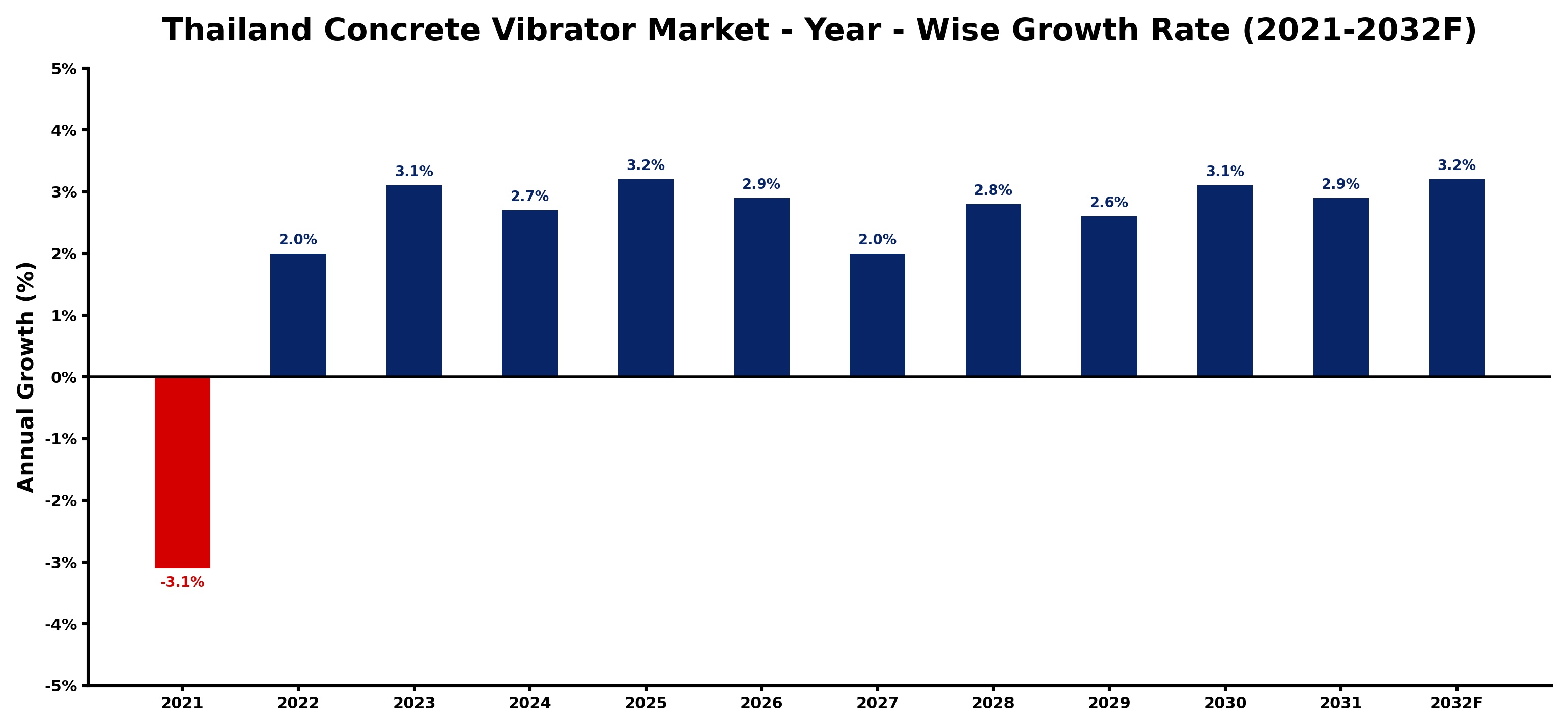
The table below presents the year‑wise growth rates along with the key drivers influencing the market
| Year | Growth Rate | Major Drivers |
| 2021 | -3.1% | Reduced infrastructure investments slowed demand for concrete vibrators |
| 2022 | 2.0% | Concrete construction demand spurred investment in vibrator production facilities |
| 2023 | 3.1% | Infrastructure projects boosted demand for high performance concrete vibrators |
| 2024 | 2.7% | Accelerated infrastructure projects boosted concrete vibrator demand and production |
| 2025 | 3.2% | Advanced sensor technology optimizes concrete vibrator performance and reliability |
| 2026 | 2.9% | Concrete infrastructure projects boosted demand for vibration equipment supplies |
| 2027 | 2.0% | Higher construction project volume boosts concrete vibrator manufacturing demand |
| 2028 | 2.8% | Infrastructure projects boost demand for concrete vibrators in Thailand |
| 2029 | 2.6% | Infrastructure projects drove higher demand for concrete vibrator production |
| 2030 | 3.1% | Infrastructure development projects boosted concrete vibrator technology adoption |
| 2031 | 2.9% | Domestic construction projects boost demand for concrete vibration equipment |
| 2032 | 3.2% | Infrastructure projects stimulated demand for advanced concrete vibration equipment |
Note - Market size estimations and growth projections presented in this report are based on 6Wresearch's advanced forecasting approach, validated with industry datasets as of June 2026.
Thailand Concrete Vibrator Market Synopsis
The most compelling force shaping the Thailand Concrete Vibrator Market is the surge in construction activities driven by both private and public investments. As residential and infrastructure projects expand, the need for high-quality concrete compaction has never been more critical. In particular, the government's commitment to developing robust infrastructure further catalyzes this demand, positioning concrete vibrators as indispensable tools in the industry.
The market is also evolving through technological advancements in equipment design and functionality. Innovations aimed at improving efficiency and user-friendliness are gaining traction, addressing the construction industry's need for enhanced productivity. These factors collectively contribute to the promising outlook for the Thailand Concrete Vibrator Market.
Thailand Concrete Vibrator Market Key Takeaways
- The market is projected to experience steady growth, with an expected size of USD 155 Million by 2032.
- Government initiatives aimed at infrastructure development significantly boost market demand.
- Technological advancements are enhancing the efficiency and safety of concrete vibrators.
- The construction industry's focus on durable and high-quality concrete structures is driving adoption.
- As the economy rebounds post-pandemic, a resurgence in construction activities will positively impact market growth.
Evaluation of Restraints in Thailand Concrete Vibrator Market
Despite the promising growth, several restraints limit the Thailand Concrete Vibrator Market. Variations in concrete mixes and environmental conditions can hinder the consistency and quality of compaction, posing challenges to contractors striving for optimal outcomes. Additionally, the evolving demands of construction efficiency and the push for better safety standards mean that manufacturers must constantly innovate to meet market needs, which can be a resource-intensive process. This dynamic landscape necessitates ongoing investment in research and development to enhance product offerings and maintain competitive advantages.
Thailand Concrete Vibrator Market Trends
Current trends in the Thailand Concrete Vibrator Market reflect a shift toward greater automation and precision in construction processes. The adoption of digital technologies and smart equipment is enabling contractors to achieve improved compaction results while reducing labor costs. Additionally, there is a growing emphasis on environmentally friendly construction practices, prompting manufacturers to develop vibrators that are more energy-efficient and reduce carbon footprints. This trend aligns with global sustainability efforts and is likely to resonate well with government initiatives aimed at promoting eco-friendly construction.
Thailand Concrete Vibrator Market Opportunities
Opportunities in the Thailand Concrete Vibrator Market are abundant, especially in the wake of increased infrastructure spending. The ongoing urbanization process creates substantial demand for residential and commercial buildings, driving the necessity for advanced concrete compaction solutions. Additionally, as the market gradually recovers from the pandemic, there is potential for product innovation, particularly in developing lightweight and portable vibrators tailored for smaller projects. Companies that capitalize on these trends and deliver reliable, efficient solutions are poised to benefit significantly.
Government Initiatives in the Thailand Concrete Vibrator Market
The Thai government plays a vital role in shaping the landscape of the concrete vibrator market through various policies and initiatives aimed at infrastructure development. Programs associated with Thailand 4.0 emphasize modernizing construction practices and integrating innovative technologies. Public spending on large-scale infrastructure projects fosters a conducive environment for market growth, as demand for efficient construction tools like concrete vibrators is expected to rise. Furthermore, incentives for green construction practices may encourage the adoption of eco-friendly equipment, aligning with global sustainability trends.
Future Insights of the Thailand Concrete Vibrator Market
Looking ahead to 2026-2032, the Thailand Concrete Vibrator Market is set to undergo significant transformation driven by ongoing urban development and technological advancements. As construction projects expand and evolve, the demand for efficient compaction solutions will remain robust. Moreover, with a growing emphasis on durability and quality in concrete structures, manufacturers will need to innovate continually to meet these expectations. The recovery from the COVID-19 pandemic and increased public investment in infrastructure will further bolster market resilience, ensuring a positive growth trajectory.
Thailand Concrete Vibrator Market Latest Developments (May 2025 - June 2026)
In the recent months leading up to mid-2026, the Thailand Concrete Vibrator Market has experienced a notable shift towards incorporating advanced technology and automation in product offerings. Manufacturers are increasingly focusing on enhancing user experience and safety features within their vibrators. Additionally, collaborative efforts between private sectors and government bodies have accelerated the introduction of innovative solutions designed to meet the evolving needs of the construction industry. These developments reflect a broader commitment to improving construction efficiency and quality across the board.
Thailand Concrete Vibrator Market - Key Attractiveness of the Report
- 10 Years of Market Numbers
- Historical Data Starting from 2022 to 2025
- Base Year: 2025
- Forecast Data until 2032
- Key Performance Indicators Impacting the Market
- Major Upcoming Developments and Projects
Key Highlights of the Report:
- Thailand Concrete Vibrator Market Outlook
- Market Size of Thailand Concrete Vibrator Market, 2025
- Forecast of Thailand Concrete Vibrator Market, 2032
- Historical Data and Forecast of Thailand Concrete Vibrator Revenues & Volume for the Period 2022-2032F
- Thailand Concrete Vibrator Market Trend Evolution
- Thailand Concrete Vibrator Market Drivers and Challenges
- Thailand Concrete Vibrator Price Trends
- Thailand Concrete Vibrator Porter's Five Forces
- Thailand Concrete Vibrator Industry Life Cycle
- Historical Data and Forecast of Thailand Concrete Vibrator Market Revenues & Volume By Type for the Period 2022-2032F
- Historical Data and Forecast of Thailand Concrete Vibrator Market Revenues & Volume By External Vibrator for the Period 2022-2032F
- Historical Data and Forecast of Thailand Concrete Vibrator Market Revenues & Volume By Internal Vibrator for the Period 2022-2032F
- Historical Data and Forecast of Thailand Concrete Vibrator Market Revenues & Volume By Others for the Period 2022-2032F
- Historical Data and Forecast of Thailand Concrete Vibrator Market Revenues & Volume By Application for the Period 2022-2032F
- Historical Data and Forecast of Thailand Concrete Vibrator Market Revenues & Volume By Architectural Engineering for the Period 2022-2032F
- Historical Data and Forecast of Thailand Concrete Vibrator Market Revenues & Volume By Dam Engineering for the Period 2022-2032F
- Historical Data and Forecast of Thailand Concrete Vibrator Market Revenues & Volume By Mine and Well Engineering for the Period 2022-2032F
- Historical Data and Forecast of Thailand Concrete Vibrator Market Revenues & Volume By Others for the Period 2022-2032F
- Thailand Concrete Vibrator Import Export Trade Statistics
- Market Opportunity Assessment By Type
- Market Opportunity Assessment By Application
- Thailand Concrete Vibrator Top Companies Market Share
- Thailand Concrete Vibrator Competitive Benchmarking By Technical and Operational Parameters
- Thailand Concrete Vibrator Company Profiles
- Thailand Concrete Vibrator Key Strategic Recommendations






































