Thailand Consent Management Market Size & Growth Rate (2026-2032)
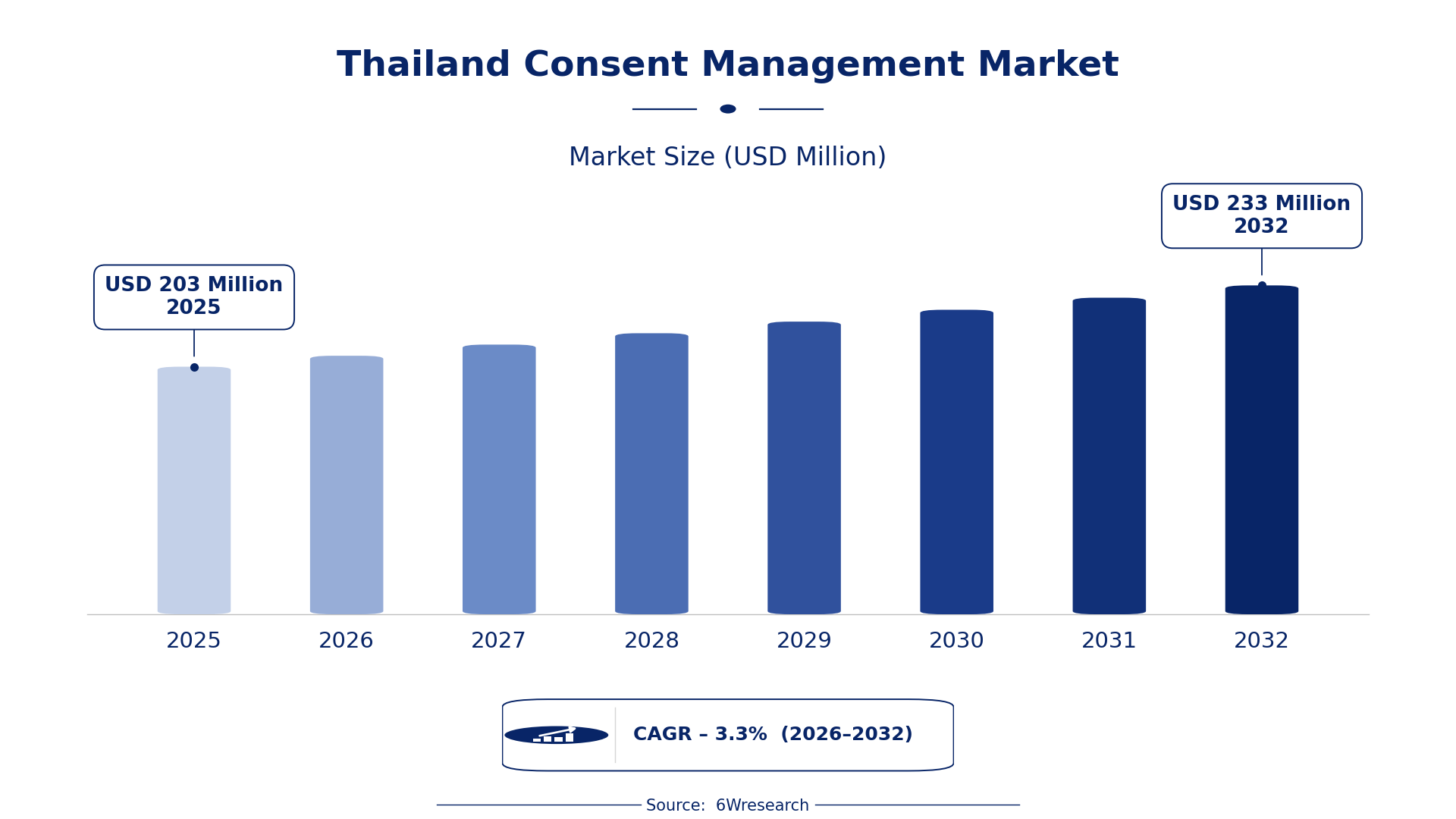
The Thailand Consent Management Market was estimated at USD 203 Million in 2025 and is projected to reach USD 233 Million by 2032, growing at a CAGR of 3.3% from 2026 to 2032.
Thailand Consent Management Market Synopsis
In Thailand, the demand for effective consent management solutions is surging as organizations grapple with stringent data privacy regulations. The implementation of the Personal Data Protection Act (PDPA) has prompted businesses to enhance their consent management practices, ensuring that user privacy is respected while maintaining compliance.
Companies are increasingly adopting sophisticated consent management platforms that not only streamline consent collection but also foster customer trust. As data privacy concerns rise, organizations recognize that transparent consent practices are critical for sustainable growth and customer loyalty.
Thailand Consent Management Market Year-wise Growth Rate and Key Drivers
This graph illustrates the annual growth rates of the Thailand Consent Management Market from 2021 to 2032, highlighting a steady upward trajectory and projected expansion over the forecast period.
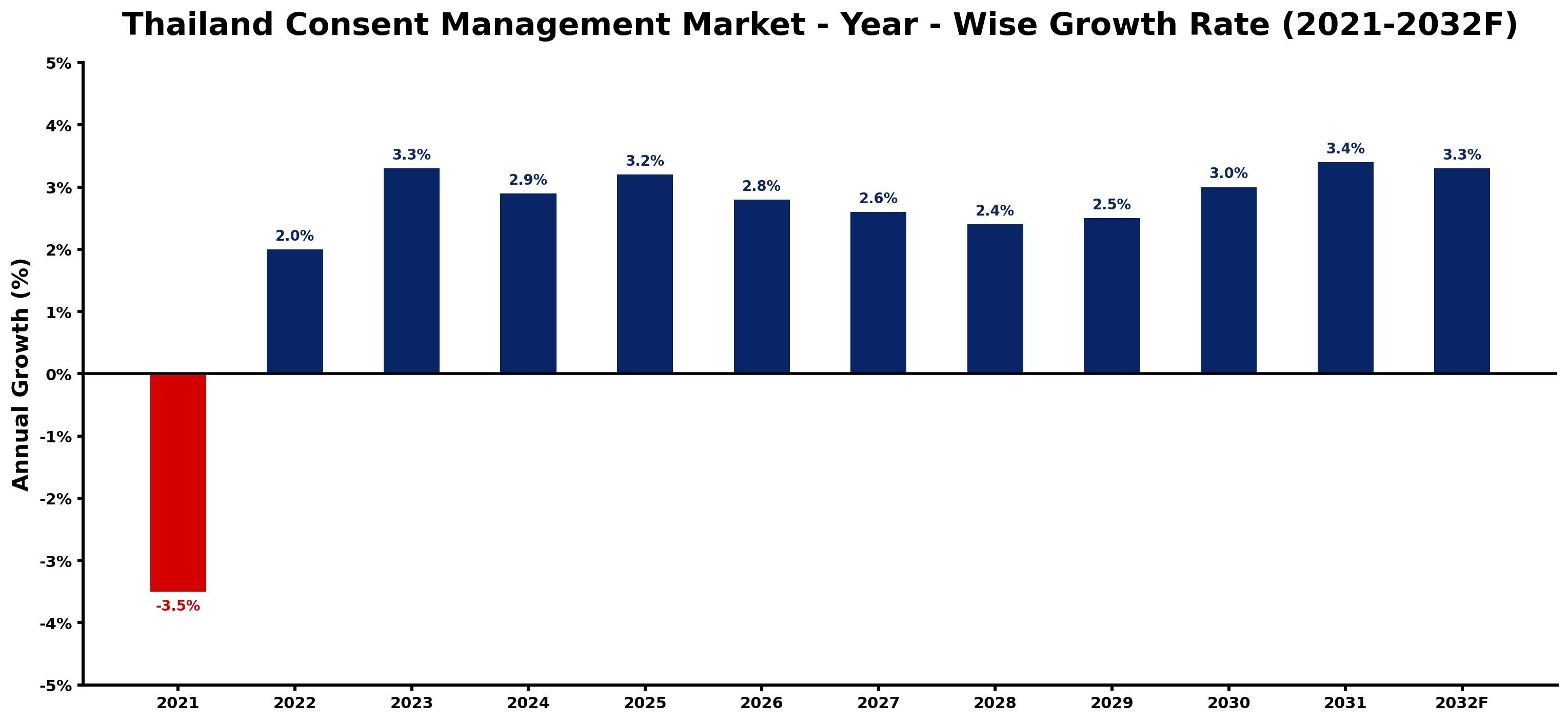
The table below presents the year‑wise growth rates along with the key drivers influencing the market
| Year | Growth Rate | Major Drivers |
| 2021 | -3.5% | Delayed data privacy regulations from the Thai government. |
| 2022 | 2.0% | Personal Data Protection Act encouraging consent transparency. |
| 2023 | 3.3% | Increased mobile banking usage necessitating user consent frameworks. |
| 2024 | 2.9% | Growth in e-commerce platforms demands robust consent protocols. |
| 2025 | 3.2% | Digital marketing regulation pushes for better user consent systems. |
| 2026 | 2.8% | Increased awareness on data privacy catalyzing consent adoption. |
| 2027 | 2.6% | Rise in online education platforms needing consent management. |
| 2028 | 2.4% | Social media usage surge drives demand for consent solutions. |
| 2029 | 2.5% | Emergence of health apps requiring enhanced user permissions. |
| 2030 | 3.0% | Government initiatives promoting digital literacy and consent understanding. |
| 2031 | 3.4% | Stricter compliance requirements boosting consent management adoption. |
| 2032 | 3.3% | Corporate governance reforms emphasizing user data rights. |
Note: Market size estimations and growth projections presented in this report are based on 6Wresearch's proprietary forecasting methodology, utilizing the latest available industry data, government publications, and primary research inputs.
Thailand Consent Management Market Key Takeaways
Below are some of the specific key takeaways from the market, including:
- The market is driven by the need for compliance with the Personal Data Protection Act.
- Organizations are prioritizing user trust through effective consent management solutions.
- Technological advancements are enabling better user control over personal data.
- Ongoing digital transformation is influencing the adoption of consent management platforms.
- Businesses face challenges in balancing regulatory compliance with user experience.
Evaluation of Restraints in Thailand Consent Management Market
The Thailand Consent Management Market encounters notable constraints primarily related to the evolving regulatory environment. Organizations struggle to keep pace with changing privacy laws and the nuanced requirements they impose. This dynamic landscape creates uncertainty, compelling businesses to continuously adjust their consent practices. Additionally, many solutions available in the market lack the user-friendliness necessary for widespread adoption, which can hinder effective implementation and user engagement.
Thailand Consent Management Market Trends
Current trends indicate a shift towards more intuitive consent management solutions that prioritize user experience. Companies are investing in technologies that allow for granular consent preferences, enabling users to easily manage their data sharing choices. on top of that, as awareness of data privacy issues grows, there is a marked increase in consumer demand for transparent practices, compelling organizations to adopt these solutions to remain competitive.
Thailand Consent Management Market Opportunities
As businesses in Thailand strive to enhance their data handling practices, numerous opportunities emerge within the consent management sector. Companies can capitalize on the demand for solutions that integrate seamlessly with existing digital platforms. Additionally, offering tailored solutions that cater to specific industry needs—such as finance or healthcare—could significantly boost market penetration and revenue generation.
Government Initiatives in the Thailand Consent Management Market
Government policies play a crucial role in shaping the Thailand Consent Management Market, reflecting a strong commitment to data privacy and protection. The regulatory framework established by the PDPA sets the foundation for how organizations must handle user consent. This approach not only promotes compliance but also enhances consumer trust in digital services.
- A regulatory framework introduced in 2022 mandating stricter guidelines for data processing and user consent.
- Ongoing government-led initiatives to educate businesses about compliance with the PDPA.
- A planned public-private partnership aimed at developing standardized consent management solutions by 2026.
- Recent revisions to data protection regulations to include clearer definitions of user rights and consent requirements.
- A nationwide campaign launched in early 2023 focused on raising public awareness about data privacy rights.
Future Insights of the Thailand Consent Management Market
Looking ahead to 2026-2032, the Thailand Consent Management Market is expected to evolve significantly. As data privacy becomes an integral part of corporate strategy, companies will increasingly invest in advanced consent management technologies. The focus will shift toward creating user-centric platforms that not only comply with regulations but also enhance customer relationships. Businesses that embrace these changes will likely gain a competitive edge as consumer expectations continue to rise.
Thailand Consent Management Market Latest Developments
In the last year, the Thailand Consent Management Market has seen a flurry of activity as organizations pivot to align with emerging regulatory standards. Increased investment in technology and public awareness campaigns have influenced market dynamics, driving demand for more effective consent management solutions.
- A leading regional provider launched a new consent management platform in Q2 2023, designed to simplify compliance with the PDPA.
- An ongoing initiative to integrate consent management capabilities into popular digital services began in early 2023, aiming to enhance user experience.
- A partnership between technology vendors and local businesses was announced in late 2022, focusing on developing tailored consent solutions for the healthcare sector.
- A government-backed project to standardize consent management protocols is expected to commence in mid-2024.
- By late 2023, several organizations will begin pilot programs for advanced consent management features aimed at improving user engagement.
Thailand Consent Management Market - Key Attractiveness of the Report
- 10 Years of Market Numbers
- Historical Data Starting from 2022 to 2025
- Base Year: 2025
- Forecast Data until 2032
- Key Performance Indicators Impacting the Market
- Major Upcoming Developments and Projects
Key Highlights of the Report:
- Thailand Consent Management Market Outlook
- Market Size of Thailand Consent Management Market, 2025
- Forecast of Thailand Consent Management Market, 2032
- Historical Data and Forecast of Thailand Consent Management Revenues & Volume for the Period 2022-2032F
- Thailand Consent Management Market Trend Evolution
- Thailand Consent Management Market Drivers and Challenges
- Thailand Consent Management Price Trends
- Thailand Consent Management Porter's Five Forces
- Thailand Consent Management Industry Life Cycle
- Historical Data and Forecast of Thailand Consent Management Market Revenues & Volume By Component for the Period 2022-2032F
- Historical Data and Forecast of Thailand Consent Management Market Revenues & Volume By Software for the Period 2022-2032F
- Historical Data and Forecast of Thailand Consent Management Market Revenues & Volume By Services for the Period 2022-2032F
- Historical Data and Forecast of Thailand Consent Management Market Revenues & Volume By Deployment Type for the Period 2022-2032F
- Historical Data and Forecast of Thailand Consent Management Market Revenues & Volume By Cloud for the Period 2022-2032F
- Historical Data and Forecast of Thailand Consent Management Market Revenues & Volume By On-premises for the Period 2022-2032F
- Historical Data and Forecast of Thailand Consent Management Market Revenues & Volume By Touchpoint for the Period 2022-2032F
- Historical Data and Forecast of Thailand Consent Management Market Revenues & Volume By Mobile App for the Period 2022-2032F
- Historical Data and Forecast of Thailand Consent Management Market Revenues & Volume By Web App for the Period 2022-2032F
- Historical Data and Forecast of Thailand Consent Management Market Revenues & Volume By Organization Size for the Period 2022-2032F
- Historical Data and Forecast of Thailand Consent Management Market Revenues & Volume By Large Enterprises for the Period 2022-2032F
- Historical Data and Forecast of Thailand Consent Management Market Revenues & Volume By Small and Medium-sized Enterprises (SMEs) for the Period 2022-2032F
- Thailand Consent Management Import Export Trade Statistics
- Market Opportunity Assessment By Component
- Market Opportunity Assessment By Deployment Type
- Market Opportunity Assessment By Touchpoint
- Market Opportunity Assessment By Organization Size
- Thailand Consent Management Top Companies Market Share
- Thailand Consent Management Competitive Benchmarking By Technical and Operational Parameters
- Thailand Consent Management Company Profiles
- Thailand Consent Management Key Strategic Recommendations






































