Thailand Construction Glass Market: Import Trend Analysis
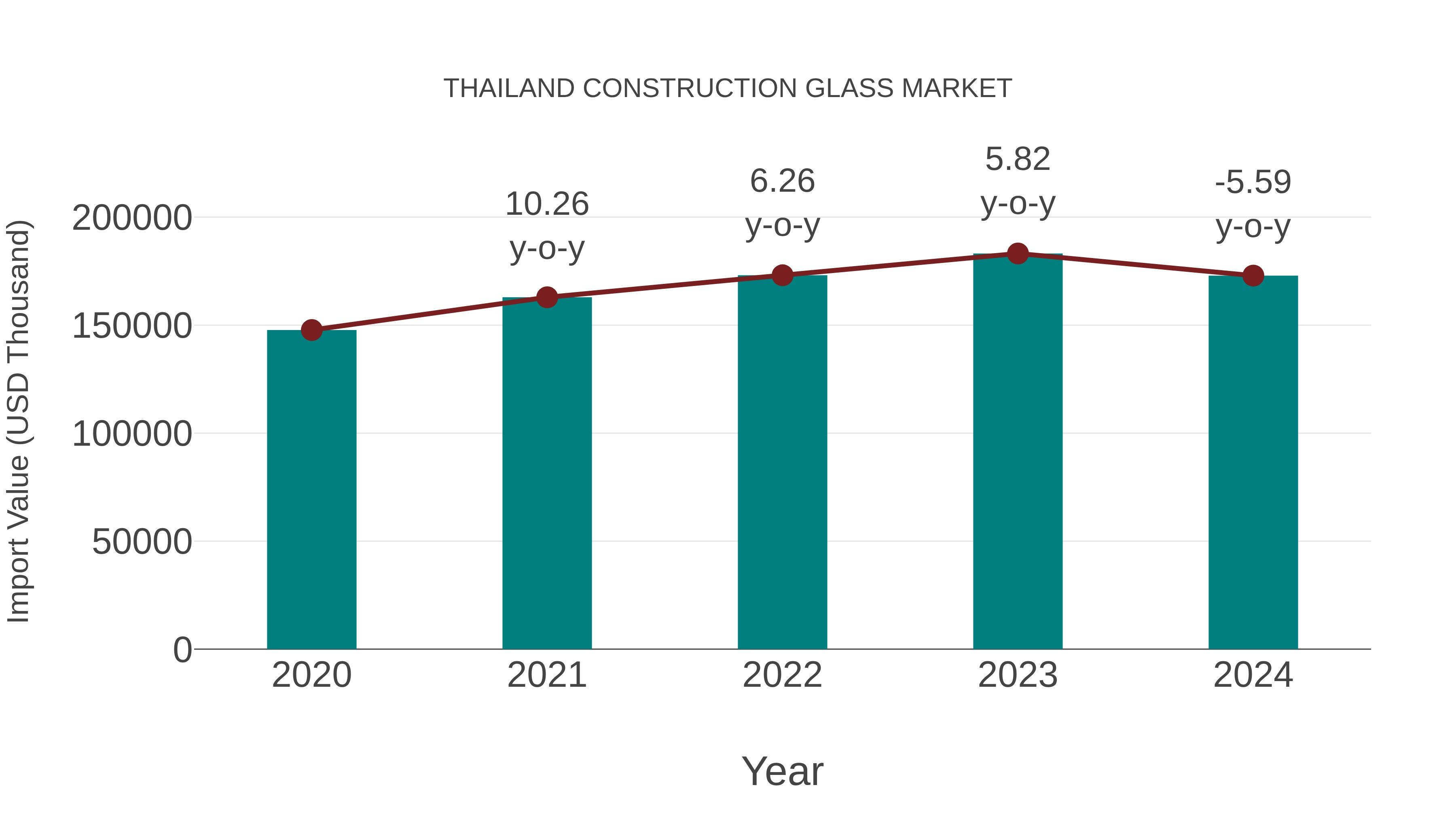
Thailand construction glass market witnessed a -5.59% decline in import growth from 2023 to 2024, with a compound annual growth rate (CAGR) of 4.02% from 2020 to 2024. This negative import momentum in 2024 could be attributed to shifts in domestic demand or changes in trade policies impacting market stability.
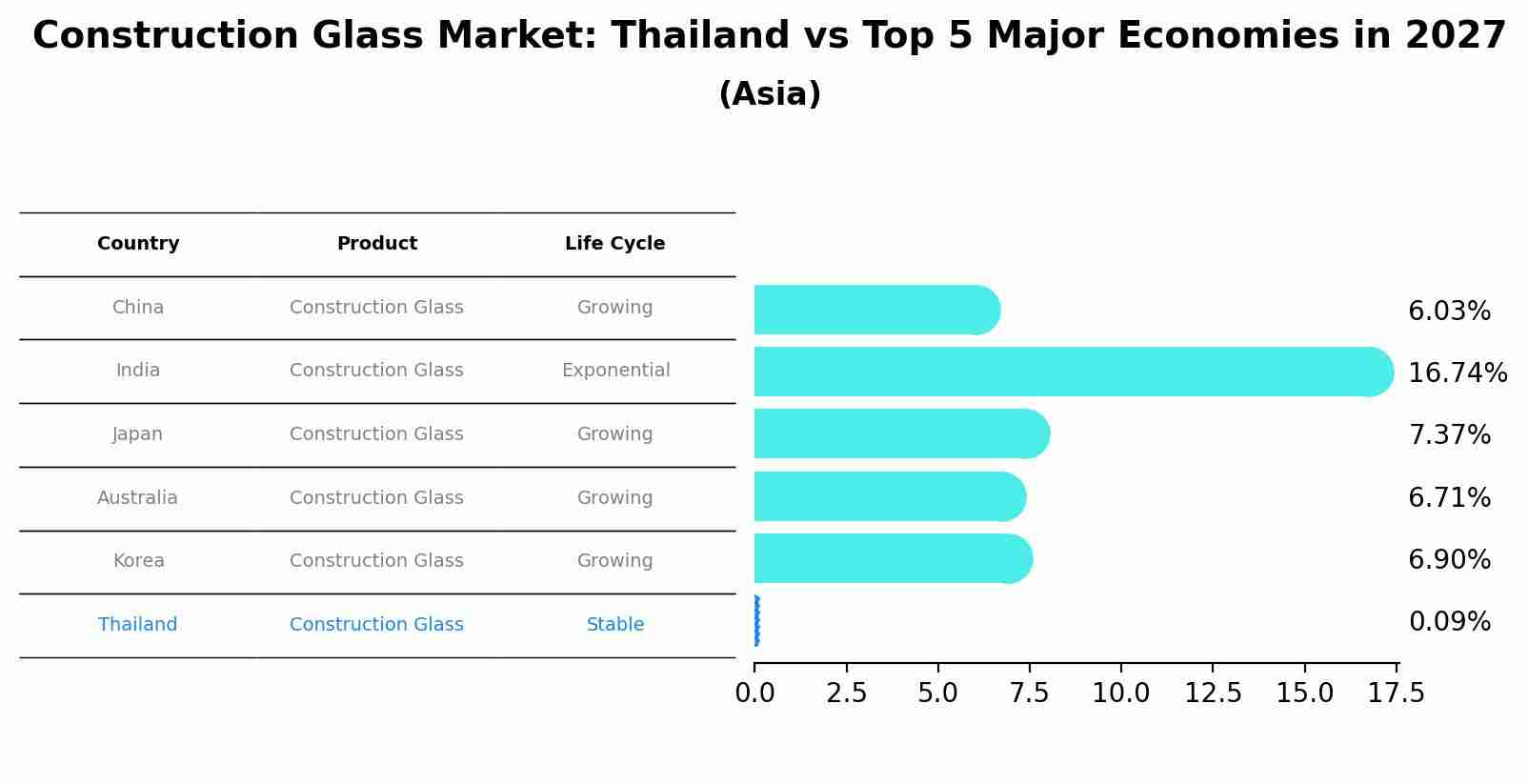
Construction Glass Market: Thailand vs Top 5 Major Economies in 2027 (Asia)
By 2027, the Construction Glass market in Thailand is anticipated to reach a growth rate of 0.09%, as part of an increasingly competitive Asia region, where China remains at the forefront, supported by India, Japan, Australia and South Korea, driving innovations and market adoption across sectors.
Thailand Construction Glass Market Synopsis
The construction glass market in Thailand has experienced significant growth in recent years, driven by the booming construction industry in the country. With Thailand expanding urbanization and infrastructure development projects, there has been a rising demand for high-quality and energy-efficient glass products. This market encompasses a wide range of glass products, including float glass, tempered glass, laminated glass, and insulated glass, catering to various architectural and design needs. Moreover, the incorporation of sustainable and eco-friendly building practices has led to an increased use of energy-efficient and low-emissivity (Low-E) glass in construction projects. The market also benefits from technological advancements that have improved the strength, safety, and aesthetic appeal of glass products, making them a preferred choice in modern building design.
Drivers of the Market
The Thailand Construction Glass market is experiencing robust growth, primarily driven by the booming construction sector. With numerous infrastructure projects, including residential and commercial buildings, the demand for construction glass is soaring. Energy-efficient glass solutions, which aid in reducing cooling and heating costs, are especially popular in the region. Additionally, the increasing focus on sustainable construction practices is leading to the use of construction glass with advanced properties such as self-cleaning and solar-reflective coatings.
Challenges of the Market
The Thailand construction glass market encounters various challenges, including the cyclical nature of the construction industry. Economic downturns can lead to reduced construction projects, impacting demand for construction glass. Moreover, sustainability and energy efficiency considerations are becoming increasingly important, requiring manufacturers to develop eco-friendly glass products. Additionally, stringent building codes and regulations add complexity to the market, necessitating compliance and certification efforts.
COVID-19 Impact on the Market
The COVID-19 pandemic had a mixed impact on the Thailand Construction Glass market. While the initial lockdowns led to a slowdown in construction activity, the market experienced a resurgence as the government launched stimulus packages to boost the economy, including infrastructure projects. Safety measures and hygiene concerns led to increased interest in antimicrobial and easy-to-clean glass solutions. However, supply chain disruptions and rising material costs posed challenges to manufacturers. The market`s recovery depended on the pace of construction projects and the economic outlook.
Key Players in the Market
The Thailand construction glass market is led by established players specializing in architectural glass solutions. Leading companies such as ThaiGlassWorks, GlassBuild Thailand, and ArchitecturalGlass Innovations are prominent names in this sector. They provide a diverse range of construction glass products that emphasize safety, energy efficiency, and aesthetics. These firms have gained recognition through their commitment to delivering high-performance glass solutions for architectural projects.
Key Highlights of the Report:
- Thailand Construction Glass Market Outlook
- Market Size of Thailand Construction Glass Market, 2025
- Forecast of Thailand Construction Glass Market, 2032
- Historical Data and Forecast of Thailand Construction Glass Revenues & Volume for the Period 2022-2032F
- Thailand Construction Glass Market Trend Evolution
- Thailand Construction Glass Market Drivers and Challenges
- Thailand Construction Glass Price Trends
- Thailand Construction Glass Porter's Five Forces
- Thailand Construction Glass Industry Life Cycle
- Historical Data and Forecast of Thailand Construction Glass Market Revenues & Volume By Chemical Composition for the Period 2022-2032F
- Historical Data and Forecast of Thailand Construction Glass Market Revenues & Volume By Soda-lime for the Period 2022-2032F
- Historical Data and Forecast of Thailand Construction Glass Market Revenues & Volume By Potash-lime for the Period 2022-2032F
- Historical Data and Forecast of Thailand Construction Glass Market Revenues & Volume By Potash-lead for the Period 2022-2032F
- Historical Data and Forecast of Thailand Construction Glass Market Revenues & Volume By Type for the Period 2022-2032F
- Historical Data and Forecast of Thailand Construction Glass Market Revenues & Volume By Low-e Glass for the Period 2022-2032F
- Historical Data and Forecast of Thailand Construction Glass Market Revenues & Volume By Special Glass for the Period 2022-2032F
- Historical Data and Forecast of Thailand Construction Glass Market Revenues & Volume By Manufacturing Process for the Period 2022-2032F
- Historical Data and Forecast of Thailand Construction Glass Market Revenues & Volume By Float Process for the Period 2022-2032F
- Historical Data and Forecast of Thailand Construction Glass Market Revenues & Volume By Rolled/sheet Process for the Period 2022-2032F
- Historical Data and Forecast of Thailand Construction Glass Market Revenues & Volume By Application for the Period 2022-2032F
- Historical Data and Forecast of Thailand Construction Glass Market Revenues & Volume By Residential for the Period 2022-2032F
- Historical Data and Forecast of Thailand Construction Glass Market Revenues & Volume By Commercial for the Period 2022-2032F
- Historical Data and Forecast of Thailand Construction Glass Market Revenues & Volume By Others for the Period 2022-2032F
- Thailand Construction Glass Import Export Trade Statistics
- Market Opportunity Assessment By Chemical Composition
- Market Opportunity Assessment By Type
- Market Opportunity Assessment By Manufacturing Process
- Market Opportunity Assessment By Application
- Thailand Construction Glass Top Companies Market Share
- Thailand Construction Glass Competitive Benchmarking By Technical and Operational Parameters
- Thailand Construction Glass Company Profiles
- Thailand Construction Glass Key Strategic Recommendations






































