Thailand Content Intelligence Market Size & Growth Rate (2026-2032)
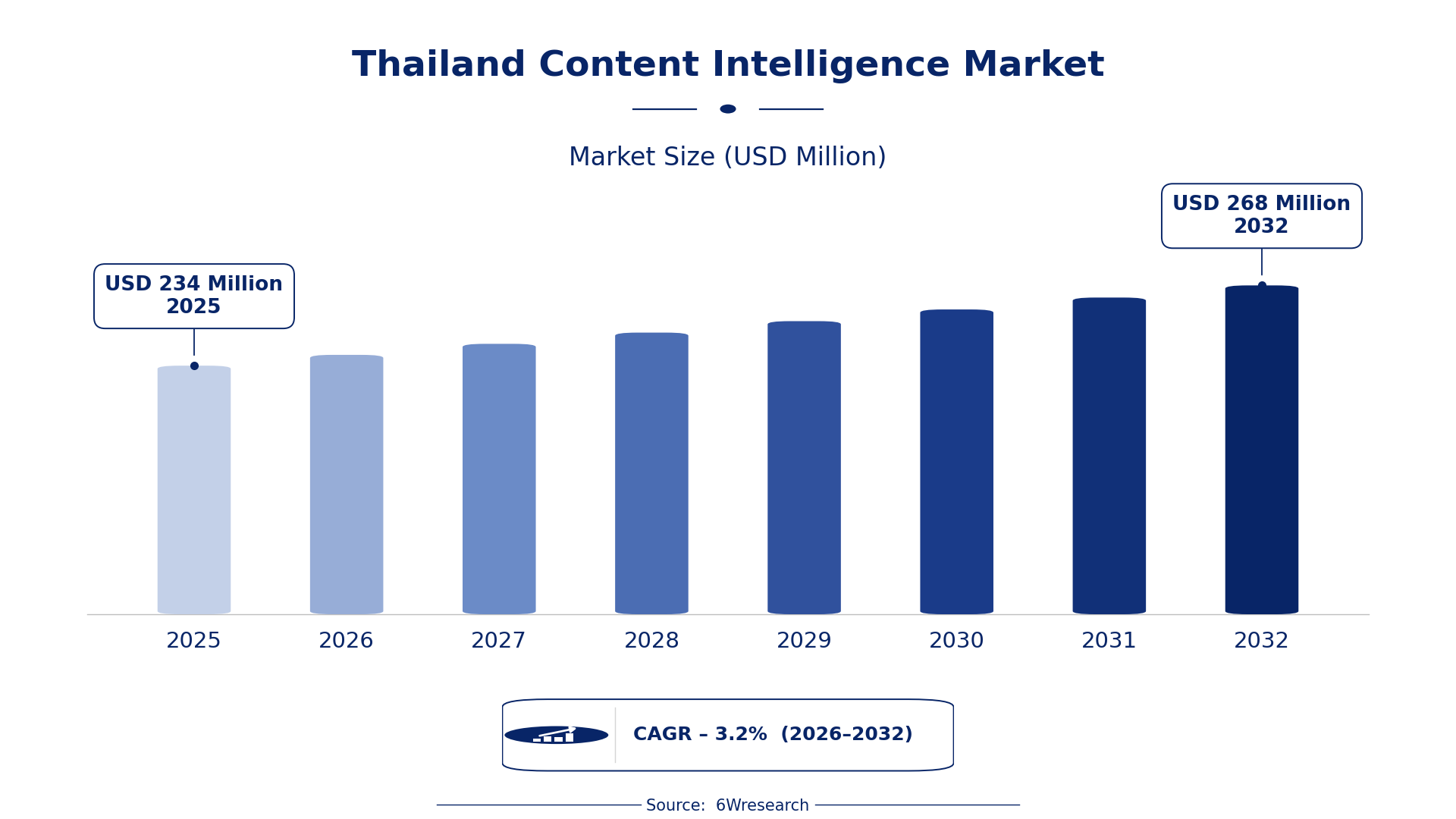
The Thailand Content Intelligence Market was estimated at USD 234 Million in 2025 and is projected to reach USD 268 Million by 2032, growing at a CAGR of 3.2% from 2026 to 2032.
Thailand Content Intelligence Market Synopsis
Businesses in Thailand are increasingly recognizing the value of content intelligence solutions to enhance engagement and optimize their digital content. The demand for tools that analyze and categorize content effectively is rising, driven by a surge in digital consumption and the necessity for personalized experiences.
As organizations strive for greater relevance in their messaging, content intelligence is becoming a crucial component of their strategies. Companies are leveraging AI-powered solutions to extract actionable insights from vast amounts of unstructured data, a task that is both complex and critical for effective audience engagement.
Thailand Content Intelligence Market Year-wise Growth Rate and Key Drivers
This graph illustrates the annual growth rates of the Thailand Content Intelligence Market from 2021 to 2032, highlighting a steady upward trajectory and projected expansion over the forecast period.
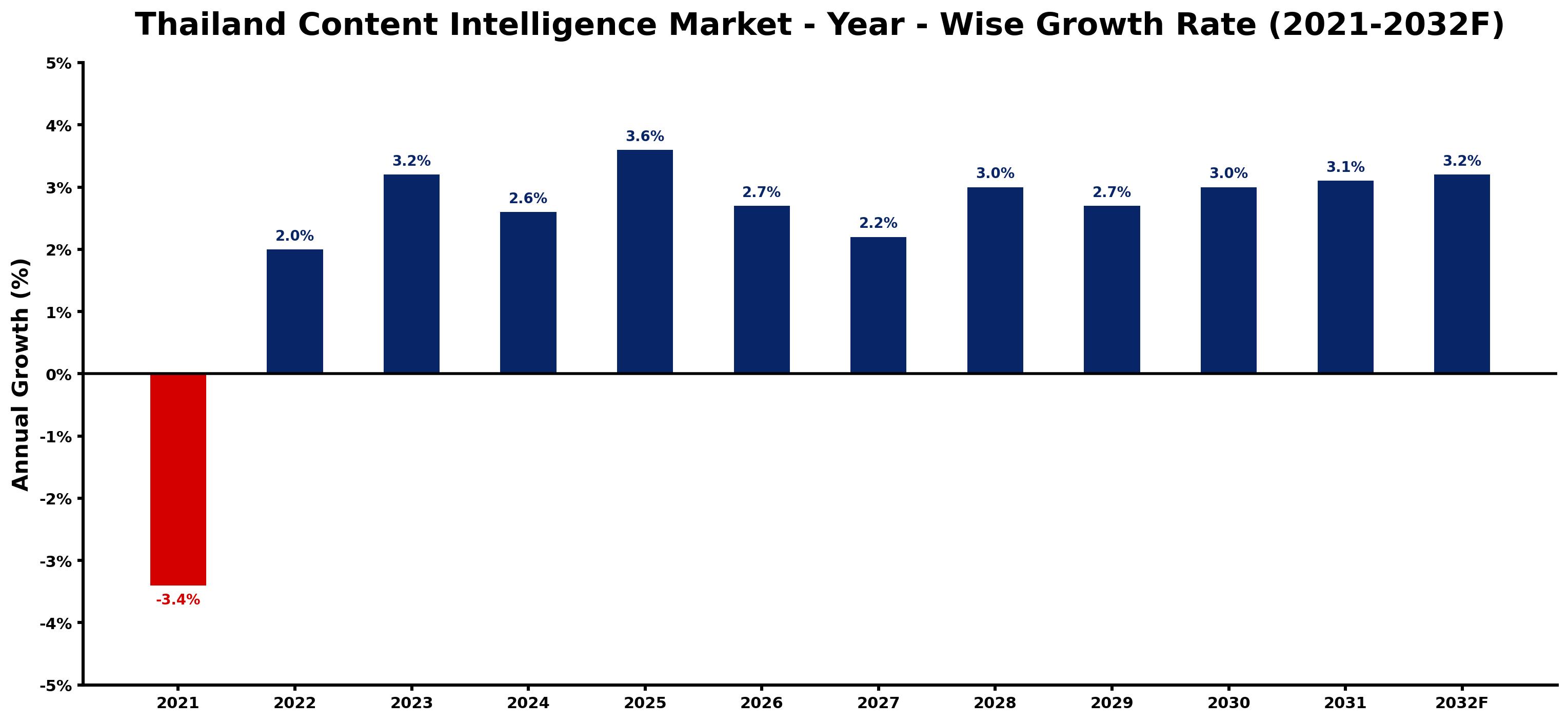
The table below presents the year‑wise growth rates along with the key drivers influencing the market
| Year | Growth Rate | Major Drivers |
| 2021 | -3.4% | Government censorship impacted content distribution capabilities. |
| 2022 | 2.0% | Adoption of AI-driven analytics by local media companies |
| 2023 | 3.2% | Growing interest in e-learning solutions among businesses |
| 2024 | 2.6% | Increased regulatory support for digital content creators |
| 2025 | 3.6% | Tourism recovery fueling demand for digital storytelling |
| 2026 | 2.7% | Emergence of local influencers driving brand collaborations |
| 2027 | 2.2% | Government initiatives promoting cultural content production |
| 2028 | 3.0% | Surge in social media usage enhancing content engagement |
| 2029 | 2.7% | Rise of mobile commerce boosting content-driven marketing |
| 2030 | 3.0% | Increased content personalization in e-commerce strategies |
| 2031 | 3.1% | Higher digital literacy fostering content consumption growth |
| 2032 | 3.2% | Adoption of multimedia content in educational platforms |
Note: Market size estimations and growth projections presented in this report are based on 6Wresearch's proprietary forecasting methodology, utilizing the latest available industry data, government publications, and primary research inputs.
Thailand Content Intelligence Market Key Takeaways
Below are some of the specific key takeaways from the market, including:
- The market is driven by the increasing volume of digital content and the need for personalized user experiences.
- AI-powered solutions are at the forefront of content optimization, providing businesses with actionable insights.
- Challenges remain in extracting meaningful insights from diverse content sources.
- COVID-19 has accelerated the adoption of content intelligence technologies in Thailand.
- Key players in the market are focusing on innovation to enhance content strategy and audience engagement.
Evaluation of Restraints in Thailand Content Intelligence Market
Despite the promising growth trajectory, several factors are hindering the Thailand Content Intelligence Market. The sheer volume of unstructured data presents a challenge for organizations trying to derive useful insights. Many businesses struggle to find solutions that can effectively categorize and analyze diverse content formats. Additionally, the lack of skilled professionals who can interpret this data compounds the issue, making it difficult for companies to fully capitalize on the potential of content intelligence.
Thailand Content Intelligence Market Trends
There are several trends shaping the Thailand Content Intelligence Market. The rise of AI and machine learning technologies is facilitating more sophisticated content analysis, enabling organizations to tailor content to specific audience segments. The demand for interactive and engaging content is also growing, prompting businesses to invest in tools that enhance user experiences. on top of that, as data privacy regulations become more stringent, companies are prioritizing compliance while still seeking innovative content solutions.
Thailand Content Intelligence Market Opportunities
Opportunities for growth are abundant in the Thailand Content Intelligence Market. Businesses can tap into the increasing demand for personalized content experiences by investing in advanced analytics tools. There is also a significant market for training and development programs focused on content intelligence, addressing the skills gap that currently exists. As more organizations recognize the importance of data-driven content strategies, the potential for innovative solutions will only expand.
Government Initiatives in the Thailand Content Intelligence Market
Government policies in Thailand are playing a crucial role in shaping the Content Intelligence Market. With a focus on enhancing digital infrastructure and promoting technology adoption, the Thai government is creating an environment conducive to growth in this sector. Public-sector priorities include supporting businesses in their digital transformation journeys and fostering innovation in content analytics.
- A national digital infrastructure upgrade programme was recently completed, enhancing connectivity across urban and rural areas.
- Currently, there is an initiative aimed at boosting AI adoption in small and medium enterprises (SMEs) to improve content strategies.
- Plans are underway for a regulatory framework focusing on data privacy and security, expected to launch in 2026.
- The government is promoting public-private partnerships to drive innovation in content intelligence technologies.
Future Insights of the Thailand Content Intelligence Market
Looking ahead to 2026-2032, the Thailand Content Intelligence Market is expected to experience steady growth. The integration of AI and machine learning will continue to transform how organizations approach content strategy, making it more data-driven and audience-focused. As businesses increasingly recognize the necessity for personalized content, investments in content intelligence solutions will surge. This market will likely witness the emergence of new technologies designed to enhance content creation and distribution, providing companies with a competitive edge.
Thailand Content Intelligence Market Latest Developments
Recent activity in the Thailand Content Intelligence Market reflects a growing emphasis on technological advancement and content optimization. Over the past year, companies have been actively seeking innovative solutions to enhance their content strategies and engage audiences more effectively.
- A major technology vendor launched a new AI-powered content analytics tool in early 2025, aimed at improving content personalization.
- Currently, a regional operator is upgrading its content intelligence platform to incorporate machine learning capabilities, with implementation expected by mid-2026.
- A public-private partnership initiative aimed at fostering innovation in content intelligence is currently underway.
- A leading regional operator is planning a rollout of a new content optimization service, expected to begin in late 2026.
Thailand Content Intelligence Market - Key Attractiveness of the Report
- 10 Years of Market Numbers
- Historical Data Starting from 2022 to 2025
- Base Year: 2025
- Forecast Data until 2032
- Key Performance Indicators Impacting the Market
- Major Upcoming Developments and Projects
Key Highlights of the Report:
- Thailand Content Intelligence Market Outlook
- Market Size of Thailand Content Intelligence Market, 2025
- Forecast of Thailand Content Intelligence Market, 2032
- Historical Data and Forecast of Thailand Content Intelligence Revenues & Volume for the Period 2022-2032F
- Thailand Content Intelligence Market Trend Evolution
- Thailand Content Intelligence Market Drivers and Challenges
- Thailand Content Intelligence Price Trends
- Thailand Content Intelligence Porter's Five Forces
- Thailand Content Intelligence Industry Life Cycle
- Historical Data and Forecast of Thailand Content Intelligence Market Revenues & Volume By Component for the Period 2022-2032F
- Historical Data and Forecast of Thailand Content Intelligence Market Revenues & Volume By Solutions for the Period 2022-2032F
- Historical Data and Forecast of Thailand Content Intelligence Market Revenues & Volume By Services for the Period 2022-2032F
- Historical Data and Forecast of Thailand Content Intelligence Market Revenues & Volume By Vertical for the Period 2022-2032F
- Historical Data and Forecast of Thailand Content Intelligence Market Revenues & Volume By BFSI for the Period 2022-2032F
- Historical Data and Forecast of Thailand Content Intelligence Market Revenues & Volume By Government & Public Sector for the Period 2022-2032F
- Historical Data and Forecast of Thailand Content Intelligence Market Revenues & Volume By Healthcare & Life Sciences for the Period 2022-2032F
- Historical Data and Forecast of Thailand Content Intelligence Market Revenues & Volume By IT & Telecommunications for the Period 2022-2032F
- Historical Data and Forecast of Thailand Content Intelligence Market Revenues & Volume By Manufacturing for the Period 2022-2032F
- Historical Data and Forecast of Thailand Content Intelligence Market Revenues & Volume By Media & Entertainment for the Period 2022-2032F
- Historical Data and Forecast of Thailand Content Intelligence Market Revenues & Volume By Retail & Consumer Goods for the Period 2022-2032F
- Historical Data and Forecast of Thailand Content Intelligence Market Revenues & Volume By Deployment Type for the Period 2022-2032F
- Historical Data and Forecast of Thailand Content Intelligence Market Revenues & Volume By Cloud for the Period 2022-2032F
- Historical Data and Forecast of Thailand Content Intelligence Market Revenues & Volume By On-Premises for the Period 2022-2032F
- Historical Data and Forecast of Thailand Content Intelligence Market Revenues & Volume By Hybrid for the Period 2022-2032F
- Historical Data and Forecast of Thailand Content Intelligence Market Revenues & Volume By Organization Size for the Period 2022-2032F
- Historical Data and Forecast of Thailand Content Intelligence Market Revenues & Volume By Large enterprises for the Period 2022-2032F
- Historical Data and Forecast of Thailand Content Intelligence Market Revenues & Volume By Small and Medium-sized Enterprises (SMEs) for the Period 2022-2032F
- Thailand Content Intelligence Import Export Trade Statistics
- Market Opportunity Assessment By Component
- Market Opportunity Assessment By Vertical
- Market Opportunity Assessment By Deployment Type
- Market Opportunity Assessment By Organization Size
- Thailand Content Intelligence Top Companies Market Share
- Thailand Content Intelligence Competitive Benchmarking By Technical and Operational Parameters
- Thailand Content Intelligence Company Profiles
- Thailand Content Intelligence Key Strategic Recommendations






































