Thailand Corporate Learning Management System (LMS) Market Size & Growth Rate (2026-2032)
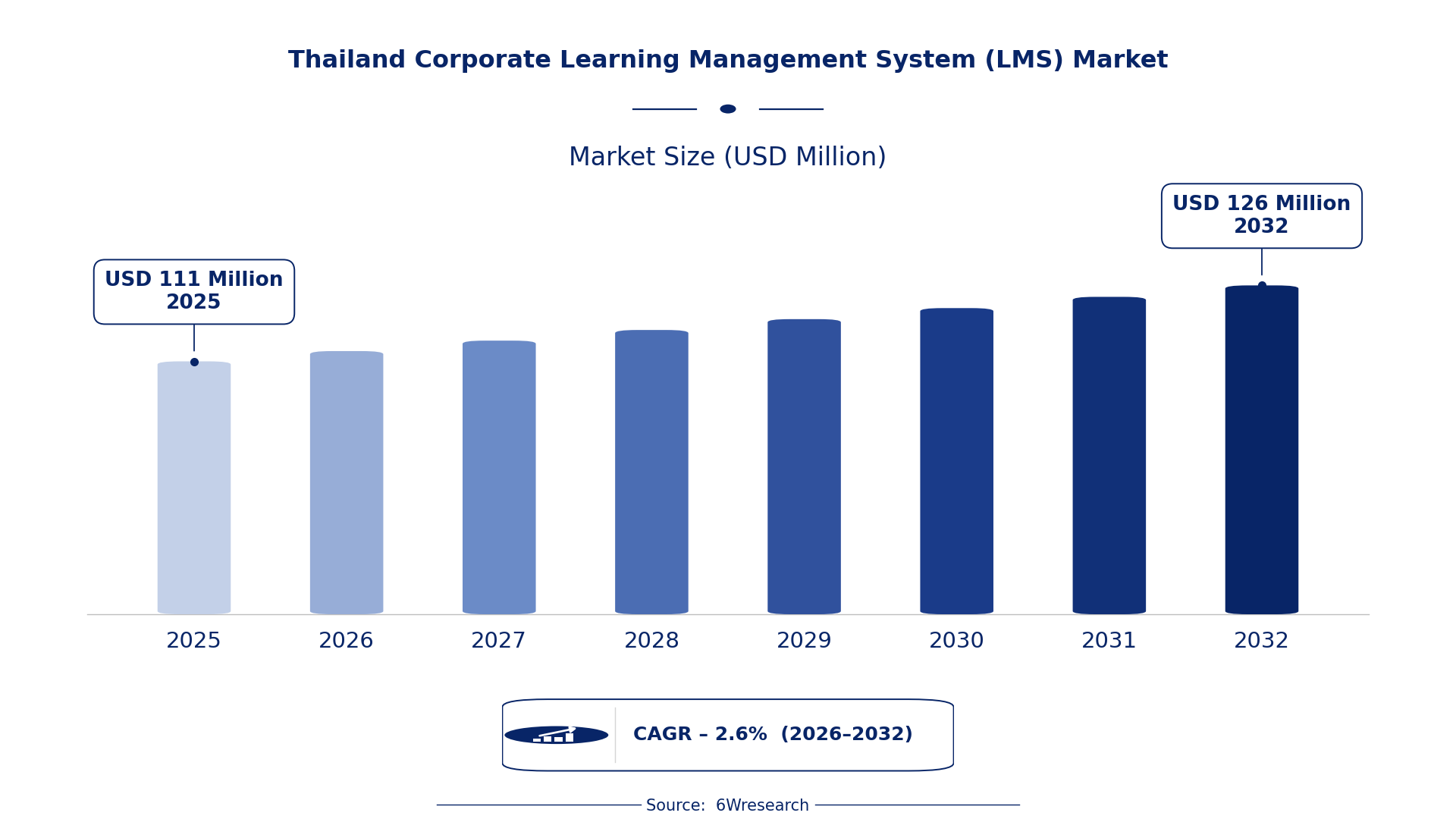
The Thailand Corporate Learning Management System (LMS) Market was estimated at USD 111 Million in 2025 and is projected to reach USD 126 Million by 2032, growing at a CAGR of 2.6% from 2026 to 2032.
Thailand Corporate Learning Management System (LMS) Market Synopsis
The Corporate Learning Management System (LMS) market in Thailand has become essential for businesses looking to enhance workforce capabilities. With a strong focus on employee training and development, organizations are increasingly adopting digital platforms that facilitate effective learning experiences.
Amid the rise of remote work and the need for continuous skill enhancement, LMS solutions are gaining traction. Companies recognize that investing in these systems is not just about compliance, but a strategic move to cultivate talent and drive performance improvements across the organization.
Thailand Corporate Learning Management System (LMS) Market Year-wise Growth Rate and Key Drivers
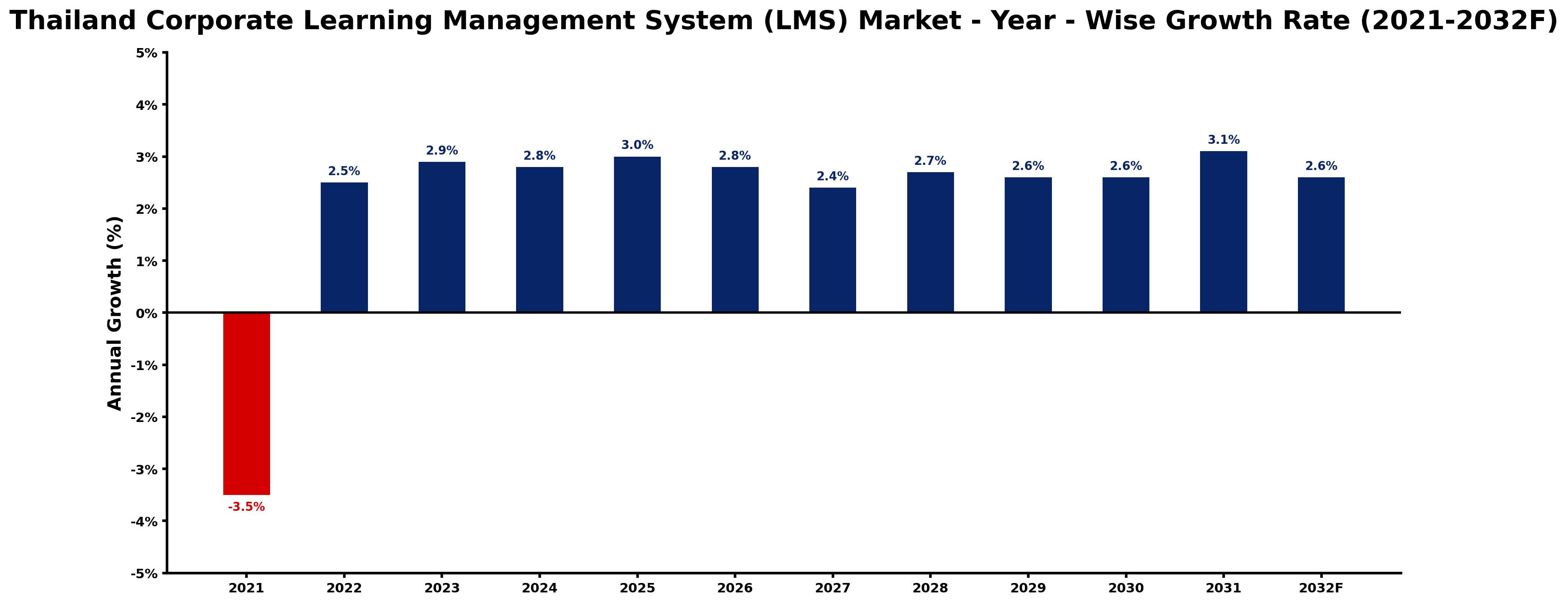
This graph illustrates the annual growth rates of the Thailand Corporate Learning Management System (LMS) Market from 2021 to 2032, highlighting a steady upward trajectory and projected expansion over the forecast period.
The table below presents the year‑wise growth rates along with the key drivers influencing the market
| Year | Growth Rate | Major Drivers |
| 2021 | -3.5% | Pandemic restrictions limited corporate training initiatives in Thailand. |
| 2022 | 2.5% | Rise in online training demand post-pandemic recovery. |
| 2023 | 2.9% | Thai government promotes digital skills for workforce improvement. |
| 2024 | 2.8% | Increased corporate investment in employee upskilling programs. |
| 2025 | 3.0% | Digital Transformation Framework boosts LMS adoption among firms. |
| 2026 | 2.8% | Growing trend of remote work necessitating innovative training solutions. |
| 2027 | 2.4% | Focus on lifelong learning aligns with national education policy. |
| 2028 | 2.7% | Enhanced mobile learning accessibility improves corporate training effectiveness. |
| 2029 | 2.6% | Emerging startups drive adoption of tailored LMS solutions. |
| 2030 | 2.6% | Integration of AI tools enhances personalized learning experiences. |
| 2031 | 3.1% | National 5G rollout supports seamless online training platforms. |
| 2032 | 2.6% | Increased emphasis on compliance training due to regulatory changes. |
Note: Market size estimations and growth projections presented in this report are based on 6Wresearch's proprietary forecasting methodology, utilizing the latest available industry data, government publications, and primary research inputs.
Thailand Corporate Learning Management System (LMS) Market Key Takeaways
Below are some of the specific key takeaways from the market, including:
- The market is driven by an increasing demand for digital training solutions tailored to diverse learning styles.
- Organizations are prioritizing platforms that allow for personalized learning paths and performance tracking.
- Technological advancements are pushing LMS providers to innovate content delivery methods.
- The pandemic has accelerated the adoption of LMS, making it a critical element of corporate training strategies.
- Key players are focusing on enhancing user engagement to address content relevance issues.
Evaluation of Restraints in Thailand Corporate Learning Management System (LMS) Market
Despite the growth potential, the Thailand Corporate LMS market faces notable restraints. A key challenge is ensuring the content remains relevant and engaging for users. Many organizations struggle to adapt their training materials to cater to varying learning preferences, which can lead to a lack of engagement and ineffective learning outcomes. Addressing these issues requires LMS platforms to continuously innovate in content development and delivery mechanisms, fostering a more dynamic learning environment.
Thailand Corporate Learning Management System (LMS) Market Trends
The market is currently influenced by several trends that are reshaping how corporate training is delivered. The increasing preference for mobile learning solutions is evident, as employees seek flexibility in accessing training materials. Gamification is another trend gaining traction, with organizations looking to enhance user engagement through interactive learning experiences.
on top of that, the integration of Artificial Intelligence (AI) in LMS platforms is becoming a game changer. AI-driven analytics can provide insights into learning behaviors, enabling organizations to tailor training programs effectively. This trend towards data-driven decision-making is expected to shape the future of corporate training.
Thailand Corporate Learning Management System (LMS) Market Opportunities
There are substantial growth opportunities within the Thailand Corporate LMS market. The push for digital transformation across various sectors means that companies are actively seeking sophisticated learning solutions. Investment in LMS platforms that offer advanced analytics and reporting features can provide organizations with insights that drive training effectiveness.
Additionally, as remote work becomes increasingly normalized, the demand for robust e-learning solutions will likely continue to rise. Companies that invest in adaptive learning technologies that respond to individual employee needs are well-positioned to capitalize on this trend.
Government Initiatives in the Thailand Corporate Learning Management System (LMS) Market
The Thai government is actively shaping the Corporate Learning Management System market through various initiatives aimed at enhancing workforce skills. Public policy is increasingly recognizing the importance of digital learning in fostering a skilled labor force. As organizations pivot towards continuous learning, government support can drive further adoption of LMS solutions.
- A recently completed initiative focused on upgrading the national digital infrastructure to support e-learning platforms.
- A current program promoting partnerships between educational institutions and businesses to ensure training content is relevant to market needs.
- A planned public-private initiative aimed at increasing access to digital learning resources in rural areas by 2027.
- Ongoing efforts to establish regulatory guidelines that encourage transparency and effectiveness in corporate training programs.
Future Insights of the Thailand Corporate Learning Management System (LMS) Market
Looking ahead to 2026-2032, the Thailand Corporate LMS market is set to witness significant changes driven by technological advancements and shifting workforce expectations. Companies that prioritize flexibility and personalization in their training programs will likely outperform competitors. on top of that, as businesses increasingly recognize the value of upskilling, the demand for comprehensive LMS solutions will expand, reinforcing the market's growth trajectory.
Thailand Corporate Learning Management System (LMS) Market Latest Developments
Over the past 12-14 months, the Thailand Corporate LMS market has seen heightened activity, with organizations actively seeking innovative solutions to enhance employee training. The emphasis on digital learning has led to the introduction of various platforms designed to meet evolving corporate needs.
- A leading technology vendor launched an enhanced LMS platform in early 2025, featuring AI-driven personalization capabilities.
- An ongoing collaboration between major corporations and educational institutions aims to develop industry-relevant training modules, currently underway since mid-2025.
- A major service provider is expected to roll out a new mobile learning application in the second half of 2026, aimed at enhancing accessibility for remote workers.
- A partnership established in early 2025 focuses on integrating gamification elements into existing LMS solutions to improve engagement.
Thailand Corporate Learning Management System (LMS) Market - Key Attractiveness of the Report
- 10 Years of Market Numbers
- Historical Data Starting from 2022 to 2025
- Base Year: 2025
- Forecast Data until 2032
- Key Performance Indicators Impacting the Market
- Major Upcoming Developments and Projects
Key Highlights of the Report:
- Thailand Corporate Learning Management System (LMS) Market Outlook
- Market Size of Thailand Corporate Learning Management System (LMS) Market, 2025
- Forecast of Thailand Corporate Learning Management System (LMS) Market, 2032
- Historical Data and Forecast of Thailand Corporate Learning Management System (LMS) Revenues & Volume for the Period 2022-2032F
- Thailand Corporate Learning Management System (LMS) Market Trend Evolution
- Thailand Corporate Learning Management System (LMS) Market Drivers and Challenges
- Thailand Corporate Learning Management System (LMS) Price Trends
- Thailand Corporate Learning Management System (LMS) Porter's Five Forces
- Thailand Corporate Learning Management System (LMS) Industry Life Cycle
- Historical Data and Forecast of Thailand Corporate Learning Management System (LMS) Market Revenues & Volume By Vertical for the Period 2022-2032F
- Historical Data and Forecast of Thailand Corporate Learning Management System (LMS) Market Revenues & Volume By Software for the Period 2022-2032F
- Historical Data and Forecast of Thailand Corporate Learning Management System (LMS) Market Revenues & Volume By Technology for the Period 2022-2032F
- Historical Data and Forecast of Thailand Corporate Learning Management System (LMS) Market Revenues & Volume By Healthcare for the Period 2022-2032F
- Historical Data and Forecast of Thailand Corporate Learning Management System (LMS) Market Revenues & Volume By Retail for the Period 2022-2032F
- Historical Data and Forecast of Thailand Corporate Learning Management System (LMS) Market Revenues & Volume By BFSI for the Period 2022-2032F
- Historical Data and Forecast of Thailand Corporate Learning Management System (LMS) Market Revenues & Volume By Telecommunications for the Period 2022-2032F
- Historical Data and Forecast of Thailand Corporate Learning Management System (LMS) Market Revenues & Volume By Offering for the Period 2022-2032F
- Historical Data and Forecast of Thailand Corporate Learning Management System (LMS) Market Revenues & Volume By Solutions for the Period 2022-2032F
- Historical Data and Forecast of Thailand Corporate Learning Management System (LMS) Market Revenues & Volume By Services for the Period 2022-2032F
- Historical Data and Forecast of Thailand Corporate Learning Management System (LMS) Market Revenues & Volume By Deployment Mode for the Period 2022-2032F
- Historical Data and Forecast of Thailand Corporate Learning Management System (LMS) Market Revenues & Volume By Cloud for the Period 2022-2032F
- Historical Data and Forecast of Thailand Corporate Learning Management System (LMS) Market Revenues & Volume By On-premises for the Period 2022-2032F
- Historical Data and Forecast of Thailand Corporate Learning Management System (LMS) Market Revenues & Volume By Organization Size for the Period 2022-2032F
- Historical Data and Forecast of Thailand Corporate Learning Management System (LMS) Market Revenues & Volume By SMEs for the Period 2022-2032F
- Historical Data and Forecast of Thailand Corporate Learning Management System (LMS) Market Revenues & Volume By Large Enterprises for the Period 2022-2032F
- Thailand Corporate Learning Management System (LMS) Import Export Trade Statistics
- Market Opportunity Assessment By Vertical
- Market Opportunity Assessment By Offering
- Market Opportunity Assessment By Deployment Mode
- Market Opportunity Assessment By Organization Size
- Thailand Corporate Learning Management System (LMS) Top Companies Market Share
- Thailand Corporate Learning Management System (LMS) Competitive Benchmarking By Technical and Operational Parameters
- Thailand Corporate Learning Management System (LMS) Company Profiles
- Thailand Corporate Learning Management System (LMS) Key Strategic Recommendations






































