Thailand Corticosteroids Market Size, Share & Growth Rate
The Thailand Corticosteroids Market was estimated at USD 119 Million in 2025 and is projected to reach USD 137 Million by 2032, growing at a CAGR of 2.0% from 2026 to 2032. This growth trajectory is primarily driven by the rising prevalence of inflammatory and autoimmune disorders, which in turn is accelerating the demand for effective therapeutic options. Furthermore, advancements in healthcare infrastructure and increasing access to quality medical care enhance the market's potential, fostering a conducive environment for corticosteroid utilization.
Thailand Corticosteroids Market Year-wise Growth Rate and Key Drivers
This graph highlights how the Thailand Corticosteroids Market has steadily grown over the years, supported by major growth factors.
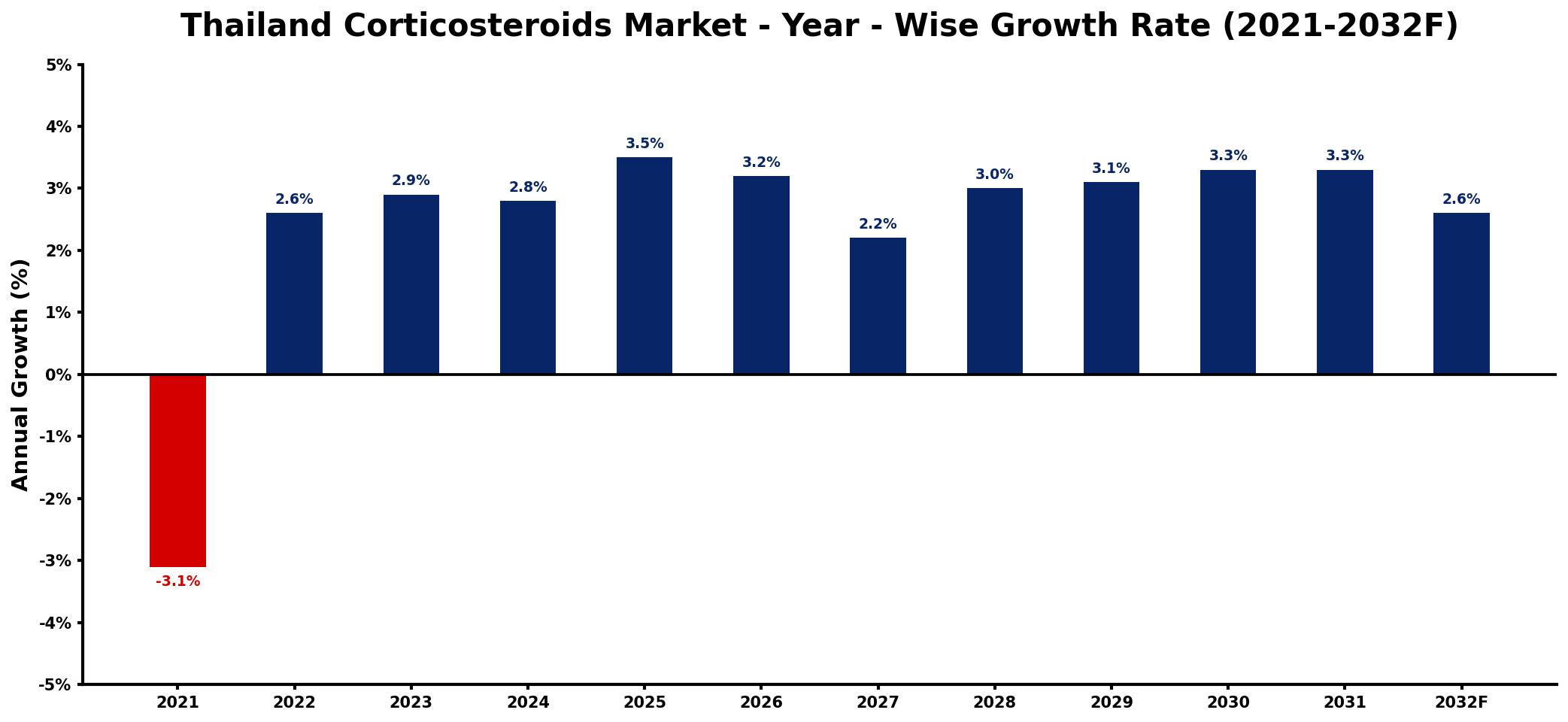
The table below presents the year‑wise growth rates along with the key drivers influencing the market
| Year | Growth Rate | Major Drivers |
| 2021 | -3.1% | decreased healthcare spending on treatments |
| 2022 | 2.6% | growing awareness of chronic conditions |
| 2023 | 2.9% | increased investment in healthcare infrastructure |
| 2024 | 2.8% | rising prevalence of autoimmune disorders |
| 2025 | 3.5% | expansion of telemedicine services |
| 2026 | 3.2% | development of innovative delivery systems |
| 2027 | 2.2% | enhanced patient access to therapies |
| 2028 | 3.0% | growing demand for specialty pharmacies |
| 2029 | 3.1% | increased focus on preventive care |
| 2030 | 3.3% | rising adoption of personalized medicine |
| 2031 | 3.3% | growing automotive sector requirements |
| 2032 | 2.6% | growing emphasis on patient education |
Note: Market size estimations and growth projections presented in this report are based on 6Wresearch's proprietary forecasting methodology, utilizing the latest available industry data, government publications, and primary research inputs.
Thailand Corticosteroids Market Synopsis
A significant force shaping the Thailand corticosteroids market is the escalating incidence of diseases requiring steroid treatment, particularly allergies and asthma. As the Thai population continues to face environmental and lifestyle changes, the demand for corticosteroids is set to increase, making it a pivotal component of the healthcare landscape.
Moreover, the evolving landscape of pharmaceutical development, including novel delivery systems and formulations, is fueling market dynamism. This innovation not only meets the diverse needs of healthcare providers and patients but also enhances therapeutic outcomes, thereby solidifying corticosteroids' role in medical treatment.
Thailand Corticosteroids Market Key Takeaways
- The market is driven by the increasing prevalence of autoimmune and inflammatory conditions.
- Innovations in corticosteroid formulations are enhancing patient compliance and treatment effectiveness.
- Improving healthcare infrastructure in Thailand is facilitating broader access to corticosteroid therapies.
- Regulatory challenges may impact the speed of drug development and market entry for new products.
- Generics continue to play a critical role in market accessibility and affordability.
Evaluation of Restraints in Thailand Corticosteroids Market
While the Thailand corticosteroids market is expanding, several key restraints hinder its full potential. Stringent regulatory compliance for drug approval often leads to prolonged timelines for new product introductions, stifling innovation. Furthermore, an oversaturated market presents challenges for differentiation, as companies compete in a crowded landscape. As a result, businesses must continually strive for innovation while navigating these regulatory and competitive barriers, which can prove to be quite complex.
Thailand Corticosteroids Market Trends
Current trends indicate a robust shift towards personalized medicine and biologics, influencing the development of corticosteroids. Researchers are increasingly exploring tailored therapies that cater to specific patient profiles, improving outcomes and reducing side effects. Additionally, the integration of digital health solutions into treatment regimens is providing healthcare professionals with better monitoring tools, ultimately enhancing patient management strategies.
Thailand Corticosteroids Market Opportunities
Opportunities for growth in the Thailand corticosteroids market lie within the development of novel delivery mechanisms that enhance drug efficacy and patient adherence. Furthermore, there is significant potential in addressing underserved therapeutic areas, such as chronic pain management and rare diseases, where corticosteroids can play a vital role. Strategic partnerships between pharmaceutical companies and healthcare institutions may also pave the way for innovative research and development efforts.
Government Initiatives in the Thailand Corticosteroids Market
The Thai government has introduced several initiatives aimed at improving healthcare access and pharmaceutical innovation. Investments in public health campaigns focus on educating the population about autoimmune and inflammatory diseases, driving awareness and demand for effective treatments. Moreover, regulatory bodies are working to streamline approval processes for essential medications, fostering a more efficient pharmaceutical environment that supports market growth.
Future Insights of the Thailand Corticosteroids Market
Looking ahead to 2026-2032, the Thailand corticosteroids market is poised for steady growth, driven by an aging population and rising healthcare expenditures. As new therapeutic areas emerge and patient needs evolve, companies will need to adapt their strategies to remain competitive. By focusing on innovative solutions, regulatory agility, and strategic collaborations, businesses can effectively navigate this dynamic landscape and capitalize on upcoming opportunities.
Thailand Corticosteroids Market Latest Developments (2025 - 2026)
Recent developments in the Thailand corticosteroids market reflect an ongoing commitment to innovation and responsiveness to healthcare demands. Companies are increasingly investing in research to enhance drug formulations and delivery systems. Additionally, the market has seen a rise in partnerships aimed at improving access to corticosteroid therapies, particularly in rural areas where medical resources may be limited. This collaborative approach marks a significant shift towards more comprehensive healthcare solutions.
Thailand Corticosteroids Market - Key Attractiveness of the Report
- 10 Years of Market Numbers
- Historical Data Starting from 2022 to 2025
- Base Year: 2025
- Forecast Data until 2032
- Key Performance Indicators Impacting the Market
- Major Upcoming Developments and Projects
Key Highlights of the Report:
- Thailand Corticosteroids Market Outlook
- Market Size of Thailand Corticosteroids Market, 2025
- Forecast of Thailand Corticosteroids Market, 2032
- Historical Data and Forecast of Thailand Corticosteroids Revenues & Volume for the Period 2022-2032F
- Thailand Corticosteroids Market Trend Evolution
- Thailand Corticosteroids Market Drivers and Challenges
- Thailand Corticosteroids Price Trends
- Thailand Corticosteroids Porter's Five Forces
- Thailand Corticosteroids Industry Life Cycle
- Historical Data and Forecast of Thailand Corticosteroids Market Revenues & Volume By Application for the Period 2022-2032F
- Historical Data and Forecast of Thailand Corticosteroids Market Revenues & Volume By Skin Allergies for the Period 2022-2032F
- Historical Data and Forecast of Thailand Corticosteroids Market Revenues & Volume By Rhuematology Indications for the Period 2022-2032F
- Historical Data and Forecast of Thailand Corticosteroids Market Revenues & Volume By Endocrinology for the Period 2022-2032F
- Historical Data and Forecast of Thailand Corticosteroids Market Revenues & Volume By Acute Respiratory Diseases for the Period 2022-2032F
- Historical Data and Forecast of Thailand Corticosteroids Market Revenues & Volume By Others for the Period 2022-2032F
- Historical Data and Forecast of Thailand Corticosteroids Market Revenues & Volume By End User for the Period 2022-2032F
- Historical Data and Forecast of Thailand Corticosteroids Market Revenues & Volume By Hospitals for the Period 2022-2032F
- Historical Data and Forecast of Thailand Corticosteroids Market Revenues & Volume By Clinics for the Period 2022-2032F
- Historical Data and Forecast of Thailand Corticosteroids Market Revenues & Volume By Research Institutes for the Period 2022-2032F
- Historical Data and Forecast of Thailand Corticosteroids Market Revenues & Volume By Others for the Period 2022-2032F
- Thailand Corticosteroids Import Export Trade Statistics
- Market Opportunity Assessment By Application
- Market Opportunity Assessment By End User
- Thailand Corticosteroids Top Companies Market Share
- Thailand Corticosteroids Competitive Benchmarking By Technical and Operational Parameters
- Thailand Corticosteroids Company Profiles
- Thailand Corticosteroids Key Strategic Recommendations






































