Thailand Cultured Meat Market Size, Share & Growth Rate
The Thailand Cultured Meat Market was estimated at USD 216 Million in 2025 and is projected to reach USD 248 Million by 2032, growing at a CAGR of 2.0% from 2026 to 2032. This growth is largely driven by shifting consumer preferences toward sustainable food sources and an increasing awareness of environmental impact. As Thailand's urban population becomes more health-conscious, the demand for lab-grown alternatives to traditional meat is expected to escalate, indicating a significant transition in the culinary landscape.
Thailand Cultured Meat Market Year-wise Growth Rate and Key Drivers
This graph highlights how the Thailand Cultured Meat Market has steadily grown over the years, supported by major growth factors.
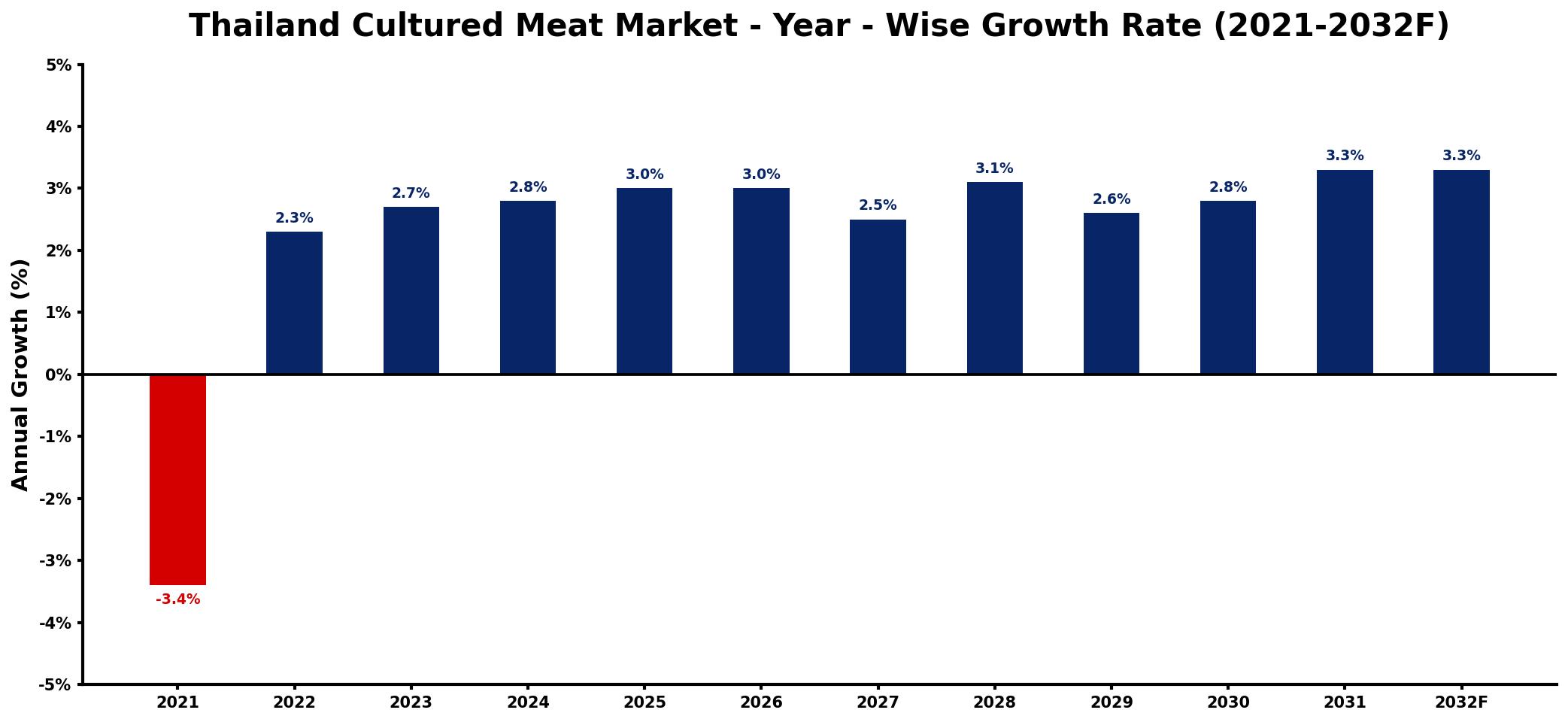
The table below presents the year‑wise growth rates along with the key drivers influencing the market
| Year | Growth Rate | Major Drivers |
| 2021 | -3.4% | consumer interest in alternatives wanes |
| 2022 | 2.3% | growing investments in technology |
| 2023 | 2.7% | rising environmental sustainability awareness |
| 2024 | 2.8% | increased regulatory support for innovations |
| 2025 | 3.0% | expansion of distribution networks |
| 2026 | 3.0% | emerging health trends driving demand |
| 2027 | 2.5% | partnerships with food service providers |
| 2028 | 3.1% | enhanced production efficiency advancements |
| 2029 | 2.6% | broader consumer acceptance of alternatives |
| 2030 | 2.8% | growing focus on ethical sourcing |
| 2031 | 3.3% | increased collaboration with researchers |
| 2032 | 3.3% | development of new flavor profiles |
Note: Market size estimations and growth projections presented in this report are based on 6Wresearch's proprietary forecasting methodology, utilizing the latest available industry data, government publications, and primary research inputs.
Thailand Cultured Meat Market Synopsis
The most influential force shaping the Thailand cultured meat market is the rising consumer awareness regarding sustainability and animal welfare. As urbanization continues to increase, Thai consumers are actively seeking alternatives to conventional meat sources, leading to a burgeoning interest in lab-grown products.
Furthermore, local cultural culinary traditions, along with a growing health consciousness, are propelling the demand for cultured meat. The unique flavors and textures that lab-grown meat can provide align well with Thailand's rich and diverse food culture, making it a promising prospect for future culinary innovation.
Thailand Cultured Meat Market Key Takeaways
- The market is experiencing growth fueled by increased consumer demand for sustainable and ethical food options.
- Urbanization and health consciousness are driving the exploration of lab-grown meat alternatives among Thai consumers.
- Investment in R&D is vital for overcoming production challenges and enhancing consumer acceptance.
- Regulatory uncertainties present a significant hurdle, impacting the speed of market adoption.
- The unique culinary landscape of Thailand offers substantial potential for diverse cultured meat applications.
Evaluation of Restraints in Thailand Cultured Meat Market
Despite its potential, the Thailand cultured meat market grapples with several notable restraints. Chief among these is the hesitance among consumers who remain loyal to traditional meat sources, often viewing lab-grown options with skepticism. This cultural attachment complicates efforts to shift dietary habits. Additionally, the high costs associated with production technology, compounded by the need for ongoing research and development, create barriers to entry for new companies. Regulatory frameworks specific to cultured meat are still evolving, which can lead to inconsistencies and uncertainties in market dynamics, further dampening investment opportunities.
Thailand Cultured Meat Market Trends
Current trends in the Thailand cultured meat market point towards a growing focus on product innovation and sustainable practices. As producers experiment with various meat types, from poultry to seafood, the emphasis is on replicating traditional flavors and textures. Moreover, the integration of health benefits associated with cultured meat—such as lower fat content and the absence of antibiotics—aligns perfectly with increasing consumer interest in wellness. Collaborative initiatives between startups and established food producers are also emerging, aiming to foster technological advancements and increase market penetration.
Thailand Cultured Meat Market Opportunities
The Thailand cultured meat market is ripe with opportunities for growth and investment. As the demand for sustainable food sources rises, companies can explore niche segments, particularly in health-focused products. The potential for partnerships with restaurants and street food vendors presents an avenue for market entry, leveraging Thailands rich culinary heritage. Additionally, targeted educational campaigns can help inform consumers about the environmental and health benefits of cultured meat, paving the way for broader acceptance.
Government Initiatives in the Thailand Cultured Meat Market
The Thai government is beginning to recognize the importance of sustainable food technologies. Although comprehensive regulations are still in development, there are initiatives aimed at supporting research and innovation in cultured meat production. Public spending on food technology and agricultural modernization is increasing, signaling a commitment to fostering a supportive environment for alternative protein sources. Additionally, potential grants and incentives are being discussed to encourage startups in the sector, reflecting a proactive approach to addressing future food security concerns.
Future Insights of the Thailand Cultured Meat Market
Looking ahead to the period from 2026 to 2032, the Thailand cultured meat market is anticipated to undergo significant transformation. As consumer acceptance grows and technological advancements reduce production costs, the market is likely to expand steadily. With a projected market size of USD 248 Million by 2032, the trajectory indicates that cultured meat could become an integral component of the Thai diet. Furthermore, as regulatory frameworks are established, they will likely facilitate faster growth and innovation, positioning Thailand as a potential leader in the Southeast Asian cultured meat landscape.
Thailand Cultured Meat Market Latest Developments (2025 - 2026)
During the period between & and June 2026, the Thailand cultured meat market has witnessed progressive strides in production capabilities and consumer outreach. Companies are focusing on enhancing product transparency, employing educational campaigns to demystify lab-grown meat. New collaborations between technology firms and food producers are emerging, aiming to streamline production processes. Notable attention is also being given to consumer feedback, which is increasingly being integrated into product development strategies.
Thailand Cultured Meat Market - Key Attractiveness of the Report
- 10 Years of Market Numbers
- Historical Data Starting from 2022 to 2025
- Base Year: 2025
- Forecast Data until 2032
- Key Performance Indicators Impacting the Market
- Major Upcoming Developments and Projects
Key Highlights of the Report:
- Thailand Cultured Meat Market Outlook
- Market Size of Thailand Cultured Meat Market, 2025
- Forecast of Thailand Cultured Meat Market, 2032
- Historical Data and Forecast of Thailand Cultured Meat Revenues & Volume for the Period 2022-2032F
- Thailand Cultured Meat Market Trend Evolution
- Thailand Cultured Meat Market Drivers and Challenges
- Thailand Cultured Meat Price Trends
- Thailand Cultured Meat Porter's Five Forces
- Thailand Cultured Meat Industry Life Cycle
- Historical Data and Forecast of Thailand Cultured Meat Market Revenues & Volume By Product Type for the Period 2022-2032F
- Historical Data and Forecast of Thailand Cultured Meat Market Revenues & Volume By Poultry for the Period 2022-2032F
- Historical Data and Forecast of Thailand Cultured Meat Market Revenues & Volume By Beef for the Period 2022-2032F
- Historical Data and Forecast of Thailand Cultured Meat Market Revenues & Volume By Seafood for the Period 2022-2032F
- Historical Data and Forecast of Thailand Cultured Meat Market Revenues & Volume By Pork for the Period 2022-2032F
- Historical Data and Forecast of Thailand Cultured Meat Market Revenues & Volume By Duck for the Period 2022-2032F
- Historical Data and Forecast of Thailand Cultured Meat Market Revenues & Volume By End-Use for the Period 2022-2032F
- Historical Data and Forecast of Thailand Cultured Meat Market Revenues & Volume By Nuggets for the Period 2022-2032F
- Historical Data and Forecast of Thailand Cultured Meat Market Revenues & Volume By Burgers for the Period 2022-2032F
- Historical Data and Forecast of Thailand Cultured Meat Market Revenues & Volume By Meatballs for the Period 2022-2032F
- Historical Data and Forecast of Thailand Cultured Meat Market Revenues & Volume By Sausage for the Period 2022-2032F
- Historical Data and Forecast of Thailand Cultured Meat Market Revenues & Volume By Hot dogs for the Period 2022-2032F
- Historical Data and Forecast of Thailand Cultured Meat Market Revenues & Volume By Others for the Period 2022-2032F
- Thailand Cultured Meat Import Export Trade Statistics
- Market Opportunity Assessment By Product Type
- Market Opportunity Assessment By End-Use
- Thailand Cultured Meat Top Companies Market Share
- Thailand Cultured Meat Competitive Benchmarking By Technical and Operational Parameters
- Thailand Cultured Meat Company Profiles
- Thailand Cultured Meat Key Strategic Recommendations






































