Thailand Decentralized Identity Market Size & Growth Rate (2026-2032)
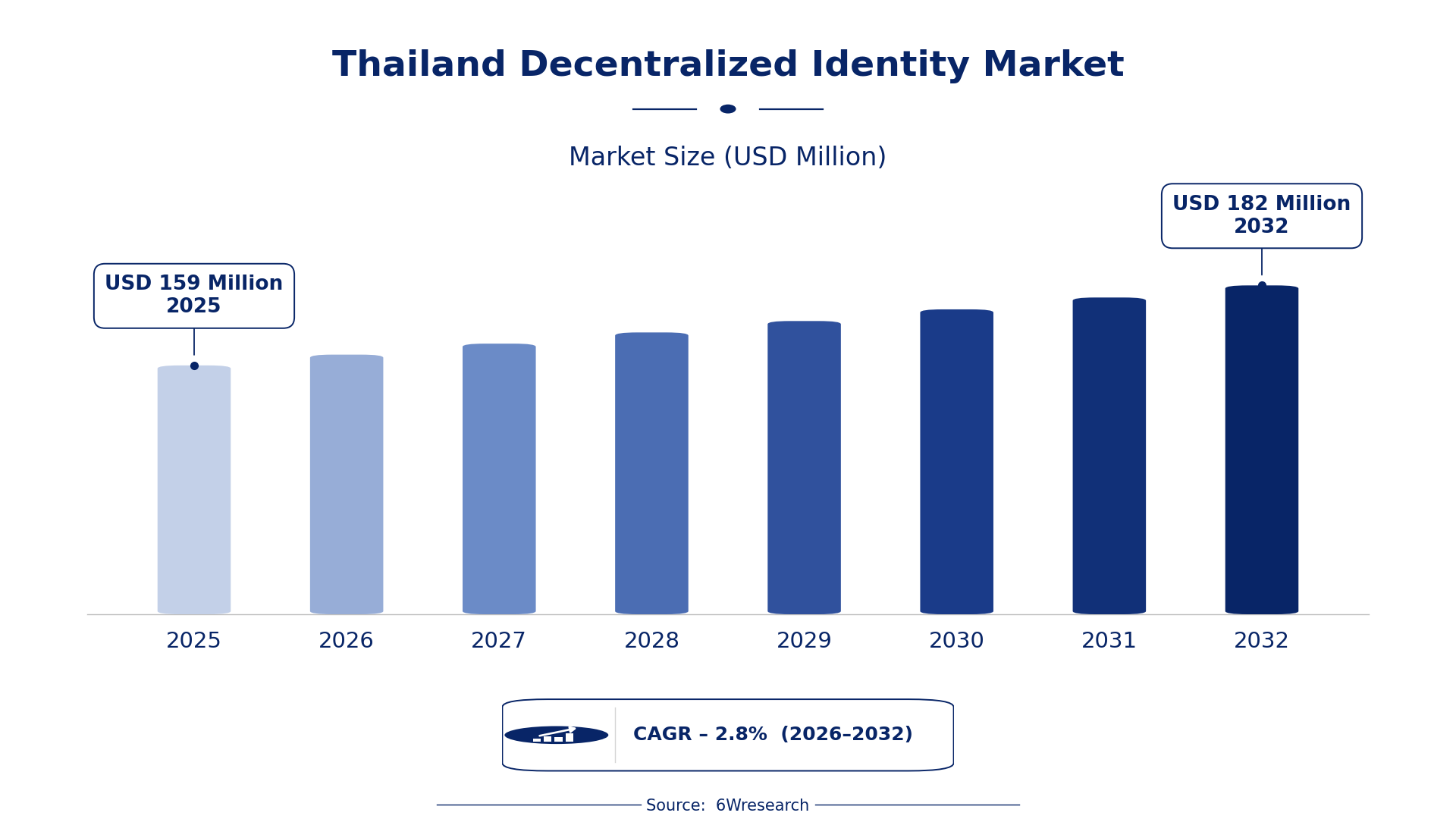
The Thailand Decentralized Identity Market was estimated at USD 159 Million in 2025 and is projected to reach USD 182 Million by 2032, growing at a CAGR of 2.8% from 2026 to 2032.
Thailand Decentralized Identity Market Synopsis
The Thailand Decentralized Identity Market is at a critical juncture, driven by the urgent need for enhanced data privacy and user control. Increasing digital interactions have magnified the vulnerabilities associated with traditional identity systems, prompting organizations and individuals to seek decentralized solutions that prioritize security and autonomy.
Utilizing blockchain technology, decentralized identity systems offer a new approach to identity management, allowing users to securely verify their identities without intermediaries. With a growing emphasis on self-sovereign identity models, the market is poised for continued growth as stakeholders recognize the potential for trust and privacy in digital transactions.
Thailand Decentralized Identity Market Year-wise Growth Rate and Key Drivers
This graph illustrates the annual growth rates of the Thailand Decentralized Identity Market from 2021 to 2032, highlighting a steady upward trajectory and projected expansion over the forecast period.
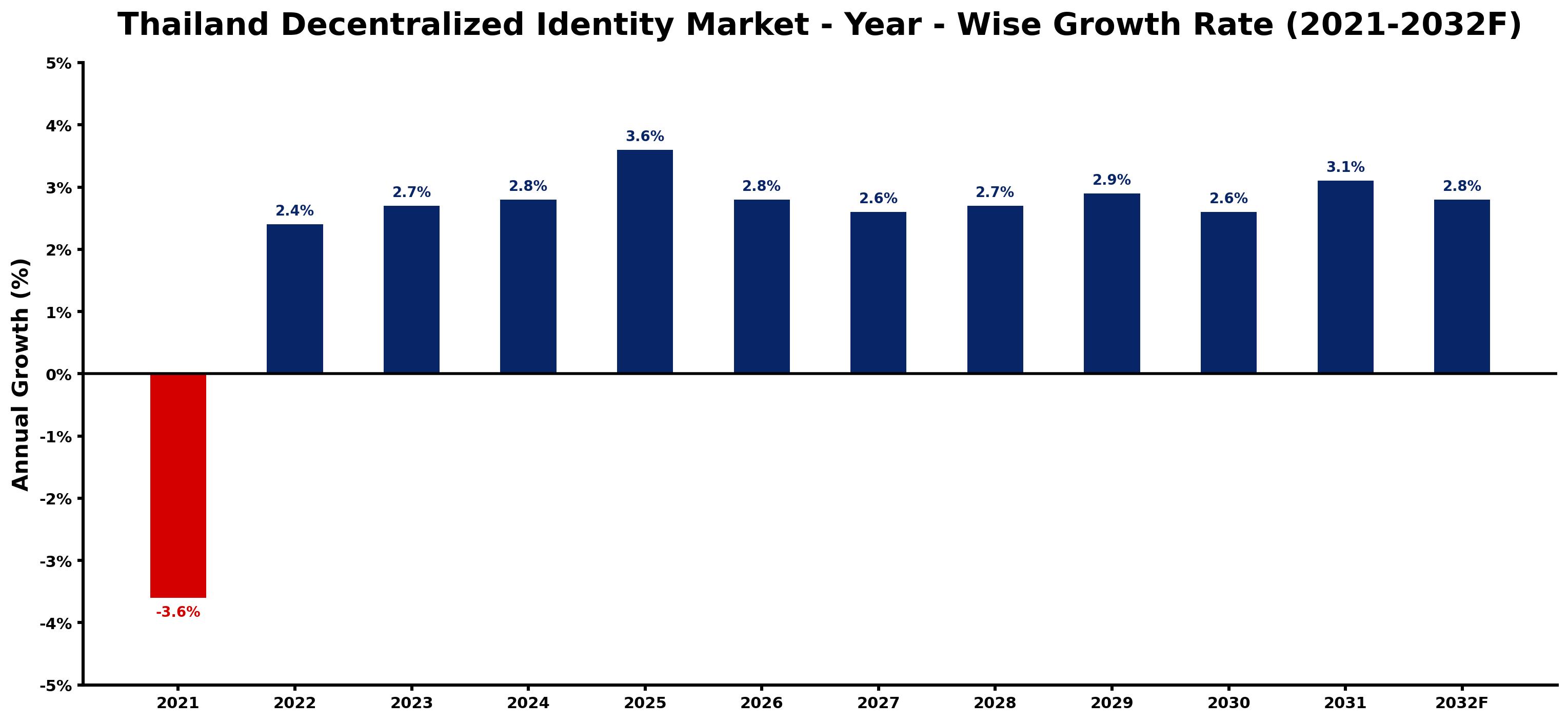
The table below presents the year‑wise growth rates along with the key drivers influencing the market
| Year | Growth Rate | Major Drivers |
| 2021 | -3.6% | Thai Digital Economy Act delayed implementation of identity solutions. |
| 2022 | 2.4% | Thai government promotes digital ID for online services |
| 2023 | 2.7% | Regulatory push for biometric authentication standards nationwide |
| 2024 | 2.8% | Growing fintech partnerships enhancing identity verification processes |
| 2025 | 3.6% | Increased mobile payment adoption driving identity solutions demand |
| 2026 | 2.8% | Government initiatives for smart cities boosting identity technologies |
| 2027 | 2.6% | Rise in telehealth services requiring secure patient identities |
| 2028 | 2.7% | Thailand's digital economy strategy emphasizes decentralized identity |
| 2029 | 2.9% | Local startups innovating in blockchain-based identity systems |
| 2030 | 2.6% | Strengthening data protection laws catalyze identity verification needs |
| 2031 | 3.1% | Growing interest in digital governance fuels identity market growth |
| 2032 | 2.8% | Public sector digitization drives decentralized identity adoption |
Note: Market size estimations and growth projections presented in this report are based on 6Wresearch's proprietary forecasting methodology, utilizing the latest available industry data, government publications, and primary research inputs.
Thailand Decentralized Identity Market Key Takeaways
Below are some of the specific key takeaways from the market, including:
- The market is experiencing a shift towards self-sovereign identity solutions, giving users control over their data.
- Blockchain technology is a core component driving the adoption of decentralized identity systems.
- Privacy concerns are motivating individuals and organizations to explore innovative identity management options.
- Collaborative efforts among technology providers and regulators are crucial for standardization and interoperability.
- The COVID-19 pandemic accelerated the need for secure digital identity solutions.
Evaluation of Restraints in Thailand Decentralized Identity Market
The Thailand Decentralized Identity Market faces notable hurdles that could impede its growth. Establishing trust among various decentralized systems is paramount but remains challenging due to the absence of standardized protocols. The lack of interoperability can deter users from adopting these solutions, as concerns about compatibility and functionality arise. Privacy regulations and compliance issues further complicate the market, as technology developers must navigate a complex regulatory landscape while striving to meet user expectations.
Thailand Decentralized Identity Market Trends
Several key trends are shaping the Thailand Decentralized Identity Market. The rising demand for enhanced user privacy is pushing organizations to adopt blockchain-based solutions. There is also a clear move toward creating frameworks that facilitate self-sovereign identity, where users retain ownership over their personal data. In addition, the integration of decentralized identity solutions with existing financial and governmental systems is gaining traction, reflecting a broader acceptance of these technologies. Increased collaboration between public and private sectors is becoming evident, indicating a collective push towards embracing innovative identity management.
Thailand Decentralized Identity Market Opportunities
As the demand for decentralized identity solutions grows, significant investment opportunities are emerging. Technology developers can capitalize on the need for interoperability by creating platforms that connect different systems. Furthermore, educational institutions and government agencies present ripe prospects for collaboration in developing user-centric identity verification processes. Expansion into adjacent markets, such as healthcare and finance, where secure identity verification is critical, offers additional avenues for growth. Organizations that can successfully address privacy regulations while fostering user trust will lead the market.
Government Initiatives in the Thailand Decentralized Identity Market
The Thai government is actively shaping the Decentralized Identity Market through a range of initiatives that emphasize regulatory frameworks and digital identity infrastructure. Policymakers recognize the importance of enhancing user privacy and security in an increasingly digital society. As the government outlines its digital transformation strategy, it places significant emphasis on implementing standards for decentralized identity solutions.
- A national digital identity framework launched in early 2025 aims to set guidelines for secure identity management.
- Current discussions are underway regarding the introduction of regulations that support self-sovereign identity models by 2026.
- The government has initiated a public-private partnership to develop a secure digital identity verification system expected to roll out by mid-2026.
- Ongoing pilot programs are testing the integration of decentralized identity solutions in public services to streamline user verification processes.
- Plans for a comprehensive digital infrastructure upgrade set for 2027 are aimed at supporting decentralized technologies.
Future Insights of the Thailand Decentralized Identity Market
Looking ahead, the Thailand Decentralized Identity Market is positioned for steady growth. As consumer awareness around data privacy heightens, the demand for decentralized identity solutions will continue to rise. Expect innovations in technology to enhance user experience and streamline identity verification processes. With government support and increasing collaboration among stakeholders, the market will likely evolve into a well-integrated ecosystem, fostering a culture of trust and security in digital identity management.
Thailand Decentralized Identity Market Latest Developments
In the past year, the Thailand Decentralized Identity Market has seen significant developments, reflecting a robust engagement from various sectors. Organizations are ramping up efforts to launch platforms that emphasize privacy and user control, reflecting the increasing importance of these values in digital interactions.
- A leading technology provider announced the launch of a decentralized identity platform in late 2025, focusing on user privacy and security features.
- A partnership between a regional fintech company and a blockchain developer was established in Q1 2026 to enhance identity verification for financial transactions.
- A major governmental initiative to pilot decentralized identity solutions across various public services began in mid-2025 and is currently ongoing.
- By late 2026, a new interoperability framework is expected to be introduced to facilitate easier integration between different decentralized identity systems.
- Future collaborations are planned between technology firms and educational institutions aimed at creating identity management solutions tailored for academic use, expected to kick off in early 2027.
Thailand Decentralized Identity Market - Key Attractiveness of the Report
- 10 Years of Market Numbers
- Historical Data Starting from 2022 to 2025
- Base Year: 2025
- Forecast Data until 2032
- Key Performance Indicators Impacting the Market
- Major Upcoming Developments and Projects
Key Highlights of the Report:
- Thailand Decentralized Identity Market Outlook
- Market Size of Thailand Decentralized Identity Market, 2025
- Forecast of Thailand Decentralized Identity Market, 2032
- Historical Data and Forecast of Thailand Decentralized Identity Revenues & Volume for the Period 2022-2032F
- Thailand Decentralized Identity Market Trend Evolution
- Thailand Decentralized Identity Market Drivers and Challenges
- Thailand Decentralized Identity Price Trends
- Thailand Decentralized Identity Porter's Five Forces
- Thailand Decentralized Identity Industry Life Cycle
- Historical Data and Forecast of Thailand Decentralized Identity Market Revenues & Volume By Vertical for the Period 2022-2032F
- Historical Data and Forecast of Thailand Decentralized Identity Market Revenues & Volume By BFSI for the Period 2022-2032F
- Historical Data and Forecast of Thailand Decentralized Identity Market Revenues & Volume By Government for the Period 2022-2032F
- Historical Data and Forecast of Thailand Decentralized Identity Market Revenues & Volume By Healthcare and Life Sciences for the Period 2022-2032F
- Historical Data and Forecast of Thailand Decentralized Identity Market Revenues & Volume By Retail and eCommerce for the Period 2022-2032F
- Historical Data and Forecast of Thailand Decentralized Identity Market Revenues & Volume By Telecom and IT for the Period 2022-2032F
- Historical Data and Forecast of Thailand Decentralized Identity Market Revenues & Volume By Transport and Logistics for the Period 2022-2032F
- Historical Data and Forecast of Thailand Decentralized Identity Market Revenues & Volume By Real Estate for the Period 2022-2032F
- Historical Data and Forecast of Thailand BFSI Decentralized Identity Market Revenues & Volume By Others for the Period 2022-2032F
- Historical Data and Forecast of Thailand Decentralized Identity Market Revenues & Volume By Identity Type for the Period 2022-2032F
- Historical Data and Forecast of Thailand Decentralized Identity Market Revenues & Volume By Non- biometrics for the Period 2022-2032F
- Historical Data and Forecast of Thailand Decentralized Identity Market Revenues & Volume By Biometrics for the Period 2022-2032F
- Historical Data and Forecast of Thailand Decentralized Identity Market Revenues & Volume By End User for the Period 2022-2032F
- Historical Data and Forecast of Thailand Decentralized Identity Market Revenues & Volume By Enterprises for the Period 2022-2032F
- Historical Data and Forecast of Thailand Decentralized Identity Market Revenues & Volume By Individual for the Period 2022-2032F
- Historical Data and Forecast of Thailand Decentralized Identity Market Revenues & Volume By Organization Size for the Period 2022-2032F
- Historical Data and Forecast of Thailand Decentralized Identity Market Revenues & Volume By Large Enterprises for the Period 2022-2032F
- Historical Data and Forecast of Thailand Decentralized Identity Market Revenues & Volume By SMEs for the Period 2022-2032F
- Thailand Decentralized Identity Import Export Trade Statistics
- Market Opportunity Assessment By Vertical
- Market Opportunity Assessment By Identity Type
- Market Opportunity Assessment By End User
- Market Opportunity Assessment By Organization Size
- Thailand Decentralized Identity Top Companies Market Share
- Thailand Decentralized Identity Competitive Benchmarking By Technical and Operational Parameters
- Thailand Decentralized Identity Company Profiles
- Thailand Decentralized Identity Key Strategic Recommendations






































