Thailand Dehydrated Culture Media Market Size, Share & Growth Rate
The Thailand Dehydrated Culture Media Market was estimated at USD 128 Million in 2025 and is projected to reach USD 147 Million by 2032, growing at a CAGR of 2.0% from 2026 to 2032. This growth trajectory is propelled by the burgeoning healthcare and biotechnology sectors in Thailand, which are increasingly reliant on efficient microbial testing solutions. Additionally, the rising awareness surrounding food safety standards and quality assurance processes is driving demand for high-quality dehydrated culture media across various industries.
Thailand Dehydrated Culture Media Market Year-wise Growth Rate and Key Drivers
This graph highlights how the Thailand Dehydrated Culture Media Market has steadily grown over the years, supported by major growth factors.
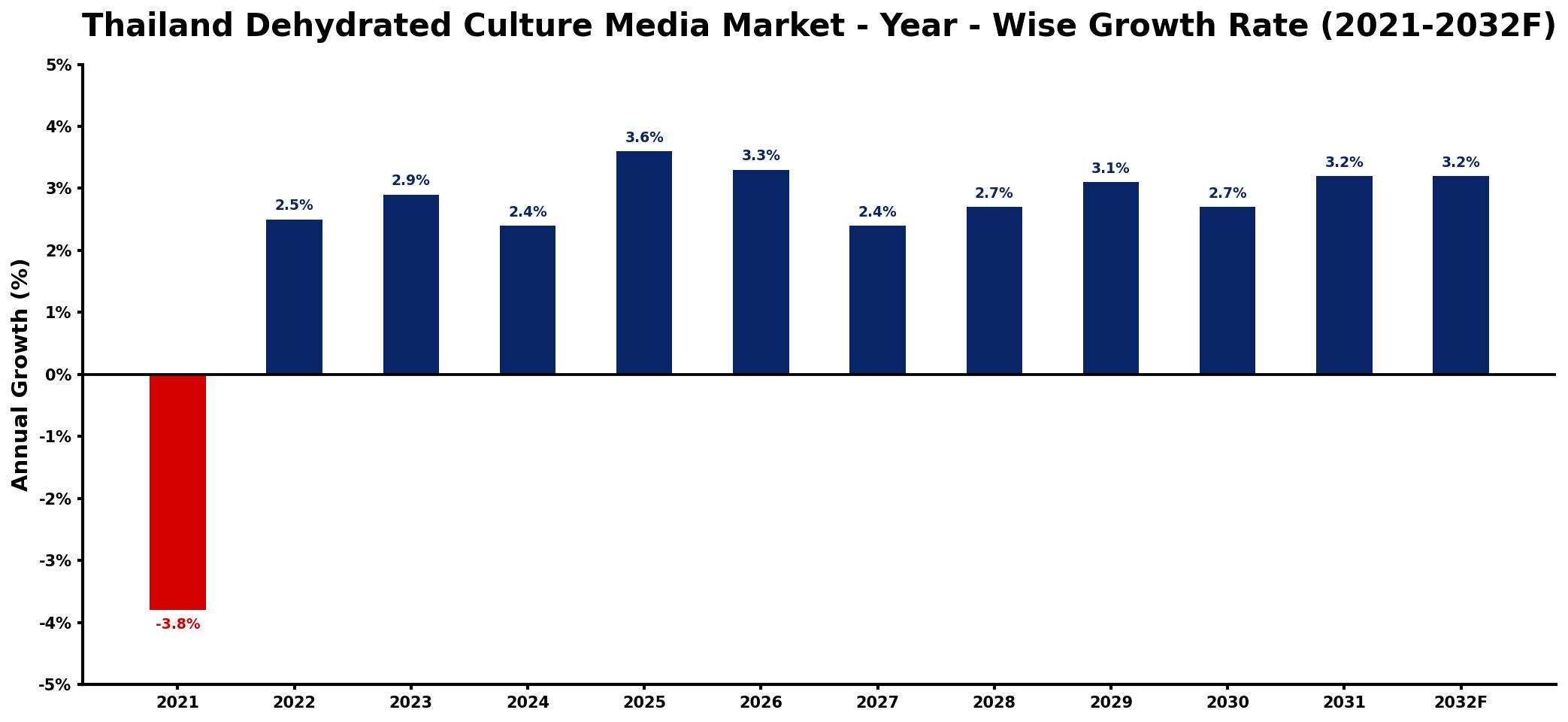
The table below presents the year‑wise growth rates along with the key drivers influencing the market
| Year | Growth Rate | Major Drivers |
| 2021 | -3.8% | decrease in laboratory investments |
| 2022 | 2.5% | rise in research funding allocations |
| 2023 | 2.9% | increased pharmaceutical production needs |
| 2024 | 2.4% | growing biotechnology sector demand |
| 2025 | 3.6% | expansion of food safety regulations |
| 2026 | 3.3% | heightened environmental testing requirements |
| 2027 | 2.4% | surge in clinical trial activities |
| 2028 | 2.7% | increased agricultural research initiatives |
| 2029 | 3.1% | growth in educational institution labs |
| 2030 | 2.7% | enhanced quality control standards |
| 2031 | 3.2% | rising public health awareness |
| 2032 | 3.2% | advancements in microbiological research |
Note: Market size estimations and growth projections presented in this report are based on 6Wresearch's proprietary forecasting methodology, utilizing the latest available industry data, government publications, and primary research inputs.
Thailand Dehydrated Culture Media Market Synopsis
The use of dehydrated culture media is essential in microbiological research and clinical diagnostics, catering to a wide array of applications, from pathogen identification to environmental assessments. In Thailand, the growing emphasis on maintaining stringent food safety regulations significantly boosts the market, as food and beverage manufacturers seek reliable microbial testing solutions.
Moreover, the increasing focus on innovative laboratory practices and the adoption of customized media formulations are further shaping the landscape of the dehydrated culture media market. The commitment to improving testing accuracy and efficiency, particularly in response to emerging health threats, underscores the importance of this market in Thailand's scientific community.
Thailand Dehydrated Culture Media Market Key Takeaways
- The market is experiencing growth driven by heightened healthcare and biotechnology sector investments.
- Food safety concerns and quality control measures are critical demand drivers.
- Customized formulations are emerging as a significant trend in product offerings.
- Government initiatives supporting research and healthcare infrastructure development are propelling market growth.
- Supply chain disruptions during the pandemic have led to a renewed focus on local sourcing and manufacturing capabilities.
Evaluation of Restraints in Thailand Dehydrated Culture Media Market
While the Thailand Dehydrated Culture Media market is poised for growth, several constraints hinder its potential. One significant issue is the challenge of ensuring quality control throughout the supply chain. Any lapses in sterility or formulation accuracy can lead to compromised test results, undermining the trust of end-users. Additionally, the relatively short shelf life of dehydrated media necessitates careful inventory management, as expired products can skew results. The competition from alternative media formats, such as ready-to-use liquid media, further complicates the landscape, as these alternatives often appeal to users seeking convenience and reliability.
Thailand Dehydrated Culture Media Market Trends
Recent trends indicate a shift towards the development of rapid microbial detection systems and tailored media formulations. Laboratories are increasingly seeking products that facilitate quicker results, aligning with the industrys demand for more efficient testing protocols. Moreover, advancements in technology are enabling the creation of more precise and effective culture media, catering to the unique requirements of various microorganisms.
Sustainability is another emerging trend, as companies strive to adopt environmentally friendly practices in product manufacturing. This includes utilizing sustainable raw materials and reducing waste throughout the production process. Together, these trends reflect a market that is not only responsive to current demands but also proactively engaged in future innovations.
Thailand Dehydrated Culture Media Market Opportunities
The Thailand Dehydrated Culture Media market presents various opportunities for growth and investment. The increasing investment in healthcare infrastructure and biotechnology research offers fertile ground for developing new products and technologies. Additionally, expanding into emerging sectors, such as agricultural testing and environmental monitoring, can further diversify market opportunities. The rise of e-commerce platforms also provides avenues for enhancing distribution channels, making high-quality products more accessible to a wider audience.
Government Initiatives in the Thailand Dehydrated Culture Media Market
The Thai government has made notable strides in bolstering healthcare and research sectors, which positively influences the dehydrated culture media market. Initiatives aimed at enhancing laboratory infrastructure, increasing funding for research and development, and implementing stricter food safety regulations are pivotal. Such government support fosters an environment conducive to innovation and quality improvement, laying the groundwork for sustained market growth.
Future Insights of the Thailand Dehydrated Culture Media Market
Looking ahead to 2026-2032, the Thailand Dehydrated Culture Media market is set to evolve with continued emphasis on innovation and quality assurance. The anticipated growth in healthcare spending and the ongoing development of biotechnology research will likely drive demand for advanced microbiological testing solutions. Additionally, as more companies recognize the importance of food safety and environmental monitoring, the market will align itself to meet these emerging needs, making it a vital component of Thailand's scientific and industrial landscape.
Thailand Dehydrated Culture Media Market Latest Developments (2025 - 2026)
Recent developments in the Thailand dehydrated culture media market reflect a dynamic shift towards enhancing product formulations and distribution methods. The sector is witnessing increased collaboration between research institutions and manufacturers to create innovative media solutions tailored to contemporary testing challenges. Moreover, several companies are focusing on expanding their online presence and improving logistics to facilitate quicker access to high-quality products, addressing demand efficiently.
Thailand Dehydrated Culture Media Market - Key Attractiveness of the Report
- 10 Years of Market Numbers
- Historical Data Starting from 2022 to 2025
- Base Year: 2025
- Forecast Data until 2032
- Key Performance Indicators Impacting the Market
- Major Upcoming Developments and Projects
Key Highlights of the Report:
- Thailand Dehydrated Culture Media Market Outlook
- Market Size of Thailand Dehydrated Culture Media Market, 2025
- Forecast of Thailand Dehydrated Culture Media Market, 2032
- Historical Data and Forecast of Thailand Dehydrated Culture Media Revenues & Volume for the Period 2022-2032F
- Thailand Dehydrated Culture Media Market Trend Evolution
- Thailand Dehydrated Culture Media Market Drivers and Challenges
- Thailand Dehydrated Culture Media Price Trends
- Thailand Dehydrated Culture Media Porter's Five Forces
- Thailand Dehydrated Culture Media Industry Life Cycle
- Historical Data and Forecast of Thailand Dehydrated Culture Media Market Revenues & Volume By Type for the Period 2022-2032F
- Historical Data and Forecast of Thailand Dehydrated Culture Media Market Revenues & Volume By Natural Medium for the Period 2022-2032F
- Historical Data and Forecast of Thailand Dehydrated Culture Media Market Revenues & Volume By Mixed Medium for the Period 2022-2032F
- Historical Data and Forecast of Thailand Dehydrated Culture Media Market Revenues & Volume By Semi-Composite Medium for the Period 2022-2032F
- Historical Data and Forecast of Thailand Dehydrated Culture Media Market Revenues & Volume By End-User for the Period 2022-2032F
- Historical Data and Forecast of Thailand Dehydrated Culture Media Market Revenues & Volume By Hospitals for the Period 2022-2032F
- Historical Data and Forecast of Thailand Dehydrated Culture Media Market Revenues & Volume By Diagnostic centers for the Period 2022-2032F
- Historical Data and Forecast of Thailand Dehydrated Culture Media Market Revenues & Volume By Biotechnology & Pharmaceutical Industries for the Period 2022-2032F
- Historical Data and Forecast of Thailand Dehydrated Culture Media Market Revenues & Volume By Academic and Research Institutes for the Period 2022-2032F
- Historical Data and Forecast of Thailand Dehydrated Culture Media Market Revenues & Volume By Others for the Period 2022-2032F
- Thailand Dehydrated Culture Media Import Export Trade Statistics
- Market Opportunity Assessment By Type
- Market Opportunity Assessment By End-User
- Thailand Dehydrated Culture Media Top Companies Market Share
- Thailand Dehydrated Culture Media Competitive Benchmarking By Technical and Operational Parameters
- Thailand Dehydrated Culture Media Company Profiles
- Thailand Dehydrated Culture Media Key Strategic Recommendations






































