Thailand Deodorants and Anti-Perspirant Products Market Summary
The thailand deodorants and anti-perspirant products market was estimated at USD 103 Million in 2025 and is projected to reach USD 118 Million by 2032, growing at a CAGR of 3.1% from 2026 to 2032.
Thailand Deodorants and Anti-Perspirant Products Market Year-wise Growth Rate and Key Drivers
This graph highlights how the Thailand Deodorants and Anti-Perspirant Products Market has steadily grown over the past five years, supported by major growth factors.
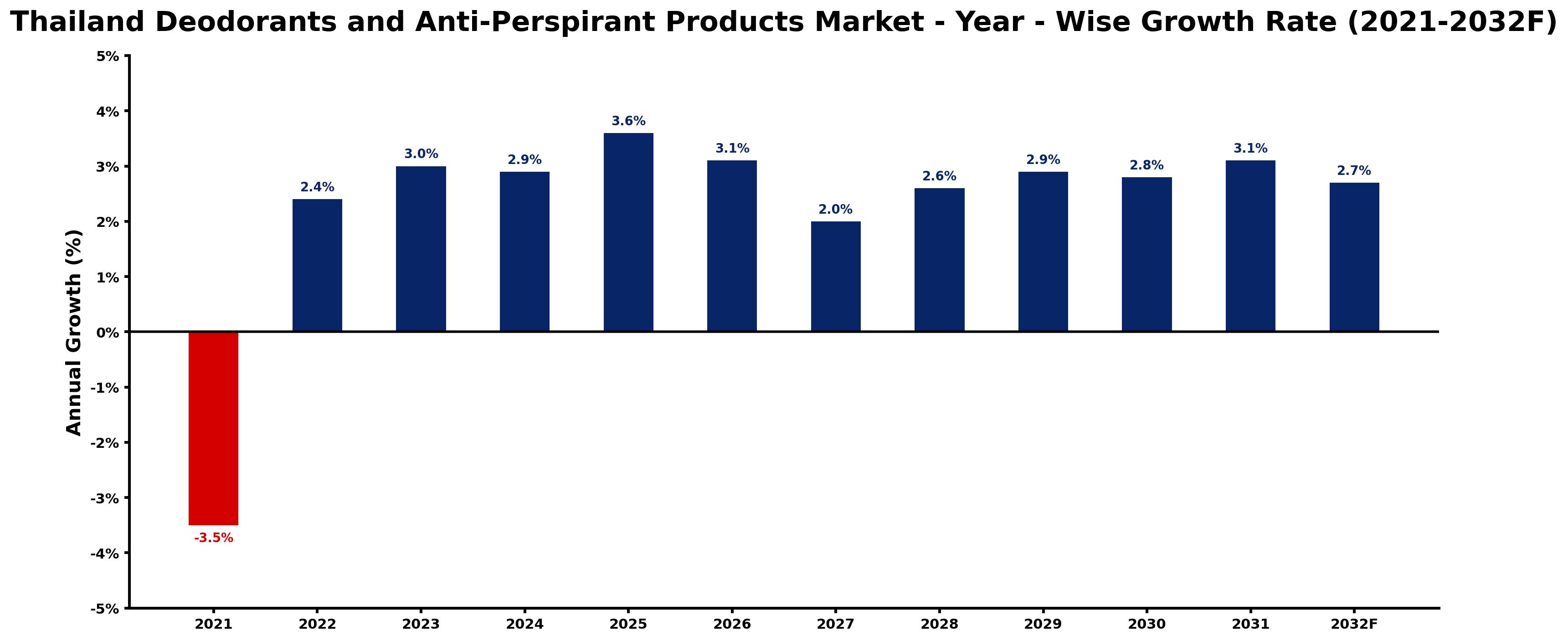
The table below presents the year wise growth rates along with the key drivers influencing the market
| Year | Growth Rate | Major Drivers |
| 2021 | -3.5% | Shifts in consumer preferences toward natural and organic products diminished demand for conventional deodorants. |
| 2022 | 2.4% | Online retail channels witness significant adoption, enhancing product accessibility for urban consumers. |
| 2023 | 3.0% | Brand loyalty shifts as younger demographics seek sustainable and eco-friendly deodorant options. |
| 2024 | 2.9% | Innovative packaging designs attract attention, driving impulse purchases in retail environments. |
| 2025 | 3.6% | Local manufacturing initiatives improve supply chain efficiencies, reducing product costs for consumers. |
| 2026 | 3.1% | Social media marketing campaigns become prevalent, influencing consumer perceptions and preferences significantly. |
| 2027 | 2.0% | Post-pandemic lifestyles emphasize wellness, prompting a shift toward premium personal care products. |
| 2028 | 2.6% | Collaborations with local influencers enhance brand visibility, aligning products with cultural values. |
| 2029 | 2.9% | Climate change awareness influences formulation choices, driving demand for biodegradable materials. |
| 2030 | 2.8% | E-commerce platforms integrate AI, personalizing shopping experiences for deodorant product selections. |
| 2031 | 3.1% | Retail experiences evolve with augmented reality, allowing virtual product trials for consumers. |
| 2032 | 2.7% | Changing social norms regarding body care encourage broader acceptance of diverse deodorant options. |
Note - Market size estimations and growth projections presented in this report are based on 6Wresearch's advanced forecasting approach, validated with industry datasets as of June 2026.
Thailand Deodorants and Anti-Perspirant Products Market Synopsis
The Thailand Deodorants and Anti-Perspirant Products Market is projected to reach 3.1% and witness significant growth during the forecast period (2026-2032). This market encompasses a diverse range of products aimed at preventing body odor and perspiration, which have gained popularity due to their effectiveness and multifunctional benefits, including skin whitening and moisturizing properties.
Thailand Deodorants and Anti-Perspirant Products Market Growth Drivers
Several factors are propelling the growth of the Thailand deodorants and anti-perspirant products market. The rising awareness of personal hygiene among the Thai population has significantly increased the demand for these products. Consumers are increasingly seeking effective solutions that can combat body odor while also providing additional skincare benefits. The growing trend towards natural and herbal ingredients is attracting a clientele that prefers safer, organic alternatives that deliver effective results.
- The growing consumer preference for herbal and natural formulations has led to an influx of products that assure better protection against body odor and perspiration.
- Innovative product offerings, such as long-lasting formulations and fragrances that appeal to today's consumers, are boosting market demand.
- As disposable incomes rise among the middle-class demographic, the consumption of personal care products, including deodorants and anti-perspirants, is also on the rise.
- The expansion of e-commerce platforms has transformed purchasing behaviors, offering consumers convenient access to a variety of products at competitive prices.
- Brand loyalty developed through effective marketing strategies and product satisfaction is further solidifying market growth.
Thailand Deodorants and Anti-Perspirant Products Market Challenges and Restraints
Despite the positive growth trajectory, the market faces several challenges that could hinder progress. The high price associated with premium brands can be a significant deterrent for price-sensitive consumers. Moreover, businesses in this sector must navigate complex regulatory frameworks governing advertising and labeling, which may restrict promotional activities.
- Stringent regulations on product claims and ingredient disclosure can limit marketing strategies, affecting sales potential.
- The economic aftermath of the COVID-19 pandemic has shifted consumer spending priorities, leading to reduced expenditure on personal care items.
- Increased competition from local brands offering lower-priced alternatives can pressure margins for established companies.
- The evolving landscape of consumer preferences necessitates continuous product innovation, which can be resource-intensive for manufacturers.
- Supply chain disruptions caused by global events can impact product availability and pricing, thus affecting sales volumes.
Thailand Deodorants and Anti-Perspirant Products Market COVID-19 Impact
The COVID-19 pandemic has left an indelible mark on global markets, including the Thailand deodorants and anti-perspirant products market. With lockdown measures leading to temporary store closures and shifts in consumer buying habits, sales experienced a notable decline during the peak of the crisis. However, the pandemic has also heightened awareness regarding personal hygiene and cleanliness, potentially boosting demand for deodorants and anti-perspirants in the post-pandemic era.
Thailand Deodorants and Anti-Perspirant Products Market Government Investment and Initiatives
The Thai government has been instrumental in promoting personal care sectors, including deodorants and anti-perspirants, through various initiatives aimed at enhancing public health standards. Efforts to encourage the adoption of hygiene products in the consumer market are part of broader public health campaigns. Additionally, investments in infrastructure and logistics to support local manufacturing and distribution of personal care products are being prioritized.
- Government initiatives promoting public health awareness are likely to create a more informed consumer base demanding hygiene products.
- Subsidies and incentives for manufacturers to adopt sustainable practices and ingredients are being introduced to enhance product quality and safety.
- Collaboration with health organizations to develop educational programs on hygiene practices is increasing consumer trust in deodorant and anti-perspirant products.
- Regulations encouraging product safety and effectiveness can enhance consumer confidence, boosting market growth.
- Public investments in e-commerce infrastructure support the accessibility of personal care products to a wider audience across the country.
Thailand Deodorants and Anti-Perspirant Products Market Latest Developments (May 2025 - June 2026)
In the period leading up to mid-2026, the Thailand deodorants and anti-perspirant products market has seen several notable trends shaping the direction of the industry. Innovations focusing on eco-friendly packaging and sustainable ingredient sourcing are gaining traction, reflecting consumer preferences for environmentally conscious products. Additionally, the ongoing growth of online retail channels is expected to continue influencing purchasing habits, offering convenience and a wider selection for consumers.
- There is a marked increase in brands focusing on product formulations that cater to specific consumer needs, such as sensitive skin or long-lasting effects.
- Collaborative initiatives between businesses and health organizations are fostering increased awareness around personal hygiene, driving product uptake.
- Research and development efforts are being amplified to enhance product efficacy, particularly in addressing diverse consumer demographics.
- Emerging brands are leveraging social media platforms to engage with consumers, building brand loyalty through targeted marketing strategies.
- Focus on reducing the carbon footprint through sustainable production processes is becoming a significant talking point within the market.
Thailand Deodorants and Anti-Perspirant Products Market - Key Attractiveness of the Report
- 10 Years of Market Numbers
- Historical Data Starting from 2022 to 2025
- Base Year: 2025
- Forecast Data until 2032
- Key Performance Indicators Impacting the Market
- Major Upcoming Developments and Projects
Key Highlights of the Report:
- Thailand Deodorants and Anti-Perspirant Products Market Outlook
- Market Size of Thailand Deodorants and Anti-Perspirant Products Market, 2025
- Forecast of Thailand Deodorants and Anti-Perspirant Products Market, 2032
- Historical Data and Forecast of Thailand Deodorants and Anti-Perspirant Products Revenues & Volume for the Period 2022-2032F
- Thailand Deodorants and Anti-Perspirant Products Market Trend Evolution
- Thailand Deodorants and Anti-Perspirant Products Market Drivers and Challenges
- Thailand Deodorants and Anti-Perspirant Products Price Trends
- Thailand Deodorants and Anti-Perspirant Products Porter's Five Forces
- Thailand Deodorants and Anti-Perspirant Products Industry Life Cycle
- Historical Data and Forecast of Thailand Deodorants and Anti-Perspirant Products Market Revenues & Volume By Function for the Period 2022-2032F
- Historical Data and Forecast of Thailand Deodorants and Anti-Perspirant Products Market Revenues & Volume By Aerosol Spray for the Period 2022-2032F
- Historical Data and Forecast of Thailand Deodorants and Anti-Perspirant Products Market Revenues & Volume By Cream for the Period 2022-2032F
- Historical Data and Forecast of Thailand Deodorants and Anti-Perspirant Products Market Revenues & Volume By Roll-On for the Period 2022-2032F
- Historical Data and Forecast of Thailand Deodorants and Anti-Perspirant Products Market Revenues & Volume By Gel for the Period 2022-2032F
- Historical Data and Forecast of Thailand Deodorants and Anti-Perspirant Products Market Revenues & Volume By Ingredient for the Period 2022-2032F
- Historical Data and Forecast of Thailand Deodorants and Anti-Perspirant Products Market Revenues & Volume By Alcohol for the Period 2022-2032F
- Historical Data and Forecast of Thailand Deodorants and Anti-Perspirant Products Market Revenues & Volume By Antimicrobials for the Period 2022-2032F
- Historical Data and Forecast of Thailand Deodorants and Anti-Perspirant Products Market Revenues & Volume By Conditioner and Moisturizer for the Period 2022-2032F
- Historical Data and Forecast of Thailand Deodorants and Anti-Perspirant Products Market Revenues & Volume By Fragrances for the Period 2022-2032F
- Historical Data and Forecast of Thailand Deodorants and Anti-Perspirant Products Market Revenues & Volume By Paraben and Propellants for the Period 2022-2032F
- Historical Data and Forecast of Thailand Deodorants and Anti-Perspirant Products Market Revenues & Volume By Others for the Period 2022-2032F
- Thailand Deodorants and Anti-Perspirant Products Import Export Trade Statistics
- Market Opportunity Assessment By Function
- Market Opportunity Assessment By Ingredient
- Thailand Deodorants and Anti-Perspirant Products Top Companies Market Share
- Thailand Deodorants and Anti-Perspirant Products Competitive Benchmarking By Technical and Operational Parameters
- Thailand Deodorants and Anti-Perspirant Products Company Profiles
- Thailand Deodorants and Anti-Perspirant Products Key Strategic Recommendations






































