Thailand Dermatology Drugs Market Size, Share & Growth Rate
The Thailand Dermatology Drugs Market was estimated at USD 235 Million in 2025 and is projected to reach USD 271 Million by 2032, growing at a CAGR of 2.1% from 2026 to 2032. This growth trajectory is driven by an increasing incidence of skin disorders such as acne, psoriasis, and eczema, alongside heightened public awareness of skincare. Additionally, a burgeoning middle class with greater disposable income has translated into a greater demand for both medical and cosmetic dermatological treatments.
Thailand Dermatology Drugs Market Year-wise Growth Rate and Key Drivers
This graph highlights how the Thailand Dermatology Drugs Market has steadily grown over the years, supported by major growth factors.
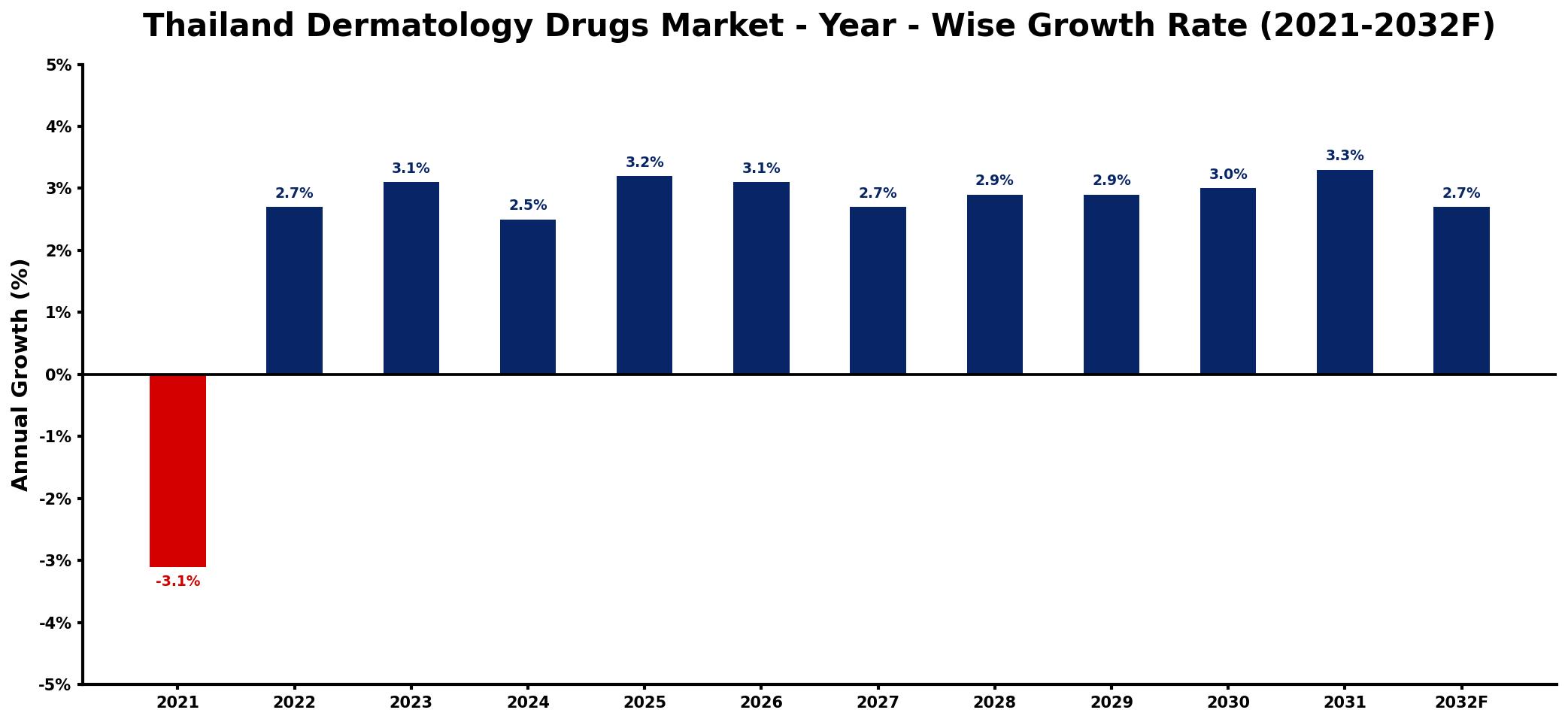
The table below presents the year‑wise growth rates along with the key drivers influencing the market
| Year | Growth Rate | Major Drivers |
| 2021 | -3.1% | decreased consumer spending on healthcare |
| 2022 | 2.7% | increased investment in healthcare infrastructure |
| 2023 | 3.1% | growing awareness of skin conditions |
| 2024 | 2.5% | rising demand for innovative treatments |
| 2025 | 3.2% | expansion of telemedicine services |
| 2026 | 3.1% | increased focus on preventive care |
| 2027 | 2.7% | growing popularity of natural remedies |
| 2028 | 2.9% | rising disposable income levels |
| 2029 | 2.9% | increased access to healthcare services |
| 2030 | 3.0% | expanding distribution channels for products |
| 2031 | 3.3% | growing interest in personalized medicine |
| 2032 | 2.7% | increased collaboration among research institutions |
Note: Market size estimations and growth projections presented in this report are based on 6Wresearch's proprietary forecasting methodology, utilizing the latest available industry data, government publications, and primary research inputs.
Thailand Dermatology Drugs Market Synopsis
The Thailand Dermatology Drugs market has shown robust growth recently, yet it stands at a pivotal point where emerging trends may dictate its future direction. With evolving consumer preferences and a focus on advanced skincare solutions, the market is expected to transition towards a more diversified product range that caters to both therapeutic and aesthetic needs.
As more individuals seek effective treatments for persistent skin conditions, the demand for innovative dermatological therapies will continue to rise. In particular, advancements in drug formulation and delivery mechanisms are set to influence the market landscape, offering more targeted and efficient solutions for patients.
Thailand Dermatology Drugs Market Key Takeaways
- The market is primarily driven by increasing skin disorders due to environmental factors and lifestyle changes.
- Consumer awareness and willingness to invest in premium skincare products significantly boosts demand.
- Advancements in healthcare infrastructure enhance the accessibility of dermatological care.
- The landscape is evolving with a shift towards digital health solutions, including telemedicine.
- Prescription and over-the-counter product availability continues to expand, catering to diverse consumer needs.
Evaluation of Restraints in Thailand Dermatology Drugs Market
Despite the optimistic growth outlook, the Thailand Dermatology Drugs market faces real constraints that could temper its expansion. Regulatory hurdles may significantly delay the approval processes for innovative drugs, thus slowing down the introduction of new therapies to the market. Furthermore, the competitive environment among pharmaceutical companies can lead to aggressive pricing strategies, which may diminish profit margins and hinder the sustainability of smaller players. These factors combined create a challenging backdrop that requires careful navigation by stakeholders.
Thailand Dermatology Drugs Market Trends
Current trends indicate a noticeable shift towards holistic and integrative skincare approaches among consumers. Additionally, there is a rising preference for products with natural and organic ingredients, which resonate well with health-conscious individuals. The growth of e-commerce platforms has made dermatological products more accessible, enabling consumers to easily find and purchase specialized items without geographical limitations. Moreover, the integration of AI-driven diagnostics in dermatology is expected to revolutionize treatment plans, further shaping market dynamics.
Thailand Dermatology Drugs Market Opportunities
There are significant opportunities for growth in the Thailand Dermatology Drugs market, especially in the development of personalized medicine that caters to the unique skin profiles of individuals. Investment in R&D for innovative drug formulations targeting specific dermatological conditions holds great promise. Furthermore, as telehealth continues to gain traction, businesses that leverage digital platforms for consultation and follow-up care could see substantial growth. Collaborations with dermatology clinics for exclusive product lines or treatment regimens also present potential avenues for expansion.
Government Initiatives in the Thailand Dermatology Drugs Market
The Thai government has implemented several initiatives to improve healthcare access, which in turn supports the dermatology drugs market. Increased public spending on health programs, alongside policies aimed at enhancing the quality of dermatological care, are notable aspects of current governance. Furthermore, initiatives promoting health education and awareness about skin diseases encourage proactive consumer behavior towards dermatological health.
Future Insights of the Thailand Dermatology Drugs Market
Looking ahead to 2026-2032, the Thailand Dermatology Drugs market is poised for continued growth, driven by a combination of increasing consumer demand and technological advancements. As new dermatological conditions emerge and the population ages, the need for effective treatments will become even more pronounced. Additionally, the expected rise in digital health solutions will redefine patient engagement in dermatological care, making the market landscape more competitive yet rewarding for innovative providers.
Thailand Dermatology Drugs Market Latest Developments (2025 - 2026)
Recent developments in the Thailand Dermatology Drugs market reflect a keen interest in innovative treatment options, particularly for chronic skin conditions. The rise of digital healthcare solutions, including online consultations and mobile health applications, has transformed the patient experience. Moreover, partnerships between pharmaceutical companies and healthcare providers are emerging, aimed at optimizing treatment protocols and enhancing patient outcomes.
Thailand Dermatology Drugs Market - Key Attractiveness of the Report
- 10 Years of Market Numbers
- Historical Data Starting from 2022 to 2025
- Base Year: 2025
- Forecast Data until 2032
- Key Performance Indicators Impacting the Market
- Major Upcoming Developments and Projects
Key Highlights of the Report:
- Thailand Dermatology Drugs Market Outlook
- Market Size of Thailand Dermatology Drugs Market, 2025
- Forecast of Thailand Dermatology Drugs Market, 2032
- Historical Data and Forecast of Thailand Dermatology Drugs Revenues & Volume for the Period 2022-2032F
- Thailand Dermatology Drugs Market Trend Evolution
- Thailand Dermatology Drugs Market Drivers and Challenges
- Thailand Dermatology Drugs Price Trends
- Thailand Dermatology Drugs Porter's Five Forces
- Thailand Dermatology Drugs Industry Life Cycle
- Historical Data and Forecast of Thailand Dermatology Drugs Market Revenues & Volume By Application for the Period 2022-2032F
- Historical Data and Forecast of Thailand Dermatology Drugs Market Revenues & Volume By Acne for the Period 2022-2032F
- Historical Data and Forecast of Thailand Dermatology Drugs Market Revenues & Volume By Atopic Dermatitis for the Period 2022-2032F
- Historical Data and Forecast of Thailand Dermatology Drugs Market Revenues & Volume By Psoriasis for the Period 2022-2032F
- Historical Data and Forecast of Thailand Dermatology Drugs Market Revenues & Volume By Others for the Period 2022-2032F
- Historical Data and Forecast of Thailand Dermatology Drugs Market Revenues & Volume By Route of Administration for the Period 2022-2032F
- Historical Data and Forecast of Thailand Dermatology Drugs Market Revenues & Volume By Oral for the Period 2022-2032F
- Historical Data and Forecast of Thailand Dermatology Drugs Market Revenues & Volume By Parenteral for the Period 2022-2032F
- Historical Data and Forecast of Thailand Dermatology Drugs Market Revenues & Volume By Topical for the Period 2022-2032F
- Historical Data and Forecast of Thailand Dermatology Drugs Market Revenues & Volume By Distribution Channel for the Period 2022-2032F
- Historical Data and Forecast of Thailand Dermatology Drugs Market Revenues & Volume By Hospital Pharmacy for the Period 2022-2032F
- Historical Data and Forecast of Thailand Dermatology Drugs Market Revenues & Volume By Retail Pharmacy for the Period 2022-2032F
- Historical Data and Forecast of Thailand Dermatology Drugs Market Revenues & Volume By Online Pharmacy for the Period 2022-2032F
- Thailand Dermatology Drugs Import Export Trade Statistics
- Market Opportunity Assessment By Application
- Market Opportunity Assessment By Route of Administration
- Market Opportunity Assessment By Distribution Channel
- Thailand Dermatology Drugs Top Companies Market Share
- Thailand Dermatology Drugs Competitive Benchmarking By Technical and Operational Parameters
- Thailand Dermatology Drugs Company Profiles
- Thailand Dermatology Drugs Key Strategic Recommendations






































