Thailand DevOps Market Size & Growth Rate (2026-2032)
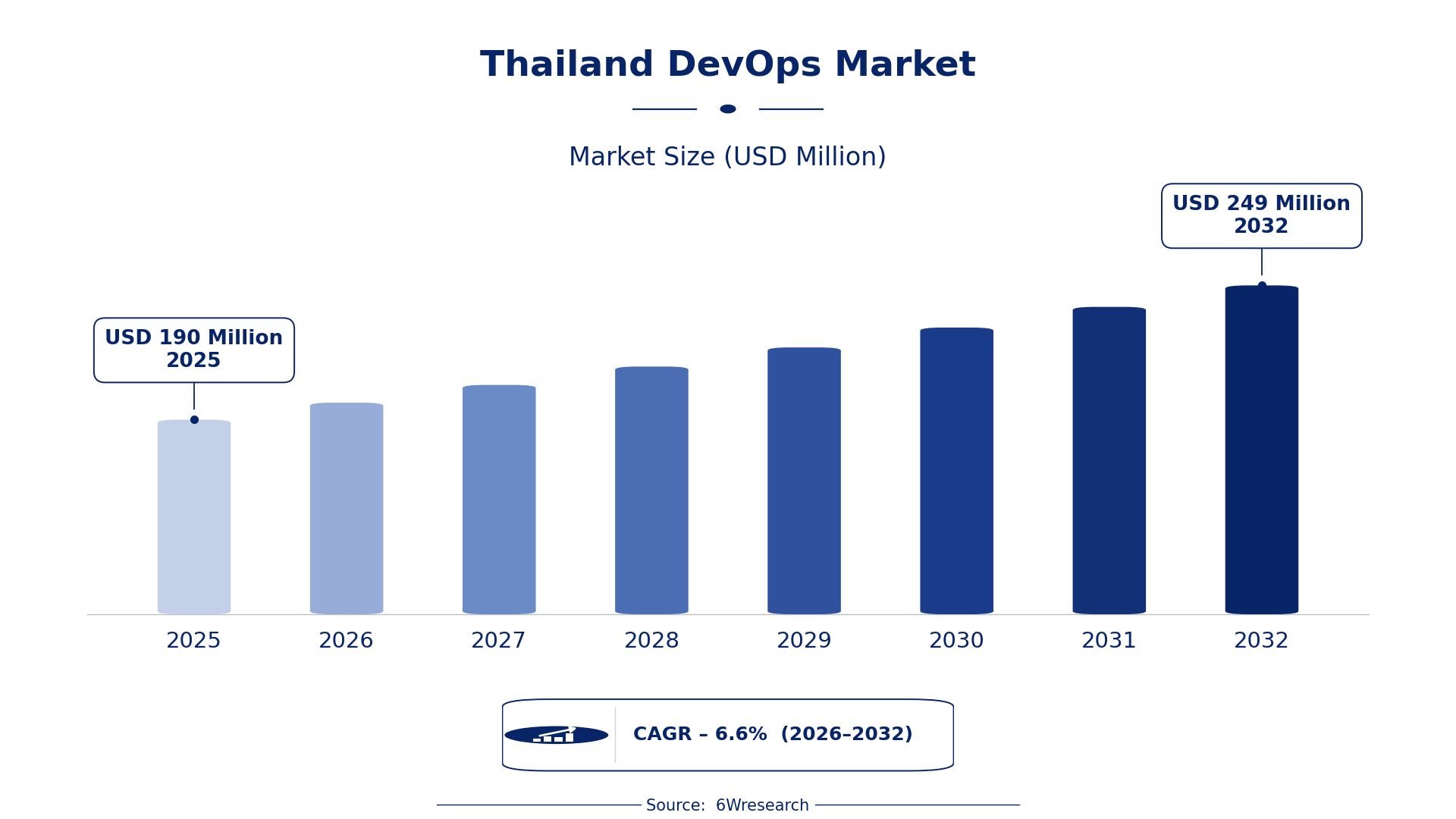
The Thailand DevOps Market was estimated at USD 190 Million in 2025 and is projected to reach USD 249 Million by 2032, growing at a CAGR of 6.6% from 2026 to 2032.
Thailand DevOps Market Synopsis
The DevOps movement is gaining traction in Thailand, as organizations increasingly recognize the need for collaboration between development and operations teams. This shift is essential for improving the speed and reliability of software delivery, which directly impacts business competitiveness in the digital age.
As businesses in Thailand embrace agile methodologies, the DevOps market is evolving rapidly. Companies are investing in tools that facilitate continuous integration, continuous delivery, and automated testing, all aimed at enhancing software quality and reducing time-to-market.
Thailand DevOps Market Year-wise Growth Rate and Key Drivers
This graph illustrates the annual growth rates of the Thailand DevOps Market from 2021 to 2032, highlighting a steady upward trajectory and projected expansion over the forecast period.
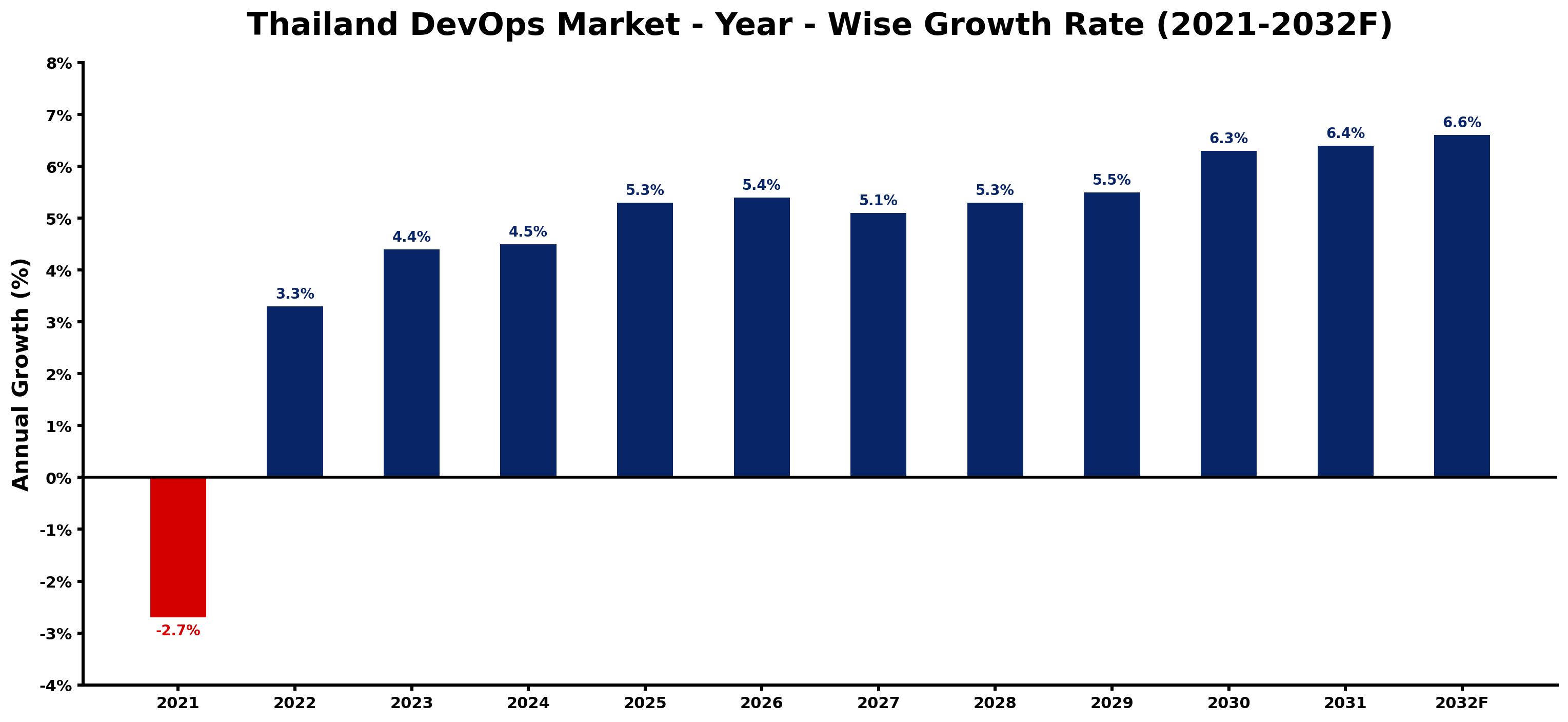
The table below presents the year‑wise growth rates along with the key drivers influencing the market
| Year | Growth Rate | Major Drivers |
| 2021 | -2.7% | Government's cybersecurity policies stifle DevOps investments. |
| 2022 | 3.3% | Rise of e-commerce driving DevOps adoption in Thailand. |
| 2023 | 4.4% | Increased investment in cloud infrastructure by Thai startups. |
| 2024 | 4.5% | Digital banking regulations fostering rapid software integration. |
| 2025 | 5.3% | Government incentives for tech innovation promoting DevOps solutions. |
| 2026 | 5.4% | Surge in mobile app development across various industries. |
| 2027 | 5.1% | Growing popularity of remote work boosting collaborative tools. |
| 2028 | 5.3% | Emergence of fintech startups requiring rapid deployment cycles. |
| 2029 | 5.5% | Strong support for digital transformation from Industry 4.0 initiatives. |
| 2030 | 6.3% | Boost in digital skill training programs enhancing workforce capabilities. |
| 2031 | 6.4% | Increased focus on customer experience drives software agility. |
| 2032 | 6.6% | Expanding IoT applications necessitating efficient development practices. |
Note: Market size estimations and growth projections presented in this report are based on 6Wresearch's proprietary forecasting methodology, utilizing the latest available industry data, government publications, and primary research inputs.
Thailand DevOps Market Key Takeaways
Below are some of the specific key takeaways from the market, including:
- Growing adoption of DevOps practices is reshaping software development in Thailand.
- Increased demand for agile methodologies is driving investment in DevOps tools.
- Cultural transformation within organizations is crucial for successful DevOps integration.
- Automation and collaboration are key focus areas for enhancing software delivery.
- COVID-19 has accelerated the shift towards technology-driven DevOps solutions.
Evaluation of Restraints in Thailand DevOps Market
Despite the promising growth of the DevOps market, several restraints hinder its full potential. One of the primary challenges is the ingrained resistance to change within organizations. Many companies still operate in silos, making cross-functional collaboration difficult. Additionally, interoperability issues between existing tools can create friction in adopting a cohesive DevOps framework. Organizations must focus on cultural shifts and invest in training to foster collaboration and ensure successful implementation of DevOps methodologies.
Thailand DevOps Market Trends
Several trends are currently shaping the Thailand DevOps market. The increased emphasis on automation is one such trend, as businesses seek to reduce manual processes and accelerate software delivery. Additionally, the rise of cloud-native development is pushing companies to adopt DevOps practices that support scalable and flexible environments. There is also a noticeable shift towards continuous testing, which helps maintain software quality throughout the development lifecycle. These trends indicate a clear trajectory towards more integrated and efficient development operations.
Thailand DevOps Market Opportunities
The Thailand DevOps market presents numerous opportunities for growth and investment. As organizations continue to prioritize agile development, the demand for advanced DevOps tools and platforms will rise. There is a growing need for specialized training programs that can equip teams with the skills necessary for successful DevOps adoption. Additionally, partnerships between technology vendors and local businesses can enhance the market's capabilities, paving the way for innovative solutions tailored to Thailand's unique needs.
Government Initiatives in the Thailand DevOps Market
The Thai government is increasingly recognizing the importance of digital transformation in driving economic growth. Public policy is now focused on enhancing the country's technological infrastructure, which directly influences the DevOps market. Regulatory frameworks are being developed to support the adoption of agile methodologies and ensure that organizations can effectively implement DevOps practices across various sectors.
- A recently completed initiative aimed at upgrading national digital infrastructure to support cloud services has set the stage for improved DevOps adoption.
- A current program is underway to provide funding for local startups specializing in DevOps tools and technologies, fostering innovation in the sector.
- Upcoming regulations are expected to mandate the use of automated testing and deployment processes in government projects, promoting best practices in DevOps.
- Ongoing collaborations between the public sector and technology providers are focused on training programs to enhance the skills of the workforce in DevOps methodologies.
- Future plans include a national strategy for digital skills development aimed at equipping the workforce with competencies in agile and DevOps practices.
Future Insights of the Thailand DevOps Market
Looking ahead, the Thailand DevOps market is expected to experience steady growth as organizations increasingly integrate DevOps practices into their development lifecycles. The shift towards automation and cloud-native development will continue to drive demand for innovative tools and solutions. As the market matures, companies that focus on fostering a collaborative culture and investing in training will be well-positioned to capitalize on the opportunities presented by this evolving landscape.
Thailand DevOps Market Latest Developments
In recent months, the Thailand DevOps market has witnessed notable activity as companies strive to enhance their development processes. Many organizations are implementing new tools and frameworks to improve collaboration and efficiency. This trend indicates a growing recognition of the importance of adopting DevOps methodologies in achieving business objectives.
- A major technology vendor launched a comprehensive DevOps platform in early 2025, aimed at streamlining development processes for local enterprises.
- A leading regional operator initiated a project in mid-2025 to integrate automated testing tools into its software development lifecycle, enhancing product quality.
- An expansion of a cloud service provider's offerings is currently underway, focusing on DevOps tools tailored to the Thai market.
- A partnership between a local startup and an international tech firm was announced in late 2025, aimed at developing innovative DevOps solutions for small and medium-sized enterprises.
- Plans are in place for a new training initiative expected to begin in the second half of 2026, designed to upskill IT professionals in DevOps practices.
Thailand DevOps Market - Key Attractiveness of the Report
- 10 Years of Market Numbers
- Historical Data Starting from 2022 to 2025
- Base Year: 2025
- Forecast Data until 2032
- Key Performance Indicators Impacting the Market
- Major Upcoming Developments and Projects
Key Highlights of the Report:
- Thailand DevOps Market Outlook
- Market Size of Thailand DevOps Market, 2025
- Forecast of Thailand DevOps Market, 2032
- Historical Data and Forecast of Thailand DevOps Revenues & Volume for the Period 2022-2032F
- Thailand DevOps Market Trend Evolution
- Thailand DevOps Market Drivers and Challenges
- Thailand DevOps Price Trends
- Thailand DevOps Porter's Five Forces
- Thailand DevOps Industry Life Cycle
- Historical Data and Forecast of Thailand DevOps Market Revenues & Volume By Type for the Period 2022-2032F
- Historical Data and Forecast of Thailand DevOps Market Revenues & Volume By Solutions for the Period 2022-2032F
- Historical Data and Forecast of Thailand DevOps Market Revenues & Volume By Services for the Period 2022-2032F
- Historical Data and Forecast of Thailand DevOps Market Revenues & Volume By Vertical for the Period 2022-2032F
- Historical Data and Forecast of Thailand DevOps Market Revenues & Volume By Telecommunications for the Period 2022-2032F
- Historical Data and Forecast of Thailand DevOps Market Revenues & Volume By IT and ITeS for the Period 2022-2032F
- Historical Data and Forecast of Thailand DevOps Market Revenues & Volume By Retail and Consumer Goods for the Period 2022-2032F
- Historical Data and Forecast of Thailand DevOps Market Revenues & Volume By Media and Entertainment for the Period 2022-2032F
- Historical Data and Forecast of Thailand DevOps Market Revenues & Volume By Government and Public Sector for the Period 2022-2032F
- Historical Data and Forecast of Thailand DevOps Market Revenues & Volume By Manufacturing for the Period 2022-2032F
- Historical Data and Forecast of Thailand DevOps Market Revenues & Volume By Healthcare and Life Sciences for the Period 2022-2032F
- Historical Data and Forecast of Thailand DevOps Market Revenues & Volume By Education for the Period 2022-2032F
- Historical Data and Forecast of Thailand DevOps Market Revenues & Volume By Deployment Model for the Period 2022-2032F
- Historical Data and Forecast of Thailand DevOps Market Revenues & Volume By Public for the Period 2022-2032F
- Historical Data and Forecast of Thailand DevOps Market Revenues & Volume By Private for the Period 2022-2032F
- Historical Data and Forecast of Thailand DevOps Market Revenues & Volume By Organization Size for the Period 2022-2032F
- Historical Data and Forecast of Thailand DevOps Market Revenues & Volume By SMEs for the Period 2022-2032F
- Historical Data and Forecast of Thailand DevOps Market Revenues & Volume By Large enterprises for the Period 2022-2032F
- Thailand DevOps Import Export Trade Statistics
- Market Opportunity Assessment By Type
- Market Opportunity Assessment By Vertical
- Market Opportunity Assessment By Deployment Model
- Market Opportunity Assessment By Organization Size
- Thailand DevOps Top Companies Market Share
- Thailand DevOps Competitive Benchmarking By Technical and Operational Parameters
- Thailand DevOps Company Profiles
- Thailand DevOps Key Strategic Recommendations






































