Thailand Digital Caliper Market: Import Trend Analysis
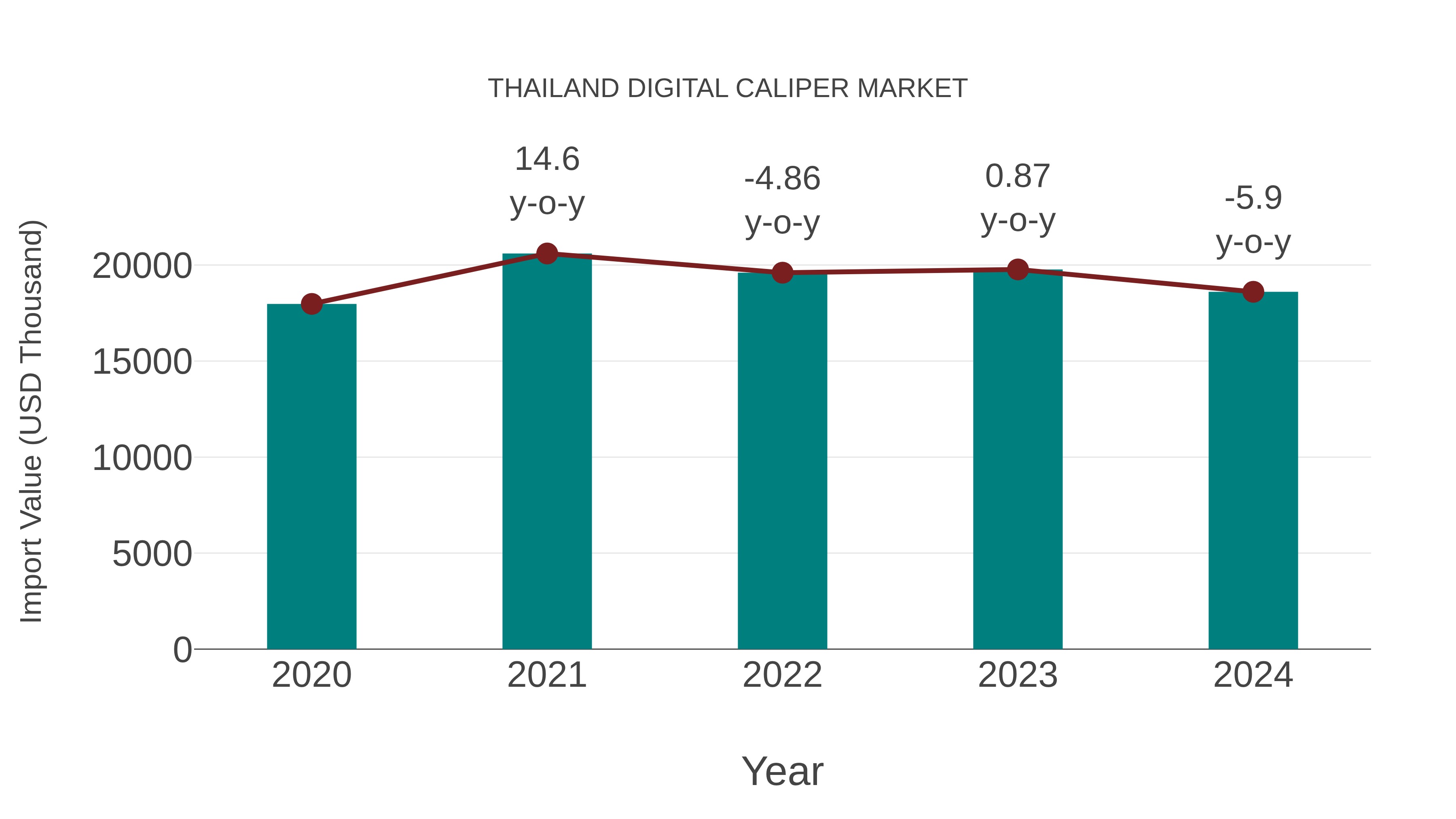
In the Thailand digital caliper market, the import trend experienced a decline from 2023 to 2024, with a growth rate of -5.9%. The compound annual growth rate (CAGR) for imports over the period from 2020 to 2024 was 0.86%. This negative growth can be attributed to a potential shift in demand or changes in trade policies impacting market dynamics.
Thailand Digital Caliper Market Synopsis
The digital caliper market in Thailand has seen steady growth as industries such as manufacturing, construction, and engineering require precise measurement tools for their operations. Digital calipers offer accuracy, ease of use, and digital readouts, making them a preferred choice over traditional vernier calipers. These tools are essential in ensuring quality control and precision in various applications, such as machining and fabrication. Both domestic production and imports contribute to the availability of digital calipers in the Thai market.
Drivers of the Market
The Thailand digital caliper market is experiencing growth due to its wide range of applications in manufacturing, engineering, and quality control processes. Digital calipers offer precision and ease of measurement, making them indispensable in various industries. The manufacturing sector`s growth, particularly in automotive and electronics, has driven the demand for precise measuring devices. Furthermore, advancements in digital caliper technology, including wireless connectivity and data storage capabilities, have made them more versatile and efficient. Continued investments in industrial automation and quality assurance are expected to sustain the market`s growth.
Challenges of the Market
The Thailand digital caliper market encounters challenges concerning precision and calibration. Ensuring the accuracy and reliability of digital calipers is critical, as they are often used in quality control and manufacturing processes. Market players must address issues related to counterfeit and low-quality digital calipers in the market. Moreover, competition from traditional vernier calipers and micrometers adds complexity to the market landscape. Continuous product innovation and customer education are essential for market growth.
COVID-19 Impact on the Market
The digital caliper market in Thailand also faced disruptions during the pandemic. With many manufacturing and industrial processes temporarily halted or scaled down, the demand for precision measurement tools like digital calipers decreased. Additionally, supply chain disruptions affected the availability of these tools. However, some segments, particularly those related to medical equipment manufacturing and quality control, experienced steady demand. As the Thai economy rebounds and industries gradually return to full capacity, the digital caliper market is expected to recover, although certain segments may see lasting changes in demand patterns.
Key Players in the Market
In the Thailand digital caliper market, several prominent players have established themselves as leaders. Companies like Mitutoyo Corporation, Starrett, and Fowler High Precision are widely recognized for their precision measuring instruments. These companies offer a wide range of digital calipers, ensuring accuracy and reliability for various industrial applications. Their commitment to quality and innovation has solidified their positions as leaders in the Thai digital caliper market.
Key Highlights of the Report:
- Thailand Digital Caliper Market Outlook
- Market Size of Thailand Digital Caliper Market, 2025
- Forecast of Thailand Digital Caliper Market, 2032
- Historical Data and Forecast of Thailand Digital Caliper Revenues & Volume for the Period 2022-2032F
- Thailand Digital Caliper Market Trend Evolution
- Thailand Digital Caliper Market Drivers and Challenges
- Thailand Digital Caliper Price Trends
- Thailand Digital Caliper Porter's Five Forces
- Thailand Digital Caliper Industry Life Cycle
- Historical Data and Forecast of Thailand Digital Caliper Market Revenues & Volume By Type for the Period 2022-2032F
- Historical Data and Forecast of Thailand Digital Caliper Market Revenues & Volume By 0-200mm for the Period 2022-2032F
- Historical Data and Forecast of Thailand Digital Caliper Market Revenues & Volume By 0-300mm for the Period 2022-2032F
- Historical Data and Forecast of Thailand Digital Caliper Market Revenues & Volume By 0-400mm for the Period 2022-2032F
- Historical Data and Forecast of Thailand Digital Caliper Market Revenues & Volume By 0-500mm for the Period 2022-2032F
- Historical Data and Forecast of Thailand Digital Caliper Market Revenues & Volume By 0-600mm for the Period 2022-2032F
- Historical Data and Forecast of Thailand Digital Caliper Market Revenues & Volume By 0-800mm for the Period 2022-2032F
- Historical Data and Forecast of Thailand Digital Caliper Market Revenues & Volume By 0-1000mm for the Period 2022-2032F
- Historical Data and Forecast of Thailand 0-200mm Digital Caliper Market Revenues & Volume By 0-2000mm for the Period 2022-2032F
- Historical Data and Forecast of Thailand Digital Caliper Market Revenues & Volume By Application for the Period 2022-2032F
- Historical Data and Forecast of Thailand Digital Caliper Market Revenues & Volume By Engineering for the Period 2022-2032F
- Historical Data and Forecast of Thailand Digital Caliper Market Revenues & Volume By Research laboratories for the Period 2022-2032F
- Historical Data and Forecast of Thailand Digital Caliper Market Revenues & Volume By Manufacturing for the Period 2022-2032F
- Historical Data and Forecast of Thailand Digital Caliper Market Revenues & Volume By Academia for the Period 2022-2032F
- Thailand Digital Caliper Import Export Trade Statistics
- Market Opportunity Assessment By Type
- Market Opportunity Assessment By Application
- Thailand Digital Caliper Top Companies Market Share
- Thailand Digital Caliper Competitive Benchmarking By Technical and Operational Parameters
- Thailand Digital Caliper Company Profiles
- Thailand Digital Caliper Key Strategic Recommendations






































