Thailand Digital Education Market Size & Growth Rate (2026-2032)
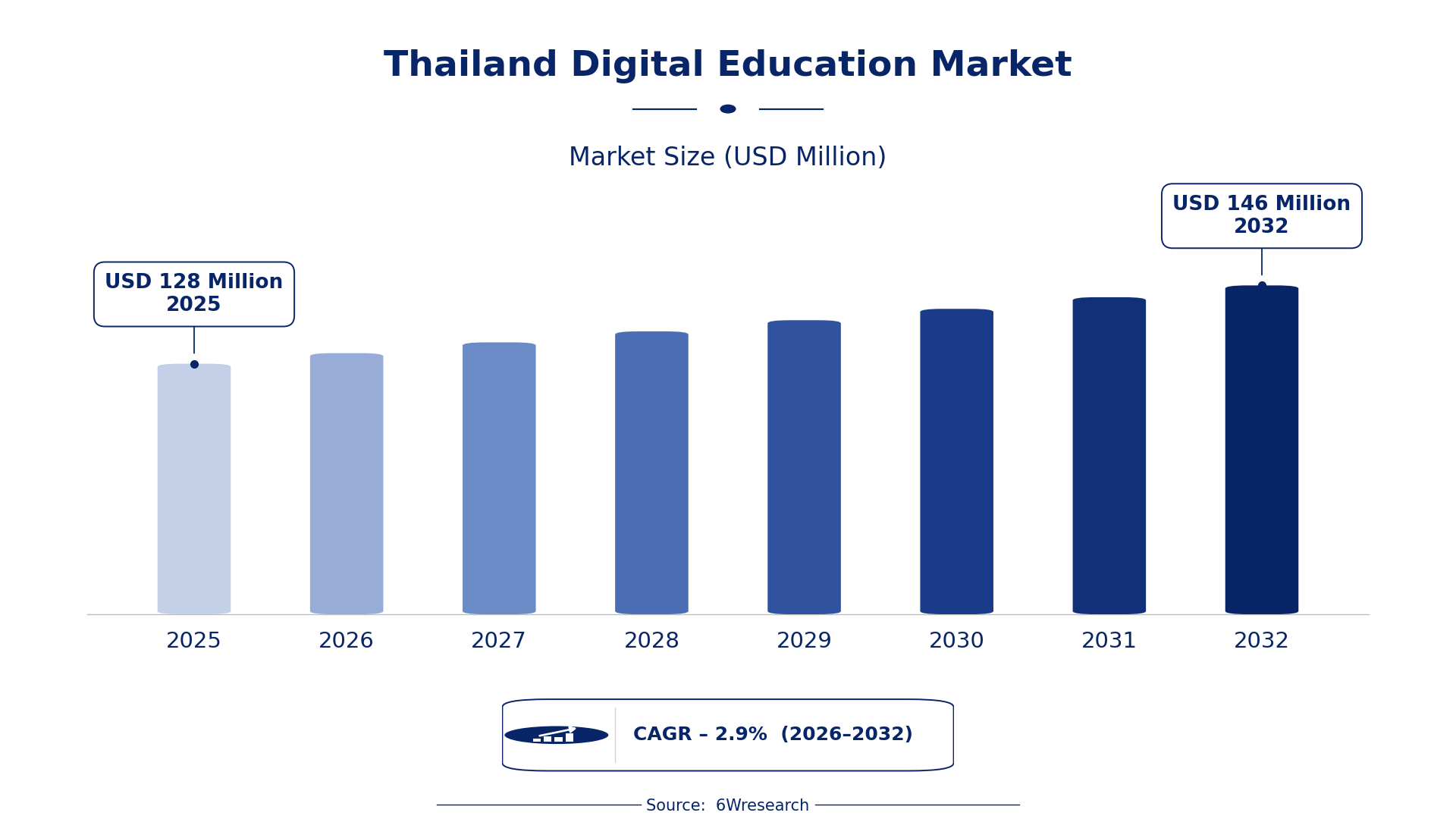
The Thailand Digital Education Market was estimated at USD 128 Million in 2025 and is projected to reach USD 146 Million by 2032, growing at a CAGR of 2.9% from 2026 to 2032.
Thailand Digital Education Market Synopsis
The Thailand Digital Education Market has gained considerable traction recently, driven by a surge in online learning solutions and a cultural shift toward digital literacy. This momentum reflects a broader recognition of the importance of accessible education in a technologically advanced society.
Looking ahead, the market is set to evolve as educational institutions increasingly embrace personalized learning environments. The integration of innovative digital tools into traditional curriculums will continue to challenge existing educational frameworks, ultimately reshaping the learning experience for students across Thailand.
Thailand Digital Education Market Year-wise Growth Rate and Key Drivers
This graph illustrates the annual growth rates of the Thailand Digital Education Market from 2021 to 2032, highlighting a steady upward trajectory and projected expansion over the forecast period.
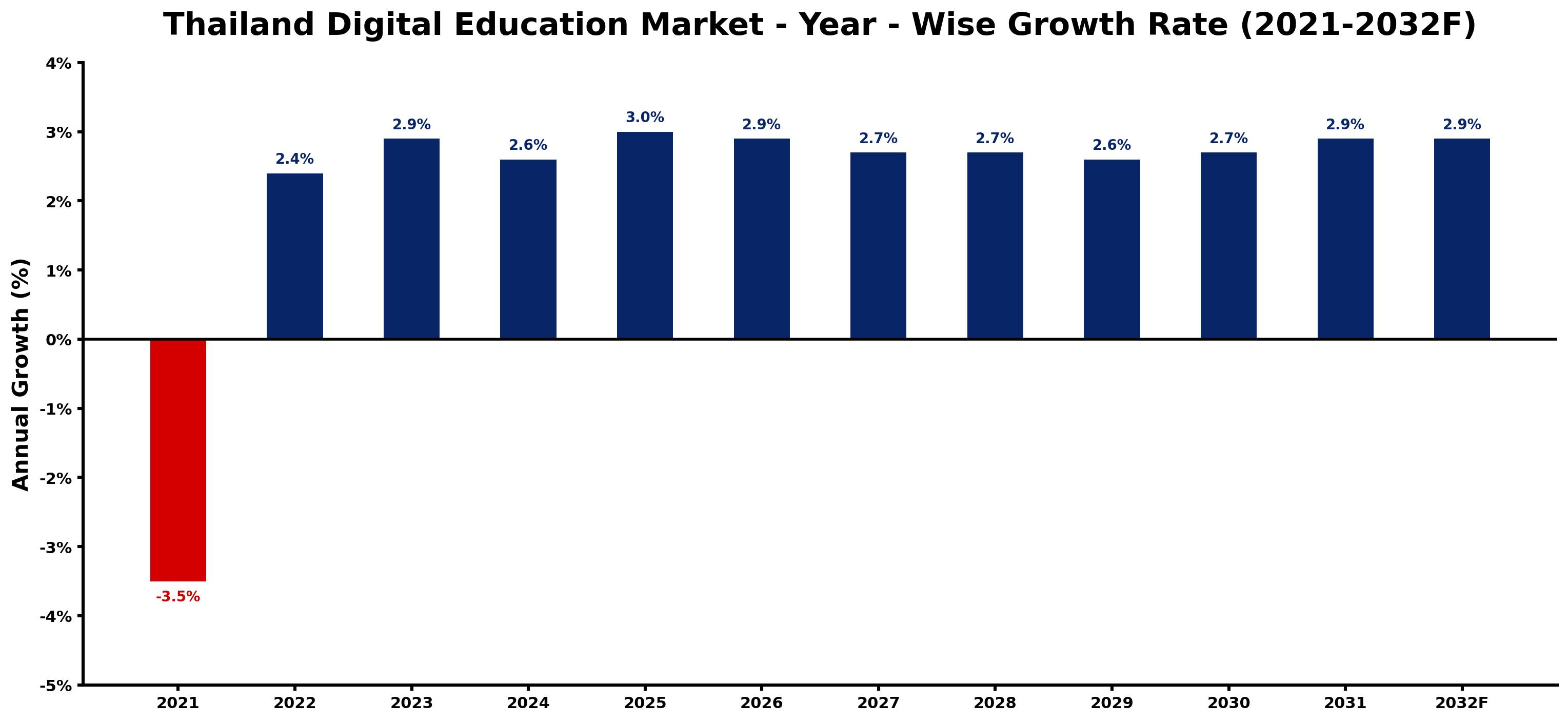
The table below presents the year‑wise growth rates along with the key drivers influencing the market
| Year | Growth Rate | Major Drivers |
| 2021 | -3.5% | School closures due to Thailand's pandemic response policies. |
| 2022 | 2.4% | Increased government investment in e-learning infrastructure. |
| 2023 | 2.9% | Growth in mobile internet penetration among students. |
| 2024 | 2.6% | Rising emphasis on digital literacy in school curricula. |
| 2025 | 3.0% | Supportive policies from Ministry of Education for online learning. |
| 2026 | 2.9% | Surge in private sector partnerships for educational technology. |
| 2027 | 2.7% | Increased competition among edtech startups boosting innovation. |
| 2028 | 2.7% | Integration of AI tools for personalized learning experiences. |
| 2029 | 2.6% | Youth population growth driving demand for digital resources. |
| 2030 | 2.7% | Continuing focus on bilingual education expanding course offerings. |
| 2031 | 2.9% | Strengthening digital skills training initiatives by the government. |
| 2032 | 2.9% | Rising adoption of blended learning models in institutions. |
Note: Market size estimations and growth projections presented in this report are based on 6Wresearch's proprietary forecasting methodology, utilizing the latest available industry data, government publications, and primary research inputs.
Thailand Digital Education Market Key Takeaways
Below are some of the specific key takeaways from the market, including:
- The rise of online learning platforms is transforming educational access for diverse demographics.
- Government initiatives are enhancing digital literacy and supporting educational technology adoption.
- Challenges related to equitable access to technology remain significant obstacles.
- Investment in digital infrastructure is critical to sustaining market growth.
- Demand for personalized and flexible learning experiences is reshaping content delivery methods.
Evaluation of Restraints in Thailand Digital Education Market
Despite its promising growth, the Thailand Digital Education Market grapples with several restraints. A primary concern is the digital divide, which restricts equitable access to technology among different socioeconomic groups. Many students, particularly in rural areas, still lack reliable internet connectivity and access to necessary devices. on top of that, the challenge of integrating digital education into traditional educational systems continues to hinder progress. Resistance to change among educators and institutions poses additional barriers, necessitating focused efforts on training and development to ensure effective technology utilization.
Thailand Digital Education Market Trends
Several trends are currently shaping the Thailand Digital Education Market. The growing popularity of blended learning models indicates a shift towards combining traditional teaching methods with digital tools. Additionally, there is an increasing emphasis on data analytics to personalize learning experiences, enabling educators to tailor content according to individual student needs. The rise of mobile learning applications reflects the demand for on-the-go access to educational resources, further driving engagement among learners. Finally, as the workforce evolves, there is a noticeable increase in demand for vocational training and skill development programs delivered through digital platforms.
Thailand Digital Education Market Opportunities
The potential for growth in the Thailand Digital Education Market is substantial. Opportunities lie in expanding the reach of online learning platforms to underserved populations, particularly in remote areas. Investments in augmented reality (AR) and virtual reality (VR) technologies could enhance immersive learning experiences, making education more engaging. The government’s commitment to improving digital infrastructure opens avenues for public-private partnerships aimed at enhancing educational access. on top of that, as lifelong learning becomes more critical in an evolving job market, there is significant demand for reskilling and upskilling programs that can be delivered digitally.
Government Initiatives in the Thailand Digital Education Market
Government policy plays a crucial role in shaping the direction of the Thailand Digital Education Market. There is a concerted effort to promote digital literacy and integrate technology into education. The government's commitment to enhancing educational access through digital means is evident, with various initiatives launched to support this transformation.
- A national digital literacy program was recently completed, aimed at equipping educators and students with essential tech skills.
- Current initiatives include the rollout of digital classrooms across public schools, providing students with access to e-learning resources.
- A planned public-private partnership is expected to enhance broadband internet access in rural areas by 2027, improving connectivity for educational purposes.
- Regulatory frameworks are currently being developed to encourage the adoption of online learning standards and best practices.
- The government is initiating a comprehensive review of educational curriculums to better incorporate digital content by 2026.
Future Insights of the Thailand Digital Education Market
In the coming years, the Thailand Digital Education Market is likely to witness significant shifts as digital technologies continue to penetrate the educational sector. The focus will be on creating adaptive learning environments that cater to individual student needs, utilizing AI and machine learning for content delivery. As educational institutions become more comfortable with technology integration, the rise of collaborative online learning will foster peer engagement and enhance educational outcomes. The need for continuous skill development will drive the creation of more vocational and professional courses, ensuring that education remains aligned with industry demands.
Thailand Digital Education Market Latest Developments
Recent developments within the Thailand Digital Education Market indicate a vibrant landscape of activity and innovation. The past year has seen a surge in initiatives aimed at enhancing digital infrastructure and promoting online learning solutions.
- A major technology vendor launched an advanced e-learning platform in early 2025, designed to support remote learning and classroom integration.
- An initiative focusing on the development of interactive digital content is currently underway, enhancing the learning experience for students.
- By mid-2026, a partnership between educational institutions and tech companies is expected to facilitate the creation of new digital curricula tailored to local needs.
- A comprehensive training program for teachers on digital tools is planned to begin in Q4 2025, aimed at increasing educator proficiency in technology integration.
- A pilot project introducing VR-based learning modules is set to launch in late 2025, targeting STEM subjects to engage students in immersive education.
Thailand Digital Education Market - Key Attractiveness of the Report
- 10 Years of Market Numbers
- Historical Data Starting from 2022 to 2025
- Base Year: 2025
- Forecast Data until 2032
- Key Performance Indicators Impacting the Market
- Major Upcoming Developments and Projects
Key Highlights of the Report:
- Thailand Digital Education Market Outlook
- Market Size of Thailand Digital Education Market, 2025
- Forecast of Thailand Digital Education Market, 2032
- Historical Data and Forecast of Thailand Digital Education Revenues & Volume for the Period 2022-2032F
- Thailand Digital Education Market Trend Evolution
- Thailand Digital Education Market Drivers and Challenges
- Thailand Digital Education Price Trends
- Thailand Digital Education Porter's Five Forces
- Thailand Digital Education Industry Life Cycle
- Historical Data and Forecast of Thailand Digital Education Market Revenues & Volume By End User for the Period 2022-2032F
- Historical Data and Forecast of Thailand Digital Education Market Revenues & Volume By Academic Institutions for the Period 2022-2032F
- Historical Data and Forecast of Thailand Digital Education Market Revenues & Volume By Enterprises and Public Sector for the Period 2022-2032F
- Historical Data and Forecast of Thailand Digital Education Market Revenues & Volume By Learning Type for the Period 2022-2032F
- Historical Data and Forecast of Thailand Digital Education Market Revenues & Volume By Self-paced Online Education for the Period 2022-2032F
- Historical Data and Forecast of Thailand Digital Education Market Revenues & Volume By Instructor-led Online Education for the Period 2022-2032F
- Historical Data and Forecast of Thailand Digital Education Market Revenues & Volume By Course Type for the Period 2022-2032F
- Historical Data and Forecast of Thailand Digital Education Market Revenues & Volume By Science and Technology Courses for the Period 2022-2032F
- Historical Data and Forecast of Thailand Digital Education Market Revenues & Volume By Entrepreneurship and Business Management Courses for the Period 2022-2032F
- Historical Data and Forecast of Thailand Digital Education Market Revenues & Volume By Other Courses for the Period 2022-2032F
- Thailand Digital Education Import Export Trade Statistics
- Market Opportunity Assessment By End User
- Market Opportunity Assessment By Learning Type
- Market Opportunity Assessment By Course Type
- Thailand Digital Education Top Companies Market Share
- Thailand Digital Education Competitive Benchmarking By Technical and Operational Parameters
- Thailand Digital Education Company Profiles
- Thailand Digital Education Key Strategic Recommendations






































