Thailand Dill Seed Oil Market Size, Share & Growth Rate
The Thailand Dill Seed Oil Market was estimated at USD 87 Million in 2025 and is projected to reach USD 100 Million by 2032, growing at a CAGR of 2.0% from 2026 to 2032. This growth trajectory is bolstered by a burgeoning health-conscious consumer base, which increasingly seeks natural and organic products. Additionally, the rising adoption of dill seed oil in culinary applications and the expanding realm of aromatherapy are significantly driving demand.
Thailand Dill Seed Oil Market Year-wise Growth Rate and Key Drivers
This graph highlights how the Thailand Dill Seed Oil Market has steadily grown over the years, supported by major growth factors.
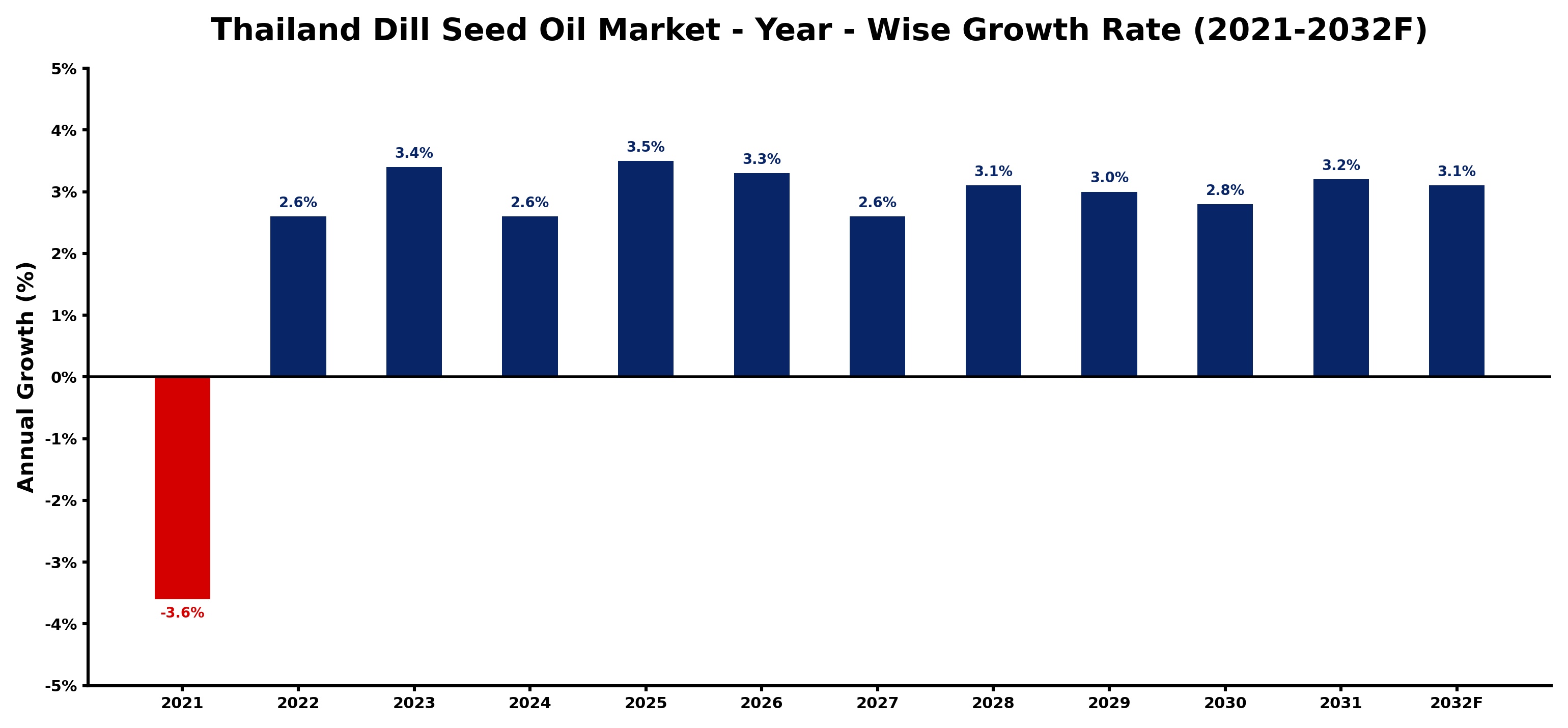
The table below presents the year‑wise growth rates along with the key drivers influencing the market
| Year | Growth Rate | Major Drivers |
| 2021 | -3.6% | Expansion of commercial construction activities |
| 2022 | 2.6% | Expansion of commercial construction activities |
| 2023 | 3.4% | Increasing industrial infrastructure investments |
| 2024 | 2.6% | Increasing industrial infrastructure investments |
| 2025 | 3.5% | Government infrastructure modernization initiatives |
| 2026 | 3.3% | Expansion of manufacturing activities |
| 2027 | 2.6% | Rapid growth in telecom and data center sectors |
| 2028 | 3.1% | Expansion of commercial construction activities |
| 2029 | 3.0% | Growing renewable energy integration projects |
| 2030 | 2.8% | Increasing industrial automation investments |
| 2031 | 3.2% | Expansion of transportation and logistics networks |
| 2032 | 3.1% | Expansion of transportation and logistics networks |
Note - Market size estimations and growth projections presented in this report are based on 6Wresearch’s advanced forecasting approach, validated with industry datasets as of June 2026.
Thailand Dill Seed Oil Market Synopsis
In Thailand, the demand for dill seed oil is notably influenced by its culinary uses, particularly in enhancing the flavors of traditional dishes. As Thai cuisine gains international acclaim, the authentic use of dill seed oil as a flavoring agent is proving essential for restaurateurs and home cooks alike.
Moreover, the therapeutic properties attributed to dill seed oil, including its potential digestive benefits and relaxation effects, have sparked interest among health-conscious consumers. This trend aligns with the growing popularity of plant-based products across various sectors, particularly in wellness and personal care.
Thailand Dill Seed Oil Market Key Takeaways
- The market is witnessing a steady demand from the food & beverage sector due to culinary applications.
- Health benefits associated with dill seed oil are driving consumer awareness and interest.
- Emerging trends in natural remedies and aromatherapy are boosting market opportunities.
- Ongoing product innovations are fostering competitive growth in the sector.
- The impact of global culinary trends is elevating the market for authentic Thai ingredients.
Evaluation of Restraints in Thailand Dill Seed Oil Market
While the Thailand dill seed oil market exhibits promising growth, several restraints exist. The primary concern revolves around the need for sustainable sourcing practices, which can hinder supply capabilities. Ensuring that dill seeds are sourced responsibly is crucial to maintain ecological balance and meet rising consumer expectations for sustainability. Furthermore, the market faces potential challenges from the volatility of raw material prices, which can affect production costs and ultimately impact pricing strategies.
Thailand Dill Seed Oil Market Trends
Current trends indicate a rising preference for organic and natural products, with an increasing number of consumers opting for plant-derived ingredients. This shift is reflected in the surge of product launches that feature dill seed oil in functional foods and natural remedies. Additionally, the integration of dill seed oil into beauty and personal care products is gaining traction, aligning with the growing demand for holistic wellness solutions.
Thailand Dill Seed Oil Market Opportunities
The Thailand dill seed oil market presents genuine growth opportunities in several key areas. The rise of e-commerce platforms offers a convenient avenue for reaching consumers looking for specialty oils. Additionally, expanding the use of dill seed oil in culinary schools and cooking classes can educate chefs and culinary enthusiasts on its benefits, thus fostering further adoption. Collaborations between local farmers and manufacturers to promote sustainable farming practices may also strengthen market positioning.
Government Initiatives in the Thailand Dill Seed Oil Market
The Thai government has implemented various initiatives aimed at supporting the agricultural sector, particularly for natural and organic products. Incentives for sustainable farming practices and organic certifications have been introduced, encouraging producers to adopt environmentally-friendly methods. Additionally, public spending on health and wellness initiatives has increased, which indirectly supports the market for plant-based oils, including dill seed oil, by promoting their benefits.
Future Insights of the Thailand Dill Seed Oil Market
Looking ahead to the period of 2026-2032, the Thailand dill seed oil market is poised for continuous expansion. As consumers increasingly prioritize health and wellness, the demand for functional food ingredients will likely rise. Furthermore, innovations in extraction and processing techniques are expected to improve the efficiency and quality of dill seed oil production. This will not only enhance supply capabilities but also broaden the applications of dill seed oil across various industries.
Thailand Dill Seed Oil Market Latest Developments (May 2025 - June 2026)
Recent developments in the Thailand dill seed oil market have shown a notable trend towards product diversification. Companies are expanding their portfolios to include blends that incorporate dill seed oil with other essential oils for enhanced therapeutic benefits. Furthermore, collaborations with culinary experts and influencers are being explored to promote the usage of dill seed oil in modern cooking, reflecting its potential to evolve beyond traditional applications.
Thailand Dill Seed Oil Market - Key Attractiveness of the Report
- 10 Years of Market Numbers
- Historical Data Starting from 2022 to 2025
- Base Year: 2025
- Forecast Data until 2032
- Key Performance Indicators Impacting the Market
- Major Upcoming Developments and Projects
Key Highlights of the Report:
- Thailand Dill Seed Oil Market Outlook
- Market Size of Thailand Dill Seed Oil Market, 2025
- Forecast of Thailand Dill Seed Oil Market, 2032
- Historical Data and Forecast of Thailand Dill Seed Oil Revenues & Volume for the Period 2022-2032F
- Thailand Dill Seed Oil Market Trend Evolution
- Thailand Dill Seed Oil Market Drivers and Challenges
- Thailand Dill Seed Oil Price Trends
- Thailand Dill Seed Oil Porter's Five Forces
- Thailand Dill Seed Oil Industry Life Cycle
- Historical Data and Forecast of Thailand Dill Seed Oil Market Revenues & Volume By Type for the Period 2022-2032F
- Historical Data and Forecast of Thailand Dill Seed Oil Market Revenues & Volume By Anethum Graveolens Seed Oil for the Period 2022-2032F
- Historical Data and Forecast of Thailand Dill Seed Oil Market Revenues & Volume By Anethum Sowa Seed Oil for the Period 2022-2032F
- Historical Data and Forecast of Thailand Dill Seed Oil Market Revenues & Volume By Application for the Period 2022-2032F
- Historical Data and Forecast of Thailand Dill Seed Oil Market Revenues & Volume By Flavor for the Period 2022-2032F
- Historical Data and Forecast of Thailand Dill Seed Oil Market Revenues & Volume By Fragrance for the Period 2022-2032F
- Historical Data and Forecast of Thailand Dill Seed Oil Market Revenues & Volume By Pharmaceutical for the Period 2022-2032F
- Historical Data and Forecast of Thailand Dill Seed Oil Market Revenues & Volume By Skincare for the Period 2022-2032F
- Historical Data and Forecast of Thailand Dill Seed Oil Market Revenues & Volume By Aromatherapy for the Period 2022-2032F
- Thailand Dill Seed Oil Import Export Trade Statistics
- Market Opportunity Assessment By Type
- Market Opportunity Assessment By Application
- Thailand Dill Seed Oil Top Companies Market Share
- Thailand Dill Seed Oil Competitive Benchmarking By Technical and Operational Parameters
- Thailand Dill Seed Oil Company Profiles
- Thailand Dill Seed Oil Key Strategic Recommendations






































