Thailand Distribution Boards Market Size, Share & Growth Rate
The Thailand Distribution Boards Market was estimated at USD 206 Million in 2025 and is projected to reach USD 238 Million by 2032, growing at a CAGR of 2.1% from 2026 to 2032. This growth trajectory is primarily fueled by the country's robust construction activities and the accelerating demand for electricity as industrial and commercial sectors expand. The increasing investments in smart grid technologies are also expected to enhance the efficiency of electrical distribution systems, driving further demand for distribution boards.
Thailand Distribution Boards Market Year-wise Growth Rate and Key Drivers
This graph highlights how the Thailand Distribution Boards Market has steadily grown over the years, supported by major growth factors.
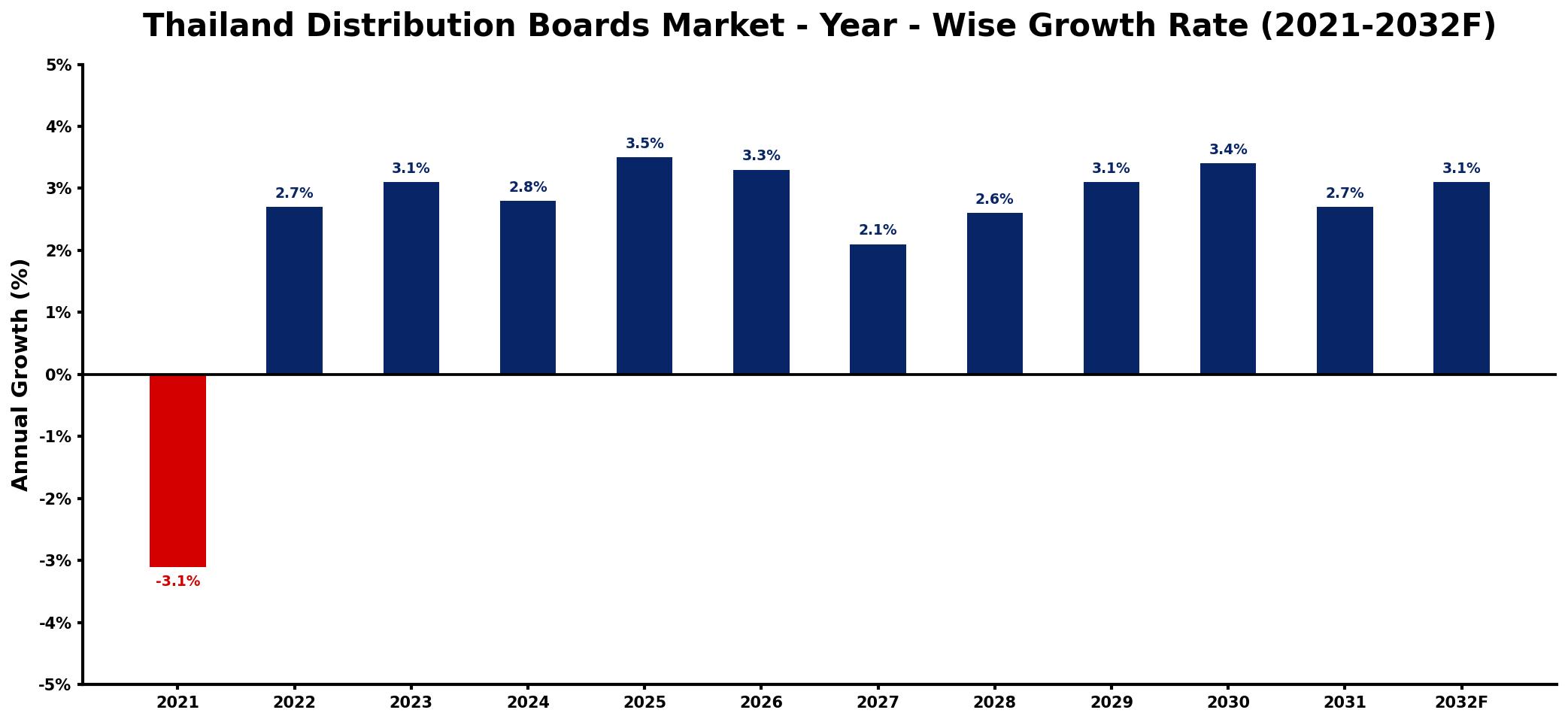
The table below presents the year‑wise growth rates along with the key drivers influencing the market
| Year | Growth Rate | Major Drivers |
| 2021 | -3.1% | decreased construction project investments |
| 2022 | 2.7% | increased infrastructure development projects |
| 2023 | 3.1% | growing renewable energy initiatives |
| 2024 | 2.8% | rising commercial real estate demand |
| 2025 | 3.5% | expansion of smart city projects |
| 2026 | 3.3% | development of residential complexes |
| 2027 | 2.1% | increased government infrastructure spending |
| 2028 | 2.6% | growing industrial automation applications |
| 2029 | 3.1% | surge in urban population growth |
| 2030 | 3.4% | enhanced energy efficiency regulations |
| 2031 | 2.7% | rising demand for electrical safety |
| 2032 | 3.1% | increased investments in technology |
Note: Market size estimations and growth projections presented in this report are based on 6Wresearch's proprietary forecasting methodology, utilizing the latest available industry data, government publications, and primary research inputs.
Thailand Distribution Boards Market Synopsis
The strongest force currently shaping the Thailand Distribution Boards Market is the expansion of the construction sector. As Thailand advances its infrastructure projects and urbanization efforts, the need for reliable power distribution is becoming increasingly critical, thereby fostering demand for distribution boards. The integration of smart technologies within these systems is emerging as a significant trend, enhancing control and monitoring capabilities and meeting the evolving requirements of modern electrical systems.
In addition to construction, the industrial sector is a major contributor to market dynamics. The ongoing growth in manufacturing and commercial activities necessitates efficient electrical distribution, making distribution boards indispensable for safe and reliable operations. Furthermore, government initiatives aimed at promoting infrastructure development are creating a conducive environment for sustained growth in this market.
Thailand Distribution Boards Market Key Takeaways
- The market is witnessing robust growth driven by expansion in the construction and industrial sectors.
- Technological advancements, especially in smart grid applications, are reshaping the distribution boards landscape.
- Government initiatives focusing on infrastructure development are key to future market opportunities.
- Adherence to stringent safety regulations is crucial for manufacturers operating in this market.
- Post-pandemic recovery is setting a positive outlook for the distribution boards market in Thailand.
Evaluation of Restraints in Thailand Distribution Boards Market
The Thailand Distribution Boards Market faces several restraints that may impede its growth trajectory. One notable challenge is the stringent safety regulations governing electrical systems, which require manufacturers to consistently meet high standards for electrical safety codes and certifications. Additionally, as the industry embraces new technologies, there is a pressing need for continuous innovation to ensure efficient energy distribution systems. This constant evolution necessitates substantial investment in research and development, which can be a barrier for smaller players in the market.
Thailand Distribution Boards Market Trends
Current trends in the Thailand Distribution Boards Market indicate a significant shift towards the adoption of smart and modular distribution boards. These systems offer enhanced control, monitoring, and efficiency, aligning with the rising demand for energy management solutions in commercial and industrial applications. The integration of IoT (Internet of Things) technologies is also becoming prevalent, allowing for real-time monitoring and data analysis, which further enhances the performance and reliability of electrical distribution systems.
Thailand Distribution Boards Market Opportunities
Opportunities for growth in the Thailand Distribution Boards Market are abundant, particularly within the context of ongoing urbanization and government-led infrastructure initiatives. Investments in smart grid technologies represent a significant area for development, as organizations seek to modernize their electrical distribution systems to improve efficiency and reduce operational costs. Additionally, the push for sustainability and energy efficiency is driving demand for innovative distribution solutions, positioning companies that invest in research and development at a competitive advantage.
Government Initiatives in the Thailand Distribution Boards Market
The Thai government has been actively promoting infrastructure development through various policies and investment programs. Initiatives aimed at enhancing electrical systems and expanding urban infrastructure are expected to bolster the distribution boards market. Public spending on urbanization projects, energy efficiency programs, and smart grid technologies are key components of this strategy, creating a favorable environment for the growth of distribution boards and electrical distribution solutions.
Future Insights of the Thailand Distribution Boards Market
Looking ahead to the period between 2026 and 2032, the Thailand Distribution Boards Market is set to evolve significantly. Continued urbanization and industrial expansion will drive an increase in demand for efficient electrical systems. As smart grid technology gains traction, distribution boards will become more sophisticated, integrating advanced features that enhance operational reliability and energy management. Overall, the market is expected to maintain a positive growth trajectory, supported by ongoing infrastructure projects and increasing power demands.
Thailand Distribution Boards Market Latest Developments (2025 - 2026)
Recent developments in the Thailand Distribution Boards Market reflect a broader industry trend towards modernization and innovation. Companies are increasingly focusing on the development of smart distribution boards that integrate IoT capabilities for enhanced monitoring and control. Furthermore, collaborations between manufacturers and technology firms are on the rise, aimed at creating cutting-edge solutions tailored for specific industrial applications. The commitment to safety and compliance remains paramount, with ongoing efforts to meet evolving regulatory standards.
Thailand Distribution Boards Market - Key Attractiveness of the Report
- 10 Years of Market Numbers
- Historical Data Starting from 2022 to 2025
- Base Year: 2025
- Forecast Data until 2032
- Key Performance Indicators Impacting the Market
- Major Upcoming Developments and Projects
Key Highlights of the Report:
- Thailand Distribution Boards Market Outlook
- Market Size of Thailand Distribution Boards Market, 2025
- Forecast of Thailand Distribution Boards Market, 2032
- Historical Data and Forecast of Thailand Distribution Boards Revenues & Volume for the Period 2022-2032F
- Thailand Distribution Boards Market Trend Evolution
- Thailand Distribution Boards Market Drivers and Challenges
- Thailand Distribution Boards Price Trends
- Thailand Distribution Boards Porter's Five Forces
- Thailand Distribution Boards Industry Life Cycle
- Historical Data and Forecast of Thailand Distribution Boards Market Revenues & Volume By Voltage Rating for the Period 2022-2032F
- Historical Data and Forecast of Thailand Distribution Boards Market Revenues & Volume By Low Voltage for the Period 2022-2032F
- Historical Data and Forecast of Thailand Distribution Boards Market Revenues & Volume By Medium Voltage for the Period 2022-2032F
- Historical Data and Forecast of Thailand Distribution Boards Market Revenues & Volume By End Use for the Period 2022-2032F
- Historical Data and Forecast of Thailand Distribution Boards Market Revenues & Volume By Transmission & Distribution Utilities for the Period 2022-2032F
- Historical Data and Forecast of Thailand Distribution Boards Market Revenues & Volume By Manufacturing & Processing Industry for the Period 2022-2032F
- Historical Data and Forecast of Thailand Distribution Boards Market Revenues & Volume By Commercial & Residential for the Period 2022-2032F
- Historical Data and Forecast of Thailand Distribution Boards Market Revenues & Volume By Others for the Period 2022-2032F
- Thailand Distribution Boards Import Export Trade Statistics
- Market Opportunity Assessment By Voltage Rating
- Market Opportunity Assessment By End Use
- Thailand Distribution Boards Top Companies Market Share
- Thailand Distribution Boards Competitive Benchmarking By Technical and Operational Parameters
- Thailand Distribution Boards Company Profiles
- Thailand Distribution Boards Key Strategic Recommendations






































