Thailand Drill Pipe Market: Import Trend Analysis
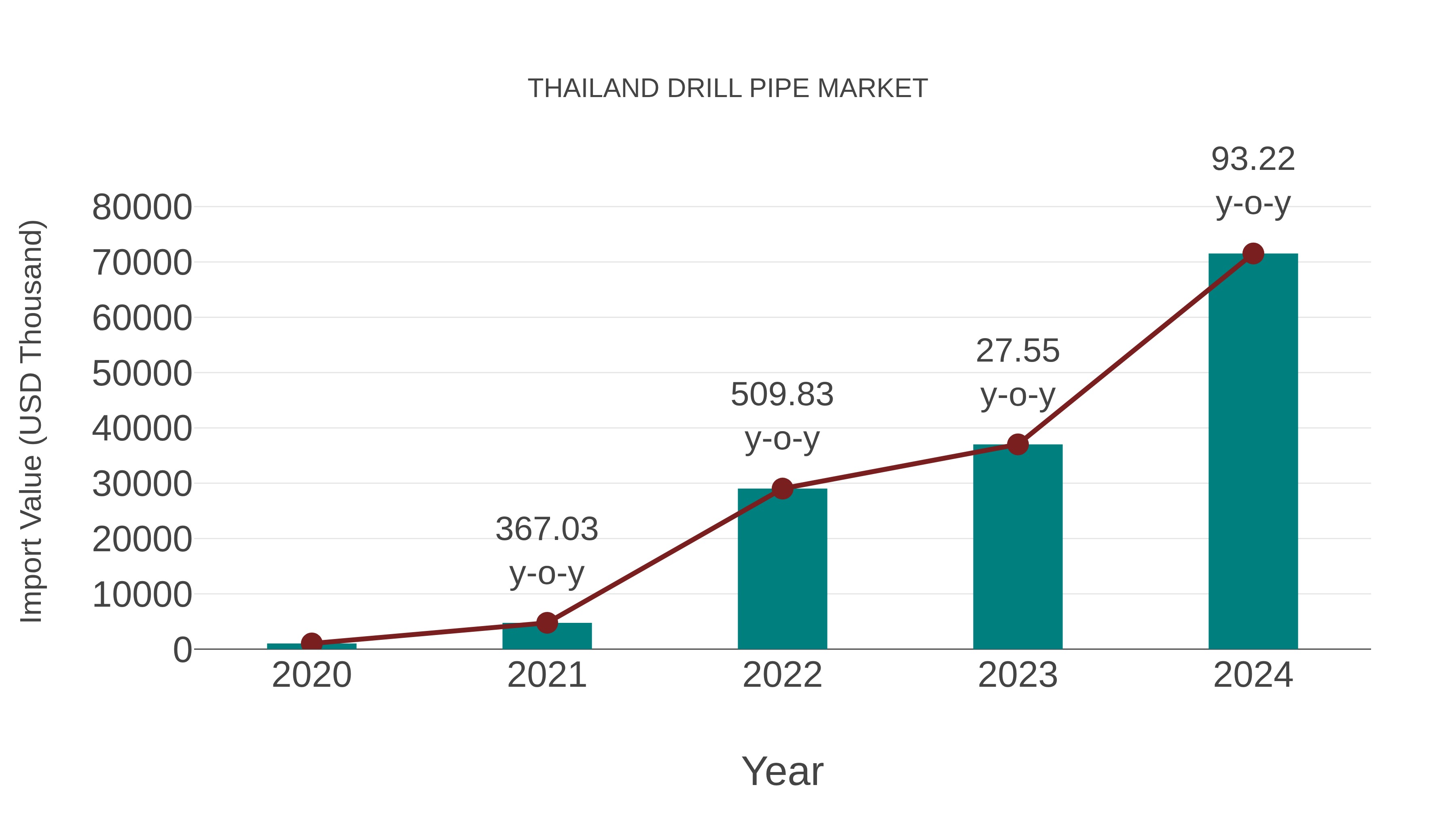
Thailand import trend in the drill pipe market showed significant growth from 2023 to 2024, with a remarkable increase of 93.22%. The compound annual growth rate (CAGR) for the period from 2020 to 2024 stood at an impressive 189.45%. This surge in imports can be attributed to a notable demand shift towards advanced drilling technologies in the region.
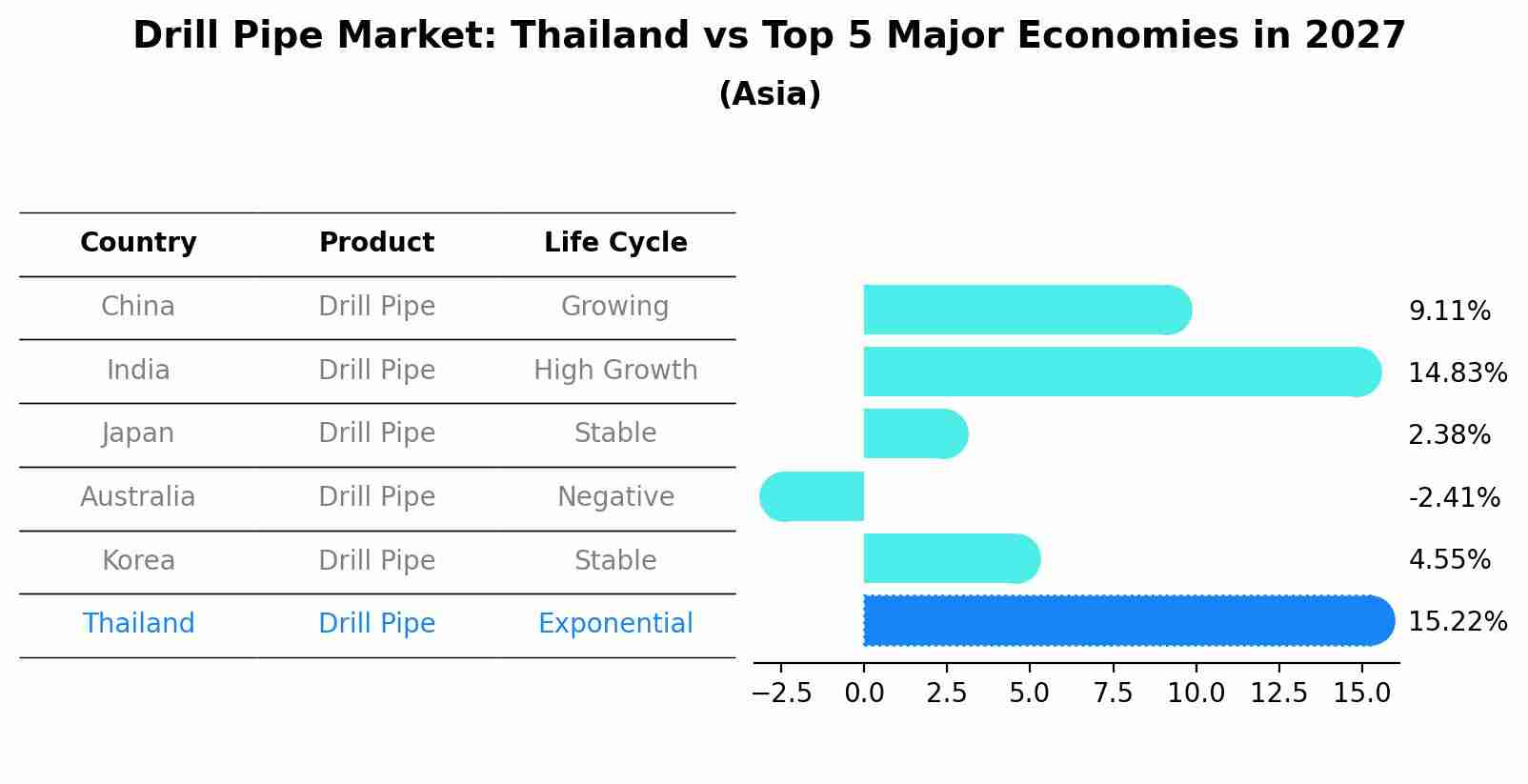
Drill Pipe Market: Thailand vs Top 5 Major Economies in 2027 (Asia)
In the Asia region, the Drill Pipe market in Thailand is projected to expand at a exponential growth rate of 15.22% by 2027. The largest economy is China, followed by India, Japan, Australia and South Korea.
Thailand Drill Pipe Market Synopsis
The drill pipe market in Thailand is closely tied to the country`s oil and gas exploration activities. Drill pipes are essential components in drilling operations for extracting hydrocarbons. As Thailand continues to explore its energy resources, the demand for high-quality drill pipes remains steady. Market participants offer various grades and specifications of drill pipes to meet the diverse needs of the oil and gas sector.
Drivers of the Market
The Thailand drill pipe market is primarily driven by the country`s burgeoning oil and gas exploration and production activities. As Thailand seeks to enhance its energy security and reduce dependence on imports, there is a growing need for drilling and exploration, which in turn fuels the demand for drill pipes. Moreover, the construction and mining sectors in Thailand are also expanding, contributing to the demand for drill pipes in these industries. The adoption of advanced drilling technologies and the need for longer-lasting, durable drill pipes have further propelled market growth. Additionally, government initiatives to attract investments in the energy sector and infrastructure development projects have created a conducive environment for drill pipe manufacturers and suppliers.
Challenges of the Market
The Thailand drill pipe market faces challenges related to the cyclical nature of the oil and gas industry. This market is heavily dependent on oil and gas exploration and drilling activities. Consequently, fluctuations in global oil prices and shifts in energy policies can significantly impact the demand for drill pipes. Market players must navigate these uncertainties and adapt their strategies accordingly. Moreover, there is a growing emphasis on environmental sustainability and regulations related to drilling practices, which necessitate the development of environmentally friendly drill pipe materials and processes. Ensuring compliance with these regulations while remaining competitive poses a challenge for industry participants.
COVID-19 Impact on the Market
The COVID-19 pandemic significantly impacted the Thailand drill pipe market. The restrictions on movement and the slowdown in various industries led to a decrease in drilling activities. Many oil and gas projects were postponed or canceled due to the uncertainty surrounding the pandemic. As a result, the demand for drill pipes declined sharply. However, with the gradual recovery of the global economy and the oil and gas industry, the market is expected to rebound in the coming years as drilling activities pick up pace.
Key Players in the Market
Leading manufacturers in the Thailand drill pipe market encompass companies like National Oilwell Varco, Tenaris S.A., and Vallourec S.A. These companies supply durable and reliable drill pipes used in the oil and gas exploration and drilling activities in Thailand energy sector.
Key Highlights of the Report:
- Thailand Drill Pipe Market Outlook
- Market Size of Thailand Drill Pipe Market, 2025
- Forecast of Thailand Drill Pipe Market, 2032
- Historical Data and Forecast of Thailand Drill Pipe Revenues & Volume for the Period 2022-2032F
- Thailand Drill Pipe Market Trend Evolution
- Thailand Drill Pipe Market Drivers and Challenges
- Thailand Drill Pipe Price Trends
- Thailand Drill Pipe Porter's Five Forces
- Thailand Drill Pipe Industry Life Cycle
- Historical Data and Forecast of Thailand Drill Pipe Market Revenues & Volume By Type for the Period 2022-2032F
- Historical Data and Forecast of Thailand Drill Pipe Market Revenues & Volume By Standard Drill Pipe for the Period 2022-2032F
- Historical Data and Forecast of Thailand Drill Pipe Market Revenues & Volume By Heavy Weight Drill Pipe for the Period 2022-2032F
- Historical Data and Forecast of Thailand Drill Pipe Market Revenues & Volume By Drill Collar for the Period 2022-2032F
- Historical Data and Forecast of Thailand Drill Pipe Market Revenues & Volume By Deployment for the Period 2022-2032F
- Historical Data and Forecast of Thailand Drill Pipe Market Revenues & Volume By Onshore for the Period 2022-2032F
- Historical Data and Forecast of Thailand Drill Pipe Market Revenues & Volume By Offshore for the Period 2022-2032F
- Thailand Drill Pipe Import Export Trade Statistics
- Market Opportunity Assessment By Type
- Market Opportunity Assessment By Deployment
- Thailand Drill Pipe Top Companies Market Share
- Thailand Drill Pipe Competitive Benchmarking By Technical and Operational Parameters
- Thailand Drill Pipe Company Profiles
- Thailand Drill Pipe Key Strategic Recommendations






































