Thailand E-Commerce Market Growth Rate
According to 6Wresearch internal database and industry insights, the Thailand E-Commerce Market is growing at a compound annual growth rate (CAGR) of 11.9% during the forecast period (2026-2032).
Thailand E-Commerce Market Year-wise Growth Rate and Key Drivers
This graph highlights how the Thailand E-Commerce Market has steadily grown over the past five years, supported by major growth factors.
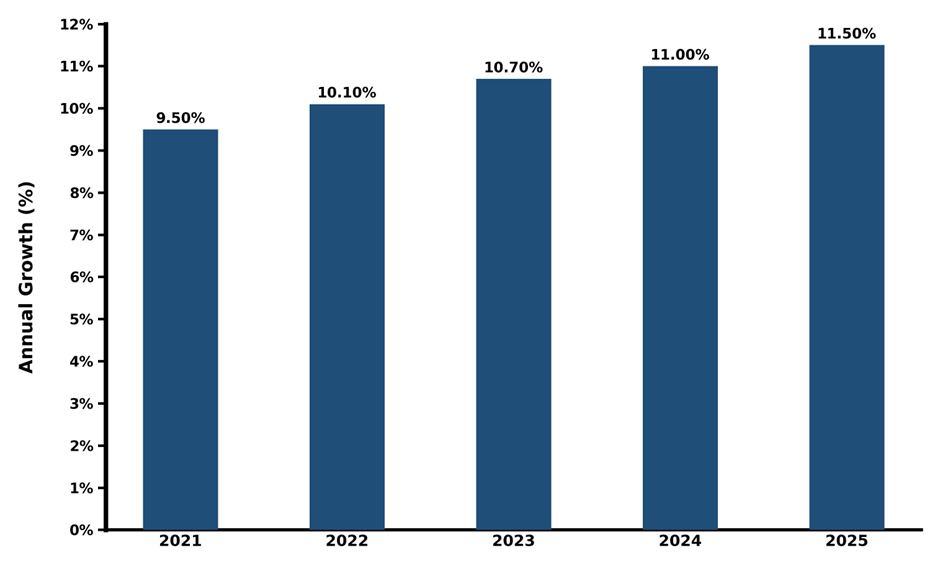
The table below presents the year‑wise growth rates along with the key drivers influencing the market
| Years | Est. Annual Growth in % | Growth Drivers |
| 2021 | 9.5% | Increase in internet penetration and mobile device usage across the country. |
| 2022 | 10.1% | Growth in online retail platforms and rising consumer confidence in e-commerce. |
| 2023 | 10.7% | Increasing adoption rate of digital payment systems and improved logistics for e-commerce platforms in the country. |
| 2024 | 11% | Government support for digital transformation and e-commerce regulations. |
| 2025 | 11.5% | Growing demand for online shopping in fashion, beauty, and consumer electronics. |
Topics Covered in the Thailand E-Commerce Market Report
The Thailand E-Commerce Market report thoroughly covers the market by application types. The market report provides an unbiased and detailed analysis of ongoing market trends, opportunities/high growth areas, and market drivers, which would help stakeholders devise and align their market strategies according to the current and future market dynamics.
Thailand E-Commerce Market Highlights
| Report Name |
Thailand E-Commerce Market |
| Forecast period | 2026-2032 |
| CAGR | 11.2% |
| Market Size |
Fashion & Apparel |
Thailand E-Commerce Market Synopsis
The Thailand E-Commerce Market growth has boosted steadily in the recent years, backed by some major factors, such as increasing internet penetration and a rising smartphone user base. The demand for seamless digital payment solutions and fast logistics infrastructure, as well as the growing consumer preference for online shopping, is expected to lead the market's growth. Moreover, advancements in mobile commerce and an increasing shift towards cross-border e-commerce are playing a main role in fueling the market's expansion.
Evaluation of Growth Drivers in the Thailand E-Commerce Market (2026-2032)
Below mentioned are some growth drivers and their impact on market dynamics:
| Drivers | Primary Segments Affected | Why It Matters |
| Rising Internet and Smartphone Penetration | By Platform (Mobile Commerce) | Expands the consumer base by allowing more people to shop online conveniently. |
| Growth in Digital Payment Solutions | By Payment Method (Digital Wallets, Online Banking) | This makes transactions easier, and increases consumer confidence, and frequency of purchases. |
| Expansion of Logistics Infrastructure | By Segment (Retail, FMCG, Electronics) | This allows faster and more reliable deliveries, which help improve the overall customer experience |
| Government Digital Economy Initiatives | By Segment (SMEs, Cross-Border Commerce) | Supports digitisation of businesses, as well as pushes the adoption of e-commerce platforms. |
| Cross-Border E-Commerce Growth | By Application (International Retail, Electronics) | Opens new revenue streams for local sellers and increases product variety for consumers. |
Thailand E-Commerce Market is projected to grow, with a CAGR of 11.9% during the forecast period of 2026-2032. This growth is influenced by various factors, like the rising digital adoption and expanding logistics networks. Furthermore, government initiatives focused on digital economy development, the growing consumer trust in online transactions and SME digitisation are also playing a main role in leading the Thailand E-Commerce Market growth.
Evaluation of Restraints in the Thailand E-Commerce Market
Below mentioned are some major restraints and their influence on market dynamics:
| Restraints | Primary Segments Affected | What This Means |
| Cybersecurity and Fraud Concerns | All Segments | Reduces consumer trust and increases operational costs for platform security. |
| Logistics Challenges in Rural Areas | By Segment (Retail, FMCG) | Limits market reach beyond urban centres, restricting overall growth potential. |
| Intense Platform Competition | All Segments | Compresses profit margins and increases customer acquisition costs for sellers. |
| Regulatory Compliance Complexity | By Segment (Cross-Border, SMEs) | Additional cost and operational burden for smaller merchants. |
| Low Digital Literacy in Tier-3 Cities | By Platform (Mobile Commerce, Retail) | Slows down the adoption in underserved areas, which limit the expansion of the consumer base |
Thailand E-Commerce Market Challenges
Apart from the positive outlook of the market, it also has a number of challenges such as cybersecurity threats, rural logistics gaps, and intense platform competition that compress margins and increase operational costs, especially for smaller sellers. Another major issue that creates additional burdens on cross-border merchants is having regulatory compliance complexities. Besides that, due to having low digital literacy in tier-3 cities and remote provinces, there are slow adoption rates, which make it difficult for platforms to achieve uniform growth across all regions of the country.
Thailand E-Commerce Market Trends
Some major trends contributing to the Thailand E-Commerce Market Growth are:
- Mobile-First Shopping: The dominance of smartphones in everyday life is driving a strong shift toward mobile commerce, with consumers preferring app-based shopping experiences over desktop platforms.
- Expansion of Social Commerce: Platforms such as TikTok Shop, Facebook Marketplace, and Instagram are increasingly becoming primary shopping destinations, blurring the line between social media and retail.
- Same-Day and Express Delivery: Due to increasing consumer's demand for faster fulfillment, logistics providers and platforms have started to making investment in improving last-mile delivery infrastructure.
Investment Opportunities in the Thailand E-Commerce Market
Below mentioned are some specific investment opportunities in the Thailand E-Commerce Industry:
- Logistics and Last-Mile Delivery: As e-commerce penetration expands beyond major cities, therefore investing in efficient last-mile delivery networks and fulfilment centres opens up corridors for the significant growth.
- Digital Payment Infrastructure: Growing demand for secure, seamless payment solutions creates strong investment opportunities in digital wallets, buy-now-pay-later platforms, and integrated fintech services.
- Increasing Cross-Border E-Commerce Platforms: As more Thai consumers and SMEs are joining international trade, platforms which make cross-border shopping and multi-currency transactions easier are being considered a fast-growing investment area.
Top 5 Leading Players in the Thailand E-Commerce Market
Here are some top companies operating in the Thailand E-Commerce Market:
1. Central Group
| Company Name | Central Group |
|---|---|
| Established Year | 1927 |
| Headquarters | Bangkok, Thailand |
| Official Website | Click Here |
Central Group is one of Thailand’s largest and most diversified retailers, with a strong presence in the e-commerce space. The company operates leading e-commerce platforms such as Central Online and Tops Online, offering a wide range of products from fashion to groceries.
2. Siam Commercial Bank (SCB)
| Company Name | Siam Commercial Bank (SCB) |
|---|---|
| Established Year | 1904 |
| Headquarters | Bangkok, Thailand |
| Official Website | Click Here |
SCB is a key player in the Thailand e-commerce market, offering digital banking solutions that support online transactions, mobile payments, and e-commerce platforms. The bank has partnered with various e-commerce giants to enhance the digital payment ecosystem in Thailand.
3. Lazada Thailand
| Company Name | Lazada Thailand |
|---|---|
| Established Year | 2012 |
| Headquarters | Bangkok, Thailand |
| Official Website | Click Here |
Lazada is one of the leading e-commerce platforms in Thailand, offering a wide array of products from electronics to fashion and lifestyle. The company is known for its strong logistics network and strategic partnerships with local and international sellers.
4. Shopee Thailand
| Company Name | Shopee Thailand |
|---|---|
| Established Year | 2015 |
| Headquarters | Bangkok, Thailand |
| Official Website | Click Here |
Shopee is a prominent e-commerce player in Thailand, providing a platform for users to buy a variety of goods, from electronics to beauty products. The platform emphasizes seamless mobile shopping and robust customer support.
5. Thai Airways International Public Co., Ltd.
| Company Name | Thai Airways International Public Co., Ltd. |
|---|---|
| Established Year | 1960 |
| Headquarters | Bangkok, Thailand |
| Official Website | Click Here |
While primarily known for aviation, Thai Airways has expanded into the e-commerce space with its travel and tourism offerings, leveraging its platform for online booking, travel packages, and related services, making it a notable player in Thailand’s evolving digital marketplace.
Government Regulations Introduced in the Thailand E-Commerce Market
According to Thai government data, here are various regulations that are promoting digital trade and consumer protection to shape the market growth. The PDPA (Personal Data Protection Act) imposes strict data privacy needs on online platforms. The Electronic Transactions Act addresses digital contracts and online business activities. With the e-Tax Invoice and e-Receipt initiative, the Revenue Department is driving merchants towards digital compliance, while the Ministry of Commerce aids SME digitization in the country through the Thailand 4.0 digital economy policy.
Future Insights of the Thailand E-Commerce Market
The future of the Thailand E-Commerce Market appears optimistic with certain regulations have been put in place by the government to push digital economy growth and cross-border trade facilitation, which are expected to open up new corridors for the industry’s development, especially in mobile commerce, live-stream shopping, and SME-led digital storefronts. Along with that, the need for online retail in sectors like automotive accessories, electronics, fashion, and FMCG is projected to grow, underpinned by rising consumer confidence in digital transactions and technological advancement.
Market Segmentation Analysis
The report offers a comprehensive study of the following market segments and their leading categories.
Beauty & Personal Care to Lead the Market – By Application
According to Mansi Aneja, Senior Research Analyst at 6Wresearch, the Beauty & Personal Care segment dominates the Thailand E-Commerce market due to the increasing consumer demand for skincare, cosmetics, and personal care products. The convenience of online shopping and wide product variety are key factors driving this segment’s growth.
Key attractiveness of the report
- 10 Years Market Numbers.
- Historical Data Starting from 2022 to 2025.
- Base Year: 2025
- Forecast Data until 2032.
- Key Performance Indicators Impacting the Market.
- Major Upcoming Developments and Projects.
Key Highlights of the Report:
- Thailand Ecommerce Market Outlook
- Market Size of Thailand Ecommerce Market, 2025
- Forecast of Thailand Ecommerce Market, 2032
- Historical Data and Forecast of Thailand Ecommerce Revenues & Volume for the Period 2022- 2032
- Thailand Ecommerce Market Trend Evolution
- Thailand Ecommerce Market Drivers and Challenges
- Thailand Ecommerce Price Trends
- Thailand Ecommerce Porter's Five Forces
- Thailand Ecommerce Industry Life Cycle
- Historical Data and Forecast of Thailand Ecommerce Market Revenues & Volume By Application for the Period 2022- 2032
- Historical Data and Forecast of Thailand Ecommerce Market Revenues & Volume By Beauty & Personal Care for the Period 2022- 2032
- Historical Data and Forecast of Thailand Ecommerce Market Revenues & Volume By Consumer Electronics for the Period 2022- 2032
- Historical Data and Forecast of Thailand Ecommerce Market Revenues & Volume By Fashion & Apparel for the Period 2022- 2032
- Historical Data and Forecast of Thailand Ecommerce Market Revenues & Volume By Food & Beverage for the Period 2022- 2032
- Historical Data and Forecast of Thailand Ecommerce Market Revenues & Volume By Furniture & Home for the Period 2022- 2032
- Historical Data and Forecast of Thailand Ecommerce Market Revenues & Volume By Others for the Period 2022- 2032
- Thailand Ecommerce Import Export Trade Statistics
- Market Opportunity Assessment By Application
- Thailand Ecommerce Top Companies Market Share
- Thailand Ecommerce Competitive Benchmarking By Technical and Operational Parameters
- Thailand Ecommerce Company Profiles
- Thailand Ecommerce Key Strategic Recommendations
Market Covered
The report subsequently covers the market by following segments and subsegments.
By Application:
- Beauty & Personal Care
- Consumer Electronics
- Fashion & Apparel
- Food & Beverage
- Furniture & Home
- Others






































