Thailand Electrical Testing Equipment Market Size, Share & Growth Rate
The Thailand Electrical Testing Equipment Market was estimated at USD 214 Million in 2025 and is projected to reach USD 245 Million by 2032, growing at a CAGR of 2.0% from 2026 to 2032. This growth trajectory is largely driven by escalating safety regulations in the electrical sector, alongside a push for enhanced reliability in electrical infrastructure. The rise in urbanization and industrialization further fuels the demand for sophisticated testing solutions to ensure optimal performance across various sectors, including utilities and manufacturing.
Thailand Electrical Testing Equipment Market Year-wise Growth Rate and Key Drivers
This graph highlights how the Thailand Electrical Testing Equipment Market has steadily grown over the years, supported by major growth factors.
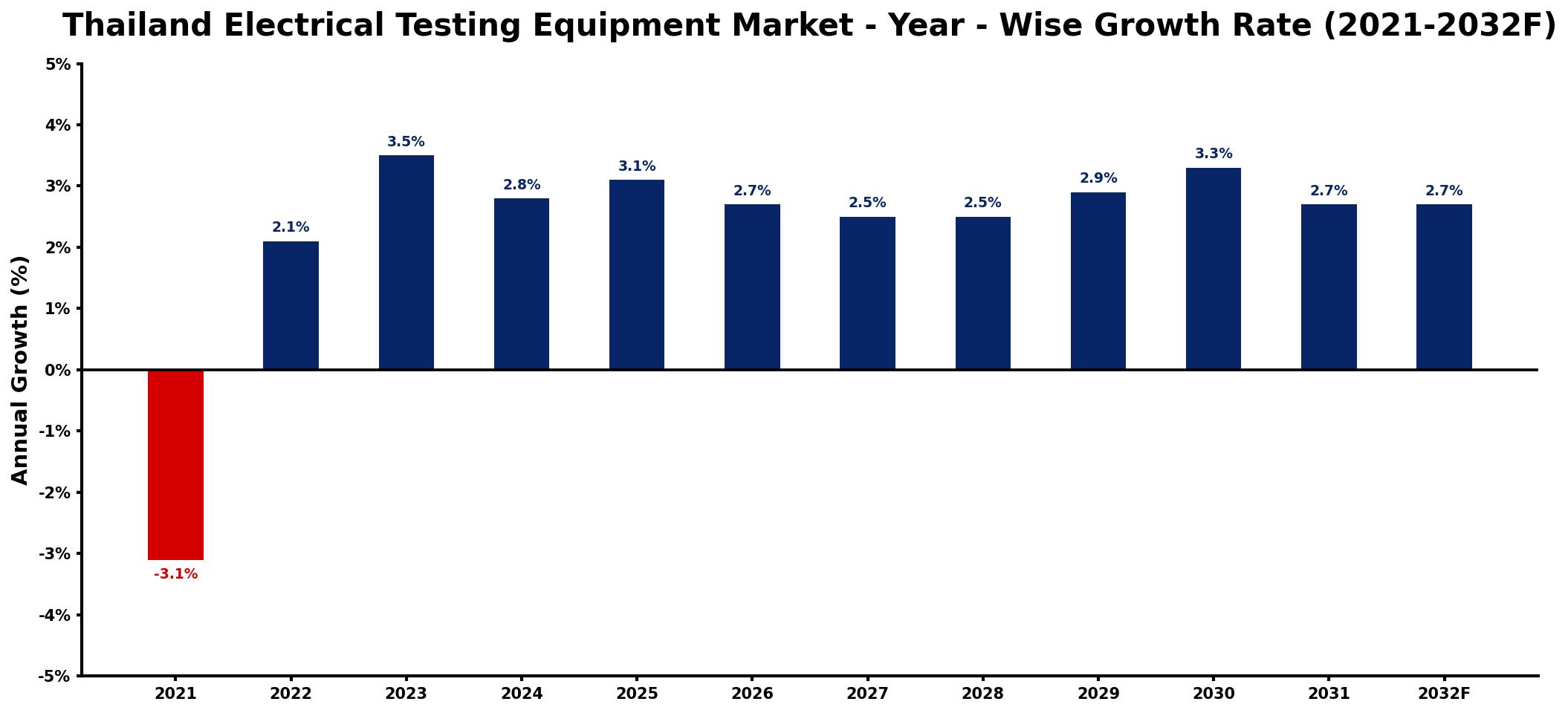
The table below presents the year‑wise growth rates along with the key drivers influencing the market
| Year | Growth Rate | Major Drivers |
| 2021 | -3.1% | decrease in construction project investments |
| 2022 | 2.1% | growing focus on safety regulations |
| 2023 | 3.5% | rise in renewable energy projects |
| 2024 | 2.8% | increased infrastructure development initiatives |
| 2025 | 3.1% | expansion of industrial automation sectors |
| 2026 | 2.7% | higher demand for maintenance services |
| 2027 | 2.5% | surge in smart grid technologies |
| 2028 | 2.5% | growth in residential energy efficiency |
| 2029 | 2.9% | increased adoption of IoT solutions |
| 2030 | 3.3% | growing regional consumption patterns |
| 2031 | 2.7% | growing investment in manufacturing sectors |
| 2032 | 2.7% | improved raw material availability |
Note: Market size estimations and growth projections presented in this report are based on 6Wresearch's proprietary forecasting methodology, utilizing the latest available industry data, government publications, and primary research inputs.
Thailand Electrical Testing Equipment Market Synopsis
A primary force shaping the Thailand Electrical Testing Equipment Market is the stringent adherence to electrical safety standards. Companies across multiple industries recognize the necessity of employing advanced testing equipment to comply with regulatory requirements and to mitigate operational risks. The critical need for uninterrupted power supply in a fast-developing economy is also contributing significantly to market expansion.
Moreover, the increasing complexity of electrical systems necessitates the use of innovative testing solutions that can effectively evaluate their performance and safety. With a variety of instruments available—ranging from insulation testers to circuit analyzers—industry professionals are equipped to address the diverse challenges presented by modern electrical networks.
Thailand Electrical Testing Equipment Market Key Takeaways
- The market is poised for steady growth driven by heightened safety and performance requirements.
- Increased investments in electrical infrastructure enhance demand for testing equipment.
- Remote diagnostics and monitoring solutions are gaining traction post-COVID-19.
- Regulatory compliance remains a pivotal factor influencing purchasing decisions.
- Technological advancements continue to redefine testing methodologies and equipment capabilities.
Evaluation of Restraints in Thailand Electrical Testing Equipment Market
Despite its promising outlook, the Thailand Electrical Testing Equipment Market encounters significant restraints primarily due to the evolving landscape of electrical safety standards. Companies must continually adapt to these changes, which can necessitate substantial investments in research and development. Additionally, a lack of skilled personnel proficient in the latest testing technologies poses challenges for effective adoption and utilization of advanced equipment in various sectors.
Thailand Electrical Testing Equipment Market Trends
Current trends in the Thailand Electrical Testing Equipment Market showcase a growing inclination towards portable and user-friendly testing devices. The rise of digital solutions has enabled real-time data collection and analysis, thus improving operational efficiency. Furthermore, the integration of IoT in electrical systems is pushing for more advanced diagnostic tools that can provide deeper insights into system performance and reliability.
Thailand Electrical Testing Equipment Market Opportunities
As the demand for renewable energy solutions intensifies, there lie substantial opportunities for growth within the electrical testing equipment market. Manufacturers and service providers are encouraged to develop specialized testing equipment designed for new energy technologies, such as solar and wind. Additionally, advancements in smart grid technology will necessitate the implementation of sophisticated testing solutions to maintain system integrity and efficiency.
Government Initiatives in the Thailand Electrical Testing Equipment Market
The Thai government has been proactive in enhancing the countrys electrical infrastructure through various initiatives. Investments in public spending directed towards improving electrical safety standards and reliability are significant. Moreover, governmental support for innovation in energy technology and testing methodologies is fostering an environment that encourages the adoption of advanced electrical testing equipment across all sectors.
Future Insights of the Thailand Electrical Testing Equipment Market
Looking ahead to 2026-2032, the Thailand Electrical Testing Equipment Market is expected to evolve significantly. As regulations tighten and technological advancements continue, the market will likely see an increase in demand for highly specialized testing equipment. The integration of AI and machine learning into testing processes is anticipated to revolutionize the way electrical systems are monitored and maintained, ensuring heightened levels of safety and efficiency.
Thailand Electrical Testing Equipment Market Latest Developments (2025 - 2026)
Recent developments in the Thailand Electrical Testing Equipment Market indicate a shift towards more comprehensive solutions that combine hardware and software capabilities. Manufacturers are focusing on enhancing the interoperability of devices, enabling seamless data sharing and analysis. Additionally, there has been a notable increase in partnerships aimed at developing cutting-edge technology designed for emerging renewable energy applications.
Thailand Electrical Testing Equipment Market - Key Attractiveness of the Report
- 10 Years of Market Numbers
- Historical Data Starting from 2022 to 2025
- Base Year: 2025
- Forecast Data until 2032
- Key Performance Indicators Impacting the Market
- Major Upcoming Developments and Projects
Key Highlights of the Report:
- Thailand Electrical Testing Equipment Market Outlook
- Market Size of Thailand Electrical Testing Equipment Market, 2025
- Forecast of Thailand Electrical Testing Equipment Market, 2032
- Historical Data and Forecast of Thailand Electrical Testing Equipment Revenues & Volume for the Period 2022-2032F
- Thailand Electrical Testing Equipment Market Trend Evolution
- Thailand Electrical Testing Equipment Market Drivers and Challenges
- Thailand Electrical Testing Equipment Price Trends
- Thailand Electrical Testing Equipment Porter's Five Forces
- Thailand Electrical Testing Equipment Industry Life Cycle
- Historical Data and Forecast of Thailand Electrical Testing Equipment Market Revenues & Volume By Service Type for the Period 2022-2032F
- Historical Data and Forecast of Thailand Electrical Testing Equipment Market Revenues & Volume By Electrical Testing Equipment Calibration Services for the Period 2022-2032F
- Historical Data and Forecast of Thailand Electrical Testing Equipment Market Revenues & Volume By Electrical Testing Equipment Repair Services or After Sales Services for the Period 2022-2032F
- Historical Data and Forecast of Thailand Electrical Testing Equipment Market Revenues & Volume By Product Type for the Period 2022-2032F
- Historical Data and Forecast of Thailand Electrical Testing Equipment Market Revenues & Volume By General Purpose Electrical Testing Equipment for the Period 2022-2032F
- Historical Data and Forecast of Thailand Electrical Testing Equipment Market Revenues & Volume By Mechanical Electrical Test Equipment for the Period 2022-2032F
- Historical Data and Forecast of Thailand Electrical Testing Equipment Market Revenues & Volume By End User for the Period 2022-2032F
- Historical Data and Forecast of Thailand Electrical Testing Equipment Market Revenues & Volume By Aerospace and Defense for the Period 2022-2032F
- Historical Data and Forecast of Thailand Electrical Testing Equipment Market Revenues & Volume By Telecommunications for the Period 2022-2032F
- Historical Data and Forecast of Thailand Electrical Testing Equipment Market Revenues & Volume By Semiconductor and Electronics for the Period 2022-2032F
- Thailand Electrical Testing Equipment Import Export Trade Statistics
- Market Opportunity Assessment By Service Type
- Market Opportunity Assessment By Product Type
- Market Opportunity Assessment By End User
- Thailand Electrical Testing Equipment Top Companies Market Share
- Thailand Electrical Testing Equipment Competitive Benchmarking By Technical and Operational Parameters
- Thailand Electrical Testing Equipment Company Profiles
- Thailand Electrical Testing Equipment Key Strategic Recommendations






































