Thailand Electronic Tube Amplifier Market Size, Share & Growth Rate
The Thailand Electronic Tube Amplifier Market was estimated at USD 205 Million in 2025 and is projected to reach USD 235 Million by 2032, growing at a CAGR of 2.0% from 2026 to 2032. This growth trajectory is largely driven by a renewed interest in high-fidelity audio systems and vintage electronics among audiophiles. The unique sound characteristics of tube amplifiers continue to capture the attention of both music enthusiasts and professionals, further bolstered by the expanding entertainment sector in Thailand.
Thailand Electronic Tube Amplifier Market Year-wise Growth Rate and Key Drivers
This graph highlights how the Thailand Electronic Tube Amplifier Market has steadily grown over the years, supported by major growth factors.
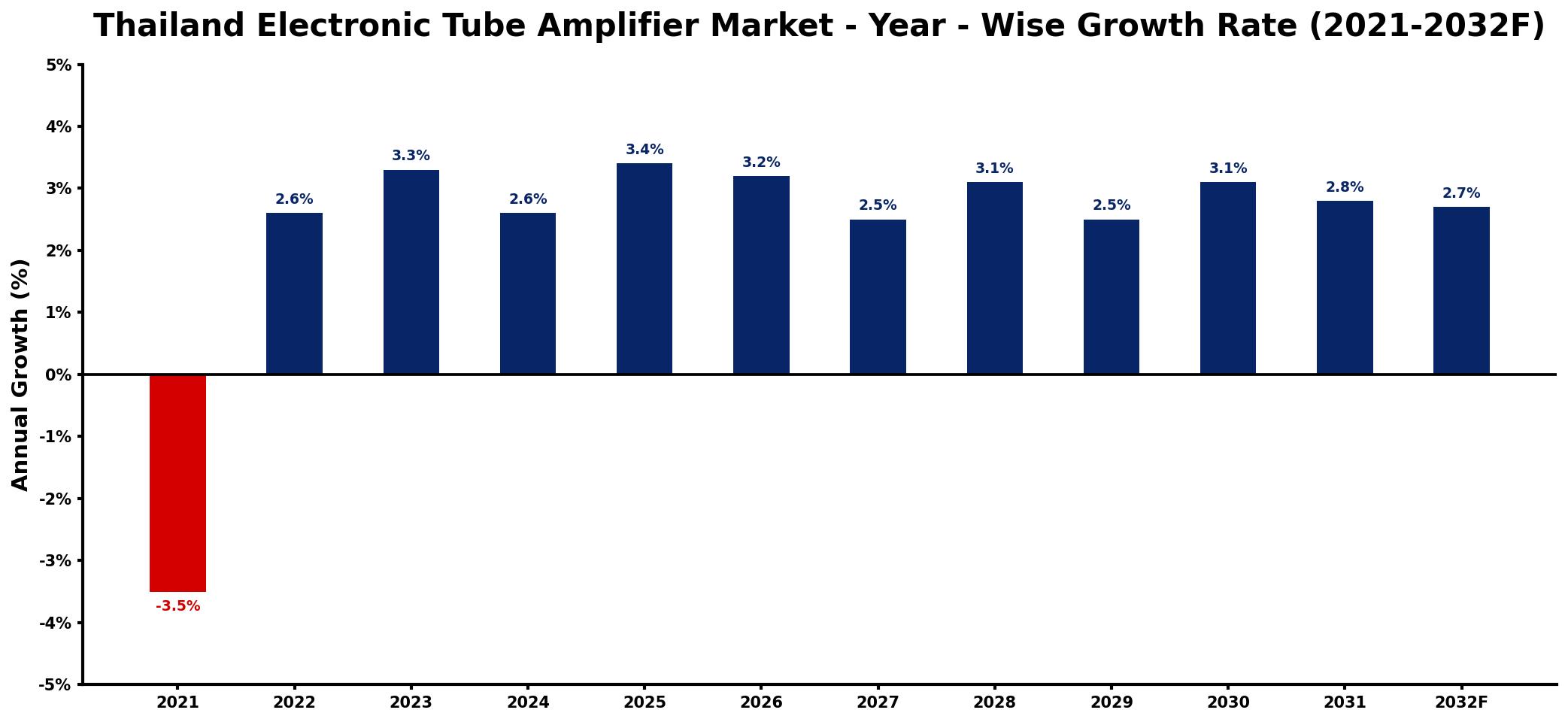
The table below presents the year‑wise growth rates along with the key drivers influencing the market
| Year | Growth Rate | Major Drivers |
| 2021 | -3.5% | decrease in consumer spending habits |
| 2022 | 2.6% | growing demand for high fidelity |
| 2023 | 3.3% | increased interest in vintage audio |
| 2024 | 2.6% | rising popularity of home audio |
| 2025 | 3.4% | expansion of online retail platforms |
| 2026 | 3.2% | increased investment in audio technology |
| 2027 | 2.5% | growth in premium audio segments |
| 2028 | 3.1% | rising trend of personalized sound |
| 2029 | 2.5% | increased collaboration with musicians |
| 2030 | 3.1% | enhanced product quality standards |
| 2031 | 2.8% | stronger distribution network expansion |
| 2032 | 2.7% | increased focus on sustainability efforts |
Note: Market size estimations and growth projections presented in this report are based on 6Wresearch's proprietary forecasting methodology, utilizing the latest available industry data, government publications, and primary research inputs.
Thailand Electronic Tube Amplifier Market Synopsis
The Thailand Electronic Tube Amplifier Market thrives on a blend of domestic craftsmanship and international demand, showcasing a rich tapestry of manufacturers that produce bespoke and high-quality audio solutions. This unique market segment is not just limited to conventional applications; it caters to a vibrant community of audiophiles and musicians who deeply appreciate the vintage aesthetic and warmth that tube amplifiers offer.
Recent trends indicate a robust growth in the professional audio sector, where tube amplifiers are increasingly being utilized for their distinct tonal qualities. As Thailand's music industry continues to flourish, demand for premium audio equipment is expected to rise, enabling the tube amplifier market to carve out a larger share of the overall electronics landscape.
Thailand Electronic Tube Amplifier Market Key Takeaways
- The market is primarily driven by the resurgence of interest in high-fidelity audio and vintage technology.
- Audiophiles and musicians are increasingly seeking the unique sound characteristics offered by tube amplifiers.
- The growth of the entertainment industry in Thailand is significantly contributing to market expansion.
- Manufacturers are adapting to changing consumer preferences, particularly in light of recent challenges.
- Emerging trends indicate a shift towards customized and bespoke tube amplifiers to meet niche demands.
Evaluation of Restraints in Thailand Electronic Tube Amplifier Market
Despite the promising growth, the Thailand Electronic Tube Amplifier Market faces certain restraints that could hinder its expansion. The niche nature of the market limits mass production capabilities, making it challenging to scale operations. Additionally, expertise in vintage technology is essential, which can be scarce among new entrants. Moreover, competition from solid-state amplifiers, which are often more affordable and technologically advanced, poses a threat to traditional tube amplifier sales.
Thailand Electronic Tube Amplifier Market Trends
Current trends indicate a growing appreciation for audio fidelity that goes beyond casual listening. Consumers are increasingly investing in high-quality audio systems that enhance their overall experience, particularly in home settings. There is also a notable shift towards customization, with enthusiasts seeking tailored solutions that reflect personal tastes. Furthermore, collaborations between modern artists and vintage technology are creating new platforms for tube amplifiers in contemporary music genres.
Thailand Electronic Tube Amplifier Market Opportunities
The market holds several genuine growth opportunities, especially in the realms of product innovation and customization. Manufacturers can explore partnerships with local musicians and audio engineers to develop products that cater to specific auditory preferences. Additionally, as the global trend towards sustainable practices gains traction, leveraging eco-friendly materials for amplifier production can attract a more conscientious consumer base.
Government Initiatives in the Thailand Electronic Tube Amplifier Market
The Thai government has been actively promoting initiatives that support the broader electronics industry, which indirectly benefits niche markets such as tube amplifiers. Public spending on cultural and musical events has also seen an uptick, creating a favorable environment for audio equipment manufacturers. Policies aimed at enhancing technological innovation and craftsmanship are expected to encourage the growth of the tube amplifier segment.
Future Insights of the Thailand Electronic Tube Amplifier Market
Looking forward to 2026-2032, the Thailand Electronic Tube Amplifier Market is poised for steady growth, driven by sustained interest from audiophiles and the music industry. The resurgence of vintage technology will likely continue to shape consumer preferences, allowing manufacturers to explore new opportunities in custom designs and collaborations. As technological advancements integrate with traditional craftsmanship, the market is likely to evolve, offering a diverse range of products that cater to both nostalgic and modern tastes.
Thailand Electronic Tube Amplifier Market Latest Developments (2025 - 2026)
In recent months, the Thailand Electronic Tube Amplifier Market has witnessed several strategic movements. Manufacturers have been increasingly focusing on enhancing product quality while reducing production times through innovative techniques. There's also been a noticeable increase in online sales platforms, making it easier for consumers to access a wider range of tube amplifiers. Events and trade shows have resumed, providing a platform for brands to showcase their latest innovations and engage directly with the audio community.
Thailand Electronic Tube Amplifier Market - Key Attractiveness of the Report
- 10 Years of Market Numbers
- Historical Data Starting from 2022 to 2025
- Base Year: 2025
- Forecast Data until 2032
- Key Performance Indicators Impacting the Market
- Major Upcoming Developments and Projects
Key Highlights of the Report:
- Thailand Electronic Tube Amplifier Market Outlook
- Market Size of Thailand Electronic Tube Amplifier Market, 2025
- Forecast of Thailand Electronic Tube Amplifier Market, 2032
- Historical Data and Forecast of Thailand Electronic Tube Amplifier Revenues & Volume for the Period 2022-2032F
- Thailand Electronic Tube Amplifier Market Trend Evolution
- Thailand Electronic Tube Amplifier Market Drivers and Challenges
- Thailand Electronic Tube Amplifier Price Trends
- Thailand Electronic Tube Amplifier Porter's Five Forces
- Thailand Electronic Tube Amplifier Industry Life Cycle
- Historical Data and Forecast of Thailand Electronic Tube Amplifier Market Revenues & Volume By Type for the Period 2022-2032F
- Historical Data and Forecast of Thailand Electronic Tube Amplifier Market Revenues & Volume By Class-A for the Period 2022-2032F
- Historical Data and Forecast of Thailand Electronic Tube Amplifier Market Revenues & Volume By Class-B for the Period 2022-2032F
- Historical Data and Forecast of Thailand Electronic Tube Amplifier Market Revenues & Volume By Class-AB for the Period 2022-2032F
- Historical Data and Forecast of Thailand Electronic Tube Amplifier Market Revenues & Volume By Application for the Period 2022-2032F
- Historical Data and Forecast of Thailand Electronic Tube Amplifier Market Revenues & Volume By Power Amplifier for the Period 2022-2032F
- Historical Data and Forecast of Thailand Electronic Tube Amplifier Market Revenues & Volume By Pre-Amplifier for the Period 2022-2032F
- Thailand Electronic Tube Amplifier Import Export Trade Statistics
- Market Opportunity Assessment By Type
- Market Opportunity Assessment By Application
- Thailand Electronic Tube Amplifier Top Companies Market Share
- Thailand Electronic Tube Amplifier Competitive Benchmarking By Technical and Operational Parameters
- Thailand Electronic Tube Amplifier Company Profiles
- Thailand Electronic Tube Amplifier Key Strategic Recommendations






































