Thailand Energy Saving & Fluorescent Market Summary
The thailand energy saving & fluorescent market was estimated at USD 106 Million in 2025 and is projected to reach USD 121 Million by 2032, growing at a CAGR of 3.3% from 2026 to 2032.
Thailand Energy Saving & Fluorescent Market Year-wise Growth Rate and Key Drivers
This graph highlights how the Thailand Energy Saving & Fluorescent Market has steadily grown over the past five years, supported by major growth factors.
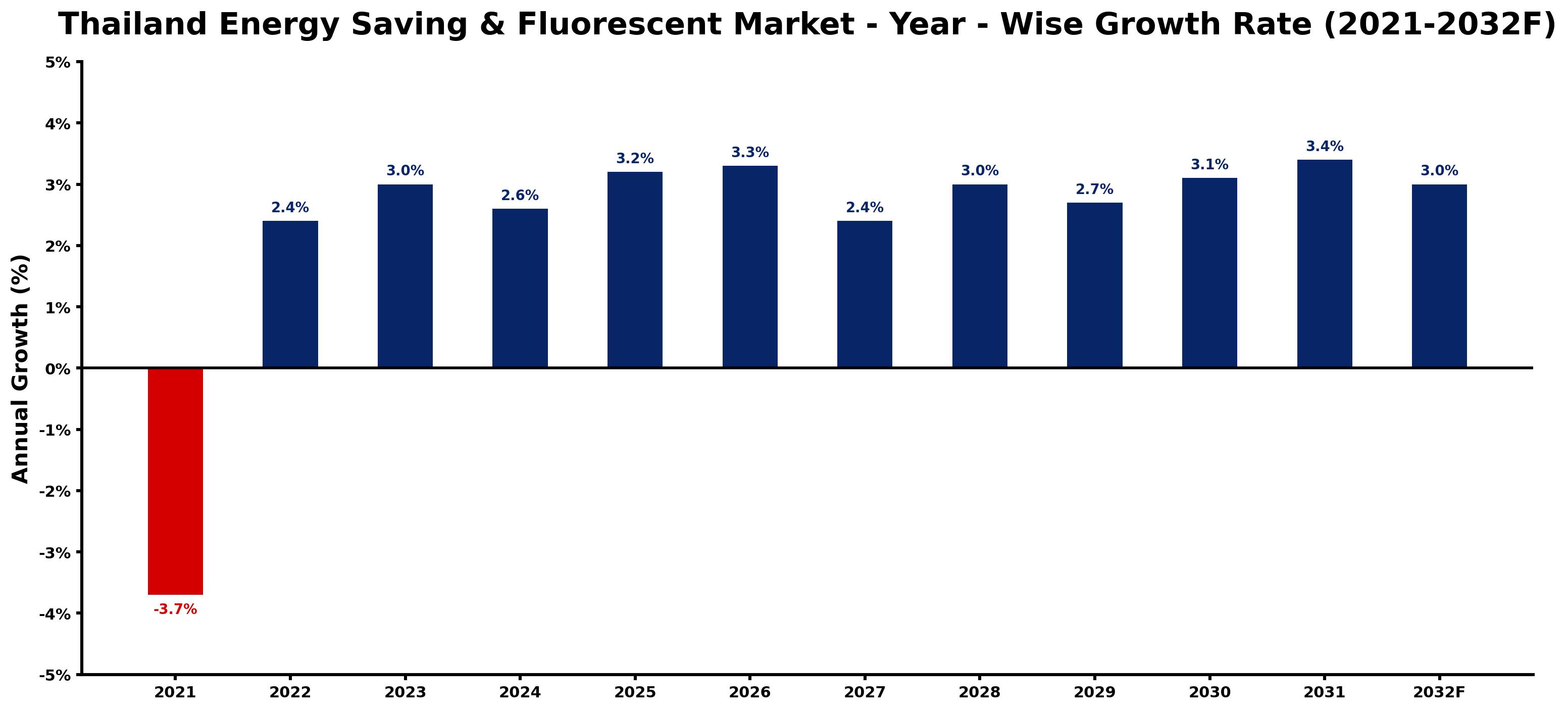
The table below presents the year wise growth rates along with the key drivers influencing the market
| Year | Growth Rate | Major Drivers |
| 2021 | -3.7% | Increased competition from advanced LED technologies discouraged investments in traditional fluorescent lighting solutions. |
| 2022 | 2.4% | Sustainability commitments by corporations increased investments in energy-efficient lighting technologies. |
| 2023 | 3.0% | Retailers began expanding energy-saving product lines in response to consumer awareness campaigns. |
| 2024 | 2.6% | Rising electricity costs drove small businesses to implement energy-saving fluorescent solutions. |
| 2025 | 3.2% | Increased urbanization led to higher demand for energy-efficient fixtures in new constructions. |
| 2026 | 3.3% | Technological advancements in LED fluorescents began capturing a larger share of the market. |
| 2027 | 2.4% | Corporate sustainability reports highlighted energy savings as a key performance indicator. |
| 2028 | 3.0% | Public awareness programs emphasized long-term savings from switching to energy-efficient lighting. |
| 2029 | 2.7% | Partnerships with local governments fostered community-based energy-saving initiatives and education. |
| 2030 | 3.1% | Emerging technologies in energy management systems began integrating with lighting solutions. |
| 2031 | 3.4% | Supply chain optimization focused on sourcing sustainable materials for fluorescent production. |
| 2032 | 3.0% | The market landscape evolved with innovative designs appealing to environmentally conscious consumers. |
Note - Market size estimations and growth projections presented in this report are based on 6Wresearch's advanced forecasting approach, validated with industry datasets as of June 2026.
Thailand Energy Saving & Fluorescent Market Synopsis
The Thailand Energy Saving Fluorescent Market is projected to reach 3.3% and witness significant growth during the forecast period (2026-2032). The surge in demand for energy-efficient lighting solutions is driven by a multitude of factors including rising energy costs, increased awareness of environmental sustainability, and government initiatives aimed at promoting the adoption of energy-saving technologies. The shift from traditional lighting methods towards energy-efficient fluorescent options reflects a broader global trend, positioning Thailand as a significant player in the Southeast Asian market for energy-efficient lighting.
Thailand Energy Saving & Fluorescent Market Growth Drivers
The Thailand Energy Saving & Fluorescent Market is propelled by several influential factors:
- The increasing awareness of energy conservation among consumers and businesses contributes significantly to the demand for energy-efficient lighting products.
- Government incentives and regulations aimed at reducing carbon emissions and promoting sustainable energy practices are enhancing the market landscape.
- Technological advancements in energy-efficient lighting solutions are making fluorescent lamps more appealing due to their cost-effectiveness and environmental benefits.
- Urbanization and infrastructural growth in Thailand are leading to heightened demand for residential and commercial lighting solutions, bolstering market growth.
- Growth in sectors such as retail, hospitality, and transportation is driving the need for effective lighting solutions that reduce operational costs.
Thailand Energy Saving & Fluorescent Market Challenges and Restraints
Despite its promising outlook, the Thailand Energy Saving & Fluorescent Market faces several challenges that could impede growth:
- The high initial investment costs associated with switching to energy-saving fluorescent technologies can deter adoption, especially among low-income households.
- Consumer awareness regarding the long-term benefits of energy-efficient lighting remains relatively low, affecting market penetration.
- Competition from alternative lighting technologies, particularly LED solutions, which offer longer lifespans and greater energy savings, poses a significant challenge.
- Production costs for energy-saving fluorescent lighting can be high, leading to pricing challenges in a price-sensitive market.
- Access to funding for small businesses involved in fluorescent lighting production is limited, which can stifle innovation and expansion within the industry.
Thailand Energy Saving & Fluorescent Market Government Investment and Initiatives
The role of the Thai government in fostering the Energy Saving & Fluorescent Market cannot be overstated. The government has initiated various policies and funding programs aimed at promoting energy efficiency and supporting the transition to more sustainable lighting solutions. Specific initiatives include:
- Implementation of energy-saving programs that offer tax benefits and subsidies for businesses and residents transitioning to fluorescent lighting.
- Investment in research and development to innovate new energy-efficient technologies that reduce dependence on traditional lighting solutions.
- Promoting educational campaigns to raise awareness among consumers regarding the benefits of energy-saving technologies and how they contribute to environmental conservation.
- Collaboration with local municipalities to upgrade public lighting infrastructure with energy-efficient fluorescent solutions.
- Encouraging public-private partnerships that facilitate the development of energy-efficient projects and enhance market infrastructure.
Thailand Energy Saving & Fluorescent Market Latest Developments (May 2025 - June 2026)
Recent developments in the Thailand Energy Saving & Fluorescent Market signal a dynamic evolution within the sector. Over this period, the market has seen an increasing focus on innovation and modernization. Key developments include:
- A growing number of companies are prioritizing research and innovation in energy-efficient lighting technologies, seeking to improve product quality and efficiency.
- Partnerships between manufacturers and technology providers are becoming more common as companies aim to enhance their product offerings through advanced technologies.
- The rise in consumer preference for sustainable products has led to more businesses adopting energy-saving fluorescent solutions as part of their corporate responsibility initiatives.
- Expansion in e-commerce channels has increased accessibility to energy-efficient lighting products, facilitating wider market reach.
- Strategic initiatives by the government aimed at achieving national energy goals have stimulated investment in energy-efficient lighting technologies.
Thailand Energy Saving & Fluorescent Market - Key Attractiveness of the Report
- 10 Years of Market Numbers
- Historical Data Starting from 2022 to 2025
- Base Year: 2025
- Forecast Data until 2032
- Key Performance Indicators Impacting the Market
- Major Upcoming Developments and Projects
Key Highlights of the Report:
- Thailand Energy Saving & Fluorescent Market Outlook
- Market Size of Thailand Energy Saving & Fluorescent Market, 2025
- Forecast of Thailand Energy Saving & Fluorescent Market, 2032
- Historical Data and Forecast of Thailand Energy Saving & Fluorescent Revenues & Volume for the Period 2022-2032F
- Thailand Energy Saving & Fluorescent Market Trend Evolution
- Thailand Energy Saving & Fluorescent Market Drivers and Challenges
- Thailand Energy Saving & Fluorescent Price Trends
- Thailand Energy Saving & Fluorescent Porter's Five Forces
- Thailand Energy Saving & Fluorescent Industry Life Cycle
- Historical Data and Forecast of Thailand Energy Saving & Fluorescent Market Revenues & Volume By Sources for the Period 2022-2032F
- Historical Data and Forecast of Thailand Energy Saving & Fluorescent Market Revenues & Volume By High-Intensity Discharge Lamps (HID) for the Period 2022-2032F
- Historical Data and Forecast of Thailand Energy Saving & Fluorescent Market Revenues & Volume By Linear Fluorescent Lamps (LFL) for the Period 2022-2032F
- Historical Data and Forecast of Thailand Energy Saving & Fluorescent Market Revenues & Volume By Light Emitting Diodes (LED) for the Period 2022-2032F
- Historical Data and Forecast of Thailand Energy Saving & Fluorescent Market Revenues & Volume By Applications for the Period 2022-2032F
- Historical Data and Forecast of Thailand Energy Saving & Fluorescent Market Revenues & Volume By Commercial for the Period 2022-2032F
- Historical Data and Forecast of Thailand Energy Saving & Fluorescent Market Revenues & Volume By Residential for the Period 2022-2032F
- Historical Data and Forecast of Thailand Energy Saving & Fluorescent Market Revenues & Volume By Government for the Period 2022-2032F
- Thailand Energy Saving & Fluorescent Import Export Trade Statistics
- Market Opportunity Assessment By Sources
- Market Opportunity Assessment By Applications
- Thailand Energy Saving & Fluorescent Top Companies Market Share
- Thailand Energy Saving & Fluorescent Competitive Benchmarking By Technical and Operational Parameters
- Thailand Energy Saving & Fluorescent Company Profiles
- Thailand Energy Saving & Fluorescent Key Strategic Recommendations






































