Thailand Energy Security Market Size & Growth Rate (2026-2032)
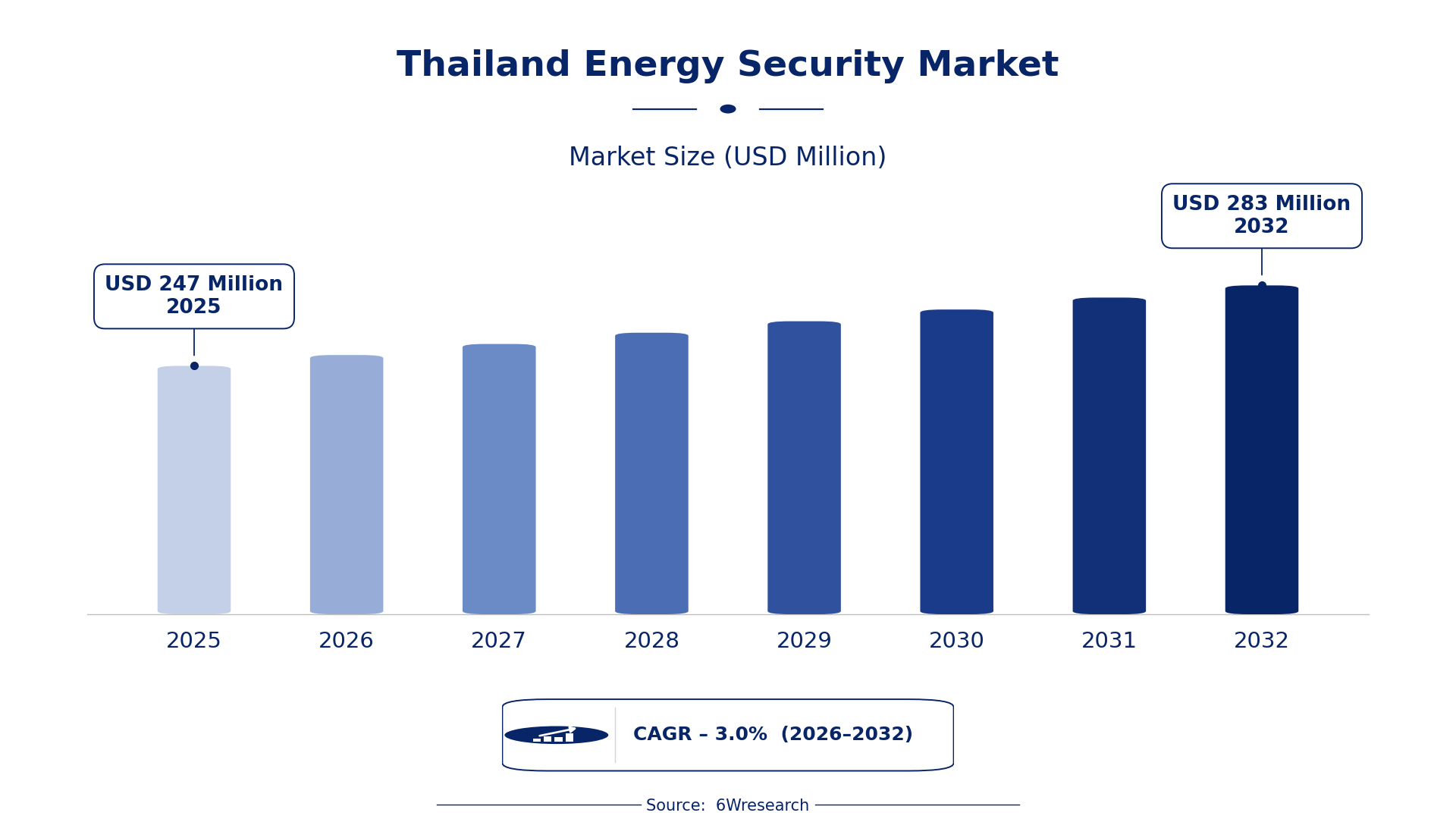
The Thailand Energy Security Market was estimated at USD 247 Million in 2025 and is projected to reach USD 283 Million by 2032, growing at a CAGR of 3.0% from 2026 to 2032.
Thailand Energy Security Market Synopsis
The Thailand Energy Security Market is increasingly critical as the country fortifies its energy infrastructure against both physical and cyber threats. With a growing emphasis on safeguarding power plants and distribution networks, the market is essential for maintaining the overall economic stability in Thailand.
As Thailand progresses in enhancing its energy infrastructure, the Energy Security Market becomes a vital facilitator. The combination of advancing technology, regulatory changes, and the pressing need for resilient energy systems is driving this market's growth. Energy security solutions are now recognized as indispensable for the nation’s future.
Thailand Energy Security Market Year-wise Growth Rate and Key Drivers
This graph illustrates the annual growth rates of the Thailand Energy Security Market from 2021 to 2032, highlighting a steady upward trajectory and projected expansion over the forecast period.
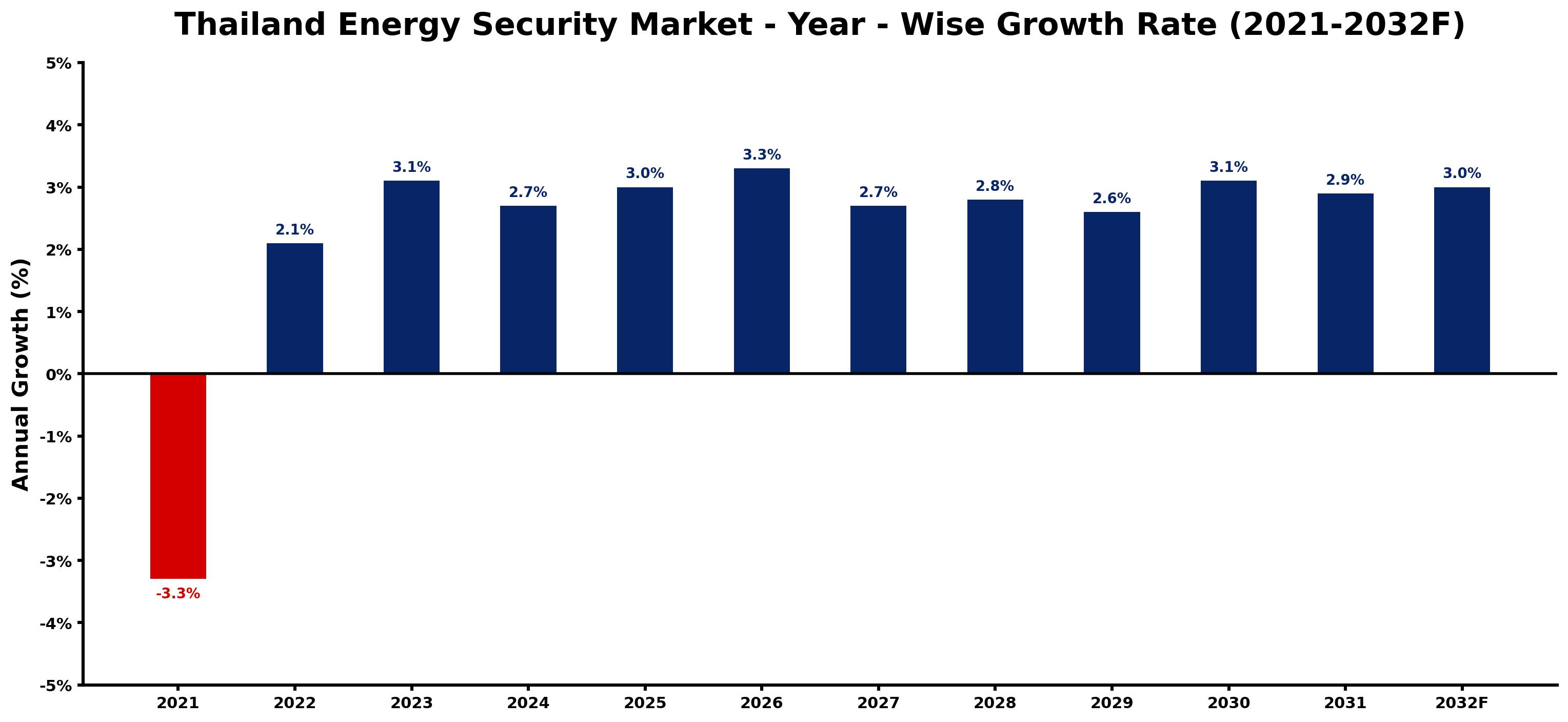
The table below presents the year‑wise growth rates along with the key drivers influencing the market
| Year | Growth Rate | Major Drivers |
| 2021 | -3.3% | Political instability affecting energy policy reforms. |
| 2022 | 2.1% | Government's Power Development Plan 2018-2037 enhancement |
| 2023 | 3.1% | Increased investment in renewable energy projects nationwide |
| 2024 | 2.7% | Enhanced energy security regulations from the Energy Ministry |
| 2025 | 3.0% | Growing consumer demand for sustainable energy solutions |
| 2026 | 3.3% | Regional collaboration on electricity trade agreements |
| 2027 | 2.7% | Technological advancements in energy storage systems |
| 2028 | 2.8% | Rising public awareness of energy conservation initiatives |
| 2029 | 2.6% | Supportive policies for electric vehicle adoption growth |
| 2030 | 3.1% | National Energy Efficiency Plan implementation boost |
| 2031 | 2.9% | Investment incentives for innovative energy startups |
| 2032 | 3.0% | Establishment of dedicated energy security task force |
Note: Market size estimations and growth projections presented in this report are based on 6Wresearch's proprietary forecasting methodology, utilizing the latest available industry data, government publications, and primary research inputs.
Thailand Energy Security Market Key Takeaways
Below are some of the specific key takeaways from the market, including:
- Robust demand for energy security solutions stemming from the digitalization of energy systems.
- Regulatory focus is intensifying around the protection of critical energy infrastructure.
- Market challenges include ensuring diversification of energy sources while maintaining security.
- Increased investment is being directed towards cybersecurity measures for energy networks.
- COVID-19 has highlighted the need for resilient energy systems, fueling market growth.
Evaluation of Restraints in Thailand Energy Security Market
The Thailand Energy Security Market faces real constraints that could hinder its potential. One major concern is the reliance on traditional energy sources, which complicates the transition to a more diversified energy portfolio. Additionally, the vulnerability of critical infrastructure to both physical attacks and cyber threats remains a pressing issue. Companies must strike a balance between providing a reliable energy supply and addressing the growing array of security challenges. Limited awareness and understanding of the available energy security solutions among some stakeholders may also impede market growth.
Thailand Energy Security Market Trends
Several trends are shaping the Thailand Energy Security Market. Firstly, the digitization of energy systems is driving demand for advanced cybersecurity solutions. As companies move towards smart grids and interconnected networks, the need for robust protection mechanisms becomes paramount. Another trend is the rise of public-private partnerships aimed at enhancing infrastructure security, allowing for greater resource pooling. A greater focus on regulatory compliance is also evident as organizations strive to meet national standards for energy security, further incentivizing investment in this area.
Thailand Energy Security Market Opportunities
In light of current trends, numerous opportunities lie ahead for investment in Thailand's Energy Security Market. The growing emphasis on renewable energy sources presents avenues for integrating security measures tailored to new technologies. Additionally, there is substantial potential for enhancing cybersecurity infrastructure across existing energy frameworks, paving the way for technological advancements. As regulatory pressures increase, businesses that proactively adopt energy security solutions may find competitive advantages in securing contracts and building partnerships.
Government Initiatives in the Thailand Energy Security Market
Government policies play a significant role in shaping the Thailand Energy Security Market. A strong regulatory framework prioritizing the protection of critical energy infrastructure has emerged as a key focus. These initiatives reflect an understanding that robust energy security is vital for national stability and economic growth. As the government intensifies its efforts in this area, the importance of compliant, proactive measures is heightened.
- A national digital infrastructure upgrade programme launched recently, aimed at enhancing cybersecurity measures for energy systems.
- Current initiatives are underway to implement stricter regulatory standards around the protection of critical infrastructure, promoting public-private collaborations.
- A comprehensive public-private initiative, expected to commence in late 2026, aims to expand cybersecurity awareness and best practices across the energy sector.
- The government is currently establishing a framework for assessing the vulnerabilities of energy facilities, projected for rollout by mid-2026.
Future Insights of the Thailand Energy Security Market
Looking towards 2026-2032, the Thailand Energy Security Market is set to evolve significantly. With a steadfast commitment to enhancing energy resilience, investments will likely concentrate on innovative security solutions that address emerging threats. As the nation transitions to more sustainable energy sources, integrating robust security measures into these systems will be crucial. Companies that adapt and innovate are expected to thrive in this evolving environment, leveraging the regulatory landscape to enhance their market positions.
Thailand Energy Security Market Latest Developments
Recent activity in the Thailand Energy Security Market reflects a strategic focus on fortifying energy infrastructure. In the past year, companies have begun to prioritize comprehensive risk assessments and the implementation of advanced security technologies. The surge in demand for reliable energy systems is influencing investments and innovations across the sector.
- A major technology vendor launched a new cybersecurity platform for energy networks in Q1 2023, aimed at enhancing threat detection capabilities.
- In early 2023, a leading regional operator announced a partnership with cybersecurity firms to bolster the physical security measures at critical energy sites.
- An initiative that began in mid-2023 is focusing on developing standardized protocols for energy facility security, which remains ongoing.
- A rollout of advanced monitoring systems for energy infrastructure is expected to begin in late 2023, designed to enhance real-time surveillance capabilities.
Thailand Energy Security Market - Key Attractiveness of the Report
- 10 Years of Market Numbers
- Historical Data Starting from 2022 to 2025
- Base Year: 2025
- Forecast Data until 2032
- Key Performance Indicators Impacting the Market
- Major Upcoming Developments and Projects
Key Highlights of the Report:
- Thailand Energy Security Market Outlook
- Market Size of Thailand Energy Security Market, 2025
- Forecast of Thailand Energy Security Market, 2032
- Historical Data and Forecast of Thailand Energy Security Revenues & Volume for the Period 2022-2032F
- Thailand Energy Security Market Trend Evolution
- Thailand Energy Security Market Drivers and Challenges
- Thailand Energy Security Price Trends
- Thailand Energy Security Porter's Five Forces
- Thailand Energy Security Industry Life Cycle
- Historical Data and Forecast of Thailand Energy Security Market Revenues & Volume By Power Plants for the Period 2022-2032F
- Historical Data and Forecast of Thailand Energy Security Market Revenues & Volume By Nuclear for the Period 2022-2032F
- Historical Data and Forecast of Thailand Energy Security Market Revenues & Volume By Thermal for the Period 2022-2032F
- Historical Data and Forecast of Thailand Energy Security Market Revenues & Volume By Hydro for the Period 2022-2032F
- Historical Data and Forecast of Thailand Energy Security Market Revenues & Volume By Oil for the Period 2022-2032F
- Historical Data and Forecast of Thailand Energy Security Market Revenues & Volume By Gas for the Period 2022-2032F
- Historical Data and Forecast of Thailand Energy Security Market Revenues & Volume By Renewable Energy for the Period 2022-2032F
- Historical Data and Forecast of Thailand Energy Security Market Revenues & Volume By Technologies for the Period 2022-2032F
- Historical Data and Forecast of Thailand Energy Security Market Revenues & Volume By Physical for the Period 2022-2032F
- Historical Data and Forecast of Thailand Energy Security Market Revenues & Volume By Network Security for the Period 2022-2032F
- Thailand Energy Security Import Export Trade Statistics
- Market Opportunity Assessment By Power Plants
- Market Opportunity Assessment By Technologies
- Thailand Energy Security Top Companies Market Share
- Thailand Energy Security Competitive Benchmarking By Technical and Operational Parameters
- Thailand Energy Security Company Profiles
- Thailand Energy Security Key Strategic Recommendations






































