Thailand Epdm Market: Import Trend Analysis
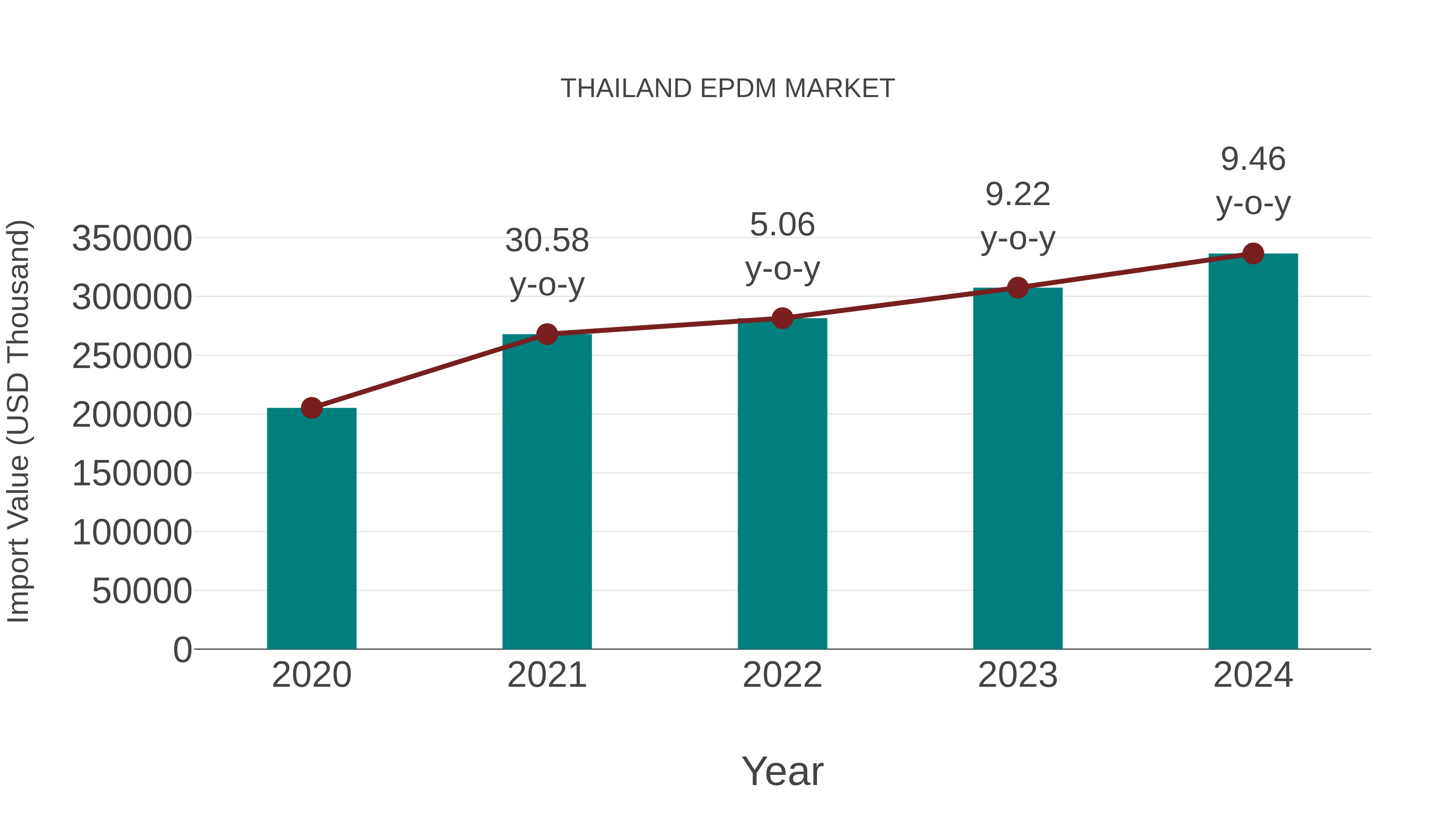
Thailand import trend for the EPDM market showed a growth rate of 9.46% from 2023 to 2024, with a compound annual growth rate (CAGR) of 13.17% from 2020 to 2024. This strong import momentum can be attributed to increasing demand for EPDM products in various industries, driving market stability and indicating a positive shift in demand dynamics.
Thailand EPDM Market Synopsis
The ethylene propylene diene monomer (EPDM) market in Thailand primarily serves the automotive and construction sectors. EPDM rubber is known for its excellent weather resistance, making it a popular choice for sealing and insulation applications.
Drivers of the Market
The EPDM (Ethylene Propylene Diene Monomer) market in Thailand is witnessing robust growth, propelled by the increasing demand for elastomeric materials with excellent weather resistance and thermal stability. EPDM, known for its flexibility and durability, is gaining prominence for its use in automotive weatherstripping, roofing membranes, and industrial gaskets. The growth of the automotive, construction, and manufacturing industries, the rising need for weather-resistant materials, and the emphasis on sustainable and energy-efficient solutions in Thailand are contributing to the adoption of EPDM. Moreover, the focus on enhancing product performance and the innovations in EPDM formulations are further fueling the positive momentum of the EPDM market.
Challenges of the Market
The EPDM market in Thailand confronts challenges linked to volatile raw material prices and the need for product differentiation. With increasing competition, manufacturers face pressure to innovate and develop EPDM products that cater to specific industry demands. Additionally, the market must navigate environmental regulations and sustainability requirements to ensure long-term viability.
COVID-19 Impact on the Market
The Thailand EPDM market faced challenges during the COVID-19 pandemic, with disruptions in automotive and construction sectors impacting demand. Ethylene Propylene Diene Monomer (EPDM), valued for its weather resistance and durability, encountered fluctuations in production and consumption. Post-pandemic, the market is recovering as automotive and construction activities resume, with industries recognizing the benefits of EPDM for its versatility and performance in various applications. The Thailand EPDM market remains integral in providing solutions for industries requiring elastomeric materials with excellent weatherability.
Key Players in the Market
The EPDM market in Thailand is thriving, driven by demand from the automotive and construction sectors. Notable players contributing to the market include IRPC, Thai Mitsui Specialty Chemicals, and Siam Mitsui PTA.
Key Highlights of the Report:
- Thailand EPDM Market Outlook
- Market Size of Thailand EPDM Market, 2025
- Forecast of Thailand EPDM Market, 2032
- Historical Data and Forecast of Thailand EPDM Revenues & Volume for the Period 2022-2032F
- Thailand EPDM Market Trend Evolution
- Thailand EPDM Market Drivers and Challenges
- Thailand EPDM Price Trends
- Thailand EPDM Porter's Five Forces
- Thailand EPDM Industry Life Cycle
- Historical Data and Forecast of Thailand EPDM Market Revenues & Volume By Manufacturing Process for the Period 2022-2032F
- Historical Data and Forecast of Thailand EPDM Market Revenues & Volume By Solution Polymerization Process for the Period 2022-2032F
- Historical Data and Forecast of Thailand EPDM Market Revenues & Volume By Slurry/Suspension Process for the Period 2022-2032F
- Historical Data and Forecast of Thailand EPDM Market Revenues & Volume By Gas-phase Polymerization Process for the Period 2022-2032F
- Historical Data and Forecast of Thailand EPDM Market Revenues & Volume By Application for the Period 2022-2032F
- Historical Data and Forecast of Thailand EPDM Market Revenues & Volume By Automotive for the Period 2022-2032F
- Historical Data and Forecast of Thailand EPDM Market Revenues & Volume By Building & Construction for the Period 2022-2032F
- Historical Data and Forecast of Thailand EPDM Market Revenues & Volume By Plastic Modifications for the Period 2022-2032F
- Historical Data and Forecast of Thailand EPDM Market Revenues & Volume By Tires & Tubes for the Period 2022-2032F
- Historical Data and Forecast of Thailand EPDM Market Revenues & Volume By Wire & Cables for the Period 2022-2032F
- Historical Data and Forecast of Thailand EPDM Market Revenues & Volume By Lubricant Additives for the Period 2022-2032F
- Historical Data and Forecast of Thailand EPDM Market Revenues & Volume By Others for the Period 2022-2032F
- Thailand EPDM Import Export Trade Statistics
- Market Opportunity Assessment By Manufacturing Process
- Market Opportunity Assessment By Application
- Thailand EPDM Top Companies Market Share
- Thailand EPDM Competitive Benchmarking By Technical and Operational Parameters
- Thailand EPDM Company Profiles
- Thailand EPDM Key Strategic Recommendations






































