Thailand Estradiol Market Size, Share & Growth Rate
The Thailand Estradiol Market was estimated at USD 222 Million in 2025 and is projected to reach USD 255 Million by 2032, growing at a CAGR of 2.0% from 2026 to 2032. This growth trajectory is fueled by increased awareness of women's health issues, particularly hormonal imbalances associated with menopause. As the healthcare infrastructure continues to advance and the population ages, demand for hormone replacement therapy (HRT) and estrogen-based treatments is expected to rise significantly.
Thailand Estradiol Market Year-wise Growth Rate and Key Drivers
This graph highlights how the Thailand Estradiol Market has steadily grown over the years, supported by major growth factors.
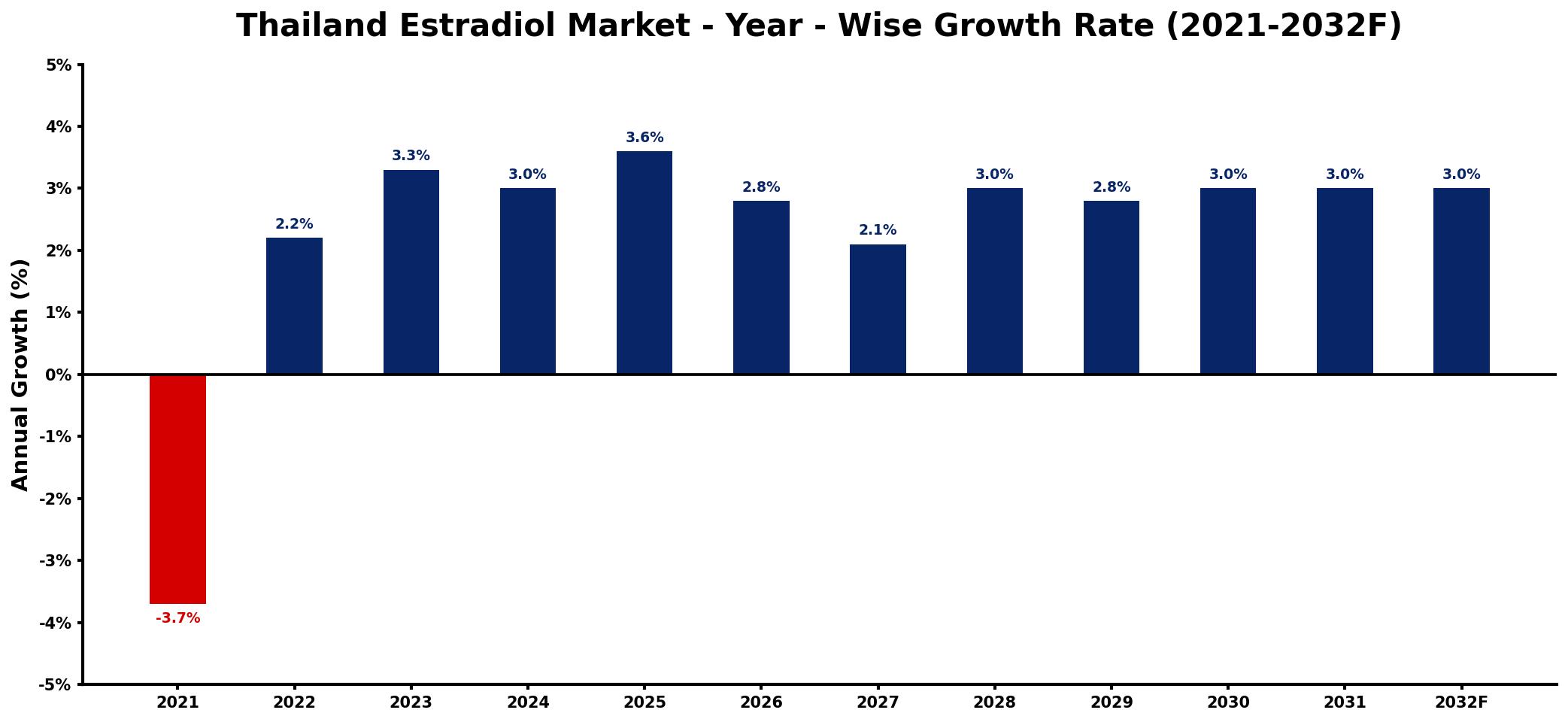
The table below presents the year‑wise growth rates along with the key drivers influencing the market
| Year | Growth Rate | Major Drivers |
| 2021 | -3.7% | decrease in healthcare investments |
| 2022 | 2.2% | rising awareness of hormone therapy |
| 2023 | 3.3% | increased healthcare access and affordability |
| 2024 | 3.0% | growing aging population demands |
| 2025 | 3.6% | expansion of women's health initiatives |
| 2026 | 2.8% | enhanced distribution network efficiency |
| 2027 | 2.1% | growing focus on preventive care |
| 2028 | 3.0% | increasing research and development funding |
| 2029 | 2.8% | rising demand for personalized medicine |
| 2030 | 3.0% | growth in telehealth services adoption |
| 2031 | 3.0% | increased investment in biotechnology |
| 2032 | 3.0% | enhanced product quality standards |
Note: Market size estimations and growth projections presented in this report are based on 6Wresearch's proprietary forecasting methodology, utilizing the latest available industry data, government publications, and primary research inputs.
Thailand Estradiol Market Synopsis
A strong force shaping the Thailand Estradiol market is the growing focus on women's health and the associated treatment options. Estradiol plays a vital role in hormone replacement therapies and contraceptive products, thus positioning itself as an indispensable component of women's healthcare solutions.
As Thai society evolves, the increasing acknowledgment of women's health issues and hormonal therapies is driving market growth. The aging demographic coupled with the rise in lifestyle-related health concerns accelerates the demand for effective treatments, opening new avenues for estradiol-based products.
Thailand Estradiol Market Key Takeaways
- The market is experiencing steady growth driven by an aging population and rising awareness of women's hormonal health.
- Pharmaceutical innovations are expanding the range of estradiol delivery methods, such as patches and creams.
- Access to healthcare services remains a critical factor influencing market penetration and product adoption.
- Ongoing research into hormone-related disorders is supporting product development and efficacy.
- Cultural sensitivities regarding women's health issues can impact education and awareness initiatives.
Evaluation of Restraints in Thailand Estradiol Market
The Thailand Estradiol market is not without its challenges. Limited awareness about women's health and hormonal therapy options can hinder adoption rates, particularly in rural areas where healthcare infrastructure may be lacking. Cultural taboos surrounding women's health discussions also serve as a barrier to open communication and education regarding estradiol treatments. Addressing these issues is essential to ensure wider acceptance and access to necessary medical therapies.
Thailand Estradiol Market Trends
Current trends in the Thailand Estradiol market indicate a shift toward personalized medicine. This approach tailors treatments to individual hormonal profiles, enhancing efficacy and reducing side effects. Moreover, the increasing integration of telemedicine in healthcare is opening doors for more women to access hormonal treatments conveniently. Another trend includes the development of combination therapies that incorporate estradiol with other hormones or treatments to improve overall effectiveness.
Thailand Estradiol Market Opportunities
Significant growth opportunities lie in expanding access to estradiol therapies in underserved regions. Investments in healthcare infrastructure and initiatives aimed at enhancing women's health education can drive product adoption. Moreover, the rising trend toward preventive healthcare and wellness provides a fertile ground for estradiol-based products aimed at younger demographics, thereby creating new market segments.
Government Initiatives in the Thailand Estradiol Market
The Thai government has initiated several policies aimed at enhancing women's healthcare services, reflecting a commitment to addressing hormonal health issues. Public health campaigns promoting education on menopause and hormone replacement therapy are vital components of these initiatives. Additionally, government funding for research into hormone-related disorders serves to stimulate advancements in treatment options, further supporting market growth.
Future Insights of the Thailand Estradiol Market
Looking ahead to 2026-2032, the Thailand Estradiol market is poised for sustained growth driven by demographic shifts and increasing health consciousness. Advancements in pharmaceutical research will likely introduce innovative formulations that enhance patient compliance and outcomes. As awareness of hormonal health continues to rise, the market will expand its reach, providing women with a broader spectrum of treatment options tailored to their needs.
Thailand Estradiol Market Latest Developments (2025 - 2026)
In recent months, the Thailand Estradiol market has seen a surge in research activities aimed at developing new delivery systems for estradiol, enhancing patient experience and therapeutic effectiveness. Regulatory changes are also anticipated, which may streamline the approval process for new hormonal therapies. Additionally, collaborations between pharmaceutical companies and healthcare providers are emerging to promote education on hormonal health, thus widening access to estradiol treatments.
Thailand Estradiol Market - Key Attractiveness of the Report
- 10 Years of Market Numbers
- Historical Data Starting from 2022 to 2025
- Base Year: 2025
- Forecast Data until 2032
- Key Performance Indicators Impacting the Market
- Major Upcoming Developments and Projects
Key Highlights of the Report:
- Thailand Estradiol Market Outlook
- Market Size of Thailand Estradiol Market, 2025
- Forecast of Thailand Estradiol Market, 2032
- Historical Data and Forecast of Thailand Estradiol Revenues & Volume for the Period 2022-2032F
- Thailand Estradiol Market Trend Evolution
- Thailand Estradiol Market Drivers and Challenges
- Thailand Estradiol Price Trends
- Thailand Estradiol Porter's Five Forces
- Thailand Estradiol Industry Life Cycle
- Historical Data and Forecast of Thailand Estradiol Market Revenues & Volume By Product Type for the Period 2022-2032F
- Historical Data and Forecast of Thailand Estradiol Market Revenues & Volume By a-Estradiol for the Period 2022-2032F
- Historical Data and Forecast of Thailand Estradiol Market Revenues & Volume By End-User for the Period 2022-2032F
- Historical Data and Forecast of Thailand Estradiol Market Revenues & Volume By Pharmaceutical for the Period 2022-2032F
- Historical Data and Forecast of Thailand Estradiol Market Revenues & Volume By Biological Research for the Period 2022-2032F
- Historical Data and Forecast of Thailand Estradiol Market Revenues & Volume By Others for the Period 2022-2032F
- Thailand Estradiol Import Export Trade Statistics
- Market Opportunity Assessment By Product Type
- Market Opportunity Assessment By End-User
- Thailand Estradiol Top Companies Market Share
- Thailand Estradiol Competitive Benchmarking By Technical and Operational Parameters
- Thailand Estradiol Company Profiles
- Thailand Estradiol Key Strategic Recommendations






































