Thailand Fiberglass Wall Meshes Market Summary
The thailand fiberglass wall meshes market was estimated at USD 150 Million in 2025 and is projected to reach USD 172 Million by 2032, growing at a CAGR of 2.7% from 2026 to 2032.
Thailand Fiberglass Wall Meshes Market Year-wise Growth Rate and Key Drivers
This graph highlights how the Thailand Fiberglass Wall Meshes Market has steadily grown over the past five years, supported by major growth factors.
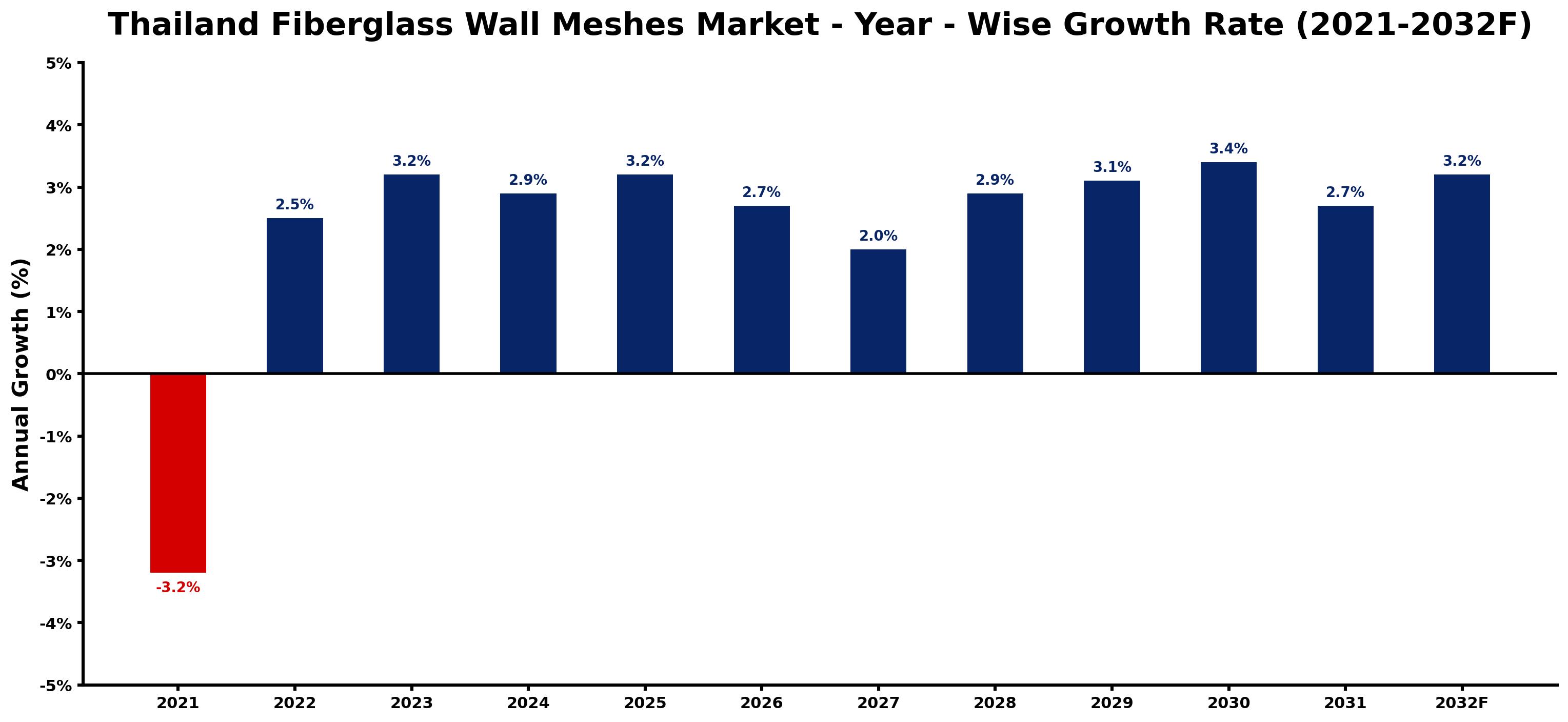
The table below presents the year wise growth rates along with the key drivers influencing the market
| Year | Growth Rate | Major Drivers |
| 2021 | -3.2% | Heightened competition from alternative wall reinforcement materials diminished demand for fiberglass wall meshes. |
| 2022 | 2.5% | Infrastructure projects gain momentum, increasing demand for reliable wall mesh solutions significantly. |
| 2023 | 3.2% | Local manufacturers expand capacities, enhancing product availability and competitive pricing for consumers. |
| 2024 | 2.9% | Emergence of innovative products caters to specialized applications in construction and agriculture. |
| 2025 | 3.2% | Increased urbanization leads to higher construction rates, augmenting market opportunities for fiberglass meshes. |
| 2026 | 2.7% | Sustainability trends drive interest in eco-friendly construction materials, supporting mesh market growth. |
| 2027 | 2.0% | Rising awareness of building safety standards prompts investments in quality wall reinforcement solutions. |
| 2028 | 2.9% | Technological advancements in production techniques reduce costs, improving profitability for manufacturers. |
| 2029 | 3.1% | Strong economic recovery fosters investor confidence, resulting in more construction projects nationwide. |
| 2030 | 3.4% | Global supply chain improvements facilitate better access to advanced fiberglass technologies and materials. |
| 2031 | 2.7% | Expanding automotive and aerospace sectors enhance fiberglass applications, further diversifying market demand. |
| 2032 | 3.2% | Local regulations evolve, encouraging the use of innovative building materials to enhance construction quality. |
Note - Market size estimations and growth projections presented in this report are based on 6Wresearch's advanced forecasting approach, validated with industry datasets as of June 2026.
Thailand Fiberglass Wall Meshes Market Synopsis
The Thailand Fiberglass Wall Meshes Market is projected to reach 2.7% and witness significant growth during the forecast period (2026-2032). This expansion is primarily driven by the increasing utilization of fiberglass wall meshes across various sectors, particularly in construction and industrial applications. As the demand for high-performance insulation materials rises, characteristics such as low thermal conductivity, noncorrosive properties, and robust strength are becoming critical factors influencing market dynamics. Furthermore, supportive government initiatives aimed at enhancing safety through effective building insulation solutions are providing an additional impetus to market growth.
Thailand Fiberglass Wall Meshes Market Growth Drivers
A confluence of factors is propelling the Thailand fiberglass wall meshes market forward. A few key growth drivers include:
- Increased demand for energy-efficient building materials, driven by rising construction activities in both residential and commercial sectors.
- The inherent advantages of fiberglass wall meshes, such as their lightweight nature and ease of installation, make them a preferred choice for builders and contractors.
- Strict building codes and standards focused on safety and energy conservation are encouraging the adoption of advanced insulation solutions.
- Innovations in fiberglass manufacturing processes, leading to improved product performance and broader application scopes.
- A growing emphasis on sustainable construction practices is pushing stakeholders toward eco-friendly alternatives like fiberglass wall meshes.
Thailand Fiberglass Wall Meshes Market Challenges and Restraints
While the Thailand fiberglass wall meshes market is poised for growth, there are challenges that could hinder progress. These encompass:
- Fluctuations in raw material prices, which can impact overall production costs and affect market pricing strategies.
- Competition from traditional insulating materials, which may offer established market presence and brand loyalty.
- Potential regulatory hurdles regarding material safety and environmental impact that could impose additional compliance costs.
- The need for continuous technological advancements in product development to meet evolving market demands.
- Market awareness and education efforts are necessary to ensure that potential users understand the benefits of fiberglass wall meshes over alternative solutions.
Thailand Fiberglass Wall Meshes Market Trends and Opportunities
The Thailand fiberglass wall meshes market is experiencing notable trends that present various opportunities for stakeholders. These include:
- A shift toward smart building materials that incorporate technological innovations for enhanced performance, such as integrated fireproofing coatings.
- Development of customized solutions tailored to specific applications within the construction and industrial sectors.
- Increased collaboration between manufacturers and construction firms to develop solutions that address specific project needs efficiently.
- Expansion of e-commerce platforms dedicated to construction materials, enabling broader product access and market penetration.
- Growing awareness of the sustainability benefits associated with fiberglass wall meshes is encouraging industry stakeholders to explore eco-centric marketing strategies.
Thailand Fiberglass Wall Meshes Market Government Investment and Initiatives
Government initiatives play a pivotal role in shaping the landscape of the Thailand fiberglass wall meshes market. The Thai government has been focusing on enhancing building safety standards and energy efficiency in construction practices. Recent policies include investments in infrastructure projects aimed at modernizing urban environments and adopting sustainable building practices.
Additionally, the government emphasizes safety regulations that encourage the use of non-corrosive and effective insulation solutions, thereby favoring the use of fiberglass wall meshes. Public funding for research and development projects, aimed at improving building materials' performance, is also amplifying interest and investment in fiberglass solutions within the industry.
Thailand Fiberglass Wall Meshes Market Latest Developments (May 2025 - June 2026)
The period from May 2025 to June 2026 has seen pivotal movements in the Thailand fiberglass wall meshes market. Innovations in product formulations and manufacturing technologies have been at the forefront, focusing on enhancing durability and fire-resistant properties. The market has witnessed a surge in collaborations among various stakeholders, including construction firms and material manufacturers, aimed at developing specialized products for high-demand construction projects.
Furthermore, increased participation in international trade expos has facilitated knowledge exchange and provided platforms for showcasing advancements in fiberglass technology. Industry forums have also emphasized sustainability, leading to more eco-friendly product offerings gaining traction among consumers.
To supplement these growth trends, the market has experienced expanded distribution networks, enhancing the availability of fiberglass wall meshes across Thailand. Collectively, these developments position the market favorably for the foreseeable future.
Thailand Fiberglass Wall Meshes Market - Key Attractiveness of the Report
- 10 Years of Market Numbers
- Historical Data Starting from 2022 to 2025
- Base Year: 2025
- Forecast Data until 2032
- Key Performance Indicators Impacting the Market
- Major Upcoming Developments and Projects
Key Highlights of the Report:
- Thailand Fiberglass Wall Meshes Market Outlook
- Market Size of Thailand Fiberglass Wall Meshes Market, 2025
- Forecast of Thailand Fiberglass Wall Meshes Market, 2032F
- Historical Data and Forecast of Thailand Fiberglass Wall Meshes Revenues & Volume for the Period 2022-2032F
- Thailand Fiberglass Wall Meshes Market Trend Evolution
- Thailand Fiberglass Wall Meshes Market Drivers and Challenges
- Thailand Fiberglass Wall Meshes Price Trends
- Thailand Fiberglass Wall Meshes Porter's Five Forces
- Thailand Fiberglass Wall Meshes Industry Life Cycle
- Historical Data and Forecast of Thailand Fiberglass Wall Meshes Market Revenues & Volume By Type for the Period 2022-2032F
- Historical Data and Forecast of Thailand Fiberglass Wall Meshes Market Revenues & Volume By C-Glass for the Period 2022-2032F
- Historical Data and Forecast of Thailand Fiberglass Wall Meshes Market Revenues & Volume By E-Glass for the Period 2022-2032F
- Historical Data and Forecast of Thailand Fiberglass Wall Meshes Market Revenues & Volume By Others for the Period 2022-2032F
- Historical Data and Forecast of Thailand Fiberglass Wall Meshes Market Revenues & Volume By Applications for the Period 2022-2032F
- Historical Data and Forecast of Thailand Fiberglass Wall Meshes Market Revenues & Volume By External Wall Insulation for the Period 2022-2032F
- Historical Data and Forecast of Thailand Fiberglass Wall Meshes Market Revenues & Volume By Building Waterproof for the Period 2022-2032F
- Historical Data and Forecast of Thailand Fiberglass Wall Meshes Market Revenues & Volume By Others for the Period 2022-2032F
- Thailand Fiberglass Wall Meshes Import Export Trade Statistics
- Market Opportunity Assessment By Type
- Market Opportunity Assessment By Applications
- Thailand Fiberglass Wall Meshes Top Companies Market Share
- Thailand Fiberglass Wall Meshes Competitive Benchmarking By Technical and Operational Parameters
- Thailand Fiberglass Wall Meshes Company Profiles
- Thailand Fiberglass Wall Meshes Key Strategic Recommendations






































